


Aydınlatma metni yükleniyor…
An agricultural producer, cooperative, supplier or local-product organisation searching for web design services in Silivri may need more than a gallery of product photographs. A retail customer wants to understand the product and how it can be purchased. A restaurant, shop, distributor or institutional buyer may need to compare variety, source, harvest or preparation period, current quantity, packaging, minimum order, delivery method and the information required for a proposal. If those records are disconnected, the site may attract attention without preparing a reliable buying decision.
Short labels such as “in stock,” “organic,” “local” or “immediate delivery” are not evidence by themselves. Season, weather, harvest, grading, lot size, packaging, storage and transport can change the current position. This guide treats the website not as a generic product showcase but as a governed record system connecting an identified source, dated availability, lot and quantity boundaries, packaging and delivery terms, a minimum buyer brief and accountable enquiry delivery.
Why is local-product presentation a relevant task in Silivri?
The Silivri Municipality 2025–2029 Strategic Plan lists qualified farmers and the Agricultural Production and Research Centre among local strengths. It records insufficient promotion of rural and local products as a weakness, while identifying fertile agricultural land and local products, organic-agriculture potential, proximity to agricultural markets and access to a large market among opportunities. It also defines a strategic objective to support producers and increase agricultural production, especially for local products and aromatic plants (Silivri Municipality 2025–2029 Strategic Plan).
This official context does not prove that every business in Silivri produces agricultural goods, holds organic certification, has a particular capacity or sells to large buyers. A specific organisation's production location, product source, certification, current lots, quantities, storage, cold-chain capability and delivery coverage must come from its own current records. The narrower design task is to help organisations that genuinely offer agricultural or local products govern changing information between presentation and buyer enquiry.
Is a product catalogue the same as a current sales record?
No. A catalogue can provide a durable account of the products and varieties an organisation works with. A current sales record describes whether a particular lot can be evaluated at a given date, approximate quantity, grade, package and delivery condition. Not every product is available in every season or volume, and the catalogue must not conceal that difference.
A retail basket and a B2B buyer enquiry are also different journeys. A product sold in a fixed unit at a fixed price may enter a basket. A purchase affected by quantity, grade, packaging, delivery point or contract terms may require assessment and a proposal. “Enquiry sent” does not mean inventory is reserved, an order exists or the price is final.
The Kumsal six-record source-to-buyer system
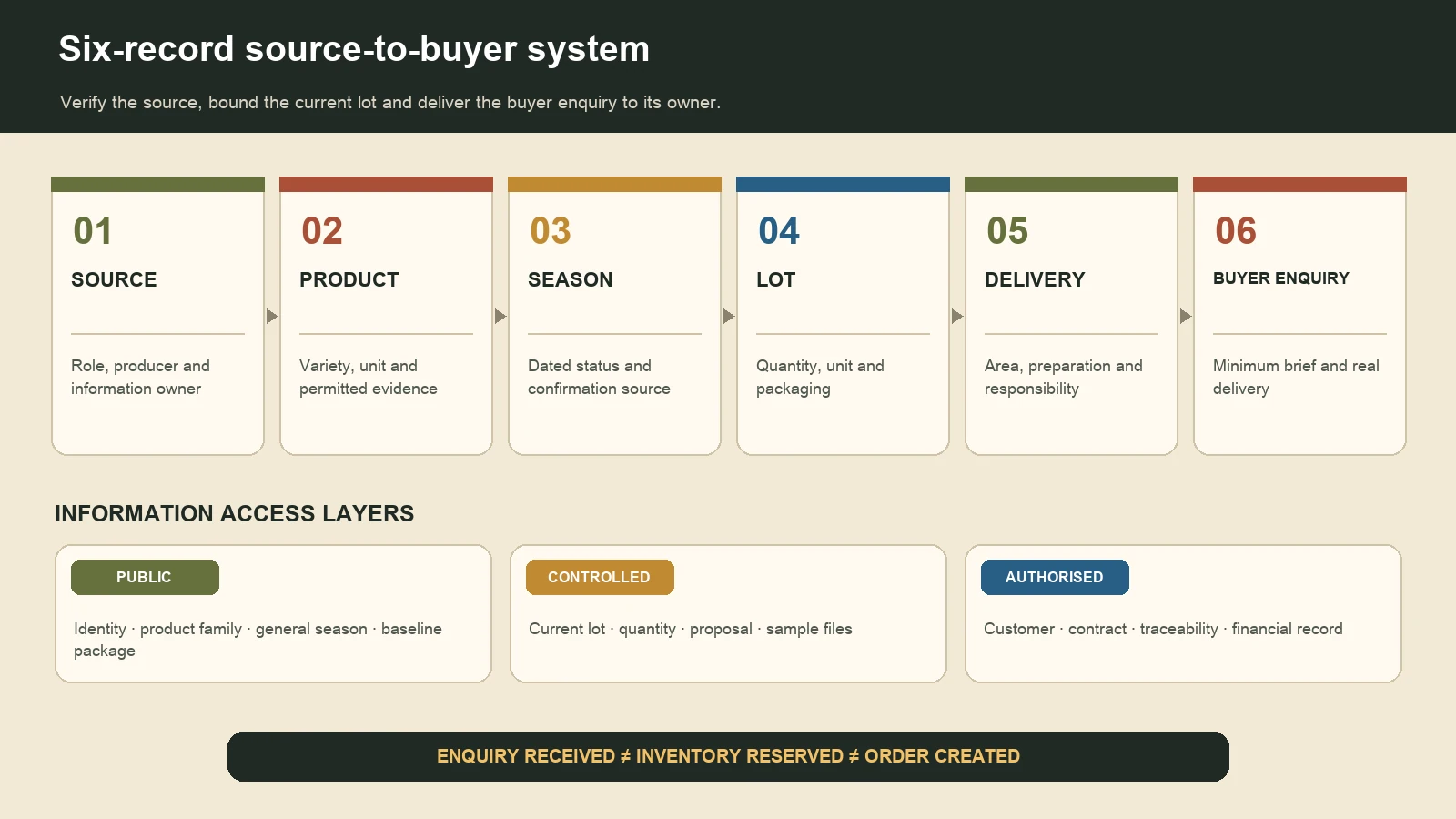
This original framework connects six records: source and producer identity, product and verifiable attributes, season and status, lot–quantity–packaging, delivery boundaries, and a minimum buyer brief with verified delivery. Its purpose is not to expose every detail to everyone. It gives buyers the information needed for a decision, keeps current commercial data controlled and delivers each enquiry to an accountable owner.
1. Identify the source and accountable party
The party growing, processing, packing, selling and delivering a product may not be the same organisation. The website should state the organisation's role, physical or legal identity, service coverage and information owner. Claims such as “our own production,” “a Silivri product” or “direct from the producer” should appear only when supported by the underlying record.
Product pages can share a template, but source, intended buyer, decision question, evidence and action ownership need product-level definition. A corporate website content matrix can govern these fields. Identity, address, contact details, map and delivery coverage should remain materially consistent across Turkish and English pages.
2. Record the product with its variety and evidence
“Fresh produce,” “natural product” or “high quality” is not a sufficient buyer specification. Product name, variety, intended use, grade, unit, tolerance, preparation method and any verified standard or certification need separate fields. Do not extend a certificate to every product without knowing its owner, scope and validity date.
Photography should represent the actual product. A stock image should not be presented as a specific lot or production site. If test reports, certificates, production records or customer logos are public, retain their source, date, scope and permission. The website can surface evidence; it does not create a certificate of quality or fitness.
3. Show season and availability with a date
A season calendar helps planning, but it is not a product guarantee for a particular week. State the expected harvest or preparation window, last update, conditions that can change the position and the source of definitive confirmation. Internal meanings can be defined for states such as “available,” “limited,” “pre-enquiry,” “out of season” and “confirmation required.”
If status is maintained manually, assign an owner and review frequency. Where ERP, inventory or production systems are connected, define which field is authoritative and what the website shows when data is delayed or unavailable. A historical quantity must not remain visible as current inventory.
4. Connect lot, quantity and packaging
An institutional buyer compares more than a product name: lot or batch reference, available or planned quantity range, unit, grade, case–crate–pallet structure, minimum order, preparation time and labelling requirements can all matter. If these details are not public, they may be shown to signed-in buyers, approved accounts or at the proposal stage.
The retail package and the horeca or distributor package for the same product may differ. Unit conversion, net and gross weight, variant and packaging records should remain aligned with the operational source. Where account, pricing, minimum-order and proposal rules are complex, the B2B software guide helps separate the content interface from the commercial rules engine.
5. State delivery, collection and storage boundaries
Claims such as “delivery throughout Türkiye” or “cold chain” should not be used unless the carrier, product and service model have been verified. Explain who delivers, which areas can be assessed, minimum quantity, preparation time, delivery method, buyer responsibility and when the final cost is determined. If delivery time depends on traffic, weather, lot preparation or a third-party carrier, do not present it as a guarantee.
Storage temperature, shelf life, collection point and traceability information must come from an authorised product record. A public page can show the general fulfilment model; current route, price, customer address, contract and sensitive traceability records belong in an authorised layer.
6. Deliver the minimum buyer brief to the right owner
The first form should not collect a complete procurement file. Product or variety, intended use, estimated quantity and unit, preferred packaging, delivery location and period, decision date, organisation and contact method may be enough for assessment. Identity documents, bank details, contracts and sensitive supply information should not be collected through a general form.
Enquiries can be classified as retail support, new institutional purchase, existing-customer order, sample request or logistics question. A success message on screen does not prove delivery: test the administration record, email or CRM, attachments, spam filters, correct owner and backup recipient end to end. The scenarios in the website form monitoring guide can be used to test that chain.
The automated response should confirm receipt, state the expected response route, and clarify that the enquiry does not reserve inventory or create an order or contract. The framework's original contribution is to move a local-product website beyond photographs and a generic contact form into a traceable record connecting known source, dated status, assessable lot and accountable buyer delivery.
Should every user see the same level of information?
No. The public layer can contain the organisation's role, product family, general season, verifiable attributes, baseline package options and general delivery model. A controlled layer can show current lots, quantities, proposal prices, customer-specific packaging or sample files. An authorised layer holds customer, contract, traceability, financial and personal records.
This distinction is not a reason to withhold necessary information; it serves the right detail to the right user from the right source. Role-based access, audit history, exports, retention and access-removal rules should be included in project scope.
How should multilingual product records be aligned?
Turkish and English product names can be localised naturally, but variety, source, grade, quantity, unit, season, package, certification scope and delivery boundaries must remain materially consistent. Automated translation must not invent a feature, organic claim, inventory position, export fitness or delivery outcome.
Units and dates should be explicit, while currency, tax and proposal validity must not be confused. Form options in both languages should map to the same controlled back-end values. The language selector should open the actual counterpart, each canonical should be self-referencing and hreflang should be reciprocal.
How should web design providers in Silivri be compared?
Give candidate providers the same scenario: three product families, two varieties, a season calendar, two lots, retail and institutional packaging, controlled quantities, two delivery models, Turkish and English pages, and separate sales and operations recipients. Ask each provider to show how the model becomes content types, administrative fields, permissions, forms, integrations and acceptance tests.
Review these outputs separately:
- Organisation role, source and product-owner records
- Product, variety, grade, unit and permitted-evidence fields
- Season, last update, status and definitive-confirmation source
- Lot, quantity, minimum order and packaging relationships
- Separation of retail basket and B2B enquiry
- Delivery, collection, storage and third-party boundaries
- Public, controlled and authorised data layers
- Minimum buyer brief, sensitive-data boundary and correct recipient
- TR/EN product, form, canonical and hreflang alignment
- Mobile, accessibility, performance, security and real delivery tests
- Publication, training, maintenance and new-development responsibilities
Ask what “SEO-ready,” “best price,” “unlimited products,” “real-time inventory,” “full traceability” or “continuous support” means as a deliverable and acceptance test. Strong product photography does not prove that a lot is available or an enquiry reached the sales owner.
What determines web design cost in Silivri?
The district name does not determine cost. Scope depends on product and page types, data fields, languages, photography, season and lot updates, retail or B2B account structures, pricing rules, forms, ERP–inventory–CRM integrations, roles and permissions, secure file exchange, accessibility, testing, training, hosting and maintenance responsibilities.
A static catalogue is not equivalent to a system that maintains current lots, exposes customer-specific quantities or prices and routes enquiries to sales operations. Payment, shipping, maps, messaging, email and other third-party licences; usage charges, routine maintenance and new development should be shown separately.
How should success be measured?
Success is not only form volume or traffic. Measure whether a visitor finds the right product, understands source and season boundaries, submits a sufficient brief, reaches the real owner and gives the team enough information to assess the request. Useful indicators include:
- Intent alignment of queries reaching product and variety pages
- Access to season, packaging and delivery information
- Form errors and abandonment points
- Verified delivery, first-view and first-response time
- Repeat contact caused by missing quantity, unit, period or destination
- Retail, new B2B, existing customer, out-of-season, out-of-scope and spam classes
- Time for a lot or season change to reach the page
- Consistency of Turkish and English product and form records
These indicators do not guarantee sales, revenue, exports or ranking. They should be interpreted with product fit, price, quantity, delivery conditions, buyer assessment and the offline contracting process.
Conclusion: Govern the local-product website as a current commercial record
For an organisation operating in Silivri or serving producers in the district, web design should not turn agricultural potential into a generic sales promise. Real source, verifiable product attributes, dated seasonal status, lot–quantity–packaging relationships, delivery boundaries and accountable buyer enquiries need to be governed in one system.
The existing Turkish and English slugs remain unchanged, so this refresh needs no 301 redirect. When populated from the organisation's own records, the six-record source-to-buyer system allows web design providers in Silivri to be compared through information ownership, freshness, access levels, integration, real delivery tests and measurable acceptance conditions rather than abstract claims such as “innovative,” “best” or “affordable.”