


Aydınlatma metni yükleniyor…
The total cost of a website is not limited to the initial design and development proposal. A useful budget also accounts for domain and hosting renewals, licences, usage-based services, maintenance and technical support, content operations, and future development needs.
Trying to turn all of these items into one universal price is rarely helpful. They do not occur at the same time, follow the same billing model, or belong to the same party. A three-year view makes those differences visible without pretending to predict an exact market price.
A practical formula is:
Three-year website cost=initial delivery + recurring renewals + usage-based services + internal operations + maintenance and support + future development budget
The purpose is not to find the lowest figure. It is to identify which cost may arise after the first proposal, when it may arise, and who is responsible for it.
What Does the Total Cost of a Website Mean?
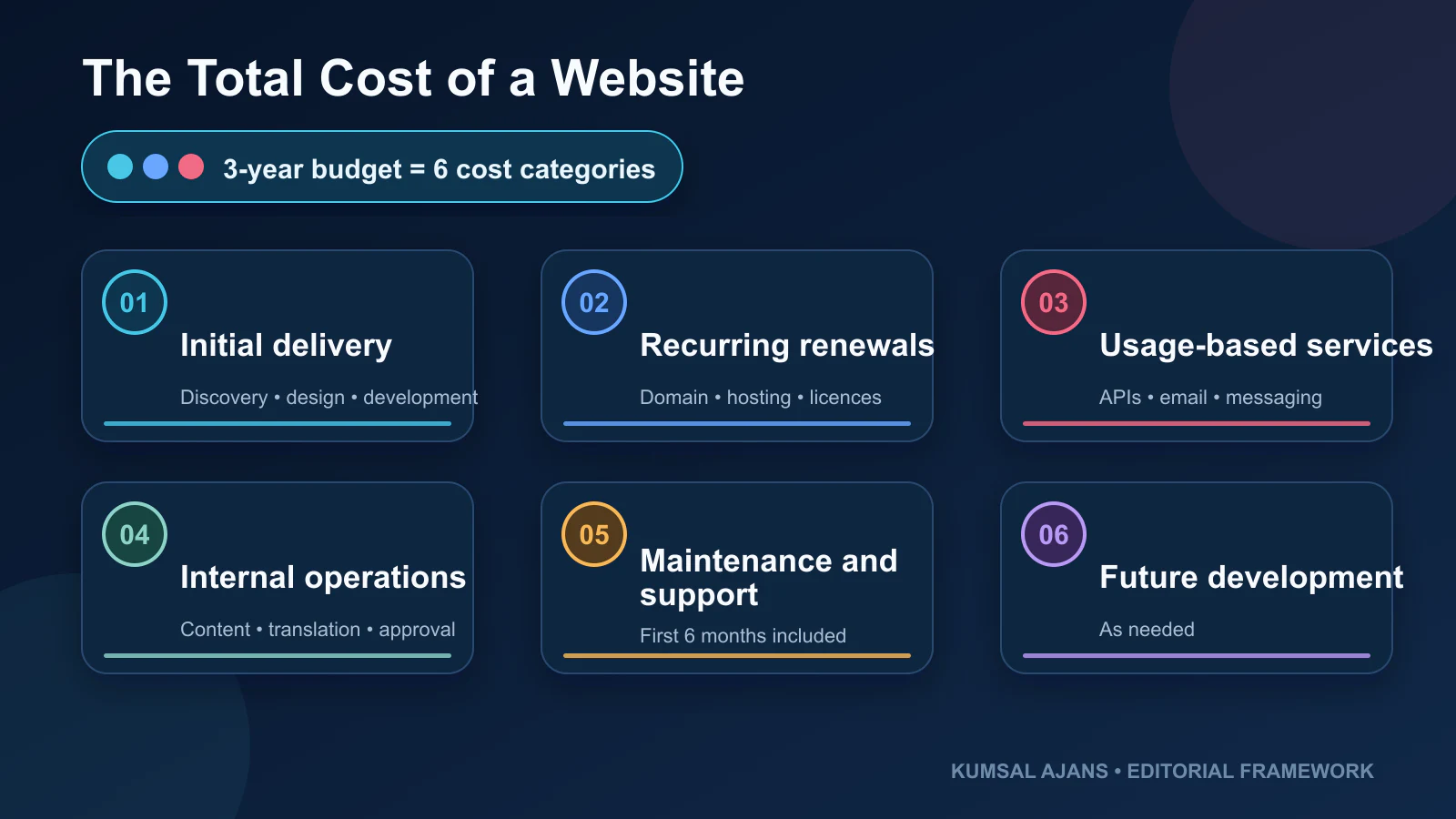
Total cost of ownership is a planning approach that looks beyond the fee required to design and build the website. It also includes the resources needed to keep the site available, current, useful, and aligned with changing business requirements.
Not every item is an agency fee. Some services may be paid by the client, some managed by the agency, and others billed directly by an infrastructure or software provider. Content preparation and approval also consume internal capacity even when they do not create an external invoice.
Ask five questions about every cost item:
- Is it included in the initial proposal?
- Who owns the task or payment responsibility?
- Is it one-time, recurring, usage-based, or required only when a change is requested?
- When must it be renewed or reviewed?
- What happens if usage, exchange rates, scope, or service terms change?
If the scope is not yet defined, start with our guide to preparing a website requirements document.
1. Separate Initial Delivery Costs
The project fee is the most visible part of the budget. However, the three-year model will be inaccurate from the beginning if that fee does not show what is included.
Depending on the project, initial delivery may include:
- Discovery, requirements analysis, and project planning
- Information architecture, user experience, and interface design
- Front-end and back-end development
- A project-specific content management platform
- Content production and entry for an agreed number of pages, services, or products
- Migration from an existing website or data source
- Multilingual functionality, translation, and localisation
- CRM, ERP, payment, booking, or other integrations
- Testing, launch, training, documentation, and handover
- Delivery of design files, project assets, and account access
Mark every item as included, client responsibility, third-party payment, or separately quoted. A multilingual platform may be included, for example, while translation remains the client's responsibility. A payment integration may be part of development while transaction fees are billed by the payment provider.
When evaluating multiple suppliers, use the website proposal comparison scorecard to place their initial scopes on a common basis.
2. Record Recurring and Renewal Costs
Some services must be renewed after the website is launched. The exact list depends on the platform, infrastructure, contract, and operating model.
Domain registration and hosting
A domain should not be treated as a permanently purchased asset. ICANN's guidance on domain renewals explains that a registration must be renewed before it expires and that renewal terms and fees may vary by registrar. Your budget should record the registrant, registrar, expiry date, account owner, and payment responsibility.
For hosting or infrastructure, document more than the plan name:
- Renewal period
- Storage, bandwidth, and backup limits
- Whether SSL, CDN, email, or managed administration is included
- What happens when traffic or resource usage grows
- Whether technical management belongs to the agency, client, or infrastructure provider
Licences and subscriptions
Fonts, stock media, plugins, analytics services, security products, or other software may require licences. Record who owns the account, how many users or projects the licence covers, when it renews, and what happens if the website is handed to another team.
Maintenance and technical support
For Kumsal Ajans website projects, the project fee is treated as a one-time project cost. Maintenance and technical support are provided at no additional charge for the first six months after launch. New pages, features, integrations, content changes, and other development are not included in this period. After the first six months, ongoing maintenance follows an annual service model.
The budget should therefore show the launch date, the end of the included six-month period, the start of the annual maintenance period, the services covered, and the work explicitly excluded. The phrase “support included” is not useful unless the period and boundaries are visible.
3. Track Usage-Based Third-Party Services
Some services are not billed as one fixed annual amount. Their cost can change with traffic, messages, API requests, stored data, or transactions.
Possible items include:
- Maps, geocoding, and address validation
- Transactional or bulk email
- SMS and identity verification messages
- Payment processing
- Artificial intelligence or data-processing APIs
- Video, storage, and CDN usage
- Search, translation, shipping, or booking services
The commercial model varies by provider. Google Maps Platform's official pricing documentation distinguishes pay-as-you-go billing from subscriptions that include a defined number of calls. Amazon SES pricing shows how email sending, receiving, data, and optional features can be measured separately. These examples do not mean that every website needs those products. They show why a budget should identify the billing unit and account owner for every third-party service.
Use a table like this:
| Service | Billing unit | Account owner | Payment owner | Alert or limit | Budget method |
|---|---|---|---|---|---|
| Maps or location | Request, session, or map load | Recent usage or scenario | |||
| Email delivery | Messages sent or received | Low, expected, and high usage | |||
| Messaging | SMS or verification action | Monthly volume estimate | |||
| Payment service | Transaction or revenue | Provider agreement | |||
| Storage/CDN | Storage and data transfer | Current usage plus growth assumption |
Do not invent one exact number when usage is uncertain. Prepare low, expected, and high scenarios, then check the provider's current official pricing before approval and renewal.
4. Include Internal Content and Operating Effort
Some website costs never appear as a supplier invoice. Writing content, approving translations, updating product information, responding to forms, and managing campaign pages all use internal time.
Assign an owner and expected frequency to tasks such as:
- Writing and reviewing new content
- Preparing photography, video, documents, and product data
- Approving translations and localisation
- Processing enquiries, applications, bookings, or orders
- Updating campaigns and announcements
- Reviewing analytics and performance reports
- Managing users and access
- Updating legal or corporate information
The goal is not to assign an artificial market price to every employee hour. Estimate the content volume, approval path, and capacity required during normal and busy periods. An easy-to-use management panel reduces operational friction, but it does not remove the work of creating and approving content.
5. Keep Warranty, Maintenance, Support, and New Development Separate
These terms describe different responsibilities:
- Warranty: Correction of software defects within the delivered and approved scope under the stated conditions.
- Maintenance: Agreed continuity work such as updates, backups, monitoring, compatibility, security, or performance checks.
- Technical support: Help with usage, access, or operational questions through defined channels and service boundaries.
- New development: A new page, feature, integration, module, or workflow requested after the original scope was approved.
To distinguish a defect from a new request, return to the approved scope and acceptance criteria. A function that was included but does not work may be a defect. A report or integration that was never defined is new development. Written boundaries prevent budget discussions from depending on personal interpretation.
The six-month maintenance and technical support period offered by Kumsal Ajans keeps the same distinction. It does not create an unlimited right to request new features.
6. A Fillable 3-Year Website Budget Template
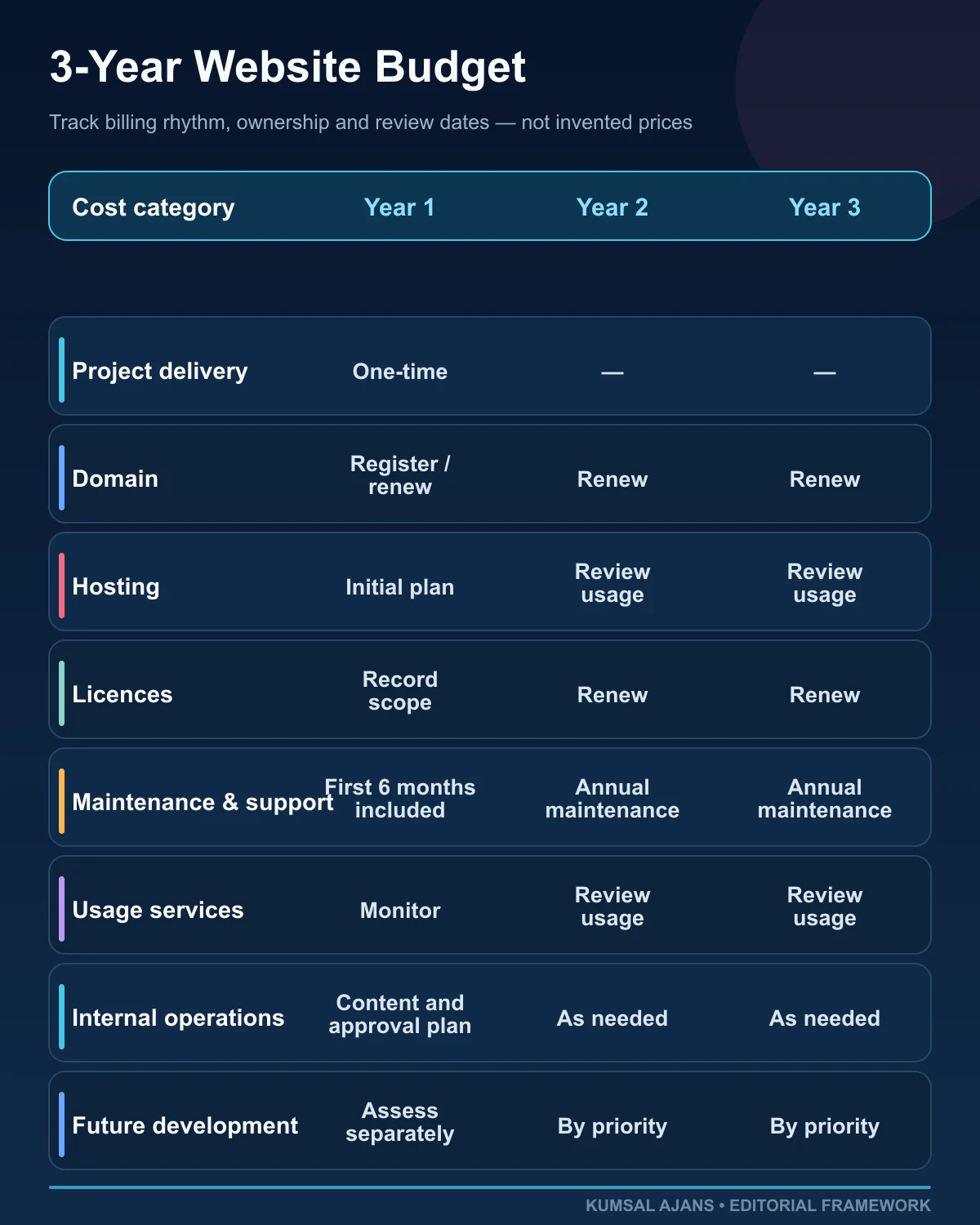
Complete this table using the figures in your own proposal. Record the currency, taxes, exchange-rate assumptions, and potential price changes in the notes column.
| Cost item | Responsible party | Billing model | Year 1 | Year 2 | Year 3 | Renewal date | Assumption or risk |
|---|---|---|---|---|---|---|---|
| Discovery, design, and development | One-time | — | — | — | Scope changes excluded | ||
| Content entry and migration | One-time / as needed | Quantity and content type | |||||
| Domain | Periodic renewal | Registrar and account owner | |||||
| Hosting/infrastructure | Annual / usage-based | Traffic and resource limits | |||||
| Licences and subscriptions | Monthly / annual | Users, projects, and terms | |||||
| Maintenance and technical support | First 6 months included; annual afterward | Scope and support channel | |||||
| Email, SMS, and API usage | Usage-based | Low/expected/high scenario | |||||
| Content and translation operations | Internal / external service | Monthly content volume | |||||
| New development budget | As needed | Approval and prioritisation method | |||||
| Redesign or renewal reserve | Planned reserve | Business and technology trigger |
Add three totals beneath the table:
- Committed costs: Items supported by a contract or current official price
- Estimated costs: Items that depend on usage or future requirements
- Internal resources: Work that uses team capacity without creating an external invoice
This prevents an estimate from being treated as a guaranteed amount.
7. Complete the Template in Six Steps
1. Gather every proposal and supporting document
Review the main proposal together with separate hosting, maintenance, licence, content, and integration documents. Do not treat a verbal statement as written scope.
2. Assign responsibility for every item
“Managed by the agency” does not necessarily mean “paid by the agency”. The account owner, invoice recipient, and technical operator may be different parties.
3. Classify the billing model
Mark each item as one-time, monthly, annual, usage-based, or required only when requested. Split a line when it combines more than one billing model.
4. Add renewal dates to a shared register
Record domain, infrastructure, licence, and maintenance dates in the handover documentation. Confirm which email address receives renewal and billing notices.
5. Write down assumptions and thresholds
Replace expressions such as “normal traffic” or “standard support” with measurable boundaries. Ask what happens when usage exceeds the current plan.
6. Keep change budget separate
A future development budget is not a commitment to spend. It creates planning capacity for business growth, new regulation, integrations, or user needs that may arise later.
A Clearly Labelled Fictional 3-Year Scenario
The following is not a client case or price proposal. It is a fictional, amount-free scenario used only to demonstrate the budgeting method.
Imagine a mid-sized manufacturer commissioning a bilingual corporate website. The project includes product pages, enquiry forms, a map, transactional email notifications, and one business-system integration.
| Item | Year 1 | Year 2 | Year 3 | Review point |
|---|---|---|---|---|
| Design and development | One-time project delivery | — | — | Approved scope and handover list |
| Content and translation | Initial preparation and entry | Update as required | Update as required | Content owner and quantities |
| Domain | Registration or renewal | Renewal | Renewal | Registrant and expiry date |
| Hosting | Initial plan | Review against usage | Review against usage | Traffic, storage, and backup limits |
| Maintenance and technical support | First 6 months included; annual model afterward | Annual maintenance period | Annual maintenance period | End date and service scope |
| Maps and email services | Monitor usage | Review usage and pricing before renewal | Review usage and pricing before renewal | Account, invoice, and alerts |
| New development | Assess separately if required | Plan against business priorities | Plan against business priorities | Business case and approval owner |
If the initial proposal explains only the first row, the budget is incomplete. The correct response is not to invent prices for the other rows. It is to identify the responsible party, billing model, and decision date before the proposal is approved.
Questions to Ask Before Approving the Proposal
- Which design, development, content, testing, and handover items are included in the project fee?
- Who owns the domain, hosting, and licence accounts, and who pays each renewal?
- Who receives invoices for third-party usage?
- When does included support begin and end, and which work does it cover?
- How are warranty, maintenance, technical support, and new development separated?
- Which traffic, message, or API thresholds could create additional cost?
- Who manages content, translations, and data updates?
- Does the three-year model separate committed costs, estimates, and internal work?
- How are source files, accounts, backups, and renewal records handed over if the service ends?
Ask for the answers to appear in the proposal, contract, or handover documentation. Obtain appropriate legal or financial advice when a clause has a material effect beyond general project planning.
Conclusion: Approve a 3-Year Model, Not Only an Initial Price
Searching for one universal website price can be misleading. Projects that appear similar may have different cost structures because of content volume, integrations, infrastructure, licences, support boundaries, and internal workload.
Start by defining the initial delivery. Then add renewals, usage-based services, maintenance and support, content operations, and possible future development to a three-year table. For every line, record the responsible party, billing model, date, and assumption.
If you would like to assess the scope and long-term budget model for your project, review the Kumsal Ajans web design service.