


Aydınlatma metni yükleniyor…
A new digital product idea often begins with a genuine observation inside a company. Customers may struggle with a recurring transaction, teams may manage the same information across disconnected files, or leaders may see an unmet opportunity in the market. Yet a promising idea is not evidence that the proposed product is the right response. Before design and development begin, teams need to understand which user problem the idea addresses, what business outcome it could support and whether it can be delivered within realistic technical and operational constraints.
This is not an approval stage designed to slow the idea down. It is a learning process that exposes weak assumptions before they become expensive software. The aim is not to settle every detail at the outset, but to reduce the uncertainties that could materially affect the investment decision. Instead of sending a long feature list directly into development, the team can define a product around demonstrated needs, measurable goals and manageable technical scope.
Why a business idea and a user need are not the same
Business ideas are usually expressed in the language of solutions: “Let’s build an app,” “We need a customer portal” or “We should automate this process with AI.” A user need describes the outcome someone is trying to achieve in a particular context. A user may need to check an order’s status, record field activity without a connection or compare offers with confidence. An app, portal or automated workflow may be one possible response; it is not the need itself.
When this distinction is ignored, research becomes an attempt to validate a solution that has already been selected. Interviews drift towards hypothetical questions such as “Would you use this app?” Positive answers reveal little about how people complete the task today, what prevents success or what would motivate them to change. The GOV.UK Service Standard recommends focusing on the problem users are trying to solve and testing assumptions early, as explained in its guidance on understanding users and their needs.
The company perspective remains essential. A viable product should contribute to revenue, service quality, operational efficiency, data integrity, retention or another defined result. Good product discovery does not dismiss the original business idea; it investigates where that idea intersects with user evidence and organisational value.
Define the problem space before testing the product idea
Begin with an investigable problem, not a prescribed solution. “Build an ordering app for dealers” closes the discussion too early. “Dealers struggle to bring together product, current stock and delivery information when placing repeat orders” is more useful because it leaves room for different responses, observable behaviours and measurable symptoms.
A problem frame should identify the target users, their current behaviour, the obstacle they encounter, the resulting consequence and the effect on the business. Existing call-centre records, support requests, sales notes, analytics, operational reports and lost-opportunity data can provide initial evidence. They do not replace direct research, but they help the team decide which questions deserve investigation.
Turn assumptions into research questions
Facts, interpretations and expectations easily become mixed together in product meetings. Record each important claim as an assumption, then rewrite it as a question. Replace “Users want to work on mobile” with “Do field employees need to enter the record on their phone immediately after completing the task?” Replace “Customers want more features” with “Which task cannot be completed in the current system, and what happens as a result?”
Each research question should connect to a decision. If the answer would not change the target audience, scope or investment choice, the question may not be a priority. GOV.UK’s guide to planning a round of user research recommends defining clear objectives, the assumptions being examined and the information needed for the next decision.
Build user research around behaviour, not approval
The purpose of new-product research is not to persuade participants to endorse the concept. People may say they would use a future product and then behave differently under real constraints. More reliable insight comes from past behaviour and current workflows: the tools people use, the delays they tolerate, the errors they encounter, the workarounds they create and the outcome that tells them a task is complete.
In-depth interviews help explain goals, choices and constraints. Contextual observation reveals how work is actually performed—for example, why an employee uses paper notes, messaging software or a spreadsheet alongside an official system. Existing product and support data can show abandonment, repeated work or requests for help at particular stages. Choose the method according to the question rather than treating one technique as universally sufficient.
Identify the right user groups and roles
“The customer” is rarely a precise enough audience for a digital product. In a B2B ordering system, a buyer may prepare the order, a manager approve the budget, finance check the credit limit, warehouse staff fulfil the shipment and an account representative resolve exceptions. Each role has different goals, permissions, information needs and definitions of success.
Research should not include only the easiest people to reach or those most enthusiastic about the concept. Depending on the service, it may need frequent and occasional users, newcomers, people who require additional support and the operational teams delivering the service. Clear role definitions also lead to more credible requirements for access control, approvals, notifications and data visibility.
Evaluate user need, business goals and technical feasibility together
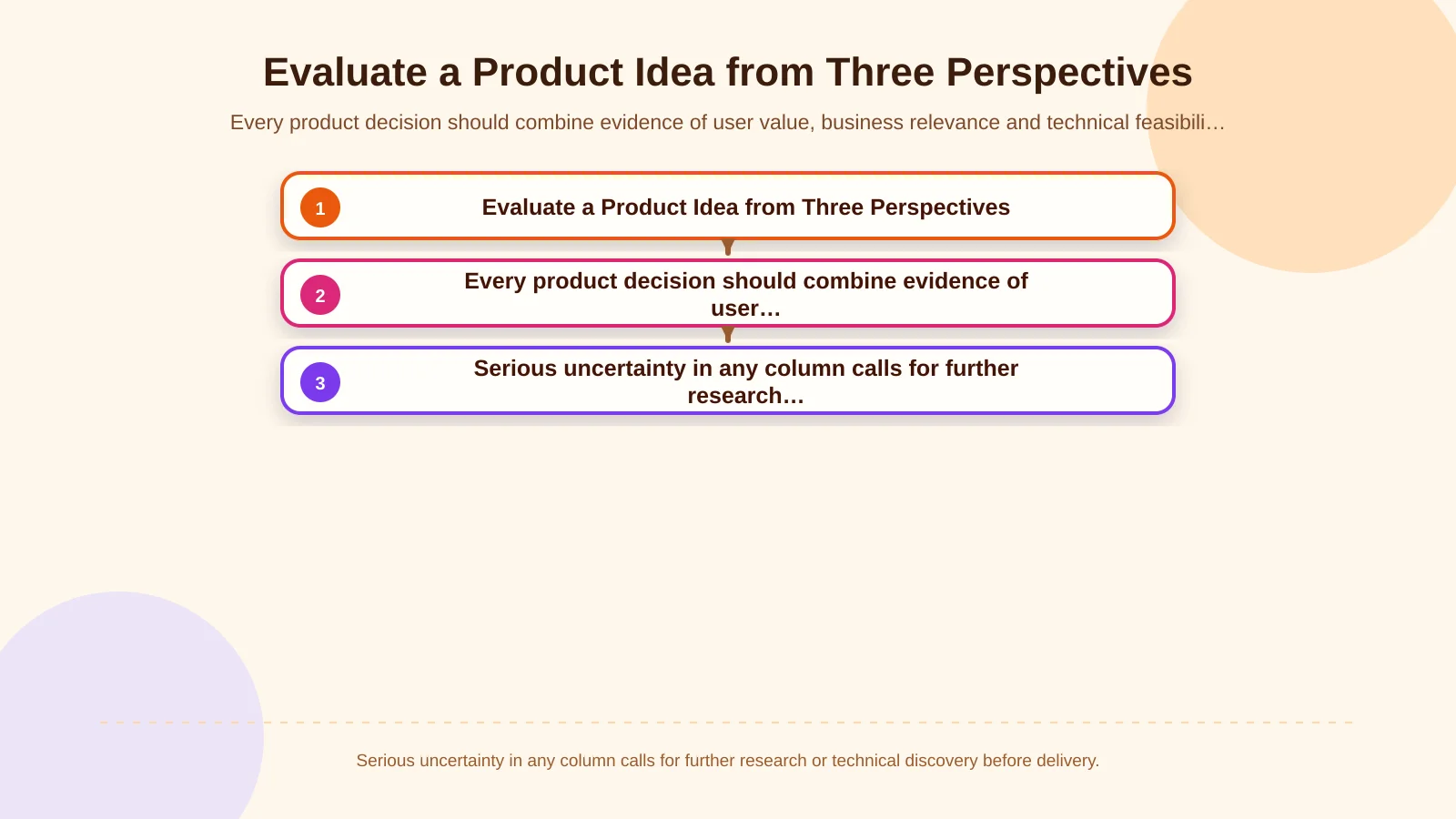
A genuine need does not automatically make the proposed product a sound investment. Teams must consider frequency and severity alongside strategic relevance, operational ownership, data requirements, integration effort and long-term maintenance. Every decision should answer three questions: Is it meaningful to users? Is it valuable to the organisation? Is it feasible under the actual conditions?
Human-centred design treats understanding users and their tasks as an activity that continues throughout the product lifecycle. ISO 9241-210 on human-centred design provides principles and recommendations for interactive-system design. This supports an iterative relationship between research, design and evaluation instead of treating research as a single stage completed before design begins.
| Evaluation area | User perspective | Business perspective | Technical perspective |
|---|---|---|---|
| Problem | Does it obstruct a real task? | Does it affect a priority goal? | How does it relate to existing systems? |
| Evidence | Behaviour and research findings | Operational and performance data | Data, API and infrastructure review |
| Success | Can the task be completed? | Can the expected outcome be measured? | Is it secure and sustainable? |
| Decision | Is the need strong enough? | Is it worth the investment? | Is the scope feasible? |
Translate business goals into measurable product outcomes
Goals such as “digitalise the business,” “improve customer experience” or “increase sales” indicate direction but are too broad for prioritisation. Translate them into observable outcomes: reduce quotation time, lower the number of incomplete orders, increase the proportion of transactions completed without support or shorten the delay before field data reaches the central system.
Metrics should remain close to the task the product is meant to improve. Screen views, registrations and downloads can be useful, but they do not prove that users received value. Completion rates, returned records, approval time, support demand and appropriate repeat use may be more informative. Define the baseline, data source and evaluation period for each measure before release.
Do not separate technical discovery from design decisions
Technical requirements are not a separate list to hand to developers after the interface has been approved. User roles affect authorisation; offline work affects storage and synchronisation; real-time stock expectations affect ERP integration; and sensitive information affects security architecture. If these relationships are discovered late, an apparently workable prototype may require substantial redesign during development.
Technical discovery should examine existing systems, API capabilities, data ownership, identities, integration frequency, failure scenarios, device conditions and operational responsibilities. For products with complex roles, workflows and integrations, Kumsal Agency’s custom web development approach considers software scope in relation to real business processes.
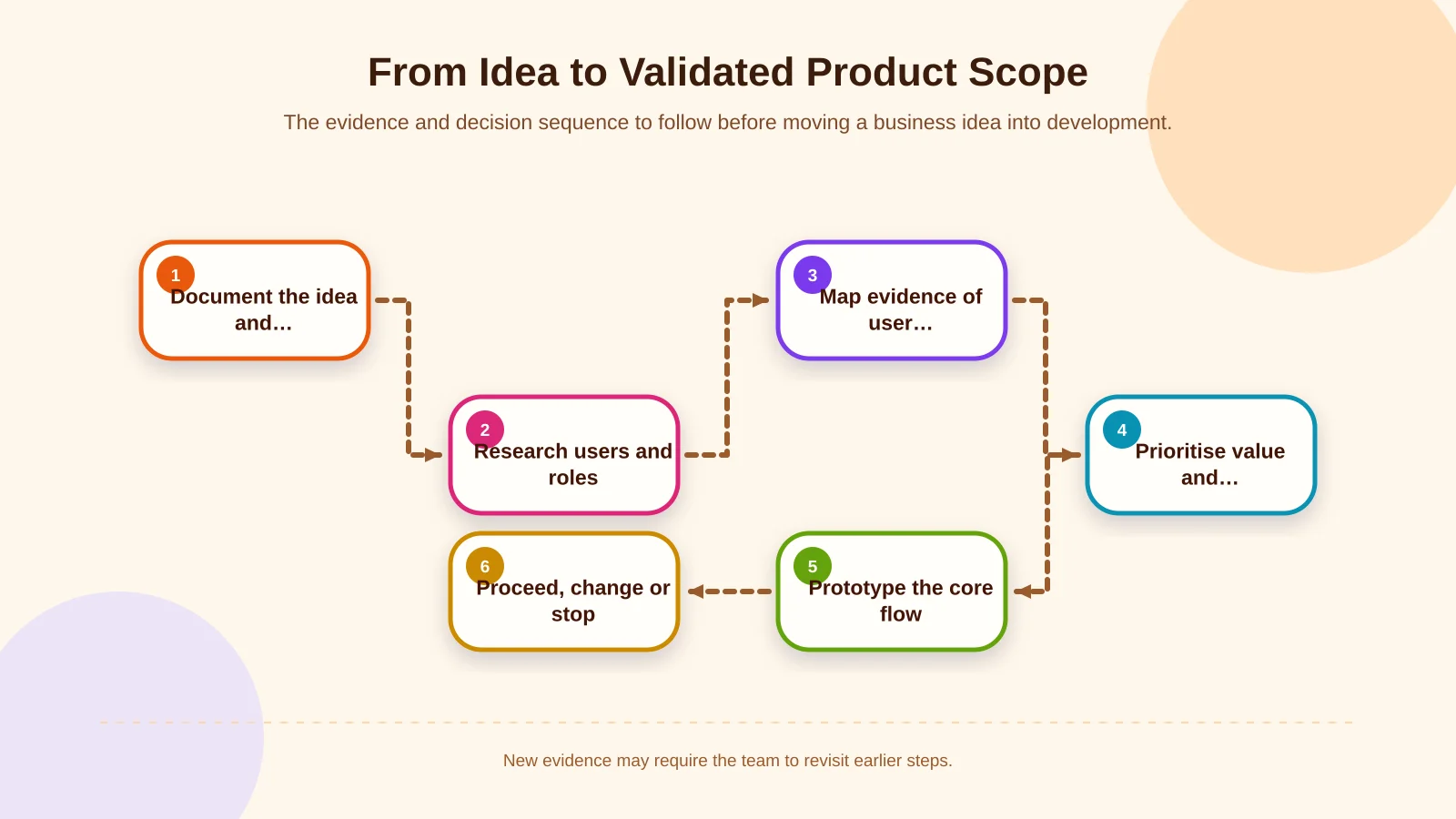
Six steps from idea to validated product scope
Product discovery is not a linear approval chain. New evidence may require earlier decisions to be revisited. Nevertheless, the following sequence gives business leaders, product owners, designers and technical teams a practical shared starting point.
- Document the business idea, expected outcome and critical assumptions.
- Research target users, distinct roles and the current working context.
- Map recurring needs, obstacles and existing alternatives to evidence.
- Prioritise according to user value, business value, risk and dependencies.
- Make the essential scenarios visible and testable through prototypes.
- Use the findings to proceed, change direction, narrow the scope or stop.
At the end of each step, record what was learned, which evidence supports it, which assumptions remain open and what decision comes next. This creates traceability and prevents the loudest opinion in a meeting from becoming the product strategy.
Prioritise features by evidence and risk
Not every need discovered through research belongs in the first release. Assess user impact, contribution to business value, strength of evidence, technical complexity and dependencies together. A costly feature that does not help users complete the core task can wait. A frequent obstacle with serious consequences may deserve earlier attention even when it appears less impressive in a presentation.
Scenario-based scope is usually more useful than a list of modules. Instead of requesting a “notification module,” define who needs to receive which information, after what event and for what purpose. This connects the experience, data source and acceptance criteria. Kumsal Agency’s existing guide, How to Prepare a Web Software Requirements Document: Practical Template, can also help teams turn feature ideas into testable requirements.
Decide what the prototype must validate
A prototype is not merely a preview of the interface. It is a low-cost way to examine an assumption, make a flow tangible and reduce ambiguity across teams. A useful test does not ask whether participants like the screens; it observes whether they understand and can complete a realistic task.
Choose fidelity according to the research question. A simple clickable wireframe may be enough to test information order and navigation. Data entry, error recovery or complex interaction may require more realistic content and states. Record hesitation, misinterpretation, backtracking and requests for help as carefully as successful steps.
When mobile use is central, test the device context, connectivity, notifications and platform behaviour. Kumsal Agency’s React Native mobile application services bring product goals, user needs and technical requirements together when planning iOS and Android products.
Turn test findings into product decisions
Research and prototype testing should produce more than a presentation. Record each finding with the relevant role, need, observed evidence, business effect, technical relationship and proposed response. Do not treat one participant’s preference as a universal requirement. Look for repeated behaviour, serious usability barriers and consistency across different evidence sources.
A decision may support proceeding with the concept, changing the solution, reducing it to a smaller core or stopping the investment when sufficient value is not evident. Stopping is not necessarily failure; it may mean an expensive assumption was rejected before development. Positive findings are not a guarantee of success either. They provide stronger grounds for the next investment step.
An MVP is a testable value proposition, not an incomplete product
A minimum viable product is not a weak release created by randomly removing features. It is the smallest meaningful scope in which a defined user group can complete its core task end to end and the organisation can gather evidence about the most important product assumption. Designing the beginning of a journey while leaving the operational continuation unowned may not produce a viable product.
Define the primary scenario, necessary roles, data sources, exceptions, security needs, operational owners and measurement events. Record deferred capabilities and the reasons for deferring them. “Not in the first release” then becomes a deliberate priority decision rather than a forgotten requirement.
Common mistakes in new product design
- Treating an executive request as a validated user need.
- Asking about future intentions instead of examining past behaviour.
- Researching only accessible or enthusiastic users.
- Presenting a prototype as a final interface awaiting approval.
- Leaving integrations, data quality and operational ownership until late.
- Defining an MVP that cannot complete the core task.
- Waiting until after launch to design the measurement plan.
The remedy is not simply more documentation. It is making the evidence behind each decision visible. When user findings, business goals, design choices and technical requirements remain connected, scope changes can be assessed and managed with greater control.
How Kumsal Agency approaches product ideas
Kumsal Agency treats new product design as more than creative concept development or interface production. The process considers company assumptions alongside user needs, business outcomes and feasibility. Research-led digital brand consulting can establish shared direction for the audience, value proposition and principles of the digital experience.
User experience and digital design work make roles, core tasks, information architecture and prototypes visible. Custom web and mobile product evaluations connect these decisions to workflows, data structures, integrations, device conditions and technical dependencies. The appropriate methods and scope depend on the product’s stage and the decisions the team needs to make.
Final questions before development begins
- Is the problem supported by evidence from real user behaviour?
- Have the target audience and distinct user roles been separated clearly?
- Does the core scenario produce a meaningful end-to-end outcome?
- Are the business goal and success measure explicit?
- Are data, integration, security and operational responsibilities defined?
- Which assumptions did prototype testing strengthen or weaken?
- Is the first release small enough to generate learning but complete enough to create value?
Not every question will have a definitive answer. The important discipline is to record uncertainty, assess its risk and plan the next learning step. This cannot remove all risk from product development, but it helps prevent an unverified problem, unnecessary features or an unprepared technical scope from driving the investment.
To evaluate your product idea across user needs, business goals and technical scope, contact Kumsal Agency.