


Aydınlatma metni yükleniyor…
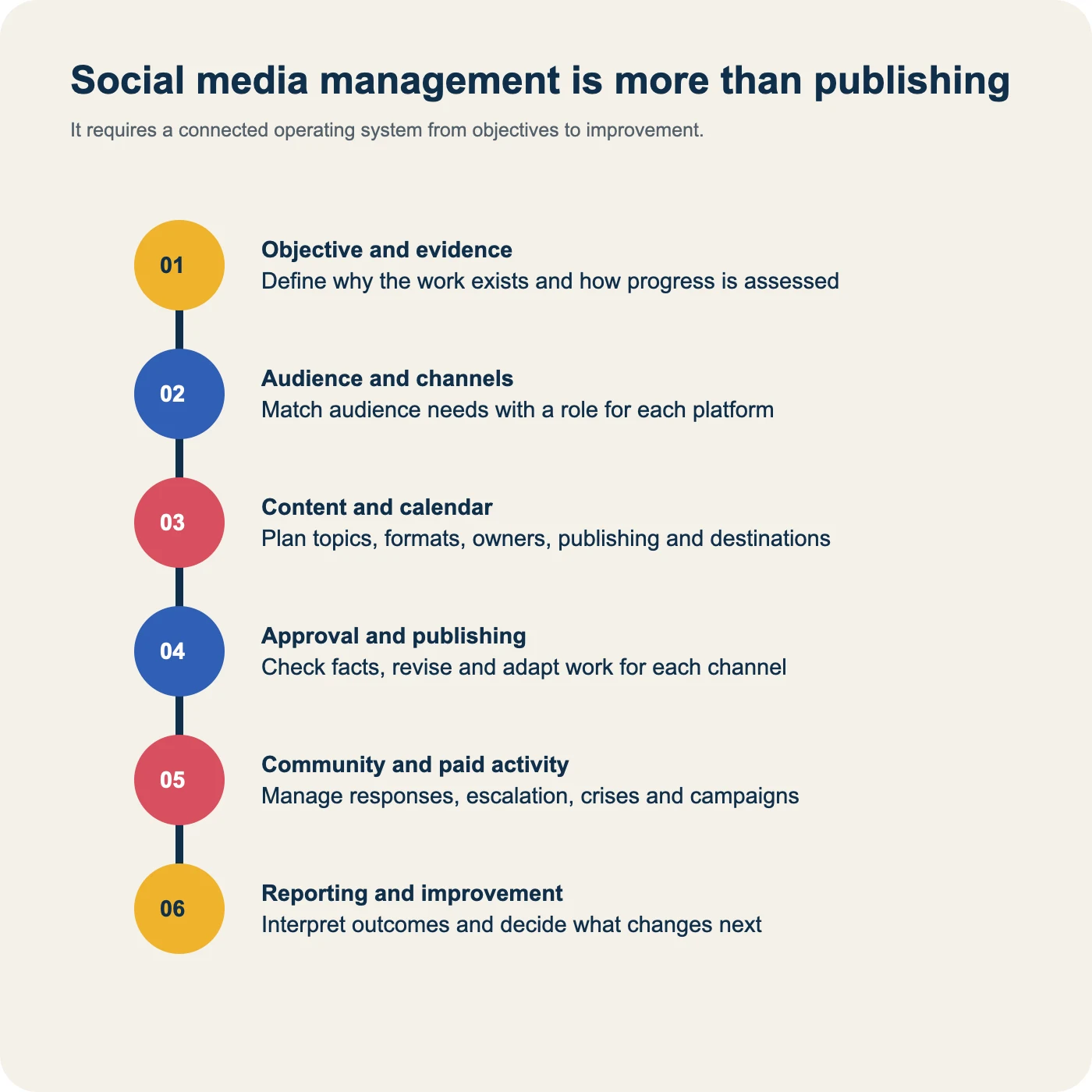
Social media management is the coordinated process of planning, publishing, monitoring and improving a brand’s activity across social platforms. It connects business and communication objectives with audience research, channel selection, content production, community responses, paid campaigns, account governance and performance measurement.
An effective programme does not begin with “What should we post this week?” It begins by defining why the organisation is using social media, who it needs to reach, what action or outcome matters, and how the team will recognise progress.
What Does Social Media Management Include?
The exact scope depends on the organisation, audience and channels, but commonly includes:
- Defining communication and business objectives
- Understanding audience needs and decision contexts
- Selecting channels with a clear role
- Planning content themes and an editorial calendar
- Coordinating copy, design and video production
- Managing comments, messages and community interactions
- Connecting organic activity with paid campaigns
- Protecting account ownership and access
- Measuring results and documenting limitations
- Improving the plan based on evidence
These responsibilities do not need to sit with one person or supplier. They do need named owners, approval points, deliverables and measurement rules.
How to Build a Social Media Management Process
1. Define the objective before choosing content
Follower growth is not a complete objective by itself. Brand awareness, qualified website traffic, lead generation, customer support, community development and customer retention each require different content and evidence.
Choose indicators that reflect the objective. Awareness may use reach or meaningful video views. Engagement may examine comments, saves and shares. Website activity may use link clicks alongside analytics data. Lead generation should use verified enquiries or agreed conversion events. No single metric explains the entire outcome.
2. Describe the audience by need, not demographics alone
Age, location and job title can help, but they do not explain why someone will pay attention. Record the problem the audience is trying to solve, questions and objections, decision stage, useful content formats, viewing context and expected next step.
This approach gives the production team a clearer brief than a broad demographic label.
3. Give each platform a specific role
An organisation does not need to be active on every network. Evaluate audience use, available production skills, response capacity, paid-media needs and the intended customer journey.
One channel may support expertise and professional communication; another may be better suited to visual demonstrations or ongoing community interaction. Adapt the message, format, length and destination rather than copying the same post everywhere without context.
4. Build an editorial calendar around content jobs
An editorial calendar should contain more than publication dates. For each item, record its objective, audience need, topic, format, owner, approver, channel, destination and measurement note.
A balanced programme may include educational explanations, product or service guidance, decision-support comparisons, process and team content, verified examples, community questions, and campaign announcements.
There is no universal posting frequency. Choose a rhythm the team can sustain without sacrificing accuracy, response quality or production standards.
5. Document production and approval
Copy, design, product information, campaign terms and legal statements may come from different owners. Use a visible workflow: brief, evidence gathering, production, accuracy and brand review, approval, publication, community follow-up and reporting.
An undefined approval process creates delays and increases the risk of publishing unverified product, price or commitment claims.
6. Plan community and escalation workflows
Community management is not limited to replying to positive comments. Define how the team handles questions, complaints, support requests, personal information, abusive language and potential crises.
The plan should name the first responder, response boundaries, escalation routes, privacy safeguards, urgent contacts and the location of interaction records.
7. Manage organic and paid activity as connected disciplines
Organic publishing and paid social can support the same objective, but they are not the same task. Paid campaigns require separate decisions about audiences, budget, creative variants, landing pages, conversion measurement and optimisation.
Before spending budget, confirm the expected action and whether it can be measured reliably. Additional reach alone does not prove a business outcome.
8. Report against the objective
A useful report goes beyond follower and like totals. Depending on the objective, it may combine reach, viewing, meaningful interaction, link activity, website behaviour, verified enquiries and customer-service evidence.
Meta Business Suite provides Meta’s official environment for managing content, messages and performance information. When campaign parameters are used for website links, Google Analytics guidance on URL builders can help teams apply consistent source, medium and campaign naming.
Every report should state what was attempted, which channels and content contributed, where the data came from, what the limitations are, and what will be retained, changed or stopped.
What Business Purposes Can Social Media Support?
Social platforms can serve different business purposes rather than one universal goal. They may support brand awareness, answer audience questions, explain products or services, attract qualified website visits, handle customer enquiries and maintain an active community. The priority should reflect the organisation’s business model and the audience’s decision journey.
Choose channels, content formats and measurements for each purpose separately. Awareness activity may be assessed through reach and meaningful viewing, while demand generation should use verified forms, conversations or enquiries passed into the sales process. This connects social media activity to an intended organisational outcome instead of measuring success by publication volume alone.
In-House Team, Consultant or Agency?
The best model depends on workload, internal knowledge, production needs and response expectations. An internal team may be closest to the product and customers. A consultant may focus on strategy, audit and team guidance. An agency may coordinate strategy, copy, design, paid activity and reporting across several specialists.
When comparing social media consultancy with a social media agency, ask who will produce each deliverable and who retains final approval. Every model still needs an accountable internal owner.
Common Social Media Management Mistakes
- Producing content without a defined objective
- Copying the same content across every channel without adaptation
- Treating the calendar as a post-count target
- Leaving comments and messages without an owner
- Evaluating paid campaigns only through reach or clicks
- Presenting follower count as a business result
- Making account access dependent on personal profiles
- Publishing without approval and crisis workflows
- Reporting platform activity without connecting it to website or customer outcomes
If social interactions need to inform customer records, social CRM should be treated as a related but distinct capability. If creator partnerships form part of the plan, influencer marketing needs its own selection, approval, disclosure and measurement process.
Social Media Management Checklist
Before implementation, answer these questions:
- Which business or communication objective will social media support?
- Who are the primary and secondary audiences?
- What role does each selected channel have?
- Which themes and formats will be produced?
- Who owns evidence, copy, design and approval?
- How will messages, comments and escalations be handled?
- How will organic activity and paid budget be separated?
- How will website actions or enquiries be measured?
- Which sources will be used in reporting?
- Who owns the accounts, roles and access controls?
Conclusion
Social media management is broader than producing posts. Without a connected system for objectives, audiences, channels, content, approval, community, paid activity and measurement, a brand can publish regularly without being able to explain what the work is intended to achieve.
A strong operating model makes responsibilities visible, gives each platform a clear role and evaluates results against the original objective. This turns social media from a continuous production queue into a communication system that can be reviewed and improved.