


Aydınlatma metni yükleniyor…
The success of a brand strategy workshop depends not only on the methods used but also on who is in the room. A session attended only by marketing may produce strong communication ideas while remaining disconnected from product capabilities and sales realities. A workshop limited to senior leadership, meanwhile, may overlook everyday customer experiences and the practical barriers teams face.
The right participant mix brings business goals, customer needs, commercial evidence, product realities and touchpoints into one decision-making process. A brand strategy workshop should therefore be designed as a structured environment in which distinct sources of knowledge are represented—not as an open-ended brainstorming meeting where everyone attends every discussion.
Why brand strategy cannot belong to one department
A brand is more than a logo, tagline or campaign voice. It connects what a company promises, which customers it prioritises, how its products or services fulfil that promise and what people experience from their first interaction through sales, delivery and support. Different teams own different parts of that system.
If marketing promises speed but operations cannot support rapid delivery, brand communication can create disappointment rather than trust. If sales consistently presents the offer through price alone, a premium position developed by the brand and design teams may not survive real customer conversations. Likewise, a technical advantage valued by the product team will have little impact if it is never translated into a benefit customers understand.
The UK Government Digital Service recommends bringing together roles across product, research, content, design and development when creating user-centred services. This is not a prescribed standard for brand workshops, but the GOV.UK guidance on multidisciplinary service teams offers a useful explanation of why strategic decisions benefit from varied expertise working around a shared user need.
Who should be in the core workshop group?
The core group should be a small, balanced team that remains involved throughout the workshop and can turn discussion into decisions. Job titles will vary between organisations; what matters is whether the necessary knowledge, authority and implementation responsibilities are represented.
Senior leadership and business unit leaders
A managing director, founder, board representative or relevant business unit leader can clarify growth goals, investment priorities and the strategic trade-offs the organisation is prepared to make. Their role is not to dominate every discussion or provide the final answer to every question. It is to connect brand choices to business direction and ensure that important decisions have a clear owner.
Without leadership representation, workshop outputs may be reopened or rejected later. Yet excessive executive influence can prevent frontline teams from discussing genuine problems. The facilitator should separate decision authority from speaking time so that leadership provides direction without narrowing the evidence available to the group.
Brand and marketing teams
Brand managers and marketers bring the current positioning, audience assumptions, research, campaign performance, competitor narratives and inconsistencies in the company’s language. They will also be among the main teams responsible for translating the strategy into content, campaigns, social media and corporate materials.
Their task should not be to defend every existing brand statement. They need to distinguish claims supported by research or performance data from assumptions repeated internally. This makes the workshop a place where previous choices can be tested rather than automatically approved.
Sales and business development teams
Sales teams know which questions buyers ask, who influences a purchase, why opportunities are lost and which objections appear repeatedly. In B2B organisations, knowledge of distributors, tenders, procurement requirements and long proposal cycles often sits primarily with sales and business development.
Ask these participants to bring more than success stories. Lost opportunities, misunderstood proposals and reasons customers chose competitors are particularly valuable. This evidence allows the group to compare the intended value proposition with the criteria buyers actually use.
Product, service and operations teams
Product managers, engineers, service-development specialists and operations teams show which promises the organisation can genuinely keep. Their input brings technical advantages, delivery constraints, quality standards, customisation capacity and future roadmap priorities into the discussion.
This participation is essential when defining proof for the brand promise. Strategy should not present an unfinished feature as a guaranteed benefit. At the same time, it should translate existing capabilities into outcomes that matter to customers rather than leaving them in technical language.
Customer experience, support and frontline teams
Customer success, call-centre, technical service, retail and field teams see what happens after a sale. Complaints, recurring support requests and moments that weaken trust reveal whether the brand experience remains consistent beyond advertising and acquisition.
These employees may not appear as strategy owners on the organisational chart, but they often identify the gap between customer expectations and operational reality first. Including at least one frontline representative can prevent the workshop from relying solely on management reports.
Digital, design, data and technology teams
Teams responsible for websites, e-commerce, mobile applications, CRM, analytics and digital content can evaluate how strategic choices will work across real touchpoints. They help clarify how a value proposition should shape navigation, product pages, enquiry forms, onboarding or personalised journeys.
Kumsal Agency’s Digital Brand Consulting service brings digital positioning, visual direction, experience principles and communication systems together in a research-led roadmap. This enables workshop decisions to inform web design, digital design, production, e-commerce, mobile applications and custom software instead of remaining confined to a presentation.
How should workshop participants be selected?
Good selection is not about completing a departmental checklist. Each participant should contribute information, authority or implementation knowledge that the group would otherwise lack. Use questions such as:
- Does this person have first-hand knowledge of customers or the market?
- Can they assess whether the proposed brand promise is deliverable?
- Can they approve a strategic choice or take it to the relevant decision-maker?
- Will they implement or communicate the outputs within their team?
- Do they add a perspective that is not yet represented?
More participants can broaden representation but make decisions slower. A practical structure combines a permanent core group with specialists invited to relevant sessions. A research or analytics lead may join when customer findings are reviewed. Export, localisation or regional sales specialists may participate when international market entry is discussed.
What evidence should each team bring?
An effective brand strategy workshop should not depend on opinion alone. Requesting specific material in advance makes the discussion more concrete. Leadership can bring growth goals and strategic priorities; marketing can supply research and channel performance; sales can share won and lost opportunities; product teams can present roadmaps, capabilities and use cases.
Customer experience teams might prepare complaint categories, satisfaction feedback and breakdowns in the service journey. Digital teams can contribute search terms, page behaviour, conversion points and recurring online support issues. Personal data and commercially sensitive information should be anonymised, with access boundaries agreed before the workshop.
Nielsen Norman Group describes research workshops as a way for stakeholders to interpret and apply findings rather than merely receive them. Its guidance on workshopping UX research with stakeholders offers useful practices for moving from raw findings to shared understanding. Brand workshops can similarly keep interview themes, customer observations and behavioural data at the centre of discussion.
A decision sequence for a brand strategy workshop
Trying to solve positioning, audience, messaging and implementation simultaneously usually creates confusion. A better sequence begins with evidence, defines the shared problem and then connects strategic choices to practical applications.
The Design Council’s Double Diamond framework separates exploring a problem from defining it, developing possible solutions and delivering an appropriate response. A brand strategy workshop does not need to replicate that process exactly, but it can apply the same principle: do not confuse discovery with selection.
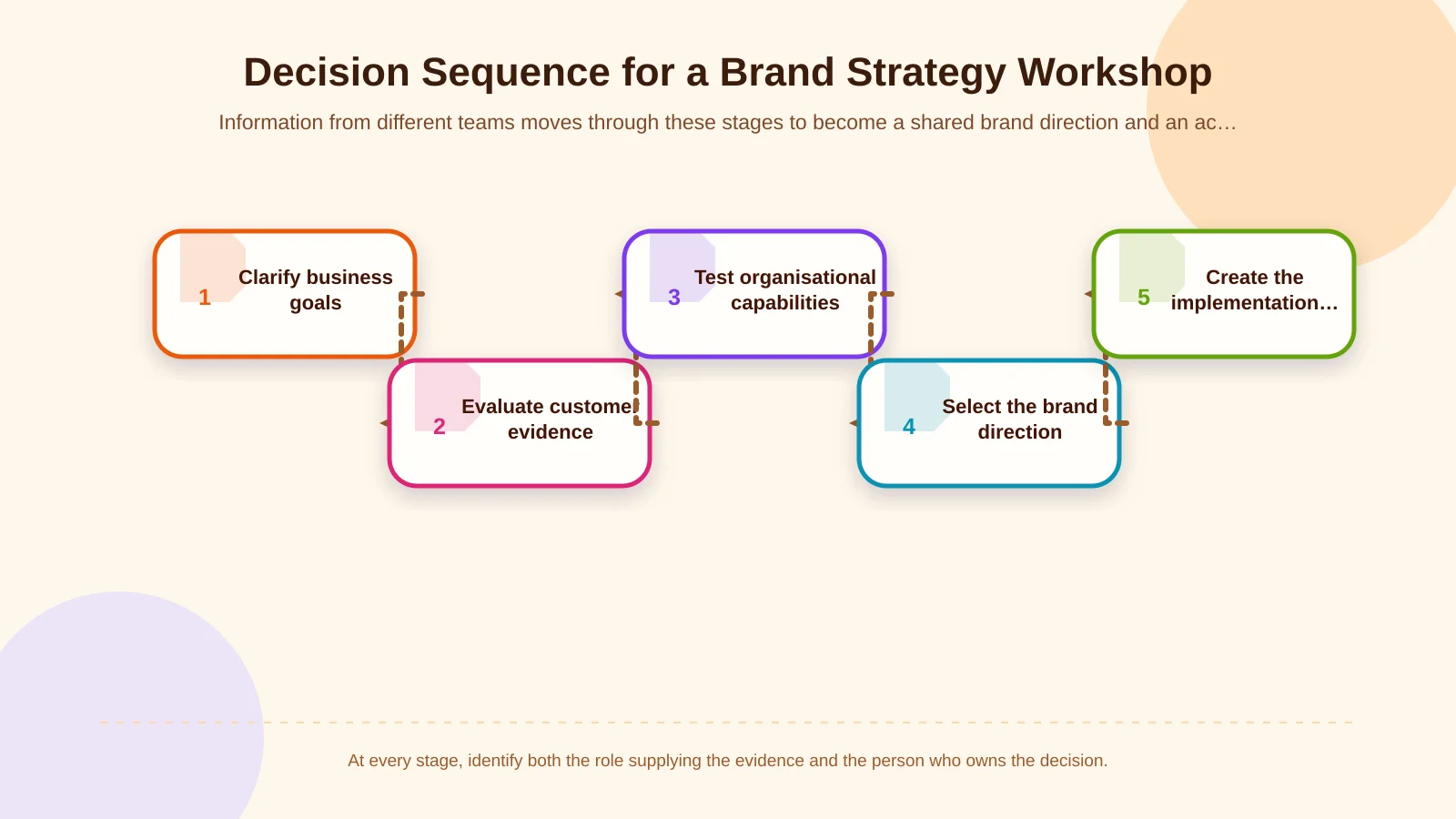
A practical sequence is to clarify business goals, examine customer and market evidence, test the organisation’s capabilities, select the brand direction and create an implementation roadmap. At every stage, record who supplies information, who recommends a choice and who owns the final decision.
Who should attend throughout, and who should join selected sessions?
A leadership sponsor, brand or marketing lead, sales representative, product or operations representative and someone who understands the customer experience will usually form the core group. If digital transformation will deliver a substantial part of the strategy, include a digital product or technology representative throughout.
Legal, HR, finance, procurement, information security and international-market specialists can join according to the agenda. Legal input may be needed for renaming or strong product claims. HR becomes important when employee experience is part of the promise. Finance and technology should contribute early when implementation requires a major platform investment.
If customers or end users join, define their role carefully. They should describe their needs and experiences, not choose the company’s strategy. Interview recordings, research summaries and usability findings can provide another route for bringing the customer voice into the workshop.
Participation model and team contributions
Every team should not be expected to make the same kind of contribution. Before the workshop, explain what evidence each participant will provide, where they have decision authority and whether they belong to the core group or a specialist session. This prevents seniority from being mistaken for expertise and helps participants prepare information that the group can use.
| Team | Evidence contributed | Workshop contribution | Participation model |
|---|---|---|---|
| Leadership | Goals and priorities | Direction and decision authority | Core group |
| Marketing and sales | Market data and objections | Audience and value proposition | Core group |
| Product and operations | Capabilities and constraints | Feasibility of the promise | Core group |
| Customer experience | Complaints and feedback | Breakdowns in the customer journey | Core group or selected sessions |
| Digital and technology | Analytics and technical requirements | Translation across touchpoints | Core group when relevant |
Common participant mistakes in brand workshops
Inviting only senior executives
This provides authority but removes knowledge held by people closest to customers and daily operations. Balance leadership representation with frontline and implementation experience.
Inviting everyone to every session
Large meetings offer variety but can lengthen discussions and blur accountability. Plan separate layers for the core team, subject specialists and final approvers.
Treating sales and marketing as one perspective
Marketing contributes scalable communication and demand-generation insight. Sales contributes objections, buying dynamics and evidence from live conversations. Both perspectives are necessary and should complement one another.
Leaving technology and operations until the end
If feasibility is assessed too late, the strategy may create promises that digital products or service processes cannot support. Technical representation should start early when a website, e-commerce platform or mobile product will change. Subsequent corporate web design work should be shaped by the agreed brand direction, content priorities and customer journeys.
Failing to name the decision owner
If participants leave with different interpretations, the problem is usually governance rather than group size. State at the beginning which choices will be made in the room, which require further validation and who gives final approval.
How can ownership continue after the workshop?
Documentation should cover more than a brand essence or positioning statement. Record the rationale, supporting evidence, priority audiences, value proposition, experience principles, unresolved questions and named owners. Each team should see its implementation responsibility, whether that concerns the sales narrative, content system, product priorities, support standards, website experience or performance measures.
A small governance group can review new campaigns, product decisions and digital projects against the agreed direction. Regular review turns the strategy from a one-off workshop deliverable into a living framework for decisions.
The right team composition creates a shared brand direction
The exact participant list will vary, but the principle remains constant: the people representing business goals, customer needs, sales evidence, product reality and operational touchpoints must meet within the same decision system. Leadership supplies direction and authority; marketing brings market knowledge; sales contributes buying realities; product and operations test feasibility; customer experience represents everyday interactions; and digital teams translate strategy into channel experiences.
Identify the teams that represent both your decision-makers and customer touchpoints. Then work with Kumsal Agency to build a research-led brand strategy roadmap and turn shared choices into practical digital experiences. To discuss the scope of your workshop and implementation needs, contact Kumsal Agency.