


Aydınlatma metni yükleniyor…
Choosing between an agency, freelancer and in-house team is not a search for the lowest fee. It is a decision about the specialist depth, continuity, speed, governance and internal ownership required to operate the work. A model that is excellent for one defined deliverable may be inadequate for a continuous multi-disciplinary programme.
This guide does not recommend an agency in every case. A freelancer may be best for narrow specialist work, an internal team for daily proximity and institutional knowledge, an agency for variable capacity and multiple disciplines, and a hybrid arrangement for mixed needs.
Why the Decision Is Not Only About Budget
The visible fee is only one part of operating cost. Writing briefs, assigning work, coordinating specialists, checking quality, managing access, buying tools, recruiting, covering absence and handing work to a successor all consume time and resources.
A monthly-price comparison can hide who will set objectives, consolidate feedback and maintain continuity when someone is unavailable. Define the operating need first; compare price only among models that can meet it.
Define the Four Working Models
- Freelancer: An independent professional providing a defined specialism through their own working arrangement. Assess continuity, contract and cover rather than assuming a label tells the whole story.
- Agency: An external partner delivering one or more disciplines under shared process, account management and delivery responsibility. Team structure and specialist depth vary substantially.
- In-house team: Employees directly connected to organisational goals, data and daily operations. One employee does not automatically cover every required discipline.
- Hybrid model: An arrangement that retains decisions and selected capabilities internally while adding agency or independent capacity and expertise.
A Seven-Criterion Decision Matrix
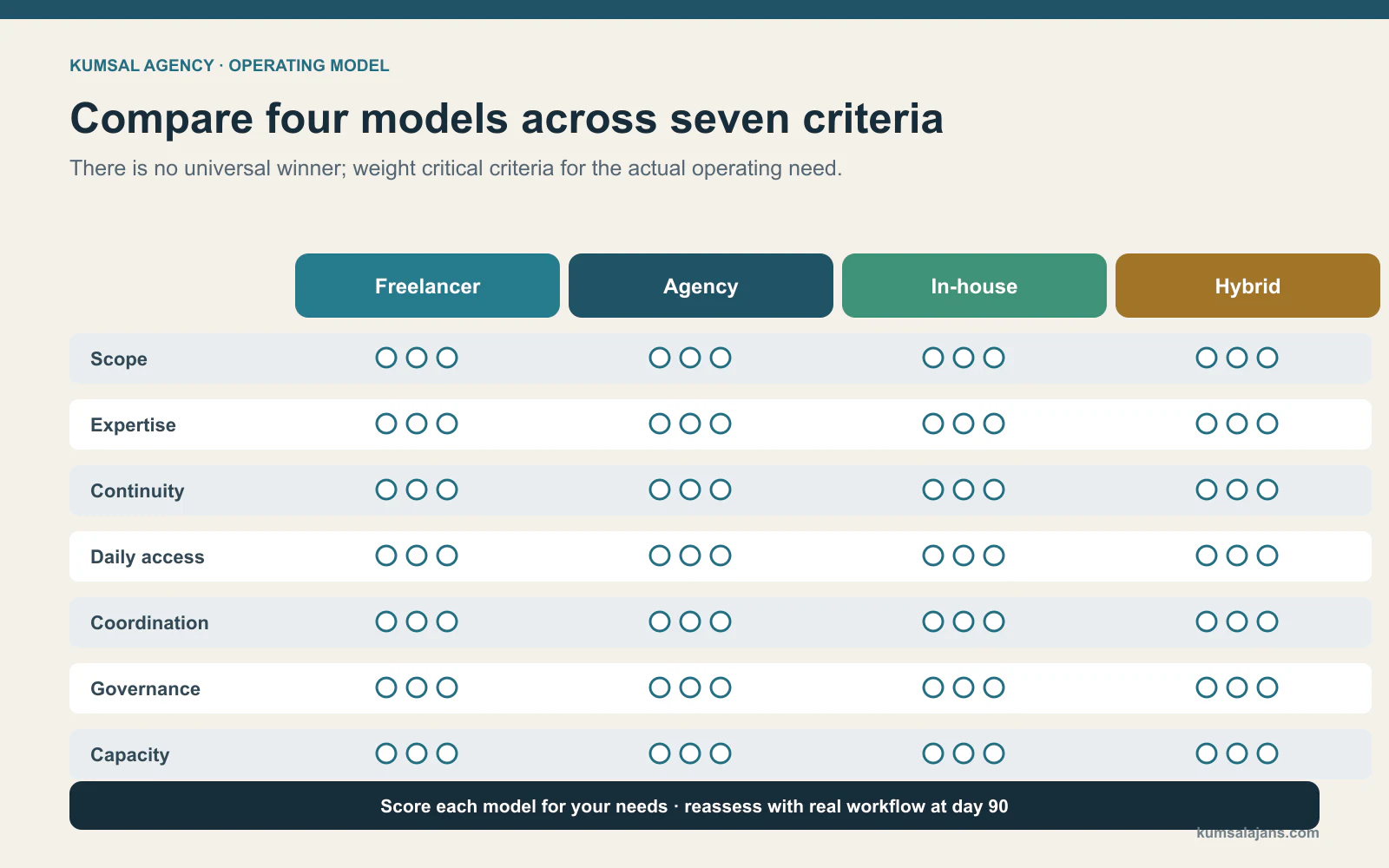
| Criterion | Freelancer | Agency | In-house | Hybrid |
|---|---|---|---|---|
| Scope | Narrow, defined work | Multiple disciplines or package | Continuous core need | Core plus variable demand |
| Expertise | Depth in a defined field | Combines several specialists | Organisation and product depth | Internal knowledge plus outside depth |
| Continuity | Depends on individual capacity | Can provide team cover | Depends on workforce planning | Distributed by role |
| Daily access | Agreed availability | Account/operations rhythm | Usually closest access | Fast through internal owner |
| Coordination | Client manages multiple specialists | Partly managed within agency | Needs an internal manager | Needs explicit boundaries |
| Governance | Built through contract and access | Process and roles expected | Directly under company policy | Requires shared rules |
| Capacity | Limited by personal schedule | Can expand through planning | Grows through hiring | Flexes with external capacity |
The matrix does not create one universal winner. Mark each criterion as critical, important or secondary, then require evidence of how the candidate actually operates. “We are an agency” or “we have a team” is not proof of capacity.
Compare Breadth with Specialist Depth
A proven freelancer can be a strong choice for one corporate video, technical SEO review or defined integration. If strategy, advertising, content, design, measurement and development affect one another within the same programme, an agency capable of coordinating those disciplines may add value.
An internal team builds product and customer knowledge over time, but placing every responsibility on one generalist is rarely sustainable. Map required decisions and expertise: who defines strategy, produces, implements, measures and approves quality?
Continuity, Cover and Key-Person Dependency
Key-person dependency is not exclusive to freelancers. A sole internal specialist or an agency that keeps all client knowledge with one account manager has the same weakness. Assess access, documentation and cover rather than the model name.
- Are domain, advertising, analytics and content accounts under organisational ownership?
- Are source files, decisions and measurement definitions documented?
- Can a secondary role continue when the primary person is unavailable?
- Are backups restorable, and has a handover been tested?
Speed, Availability and Approval Flow
An in-house team may answer daily questions quickly but slow down when its capacity is full. A freelancer may communicate directly but have other commitments. An agency may provide team cover while routing requests through account management and planning.
Separate “speed” into first response, start time, draft, revision and release. Define an urgent request and who can approve it. A two-day external draft does not create a fast cycle if internal approval takes three weeks.
Coordination Cost and Internal Ownership
The combined invoices of three freelancers may look low while matching briefs, managing versions and resolving conflicting decisions requires an internal coordinator. An agency can absorb part of this coordination, but it cannot own the organisation's commercial objective or final approval.
Every model needs an internal work owner. That person sets priorities, supplies data and access, consolidates feedback and evaluates results in business context. Outsourcing production does not outsource institutional accountability.
Security, Access and Governance
If work touches sensitive data, regulated activity, critical infrastructure or frequent permission changes, select the model together with its access design. Use named roles, least privilege, periodic access review, secure transfer and an exit process instead of shared passwords.
Internal does not automatically mean secure, and external does not automatically mean risky. Evaluate contracts, technical controls, training, records and actual practice. Ownership of source code, databases, domains, media and third-party accounts should be clear from the beginning.
Think in Total Operating Cost
Add recruitment or procurement time, management and coordination, software and data tools, equipment, absence cover, training, outside expertise, rework risk and exit or handover to the visible fee.
Do not fill uncertainty with invented prices. Mark an item as low, medium or high uncertainty and record who carries it. This reveals whether a low proposal requires substantial internal coordination or separate specialist purchases.
Which Model Fits Which Scenario?
Freelancer
A strong fit when scope is narrow, delivery is clear, the specialist requirement is specific and an internal owner can manage the work. Check availability, documentation, cover and rights delivery as well as portfolio.
Agency
A useful fit when disciplines must work together, capacity changes over time, or continuity and cross-functional quality control are required. The proposal should show the actual team, accountable roles, exclusions, approval and handover. Use the digital marketing agency services guide to review possible areas of scope.
In-house team
Valuable when there is sustained volume, product and institutional knowledge shapes daily decisions, and sensitive processes require proximity. Design roles, management capacity, career paths and cover.
Hybrid model
Keep brand, product, data and decision ownership inside while an agency supplies strategy, multi-disciplinary delivery or specialist projects and a freelancer supplies narrow depth. Avoid two owners for one task: write down decision, implementation and quality-approval roles.
A 90-Day Test and Reassessment Plan
- Start: Record three business objectives, deliverables, roles, access, meeting rhythm and acceptance conditions.
- Day 30: Review brief quality, response and delivery time, access problems and rework.
- Day 60: Inspect capacity, expertise gaps, coordination load and early measurement.
- Day 90: Keep the model, adjust role boundaries, add expertise or choose a different arrangement.
Evaluate decision quality, rework, internal time, continuity and access—not only output count. If the provider will change, open the asset and handover plan within the same decision.
Conclusion
The right working model follows the operating need rather than company size or popularity. Score breadth, expertise, continuity, speed, coordination, governance and total cost together, then observe the arrangement through real work for 90 days.
For more selection criteria, read the digital agency selection guide. To discuss an appropriate team model for your scope, contact Kumsal Agency.
Related guides: For the next decision steps, review the digital agency types and specialisms guide and the digital agency pricing and proposal comparison guide.