


Aydınlatma metni yükleniyor…
In B2B marketing, reaching a larger audience does not automatically create more sales opportunities. For companies with long sales cycles, high contract values and several decision-makers, the real challenge is reaching the right accounts, through the right people, at the right point in the buying process. LinkedIn Lead Gen and account-based marketing (ABM) are complementary approaches to that challenge.
LinkedIn provides targeting based on professional profiles and company attributes. ABM aligns marketing and sales around a limited number of high-value accounts. A successful programme, however, requires more than uploading a company list or launching a lead form. Account selection, buying-committee mapping, content, landing pages, CRM transfer and sales feedback must operate as one measurable system.
Why combine LinkedIn Lead Gen and ABM?
LinkedIn Lead Gen Ads allow people to submit their details without leaving the platform. ABM concentrates media spend, content and sales attention on priority companies and influential roles within them. Used together, they can optimise not merely for form volume but for meaningful engagement and qualified opportunities within target accounts.
This approach is particularly relevant to technology, manufacturing, professional services, logistics, fintech and enterprise software businesses with clearly defined markets. A submission becomes commercially meaningful when the person works for a suitable account, has a relevant role in the buying committee and has a genuine need that the proposed solution can address.
According to LinkedIn, Lead Gen Forms can reduce friction by pre-filling eligible information from a member’s profile. Although a form can contain up to 12 fields, every requested field should have a clear operational purpose. LinkedIn explains the available options in its Lead Gen Forms creation guide.
1. Define the business objective and a qualified opportunity
Before building a campaign, marketing and sales should agree on what constitutes a lead and a qualified opportunity. Someone who downloads a guide is not necessarily ready for a sales conversation. The objective should therefore be to identify accounts that fit the ideal customer profile and progress towards a meaningful next step—not simply to maximise submissions.
Start with average contract value, sales-cycle length, priority industries, geography, company size, technology environment, similarity to existing customers and the business problem being addressed. Then document criteria for stages such as marketing-qualified lead, sales-accepted lead, opportunity and won customer. This connects the campaign’s success criteria to commercial outcomes from the beginning.
2. Organise the target-account list into tiers
The target-account list is the core of an ABM strategy, but it should not be a collection of companies that sales happens to recognise. Score accounts using factors such as revenue potential, strategic fit, likelihood to buy, existing relationships, geographic coverage and evidence of a relevant need.
A three-tier model offers a practical starting point. Tier one may contain a small group of valuable companies requiring highly tailored content. Tier two can consist of clusters with shared industry or operational needs. Tier three can cover a broader market that still fits the ideal customer profile. Budget, personalisation and sales effort should vary by tier.
LinkedIn supports company and contact lists through Matched Audiences, and company audiences can be refined using attributes such as job function or seniority. The current process is described in LinkedIn’s company and contact list targeting documentation. After matching, review unmatched records and improve company names, domains and other identifiers rather than assuming the uploaded list is complete.
3. Map the buying committee and decision-maker segments
Enterprise purchases rarely depend on one decision-maker. The economic buyer, technical evaluator, daily user, procurement specialist and executive sponsor assess the same solution through different criteria. The target-account list should therefore be complemented by role-based segments.
For a custom software service, a managing director may focus on growth and investment value; an IT leader on security and integration; an operations leader on efficiency; and procurement on scope, risk and total cost. Showing every role the same advertisement misses these differences. Each group needs a message that answers its own questions while remaining part of one consistent proposition.
Do not depend on job titles alone. Combine job function, seniority, department, company size and industry. At the same time, avoid narrowing the audience until delivery becomes impractical. Account volume, estimated reachable contacts and budget must be assessed together.
4. Build an account- and role-based content system
ABM personalisation is more substantial than inserting a company name into an advertisement. Content should reflect the account’s industry, operating model, risks and the responsibilities of the intended reader. Early-stage content can clarify the problem, while evaluation-stage content should demonstrate the approach, evidence and implementation model.
Single-image ads can present a focused problem and value proposition. Document ads can deliver a guide or checklist, while video can explain a complex solution concisely. Retargeting can introduce higher-intent offers such as a relevant case narrative, methodology, demonstration or assessment meeting.
Visual and verbal consistency builds confidence across these encounters. Kumsal Agency’s digital brand consulting approach establishes positioning, experience principles and a communication roadmap before campaign production. Art Director-led digital design and production can then translate that direction into advertising visuals, social-content systems, photography, video and animation without fragmenting the brand.
5. Simplify the Lead Gen Form and offer
The first form should not ask for everything the sales team might eventually want to know. First name, surname, business email, company and role will provide adequate starting data in many situations. Add custom questions only when their answers will genuinely influence segmentation, qualification or routing.
The form headline should match the advertisement’s promise, and the description should make the outcome clear. Replace vague calls such as “Learn more” with a specific industry assessment, demonstration, needs analysis, guide or technical consultation. The confirmation screen should offer a logical next step—such as the promised resource, scheduling option or role-relevant landing page—instead of sending everyone to a generic homepage.
A Lead Gen Form reduces friction, but it cannot provide all the context needed for a considered purchase. For complex services, a brand-specific landing page can bring together the method, scope, evidence, frequently asked questions and next step. Its visual language and claims should remain consistent with the advertisement.
6. Create a continuous flow from form to CRM and sales
A lead waiting in a CSV file quickly loses value. On submission, the record should enter the CRM with its source, campaign, advertisement, content offer, account tier and role segment intact. The workflow should check for duplicates and connect the person to the correct company record.
Ownership can then be assigned by territory, industry, product or named account. High-priority submissions from target accounts may require alerts and a defined response-time commitment. Failed transfers should enter a visible exception queue with retry and manual correction procedures. The related architecture is explored in Kumsal Agency’s guide to website–CRM integration and sales follow-up.
With custom web development, Kumsal Agency can design post-submission routing, campaign landing pages, CRM field mappings and sales notifications around the organisation’s actual workflow. The goal is not merely to send data into another system, but to make each record’s owner, status and next action traceable.
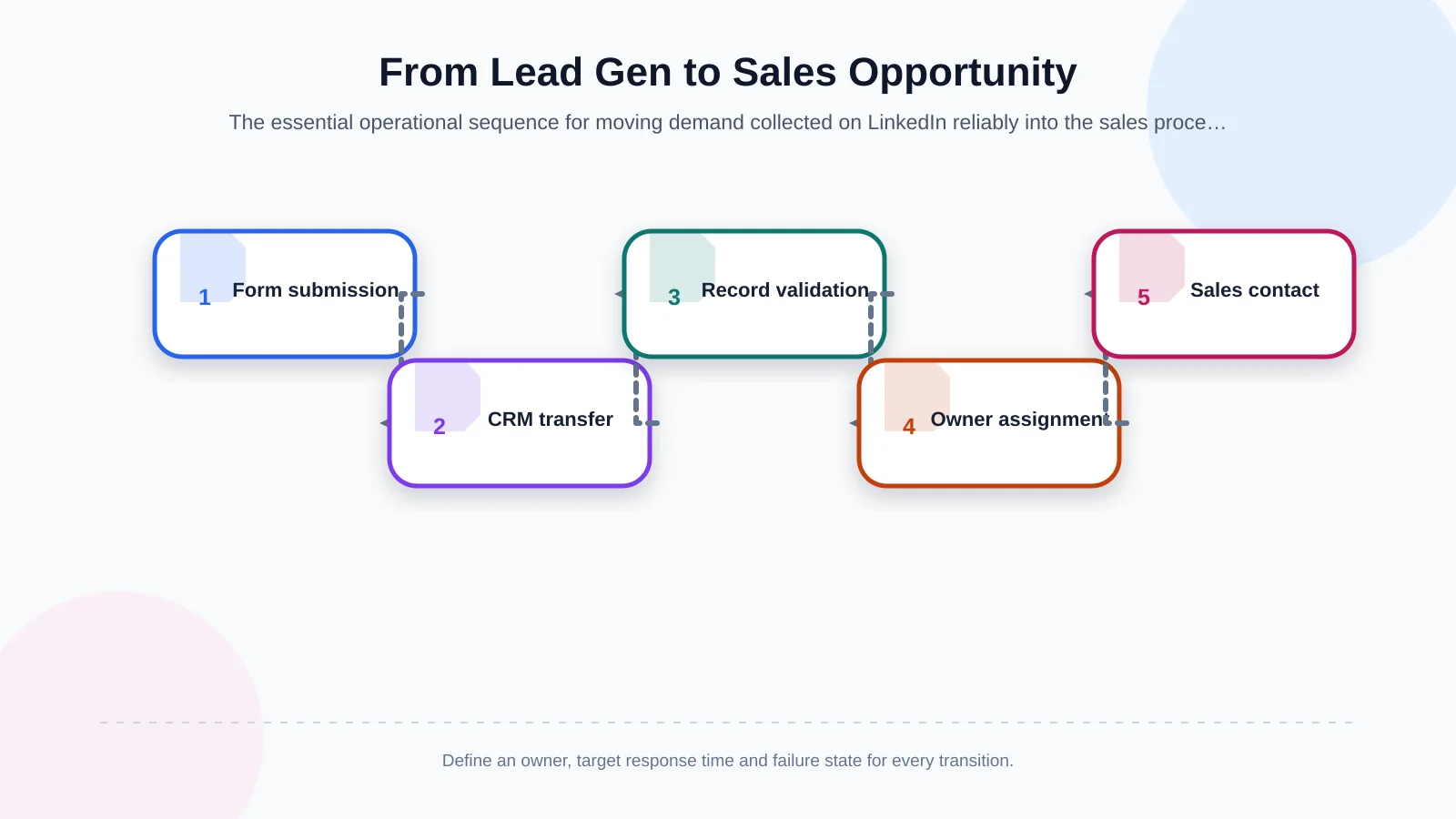
Operational flow from Lead Gen to sales opportunity
Every transition needs an owner, a target response time and a defined failure state. Form submission, CRM acceptance, initial validation, assignment, sales contact and opportunity updates should all feed campaign reporting. Marketing can then learn from outcomes instead of functioning solely as a lead-delivery team.
7. Structure campaigns around buying stages
Awareness, evaluation and sales intent should not be forced into one campaign and one message. An initial campaign can build reach and meaningful engagement among target accounts. A second stage can direct people who consumed content or watched a video towards a deeper resource. At the high-intent stage, offer a demonstration, consultation or solution assessment.
Separate campaign groups based on meaningful intersections between account tiers and role segments. This makes budget and performance comparisons clearer. However, too many small segments can restrict delivery and learning. Create a separate group only when its message, offer or sales treatment genuinely needs to change.
8. Measure account progression, not just form volume
Click-through rate, form-open rate, completion rate and cost per lead are useful operational signals, but they are not final measures of success. ABM reporting should also cover target-account reach, relevant roles reached per account, engaged-account rate, sales-accepted leads, opportunities created, opportunity value, progression time and won revenue.
LinkedIn Insight Tag can support website conversion measurement and audience creation. LinkedIn states that a conversion rule must be verified and associated with the relevant campaigns to report activity. Its Insight Tag conversion-tracking guide explains the setup options. Cookie preferences, personal-data processing and pages that may reveal sensitive information should also be reviewed with legal and information-security teams.
Mapping ABM performance indicators to sales stages
Each metric should answer a practical question. Reach and engagement show whether the message is reaching suitable accounts. CRM acceptance indicates whether the data flow works. Sales acceptance tests lead quality, while opportunity and revenue data reveal commercial contribution. Regular marketing and sales reviews should examine lost-opportunity reasons, weak segments and the content associated with genuine progression.
| Stage | Primary indicator | Question answered | Action |
|---|---|---|---|
| Awareness | Target-account reach | Are we reaching the right companies? | Adjust targeting and budget |
| Engagement | Relevant-role engagement | Does the message resonate with decision-makers? | Improve the content and offer |
| Demand | Sales acceptance rate | Are the collected leads qualified? | Refine the form and scoring |
| Opportunity | Opportunity value and progression | Is the campaign influencing the sales process? | Update the account plan |
| Revenue | Won revenue | Is the investment producing a commercial return? | Move budget to stronger segments |
Common LinkedIn ABM mistakes
- Selecting target accounts solely by company size while ignoring strategic fit and need signals.
- Targeting only senior executives and excluding technical evaluators, users and procurement stakeholders.
- Showing every account tier the same advertisement, content and offer.
- Extending forms with fields that sales neither needs nor uses.
- Managing submissions through manual files without reliable CRM integration.
- Evaluating campaigns only by clicks and cost per lead rather than opportunity quality.
- Failing to return sales outcomes and loss reasons to marketing reporting.
A practical pilot plan
Begin with a manageable set of accounts and classify them by potential value. Identify two or three critical role groups within each account. Prepare a small number of advertising variations that address their main questions, supported by one strong content offer.
Before launch, test the form, confirmation journey, landing page, CRM fields, duplicate checks, assignment rules and notifications. Agree on sales response times and outcome statuses. During the pilot, look beyond inexpensive leads to determine which accounts and roles progress into credible opportunities.
LinkedIn Lead Gen and ABM form a system that connects brand strategy, content, web experience, data and sales operations—not merely media buying. Contact Kumsal Agency to plan your target accounts, decision-maker profiles and the LinkedIn campaign infrastructure extending from form submission to measurable sales follow-up.