


Aydınlatma metni yükleniyor…
GEO, or Generative Engine Optimization, is the practice of making a brand’s information findable, understandable and verifiable for AI-powered search and answer systems—and, where relevant, eligible to be cited as a source. SEO covers the technical, content and authority work that helps search engines crawl, index, understand and surface web pages for relevant searches.
The short answer is: GEO does not replace SEO. A few “AI-ready” edits cannot turn inaccessible, unindexed, vague or unsupported content into a dependable source. SEO establishes the foundation for discovery. GEO extends that foundation by examining how answer systems retrieve, interpret, validate, cite and measure information.
The useful question is therefore not “SEO or GEO?” It is whether a visibility problem comes from technical access, inadequate content, missing evidence, unclear brand signals or weak measurement.
Where did GEO come from?
Traditional search results have usually presented a list of links. Generative systems can gather information from multiple sources and compose a direct answer. A user may see a summary, comparison or recommendation before deciding whether to visit a website. That shift creates a different visibility question: how prominently—and how accurately—is a source represented within the generated answer?
One of the first studies to formalise the term was the GEO: Generative Engine Optimization paper, first submitted in 2023 and later accepted at KDD 2024. It introduced a framework for measuring content visibility in generative engines and tested different content interventions in an experimental setting.
The study has an important limitation for commercial use. Results from a particular benchmark and experimental setup do not guarantee the same outcome for every industry, platform or query. Generative systems evolve quickly, and a content owner does not fully control when or how a source is used. GEO should therefore be treated as a discipline for managing access, content, evidence and measurement—not as a formula that guarantees visibility.
Is SEO still relevant to AI-powered search?
Yes. Google states that AI Overviews and AI Mode are grounded in its core Search ranking and quality systems, so established SEO practices remain relevant. In its guide to optimizing for generative AI features, Google acknowledges terms such as AEO and GEO but treats optimization for its own generative search experiences as part of improving the search experience—and therefore as SEO.
Google’s separate AI features and your website documentation says there are no additional technical requirements or special optimizations needed to appear in AI Overviews or AI Mode. To be eligible as a supporting link, a page must be indexed and eligible to appear in Google Search with a snippet. Meeting those conditions does not guarantee crawling, indexing or serving.
Two practical conclusions follow:
- A dependable foundation for Google’s AI search features cannot be built without addressing material technical SEO problems.
- Technical eligibility alone is not enough; the content must also be useful, original, clear and trustworthy.
This guidance is specific to Google Search. It does not mean every AI platform uses the same crawlers, source selection systems or controls.
What is the difference between SEO and GEO?
SEO and GEO share a substantial foundation. Both benefit from an accessible website, clear information architecture, useful content, credible evidence and consistent brand information. The practical difference lies in the questions each discipline brings into focus.
| Area | Core SEO question | Additional GEO question |
|---|---|---|
| Technical access | Can a search engine crawl and index the page? | Can the relevant AI search crawler or system access the content? |
| Content | Does the page satisfy the search intent? | Does it contain clear, bounded and contextual information an answer system can use responsibly? |
| Evidence | Are claims supported by reliable sources and real experience? | Can the system and reader verify who the source is, what it knows and where the claim stops? |
| Brand | Are the organization and service details consistent across the web? | Is the brand associated with the right topic and service context? |
| Measurement | How are impressions, clicks, rankings, organic sessions and conversions changing? | How are brand mentions, service visibility, citations and competitor visibility changing across priority AI queries? |
Treating GEO as a distinct workstream can make questions visible that a traditional SEO report may miss. A page can be indexed and rank for some searches while the brand is absent from important AI answers, associated with the wrong category or consistently displaced by competing sources. Addressing that situation may require content, evidence, entity clarity and monitoring—not another indexing check.
Why should AI crawler access be audited separately?
Platforms do not necessarily use the same crawler, data source or access policy. The assumption that “Googlebot can access the page, so every AI system can access it” is unreliable.
For example, OpenAI’s official crawler documentation assigns different roles to OAI-SearchBot and GPTBot. OAI-SearchBot is used to surface websites in ChatGPT search features. GPTBot relates to content that may be crawled for developing and training generative AI foundation models. A site owner can manage those preferences separately.
The practical implication is that a crawler policy needs more nuance than “allow AI bots” or “block them all.” Search visibility, model training, user-initiated visits and security policy may require separate decisions.
Allowing a crawler does not guarantee that a page will be crawled, used in an answer or cited. Access is only one early condition in a much longer eligibility and retrieval chain.
Does GEO require special schema or a special file?
Presenting a single technical file as a complete “GEO solution” is misleading. Google says that AI Overviews and AI Mode do not require a new machine-readable file, AI text file or special schema. Structured data can still support established SEO use cases when it accurately matches visible content, but there is no special schema type that guarantees AI visibility.
Similarly, proposals such as llms.txt may be useful for specific systems, documentation sites or experimental workflows. They should not be treated as universally supported. Before adopting a technical recommendation, ask:
- Which platform officially supports it?
- Does it affect crawling, indexing, training use, retrieval or display?
- What evidence will show whether the implementation works?
Without those answers, technical additions can create maintenance work while leaving the underlying access or content problem untouched.
The Kumsal Ajans SEO–GEO Responsibility Matrix
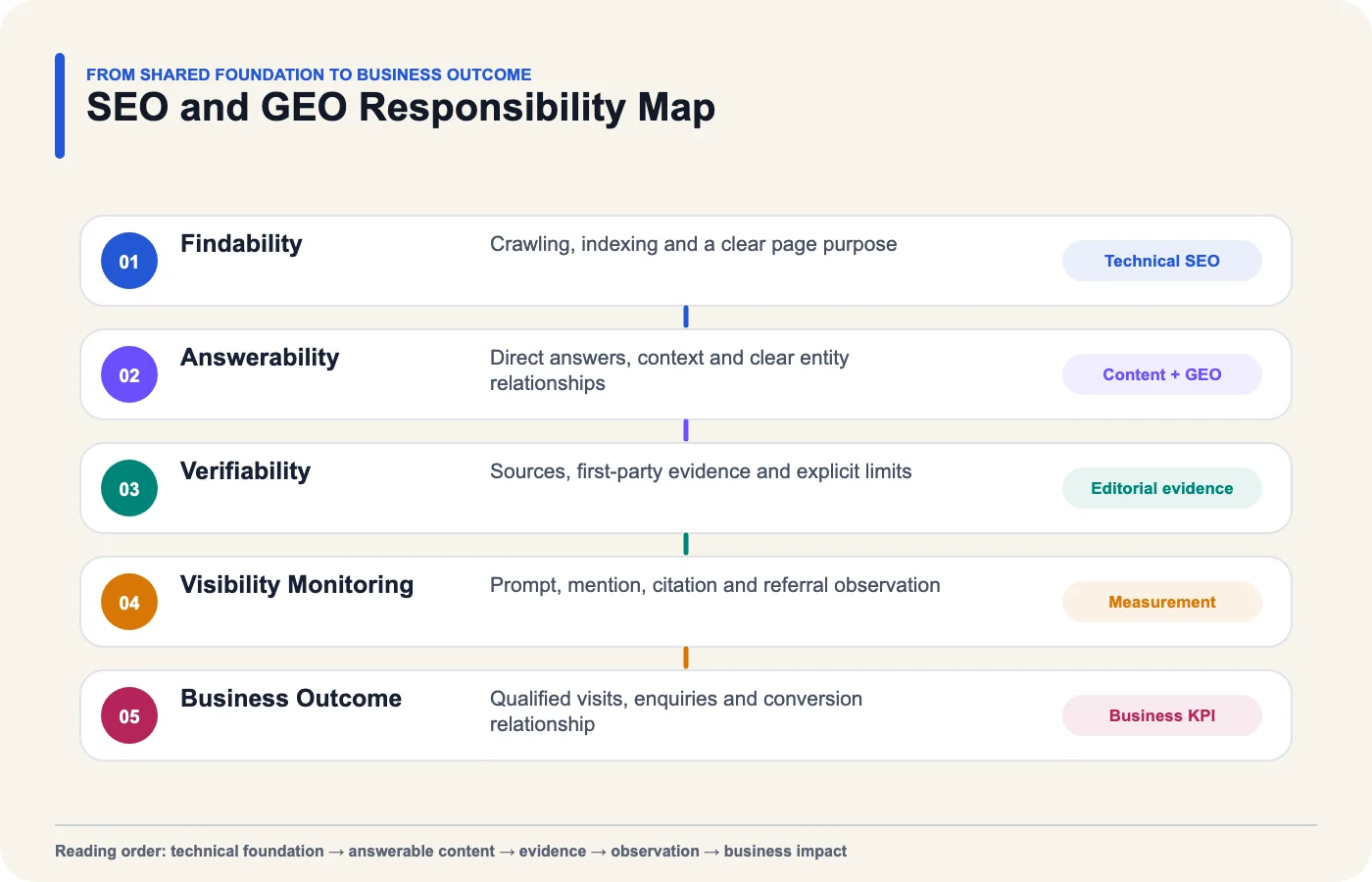
Kumsal Ajans’ confirmed scope can include AI crawler accessibility, technical GEO checks, brand and service visibility, priority query monitoring, citation review, competitor visibility and prompt-based checks where appropriate. The following five-layer matrix turns that scope into a practical sequence of responsibilities.
The matrix is not a ranking formula or a visibility guarantee.
1. Findability
The first layer checks whether the site and its priority pages are technically accessible:
- Do critical pages return the intended HTTP status?
- Are indexing signals consistent?
- Is
robots.txt, the CDN or a security layer blocking a required crawler by mistake? - Can important content be discovered through internal links?
- Is essential information hidden behind an interaction that a crawler may not execute?
This is the shared foundation of SEO and GEO. If a serious access problem exists here, polishing content format first is a prioritisation error.
2. Answerability
The second layer asks whether the page gives a clear and complete answer to the reader’s task:
- Is the main question answered near the beginning?
- Are essential terms defined?
- Are differences made understandable through steps, examples or tables?
- Does each claim include enough context to avoid a misleading interpretation?
- Does the title accurately describe the task the page completes?
The goal is not to split prose into tiny fragments for machines. Google’s generative AI guidance says there is no required “chunking” format for AI search. Structure should first help a human understand and verify the information.
3. Verifiability
The third layer makes the basis for trust visible:
- Are material claims linked to primary sources?
- Is company experience supported by a dated interview, case, process record or owned data?
- Are the author and publisher identities accurate?
- Do time-sensitive claims have a date and review plan?
- Does the page state when a claim does not apply?
Adding many links is not enough. A source must support the specific claim beside it. Company experience should be described only within the limits of the evidence, without invented outcomes, client names or performance figures.
4. Visibility monitoring
The fourth layer expands measurement beyond traditional rankings:
- Is the brand mentioned in the correct context?
- Which services are associated with the brand?
- Is the brand cited, merely mentioned or absent?
- Which competitors appear across priority question groups?
- How do results change when the same controlled prompt set is repeated over time?
Prompt monitoring does not need to have the same scope in every project. Teams should first define commercially and informationally important query groups, then record platform, date and relevant testing conditions. A single screenshot should not be treated as persistent performance evidence.
5. Business outcome
The final layer prevents visibility from becoming an isolated vanity metric:
- Does the visitor reach the correct page from organic or AI-powered search?
- Can they understand the service scope and next step?
- Are qualified enquiries, forms, calls or other conversions measured?
- Are technical and content changes evaluated alongside Search Console, Analytics and relevant GEO observations?
A brand mention in an AI answer is not, by itself, a commercial result. Organic traffic growth is also incomplete if it does not contribute to the intended user or business outcome.
In what order should SEO and GEO work begin?
There is no universal sequence for every website, but the following order usually limits wasted effort.
Identify material technical barriers first
If priority pages cannot be crawled, indexed or accessed through the relevant delivery layer, resolve those barriers first. Review search engine and AI search crawler policies separately.
Map content and evidence gaps
Identify pages that fail to answer core customer questions, describe the service or support their claims. Instead of creating a new page for every query variation, consolidate pages that perform the same user task and strengthen their evidence.
Choose priority query groups
Do not build a tracking system around hundreds of arbitrary prompts. Group brand, service, problem, comparison and decision queries according to business value. Record the platform, date and conditions of each check.
Capture a measurement baseline
Establish starting values for organic traffic, impressions, clicks, conversions, technical SEO status and GEO visibility. A later claim of “improvement” is not dependable if the measurement method changes without being documented.
Apply changes in controlled groups
Changing every technical, content and brand element at once makes interpretation difficult. Smaller work packages, prioritised by likely impact, evidence and implementation cost, support better decisions.
Common GEO mistakes to avoid
Abandoning SEO and measuring prompts only
Prompt tracking can observe visibility. It cannot repair crawler access, unclear services or weak evidence. Measurement should not replace implementation.
Publishing a separate page for every long query
Near-duplicate pages may add little user value and compete with one another. Google’s current guidance also warns against scaled pages created mainly to target the many query variations generated around AI search.
Treating crawler permission as an outcome
Permission is a technical condition. It does not guarantee crawling, indexing, citation, ranking or conversion.
Mistaking source volume for source quality
Many links do not automatically make a page reliable. Primary relevance, recency and direct support for the nearby claim matter more.
Promising guaranteed rankings or AI visibility
Search and generative answer systems remain outside the content owner’s control. Kumsal Ajans does not guarantee rankings or specific outcomes; its work aims to establish measurable improvement and sustainable growth without presenting either as a certainty.
A practical SEO–GEO starting checklist
Answer each question with “yes,” “no” or “no evidence”:
- Can search engines and the targeted AI search crawlers access the priority pages?
- Does every priority page complete one clear user task?
- Is the main question answered near the beginning?
- Are company, service and expertise claims backed by dated first-party evidence?
- Are material external claims linked to primary sources?
- Are brand and service details consistent on the site and across credible external sources?
- Are priority AI query groups, citations and competitor visibility monitored with dates?
- Are Search Console, Analytics, conversion and GEO observations interpreted together?
- Was a baseline recorded before changes were made?
- Is every technical or content intervention presented without a result guarantee?
Any “no” or “no evidence” response identifies an area to investigate before commissioning more pages. GEO then becomes a response to real access and information problems, not a separate content quota.
GEO extends a sound SEO foundation
GEO brings AI-powered access, answerability, verifiability, brand visibility and citation questions into sharper focus. SEO continues to provide the essential foundation of technical discovery, search intent, content quality and site authority.
A sound strategy manages them as related control layers. Fix the technical foundation, answer the user’s task, make claims verifiable, configure platform access deliberately and measure visibility alongside business outcomes.
For a broader introduction to the shared foundation, see our guide to effective SEO techniques. When assigning technical ownership, our comparison of website maintenance and SEO responsibilities helps separate routine upkeep from ongoing visibility work.
If you do not yet know which layer is limiting your website, the first step is not to order more content. Start with a baseline review that examines technical access, existing content, brand signals and measurement together.