


Aydınlatma metni yükleniyor…
B2B sample-request management is more than shipping a small parcel. The right product variant must reach a qualified organisation under controlled stock and cost rules, while the evaluation remains connected to a CRM opportunity.
This guide provides a system scope for sample-led B2B sales in textiles, chemicals, construction materials, packaging and ingredients. It promises no fixed conversion result. The aim is to make the gaps between request, delivery, evaluation and commercial follow-up measurable.
Why a sample request differs from a normal order
A sample may have low monetary value and high decision value. Teams must consider whether the requester has a real project, whether the colour or technical grade is correct, whether export or hazardous-material constraints apply, whether sample stock exists and who owns follow-up.
Infor’s PLM documentation treats a sample request as a record related to a product and supplier and creates a distinct sample page after submission. That supports modelling the sample as a business object with a lifecycle, not merely a message. See the Infor sample-request documentation.
The request–evidence–opportunity chain
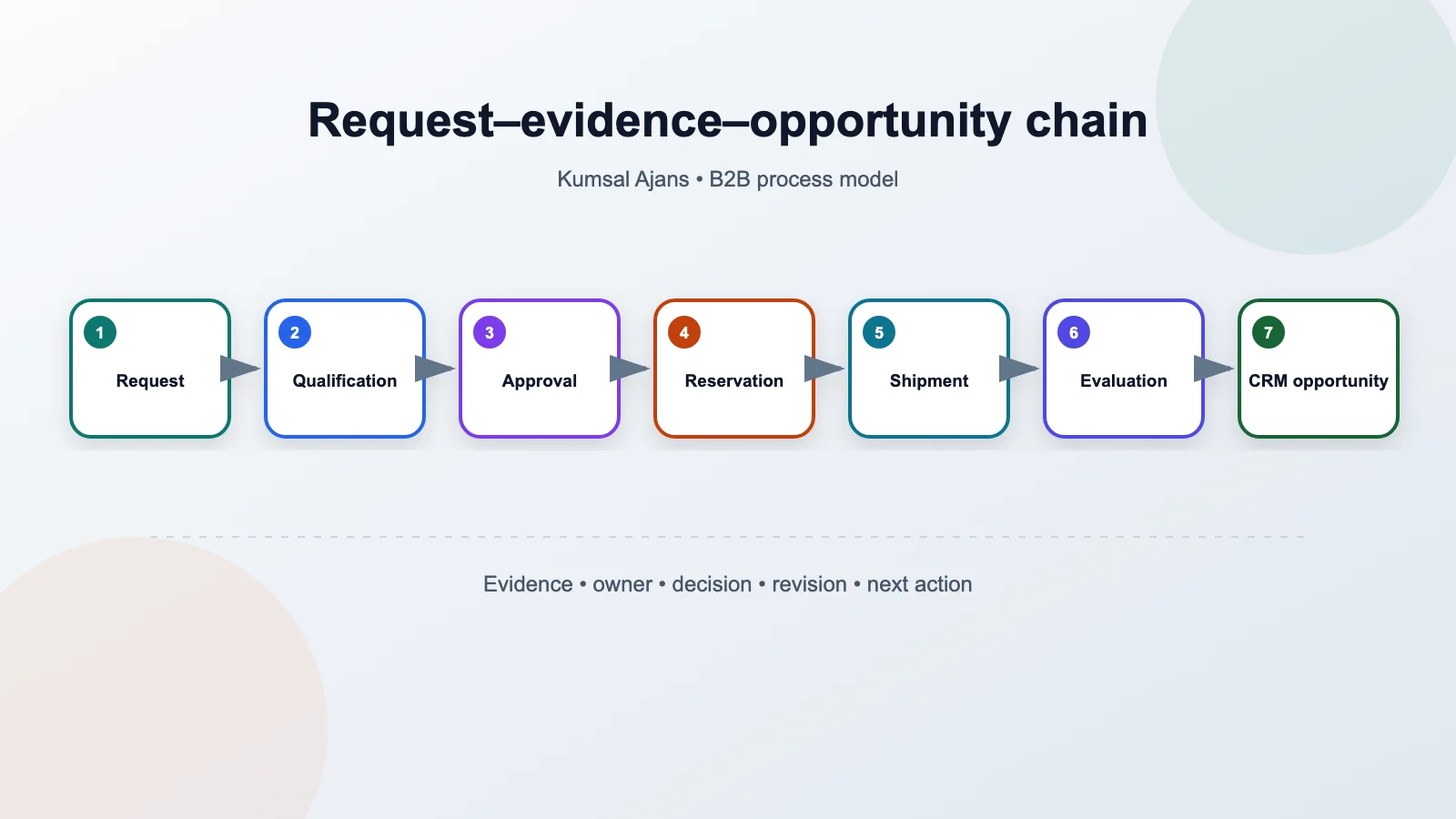
- Request: record organisation, project, product, variant, quantity and purpose.
- Qualification: review territory, industry, technical need and repetition.
- Approval: decide product charge, freight, stock and owner.
- Reservation: allocate sample stock with lot or serial context.
- Shipment: track package, address, carrier and delivery event.
- Evaluation: collect suitability, alternatives and the next action.
- Opportunity: create a CRM link, quotation or controlled closure reason.
Collect commercial context with the request
Name, phone and product code are rarely enough. Organisation, project type, use case, estimated demand range, decision date, technical property, destination country and current alternative can determine follow-up priority. Do not make every field mandatory; reveal decision-relevant questions by product group.
A requester should be able to add several products to one project. The system may fulfil them in one package or separate shipments. A repeat request should not trigger an automatic rejection; expose previous delivery and evaluation history to the decision owner.
Separate the sample catalogue from the sales catalogue
Not every sellable SKU is available as a sample. A sample code should relate to the commercial product, variant, size, packaging, language, safety document and target market. A swatch may represent a commercial roll, a test pack may replace a full container and a certificate pack may replace a physical item.
When a product changes, preserve which period and revision the old sample represented. Otherwise a later quotation can be incorrectly assumed to match the tested material.
Make approval rules explainable
Corporate email, customer status, project information, country, product cost, inventory, earlier requests and account-owner relationship can feed a decision table. Outcomes may include free approval, paid sample, freight collect, more information, human review or rejection.
Retain the rule version, decision reason and owner of any manual change. Prefer understandable reasons such as missing project information or territory restriction to an opaque low-score message.
Make inventory and cost visible
Sample stock may use a distinct warehouse or inventory type. Approval reserves stock, packing consumes it, and cancellation or failed delivery follows an explicit return rule. If lot, serial, colour batch or expiry affects the decision, link it to the dispatched sample.
Record product, packaging, handling, freight and customs costs separately. Connecting them to an account owner, campaign, territory or project supports budgeting; it does not automatically prove commercial success.
Make shipment as traceable as an order
Record address validation, recipient, package contents, carrier, tracking identity, dispatch and delivery. If the sample requires a technical data sheet or safety document, link the correct revision to both the physical package and digital record.
GS1’s traceability approach relates traceable objects to critical events and key data. A sample programme does not have to implement GS1, but the questions what, when, where and why form a useful event model. The GS1 Global Traceability Standard defines these concepts.
Connect evaluation to the CRM opportunity
Delivery is the beginning of follow-up, not the end of the process. After a product-appropriate interval, ask about technical suitability, colour or performance, decision blockers, alternative needs, quotation timing and expected next step. Create a contextual task for the account owner instead of sending endless generic reminders.
Store the request identifier on CRM organisation, contact and opportunity records. When a quotation is created, users should see which sample revision was tested. Controlled reasons for lost or postponed opportunities can improve the programme more than shipment count alone.
Acceptance tests and measurement
- Several variants for one project requested in one package;
- Inventory runs out or the sample revision changes after approval;
- A carrier submits the same event twice;
- An undeliverable parcel returns to quarantine stock;
- A user attempts to access another organisation’s request;
- The quotation variant does not match the sample that was evaluated.
Observe request completion, decision time, stock-to-dispatch time, delivery success, evaluation response, quotation links, closure reasons and actual cost per request. Treat these as baseline observations before setting targets.
Conclusion
Begin implementation with a narrow pilot
Start with one frequently requested product family, a limited delivery territory and known sample inventory. Review successful, incomplete, duplicate, undeliverable and quotation-linked historical requests together. Do not expand automation until the data model and decision table cover real exceptions.
Next, complete the sample catalogue, qualification questions, decision queue, inventory reservation and package record. If carrier integration is not ready, begin with controlled operational events while still retaining source and processing time.
Then connect delivery, the evaluation task and CRM. Do not create a second workflow that competes with the existing opportunity and quotation process; carry sample evidence into the process sales teams already use.
Finally, add product groups, supplier approval, fee or credit policies and country rules as separate revisions. For every expansion, decide which rule applies to already open requests.
What should the proposal deliver?
- Sample product, request, project, approval, stock, package, event and evaluation data models;
- Product-specific conditional form and qualification decision table;
- ERP/WMS inventory movements, cost centre and compensation rules;
- Carrier, address and delivery-event integration contract;
- CRM organisation, contact, opportunity, task and quotation field mapping;
- Role matrix, personal-data boundary, retention and audit trail;
- Pilot scenarios, baseline measures, operations training and technical handover.
Free samples, sample charges and later credits should never be assumed as universal rules. Accountable people should define policy by product, market, customer group and accounting requirement; the system applies only an approved revision.
Sample management closes the gap between a request form and a shipping label. It keeps product, stock, cost, delivery, evaluation and commercial opportunity in one evidence chain. To scope your own B2B sample workflow, explore Kumsal Agency’s ecommerce services and bring the product catalogue, approval rules, sample inventory and CRM stages to discovery.