


Aydınlatma metni yükleniyor…
Ecommerce–ERP integration is not simply a connector between two systems. It is an operating design for where product, inventory, price, customer, order, payment, fulfilment, cancellation and return data originates, and how it moves, fails and reconciles.
The first question is not “does an API exist?” but “which system owns this field?” Compare proposals by data fields, business rules, volume, latency, failures, retries, reconciliation, testing and ownership—not endpoint count alone.
What Does Ecommerce–ERP Integration Cover?
The commerce platform presents products, prices, promotions, basket, payment and account journeys. ERP may own part of product, purchasing, warehouse, accounting, receivables, invoicing or fulfilment. PIM, WMS, CRM, payment, carrier and marketplace systems can also participate.
It is therefore unsafe to assume that ERP owns every field or commerce is always the front system. Decide by data object. Use the ERP software guide for the broader role of ERP.
The Kumsal System-of-Record and Reconciliation Matrix
This original matrix records ten decisions for each data object: system of record, write authority, target, direction, trigger/frequency, transformation, validation, retry behaviour, reconciliation and operational owner. It is not a product prescription; it reveals whether competing proposals cover the same responsibilities.
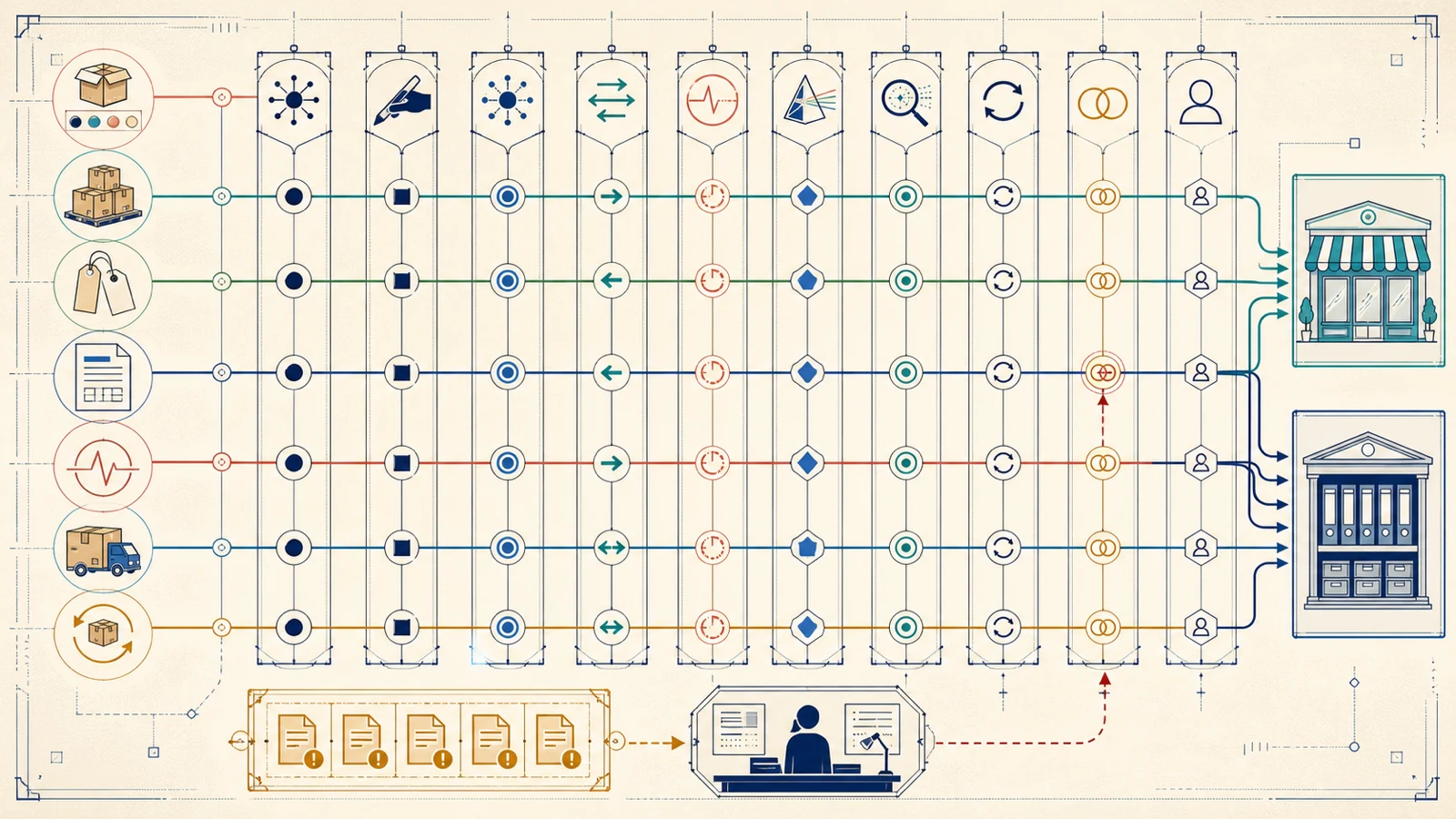
| Data | Example ownership decision | Reconciliation question |
|---|---|---|
| Product | ERP, PIM or commerce | Which codes, variants or channels are unmatched? |
| Inventory | ERP/WMS, with channel reservations | Why does available-to-sell differ from channel totals? |
| Price | ERP, pricing engine or channel | Do effective time, tax, currency and promotion agree? |
| Order | Created in commerce, processed in ERP | Do unique orders and lines match? |
| Payment | Provider outcome, ERP financial record | Do amount, state, refund and ledger agree? |
| Fulfilment | ERP/WMS/carrier | Did partial packages and tracking return correctly? |
| Cancel/return | Requested in channel, decided in operations | Are product, inventory, payment and documents closed? |
How Should Product and Variant Data Be Mapped?
Product code, variant, barcode, unit, pack, category, brand, description, image and channel status may not share one source. ERP can own commercial and inventory codes, PIM rich content, and commerce SEO or merchandising fields. Define where every field is edited.
The mapping table includes internal and channel codes, variant relationships, unit conversions and unpublish behaviour. Instead of silently dropping an unknown item, move it to a quarantine/error queue with a correction owner and authorized reprocessing method.
What Does “Inventory” Mean in the Integration?
Physical on-hand, reserved, safety stock, damaged/quarantine stock, inbound stock and channel allocation are different quantities. Define the business rule for available-to-sell. It might use on-hand minus reservations and a buffer, but no formula is universal.
For multiple warehouses, decide service regions, partial fulfilment, pickup and preorder behaviour. Select update frequency according to sales velocity and overselling risk. Even near-real-time flows can be delayed, so expose last successful update, queue age and reconciliation status.
Price, Tax and Promotion Flow
List price, discount, customer group, coupon, channel fee, currency, tax and effective dates are separate fields. ERP might publish a base price while commerce applies promotions, or a central pricing engine might serve all channels. Decide when basket price becomes fixed.
Never recalculate a historical order with the current price. Transfer the order-time unit price, discount, tax and totals, then test ERP acceptance, rejection and rounding. Whether a mismatch blocks the order or creates a review task is a business decision.
How Should the Order Flow Work?
- Commerce creates the order with a unique identity.
- The payment method or provider outcome is linked to the appropriate state.
- Customer, address, item, quantity, price, tax, discount and delivery fields are validated.
- The order is sent to ERP; technical delivery and business acceptance are recorded separately.
- ERP order number and accept/reject result return to the channel.
- Allocation, preparation, partial fulfilment, invoice and tracking states update.
- Cancellation or return closes through inventory and financial movements.
An HTTP 200 response or an empty queue does not prove ERP accepted the order under its business rules. Technical success, business acceptance and financial outcome need separate states. Define full rejection, partial acceptance and human review.
Failures, Retries and Duplicate Records
After a network timeout, the sender may not know whether the target completed the action. Blind retries can create two orders or charges. The AWS Builders’ Library guide to idempotent APIs describes client request identifiers and recognition of the same intent as approaches for safer retries.
Idempotency must be implemented by the receiving behaviour; adding a random field is not sufficient. Stripe’s idempotent-request documentation is a concrete vendor example of repeated requests using the same key, not a rule that can be assumed for every ERP or payment API.
Separate transient technical failures, permanent validation errors, business-rule rejection, authorization failure, rate limits and unknown outcomes. Define retry count and interval, status checks, alarms, human queues, correction and authorized replay for every class.
Why Is Reconciliation a Separate Workflow?
Successful event delivery does not guarantee permanent data equality. Missed events, manual ERP edits, mapping defects or channel outages can create differences. Periodic reconciliation compares order counts and values, lines, inventory, prices, payments, returns and fulfilment.
A reconciliation process needs more than a difference report. Record the class, business impact, source record, correction direction, authorized owner and retest. Automatic changes to financial or regulated records require the organisation’s controls and expert approval.
Synchronous, Event-Driven or Batch?
| Method | Potential use | Watch for |
|---|---|---|
| Synchronous API | Immediate validation or user response | Timeouts, dependent outages and latency |
| Events/queues | Durable asynchronous order and status flow | Ordering, duplicates, delay and observability |
| Batch | Large catalogue, periodic price or reconciliation | Freshness window, partial files and replay |
| Hybrid | Immediate critical flow plus batch verification | Consistency and common ownership across paths |
Choose per business impact, volume, latency tolerance and target-system capacity instead of applying one method to all data.
Logging, Monitoring and Alerts
Trace correlation/request identity, source, target, event time, operation, outcome, failure class, attempt count and a safe state summary. Do not log sensitive identity, payment or authentication data without purpose.
The OWASP Logging Cheat Sheet covers security event recording, protection and monitoring of logs, and handling of sensitive data. Separate business observability from security logging by purpose, access and retention. Referencing the guidance is not evidence of security or compliance.
Which Scenarios Belong in Acceptance Testing?
- New and updated products, variants, units and mappings
- Zero, quarantine, reserved and multi-warehouse inventory
- Price start/end, tax, currency and rounding
- Accepted, rejected, duplicate and timed-out orders
- Partial acceptance, partial fulfilment and multiple packages
- Successful/failed payment, delayed callback and refund
- Inventory and finance movement before/after cancellation
- API limits, authorization failure and system outage
- Queue backlog, replay and reconciliation variance
- Unauthorized access, log privacy and operational alerting
Use the web software integration planning guide for the general fields, failure and ownership template.
Which Proposal Items Should Remain Separate?
- System/data inventory and process discovery
- Product, variant and channel mapping and cleansing
- Fields, direction, volume and frequency per flow
- API, file, queue or middleware development
- Failure classes, retries, idempotency and human queues
- Reconciliation reports and correction authority
- Test environments, sample data and end-to-end acceptance
- Monitoring, alerts, logs, dashboards and incident ownership
- Launch, rollback, training and documentation
- Licensing, transactions, infrastructure, maintenance and new work
To assess integration scope with your commerce platform, contact Kumsal Agency’s ecommerce team.
Conclusion
A reliable ecommerce–ERP integration does more than move records. It governs who owns each field, when it is effective, how failure behaves and how correctness is proved. The System-of-Record and Reconciliation Matrix puts inventory, price, order, payment, fulfilment and returns into one operational record.