


Aydınlatma metni yükleniyor…
E-commerce advertising is not simply about showing products to more people. Media spend will not translate into sustainable sales if visitors land on the wrong product, encounter a slow page or face an unexpected problem during checkout. An e-commerce advertising agency should therefore treat Google Shopping and social media advertising as part of a wider commercial system that also includes product data, campaign creative, user experience, technical infrastructure and measurement.
Google Shopping ads often reach people who are actively searching for a specific product and comparing prices or alternatives. Social platforms such as Instagram and Facebook can introduce products, build brand recognition and re-engage people who have already interacted with the store. When both channels use the same reliable catalogue, consistent messaging and shared commercial objectives, they can create a more sustainable path to qualified traffic and conversions.
What does an e-commerce advertising agency do?
An e-commerce advertising agency does more than launch campaigns and adjust daily budgets. A complete engagement involves defining business goals, preparing the product catalogue, establishing an appropriate campaign structure, developing creative assets, improving the store experience and assessing performance against actual sales data.
Clicks and platform-reported conversions matter, but so do stock levels, product margins, average order value, returns and payment success. The agency and brand team should decide together which product groups deserve investment and which orders generate meaningful profit. This prevents media metrics from becoming disconnected from the commercial reality of the store.
Questions to answer before campaigns begin
- Is the priority customer acquisition, repeat purchases or growth in a particular product category?
- How do gross margins, inventory levels and sales periods vary between products?
- Which locations, devices and customer segments are commercially more valuable?
- Where do users leave the journey between the product page and payment confirmation?
- Do advertising platforms, analytics tools and actual order records report consistent results?
These questions help translate a broad goal such as “increase sales” into practical rules for budgeting, product selection, creative production and reporting.
How do Google Shopping ads generate sales?
Google Shopping ads can display a product image, title, price and store name directly in search results. Users can understand the basic offer before visiting the site, which makes the format useful for capturing strong purchase intent. However, campaign quality depends heavily on the accuracy and completeness of the product information submitted to Merchant Center.
Google’s Merchant Center product data specification explains fields including identifiers, titles, descriptions, links, images, prices, availability, brands and product identifiers. Missing data or information that conflicts with the landing page can affect product visibility and customer confidence. A feed should therefore be managed as an operational data source that remains synchronised with the store, not as a file uploaded once and forgotten.
Product feed quality control
Product titles should communicate the attributes customers actually search for without becoming unreadable. Images need to show the item clearly, while price, discount and availability must match the landing page. Colour and size variants should lead to the correct product option, and unavailable items should not continue consuming budget. Where valid GTINs or MPNs exist, they should be supplied in the appropriate fields.
Feed problems do not always originate in the advertising account. Delays between an ERP system, inventory software, the commerce platform and Merchant Center can cause a user to find a different price or an out-of-stock product after clicking an ad. The agency should work with technical and operations teams to define update frequency, error alerts and rules for excluding unsuitable products.
For stores managing large or complex catalogues, a structured product model becomes especially important. The principles described in Kumsal Agency’s guide to product information management can help teams clarify how product attributes, quality controls and channel distribution should be governed.
Campaign structure should reflect product economics
Placing every item under the same budget and target may simplify account management, but it can conceal important commercial differences. High-margin products, bestsellers, new collections, end-of-season stock and overstocked lines may require different priorities. Category, margin, inventory, price range and sales history can all inform campaign segmentation.
Return on ad spend should not be the only measure of success. Strong advertising revenue may contribute little profit when margins are low or return and fulfilment costs are high. Media spend should therefore be assessed alongside net revenue and, where possible, contribution margin. Product identifiers must also match across the catalogue, analytics implementation and order system so that decisions can be made at item or product-group level.
How do social media ads support product discovery?
People browsing social media are not always actively searching for a product. Creative must make a need visible, demonstrate where the product fits into everyday life and earn attention quickly. Product photography, short-form video, motion design, customer experiences, demonstrations and collection stories can be tested for different levels of awareness.
Catalogue-based campaigns are useful when a brand has many products. Meta Blueprint’s training on Advantage+ catalogue ads describes applications including broader reach, retargeting, cross-selling and upselling. Automation still requires an up-to-date catalogue, accurate event data and enough creative variety to work effectively.
Discovery, consideration and retargeting
Prospecting campaigns should introduce the product’s benefit and the brand’s distinctive value. Ads for people who viewed a product or added it to their basket can address consideration-stage questions such as delivery time, returns, materials, use or differences from other options. Showing complementary products to existing customers requires a separate strategy from acquiring first-time buyers.
Retargeting should not mean repeatedly showing everyone the same advertisement. Someone who viewed a product may have different concerns from someone who left during payment. Audience windows, exclusions, product sets and messages should reflect each stage of the journey. Frequency also needs regular review so that visibility does not turn into waste or fatigue.
From advertising click to sale: the store experience
A successful advertisement attracts the right visitor; the e-commerce experience completes the sale. Slow mobile pages, confusing variant selection, unclear delivery information and long checkout forms can undermine an otherwise effective campaign. Store design and development should therefore be treated as a direct continuation of advertising optimisation.
Trust and clarity on the product page
The product, price and promotional conditions presented in the ad should appear consistently on the landing page. Images should include useful detail and context. Descriptions should answer purchase questions about dimensions, materials, compatibility, care and use. Shipping costs, estimated delivery dates, return conditions and secure payment options should be visible before the final step.
Performance is especially important for mobile traffic from social platforms. Oversized media, unnecessary scripts and unstable interface elements can delay interaction. Performance checks should cover the actual product and category pages used in campaigns, not only the homepage.
Reducing friction in the basket and checkout
Once a customer reaches the basket, the total cost should be transparent, discounts should be easy to understand and unnecessary fields should be removed. Guest checkout, appropriate payment options, address validation and clear error messages can support completion. If payment fails, customers should be able to try again without losing their basket, while technical failure records should reach the operations team.
| Area | Google Shopping | Social Media | Shared Control |
|---|---|---|---|
| Primary role | Capture active demand | Create product discovery | Generate profitable sales |
| Main input | Product feed and pricing | Creative and messaging | Up-to-date catalogue |
| Targeting | Search and product interest | Audience and behavioural signals | Customer-journey stage |
| Optimisation | Product groups and bidding | Creative and audiences | Purchase data |
| Critical experience | Relevant product page | Mobile landing experience | Fast checkout flow |
Optimisation is incomplete without reliable measurement
Platform-reported sales should not automatically be treated as confirmed business revenue. Advertising systems use different attribution methods, so the same order may be credited to more than one channel. Campaign reports, web analytics and e-commerce order records must be read together.
Google Analytics’ guide to e-commerce events explains how behaviours such as viewing products, adding items to a basket and purchasing can be measured separately. In a dependable implementation, events such as view_item, add_to_cart, begin_checkout and purchase carry the correct product identifiers, currency, value and transaction ID. Test orders should be used to validate the data layer, tags and reports.
When Meta Pixel, server-side event transmission or other advertising integrations are implemented, teams must account for user consent, cookie preferences and applicable data-protection obligations. If an event is sent through both the browser and server, deduplication must prevent it from being counted twice. Automated bidding should not be assumed to have trustworthy conversion signals until the implementation has been technically verified.
How should shared performance indicators be defined?
Impressions and clicks describe campaign reach, but they do not explain the complete business result. Teams can monitor click-through rate, cost per click, product views, additions to basket, checkout starts, conversion rate and acquisition cost by channel, campaign and product group. Revenue, average order value, new-customer share, return rate and contribution margin should be included in commercial reporting.
Reporting should make the next decision easier rather than merely describe the past. If a product group receives many clicks but produces few sales, the team should examine price, stock variants and the product page as well as targeting. If basket additions are strong but completed payments are weak, increasing bids is unlikely to resolve the problem; the checkout flow requires investigation.
How should the agency relationship be organised?
The process begins by documenting targets, profitability thresholds, priority products and technical constraints. Accounts, catalogues, analytics, product pages and checkout are then audited. The resulting roadmap should prioritise media activity together with the technical and design improvements needed to support it.
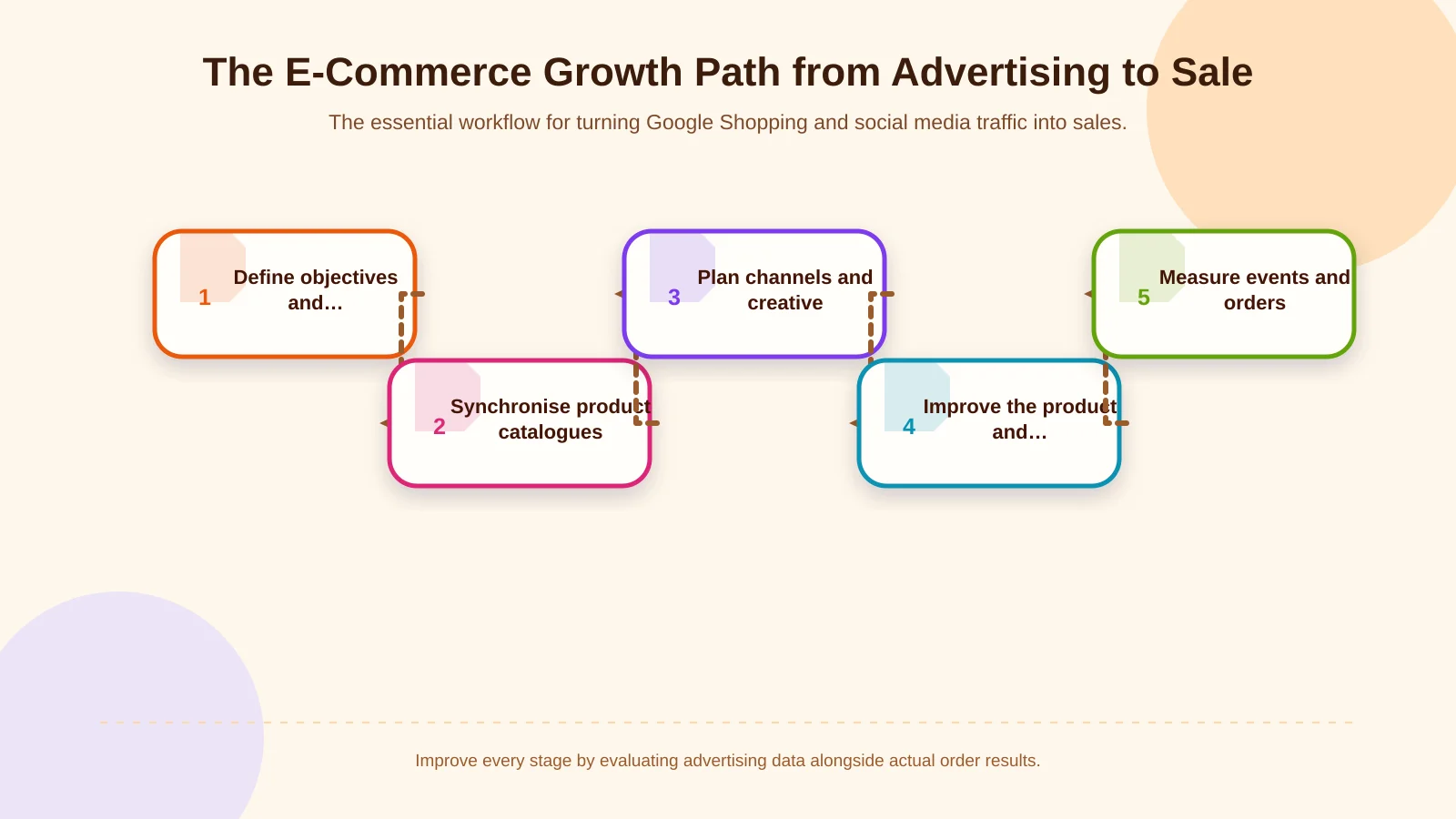
- Clarify objectives, budgets, product groups and success criteria.
- Synchronise Google and social catalogues with current store data.
- Create messages and creative sets for different customer stages.
- Test product pages, mobile performance, basket and checkout.
- Validate analytics events and order values through test transactions.
- Interpret results alongside product economics and run structured experiments.
Changing too many variables at once makes it difficult to understand what caused the result. Product groups, creative approaches, bidding methods and landing pages should be tested in controlled ways. Evaluation periods should reflect the product price, purchase cycle and available data volume; constantly changing direction in response to early fluctuations can prevent campaigns from learning.
Kumsal Agency’s integrated approach to e-commerce
Kumsal Agency does not treat e-commerce as advertising delivery alone. The agency brings the brand’s visual world, product discovery, campaign communication, user experience, checkout, technical infrastructure and measurement requirements into one connected sales system. Digital brand consulting, campaign visuals, social content and motion design can be planned alongside e-commerce design, custom software and the integrations required by the business.
This approach is intended to reduce gaps between advertising, commerce, design and development teams. A product-data error can be traced to the relevant technical process, weak page performance can become an experience-design priority, and poor creative results can inform the communication system. The objective is not merely more traffic, but a clearer, measurable and manageable route to sale.
The potential of Google Shopping and social media advertising becomes much stronger when accurate product data, effective creative, a fast store experience and dependable measurement work together. To plan your advertising channels and e-commerce infrastructure around shared sales goals, contact Kumsal Agency.