


Aydınlatma metni yükleniyor…
For businesses selling across multiple marketplaces, integration is a much broader software challenge than sending product data through an API. ERP, e-commerce, warehouse, payment, shipping and marketplace systems operate at different speeds and follow different data models and transaction rules. During a campaign launch, bulk price update or sudden order surge, those differences can lead to overselling, outdated prices, duplicate orders and inconsistencies that operations teams cannot trace to their source.
A resilient marketplace integration architecture avoids connecting systems directly without safeguards. Instead, it introduces a manageable buffer: a queue and processing layer between the source and destination. The buffer stores incoming events reliably, processes them at a rate the destination can support, retries temporary failures and moves persistent problems into a review queue. Traffic spikes therefore do not become data loss, and the status, cause and outcome of every transaction remain visible.
What Does Buffer Management Solve in Marketplace Integration?
An ERP may generate thousands of inventory changes per second while a marketplace API accepts a much lower request rate. Likewise, hundreds of marketplace orders may arrive while the ERP order service is undergoing maintenance. In a synchronous connection, the sender waits for a response. If the request times out, it may be unclear whether the destination completed the transaction. Sending the same request again can then create a second record.
A queue-based load-levelling approach separates the rate of production from the rate of consumption. Microsoft’s Queue-Based Load Leveling pattern recommends holding variable workloads in a queue so the destination service can process them at a manageable pace. In a marketplace environment, this prevents an order spike from overwhelming the ERP or a bulk inventory update from exhausting a marketplace API’s capacity.
A buffer is more than a waiting area. Each message should carry context such as event type, source system, company or store code, product or order key, creation time, version number, attempt count and correlation ID. Without this information, a team may see that a queue is growing but cannot identify which business rule, store or product group is causing the delay.
Safety Stock and Reservations in Inventory Synchronisation
The central inventory question is not “How many units are recorded in the ERP?” but “How many units can this channel sell safely?” Available-to-sell inventory may be calculated by subtracting open reservations, items under quality control, damaged quantities, warehouse or store safety stock and allocations for other channels from physical stock. The formula will vary by business and may need configuration by warehouse, product group, campaign and marketplace.
For example, an ERP may show 20 units while four are reserved for orders being prepared and three are held as safety stock. Publishing all remaining 13 units on every marketplace would still create an overselling risk when simultaneous purchases occur. A central reservation service or channel-specific quotas can control how that available quantity is distributed.
Inventory events for the same product and warehouse key should be processed in sequence. If a “stock is now 6” event is delivered before the earlier “stock is now 8” event because of network latency, the older event could overwrite the current value. Messages should therefore include a monotonically increasing version, ERP movement number or reliable event timestamp, and consumers should reject older versions.
For fast-moving products, a short coalescing window can reduce API traffic by sending only the latest value rather than every intermediate movement. Critical events such as order reservations and emergency stock-zero updates should not be delayed. Accurate product, barcode and listing mappings are equally important. A structured PIM and multichannel product information strategy helps ensure each inventory message reaches the correct marketplace listing.
Rule Order and Effective Dates in Price Synchronisation
A price should not be transferred as a single numeric field. The architecture must evaluate the list price, currency, tax treatment, channel commission, campaign discount, minimum margin, rounding rule and effective start and end times together. It must also define the authoritative source and the order in which rules apply when they conflict.
A dependable pricing flow receives the ERP base price, applies channel rules, validates minimum and maximum limits, checks effective dates and writes the resulting price to a versioned queue. The rules used for that calculation should be stored with the outcome. Operations teams can then see not only that a price of 849 was sent, but also which base price, discount and rounding steps produced it.
Bulk price changes need their own priority and capacity policy. If a campaign must begin at a specific time, generating thousands of messages at the last minute introduces unnecessary risk. Updates can be prepared and validated in advance, then released in a controlled manner when they become effective. If a critical pricing error is detected, teams should be able to pause the affected product or store flow and move an approved correction ahead of obsolete pending messages.
Moving Orders Safely from the Marketplace to the ERP
The objective of an order flow is not merely to receive a marketplace notification. The system must prove that the ERP accepted the order exactly once and that fulfilment can continue. A webhook may be missed, the same notification may arrive repeatedly, or a polling service may return an order already received. Webhooks and scheduled reconciliation can therefore work together, with records from both sources merged under the same order identity.
A secure pipeline first stores the raw order in an immutable intake record. It validates the signature and store authorisation, maps marketplace item codes to internal products, and checks address, tax, payment and delivery fields. The order is then submitted to the ERP, the ERP acceptance number is recorded and the resulting status is returned to the marketplace. The message should not be marked complete until successful acceptance has been verified.
A retry caused by a network failure must not create a second order. An idempotency key can be generated from the marketplace, store and external order number. The consumer uses that key to find a completed transaction and return its existing result. Stripe’s approach to idempotent requests illustrates the same principle: a unique key makes retries safe by preventing the same operation from being applied twice.
How Should the End-to-End Synchronisation Flow Be Built?
Inventory, pricing and order pipelines can share a common control framework, but each data type should have separate queues, priorities and failure policies. Orders do not have the same delay tolerance as a bulk catalogue-price job. A single large queue could allow heavy inventory traffic to hold back new orders.
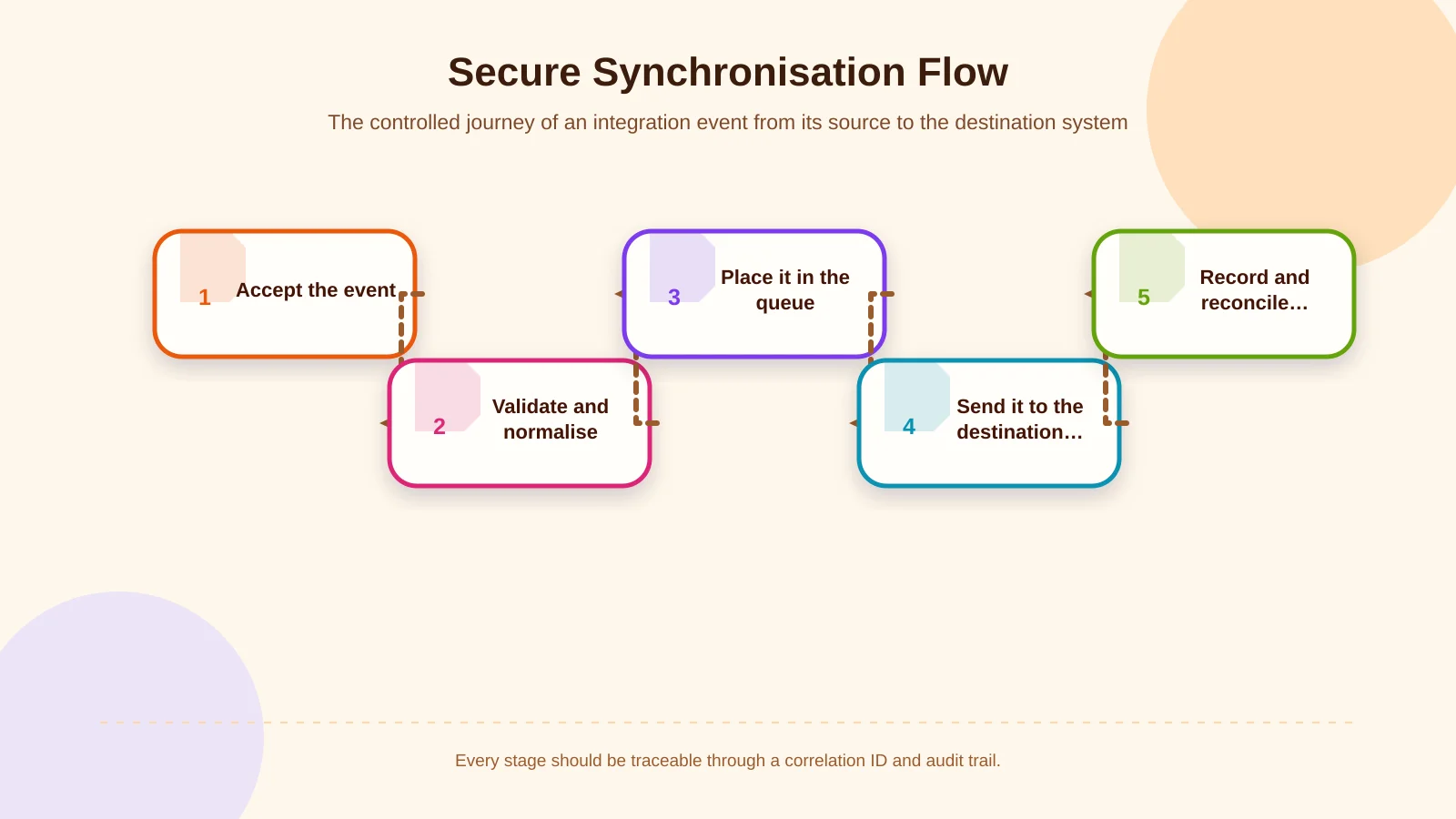
1. Accept and Persist the Event
Validate the event received from the source and write it to durable storage before further processing. Add its source, business, channel, entity key and correlation ID. Return an acceptance response only after the record has been stored safely.
2. Normalise Data and Apply Business Rules
Transform different ERP and marketplace fields into a shared data model. Apply safety-stock logic to inventory, margin and campaign rules to prices, and product mapping and mandatory-field checks to orders. Invalid business data should go to a review workflow rather than enter a technical retry loop.
3. Queue and Prioritise
Place the message in the appropriate channel and transaction queue. Emergency stock-zero events, new orders and urgent price corrections may receive higher priority. Use a partition key for events concerning the same product or order when processing order must be preserved.
4. Send to the Destination at a Controlled Rate
Worker services consume messages according to the destination API’s rate limits. Concurrency and requests per second should be configurable by channel. If the destination slows down, the queue may grow, but controlled consumption prevents the failure from spreading across connected systems.
5. Record Results, Reconcile and Report
Store the success response, external record number and processed version. An ambiguous response should first be checked against the destination rather than resent immediately. Scheduled reconciliation compares ERP and marketplace states and routes missing or inconsistent records to an operations queue.
Retries, Idempotency and the Dead-Letter Queue
Not every error should be retried in the same way. Network interruptions, timeouts, HTTP 429 responses and temporary 5xx errors may be retried with exponential backoff and random jitter. An invalid product code, inactive store, incomplete address or authorisation failure usually requires human action or corrected data. Without this distinction, messages that cannot succeed continue consuming system capacity.
Retry attempts should be limited, with messages that exceed the threshold moved to a dead-letter queue. The Amazon SQS visibility-timeout guidance describes how a message is temporarily hidden from other consumers during processing, becomes visible again if it is not completed and can be isolated in a DLQ after repeated failures. A visibility period that is too short can allow two workers to perform the same job; one that is too long delays recovery.
Idempotency should also cover inventory and price updates. Checking the message ID, entity key and version together prevents a repeated event from producing another side effect. Because storing the transaction result and its idempotency record at different times creates a new failure window, an atomic write or transactional outbox pattern should be used where practical.
Which Controls Should an Operations Console Provide?
An integration that runs technically but remains invisible to the responsible teams is not manageable. The operations console should show queue depth, oldest-message age, success and error rates, retry counts, channel latency and DLQ size. Filters should support searches by store, marketplace, transaction type, product, order and date.
Authorised users should be able to inspect a message timeline, masked request and response summaries, applied business rules and the latest failure reason. Actions such as retry, correct and reprocess, cancel or pause flow require role-based access. Pricing and order interventions may require dual approval. Every manual action should record the user, time, previous value, new value and reason in an audit trail.
Alerts should not depend only on error totals. Even without visible errors, the oldest order may exceed its target processing time or inventory events may accumulate for one store. Service-level indicators should therefore measure business outcomes, including time to ERP order acceptance, inventory propagation latency and price-verification time.
Core Control Points by Data Flow
Although inventory, pricing and orders can use the same buffer infrastructure, their business risks are different. Queue policy, validation, monitoring and operational ownership should be configured around the characteristics of each flow rather than imposed as one generic integration rule.
| Flow | Primary risk | Buffer control | Operational validation |
|---|---|---|---|
| Inventory | Overselling | Version ordering and event coalescing | Available-to-sell reconciliation |
| Pricing | Incorrect or outdated price | Rule versioning and priority correction | Margin and effective-date validation |
| Orders | Lost or duplicate record | Idempotency and safe retries | ERP acceptance number |
| All flows | Persistent processing failure | Limited retries and DLQ | Authorised correction and audit trail |
How Should a Marketplace Integration Project Be Planned?
Planning should begin with real operational workflows, not a list of API endpoints. Teams need to establish which system owns each data field, when inventory becomes reserved, who approves prices, what proves ERP order acceptance and what operations staff must do during an outage. Expected volume, peak periods, API quotas, acceptable latency and retention requirements can then be measured.
The initial design should document the shared data model, queue boundaries, message schema, ordering keys, retry matrix, idempotency policy and authorisation model. Tests should cover campaign peaks, marketplace outages, delayed or out-of-order messages, duplicate webhooks and ERP maintenance. A channel-by-channel rollout, comparative reconciliation and documented rollback plan reduce launch risk.
Kumsal Agency treats marketplace integration as a custom software and operational architecture challenge rather than a ready-made API connection. We design project-specific web software, e-commerce platforms and synchronisation systems around the organisation’s ERP, marketplace and operational requirements. Contact Kumsal Agency to analyse your data flows and business rules and plan a secure, scalable and manageable marketplace integration architecture for your brand.