


Aydınlatma metni yükleniyor…
A B2B service page should do more than describe what a company provides. It should answer the questions a potential client needs to ask before taking the next step: Is this service suitable for our situation? What is included? How does the process work? What will our team need to provide? Which items require separate scoping? How do we start a useful conversation?
The page should therefore be planned as six connected parts: problem, fit, scope, process, boundaries and next step. The enquiry form is not an isolated box added at the bottom. It should continue the information journey that the page has already begun.
At Kumsal Ajans, we assess the intended audience through the organisation's sector, needs, project goals and user expectations. We describe the service scope clearly and clarify out-of-scope or separately priced work during the proposal process. Where one fixed price would not represent the project accurately, we first gather the requirements, define the scope and prepare a customised proposal.
Why Is a Service Page More Than a Service Description?
Statements such as “we design corporate websites” or “we develop custom software” name the service, but they do not provide enough information for a buying decision. A B2B client is not assessing an output in isolation. Scope, deliverables, responsibilities, integrations, approvals and post-launch expectations can all affect the decision.
When the page leaves those questions unanswered, visitors may reach one of two unhelpful outcomes. They may leave without understanding whether the service fits their situation, or submit an incomplete or unsuitable enquiry. In either case, the issue is not simply the presence or absence of a form. The problem is a broken information journey between the service explanation and the enquiry.
Google advises content creators to focus on an existing or intended audience, first-hand expertise, original value and a satisfying outcome instead of writing to an assumed preferred word count. Applied to a service page, this means usefulness depends first on answering the right questions for the right reader—not on making the page arbitrarily long. (Google Search Central)
Start by Defining the Audience and the Problem Together
One service may be available to several sectors, but each sector does not necessarily buy it for the same reason. A manufacturer may prioritise multilingual product information and distributor enquiries. A professional services business may care more about explaining its expertise, building confidence and receiving suitable consultation requests.
Before writing the page, answer four questions:
- Who is the primary audience for this page?
- What situation has led that person to look for a solution?
- What is the main obstacle in their current setup?
- What decision or action should they be able to take after reading?
A statement such as “suitable for every sector and every requirement” may sound inclusive, but it leaves the conditions of fit unclear. If the page serves several audiences, give each group a distinct situation or requirement rather than treating them as one generic visitor.
This exercise does not replace a project-wide website requirements document. The requirements document defines the wider project; the service page communicates the decision information for one particular service.
A Six-Part B2B Service Page Worksheet
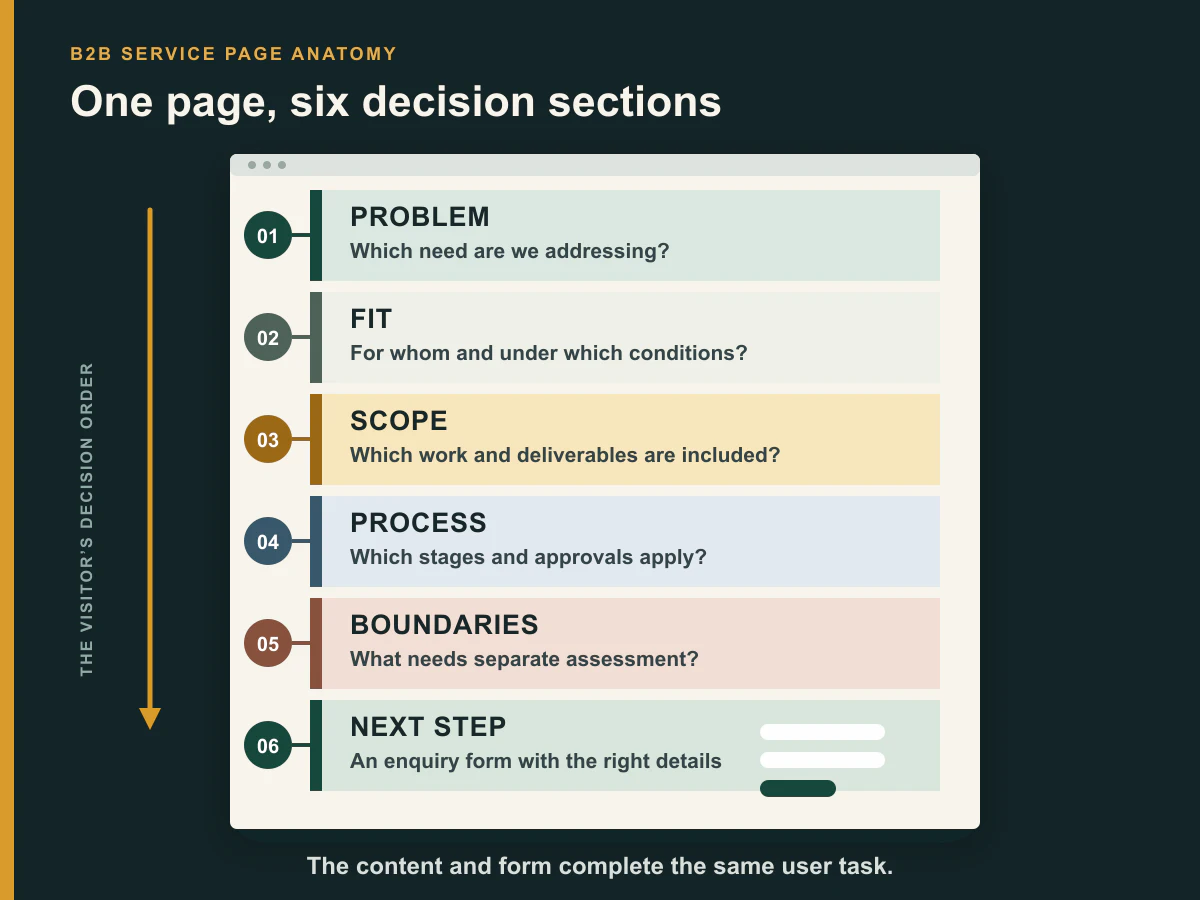
Instead of beginning with a series of paragraphs, complete this worksheet first:
| Section | Question to answer | Possible page content |
|---|---|---|
| Problem | Which need or obstacle does the service address? | Current situation, user need and business goal |
| Fit | Who is the service for, and under which conditions? | Sector, project type and starting requirements |
| Scope | Which activities are included? | Main deliverables, modules, content and technical work |
| Process | How does the engagement progress? | Discovery, design, development, testing, approval and handover |
| Boundaries | What needs separate assessment? | Out-of-scope work, third-party costs and additional development |
| Next step | How should the visitor continue? | Enquiry form, meeting, phone or email |
The aim is not to force every service into identical copy. It is to prevent an important decision area from disappearing. An integration service may need detailed prerequisites and account responsibilities. A content-led project may need clearer information about source materials, review and legal approval.
Explain Scope as Deliverables, Not Only as Benefits
A service scope should contain understandable work and deliverables rather than broad promises. The phrase “website design service”, for example, does not explain how many layouts are involved, whether responsive behaviour is included, who enters the content, how additional languages are handled, whether custom functions are needed or what happens after launch.
A practical scope section can follow this order:
- Main service outputs
- Activities that vary by project type
- Content, documents, access and approvals supplied by the client
- Third-party licences, hosting or service requirements
- Work assessed separately during proposal preparation
The public page does not need to reproduce every clause of a contract. However, it should not hide a material boundary that could cause a visitor to submit an enquiry based on the wrong assumption.
In Kumsal Ajans projects, work outside the agreed scope or requiring an additional fee is clarified during the proposal process. The summary on the service page and the later proposal should not contradict each other.
Show the Process, Deliverables and Client Responsibilities Together
A list such as “analysis, design, development and launch” gives the process a shape, but the client also needs to know what each stage produces and what is required before the next stage can begin.
During design, the client may need to provide brand assets, source content or approval from the authorised decision-maker. Development may depend on integration accounts or technical access. Testing may require acceptance against agreed user journeys.
For each stage, use three short fields:
- Work completed by Kumsal Ajans
- Resulting deliverable or decision
- Information, access or approval required from the client
This approach does more than manage expectations. It helps a potential client judge whether the organisation is ready to begin the project and which internal participants need to be involved.
If There Is No Fixed Price, Do Not Leave the Proposal Process Unexplained
A single price may not accurately represent project-specific website design or software work. Not publishing a figure does not mean the pricing process must remain opaque.
At Kumsal Ajans, requirements are gathered first, the project scope is defined and a customised proposal is prepared. The service page can explain the factors that inform that proposal, including:
- Number and type of pages or modules
- Level of design and functional customisation
- Content volume and number of languages
- Integrations
- Infrastructure and hosting requirements
- Delivery expectations
- Maintenance and support needs
This information does not promise an approximate price. It shows that the proposal will be based on identified requirements rather than an arbitrary figure. When assessing proposals from different suppliers, the reader can use our website proposal comparison scorecard to compare scope and responsibility as well as total price.
Use References and Client Logos with Permission and Context
A logo alone does not explain which service was provided, which work was completed or which outcome was verified. A reference should be accurate as well as authorised.
Kumsal Ajans uses references and client logos in accordance with contract terms or the client's permission. Before adding a reference to a service page, establish:
- Whether the client or project name may be disclosed
- Which part of the work can be described accurately
- Whether the client permits publication of any result or performance data
- Whether screenshots, interface images and logos may be used
- Which details must be removed if the example is anonymised
Permission to display a logo does not substantiate an unmeasured performance claim. Likewise, an anonymised scenario should not be presented as a named case study or given invented metrics.
Design the Enquiry Form as the Next Part of the Page
The service page explains which information matters. The enquiry form should then collect what is genuinely needed for the initial assessment. A Kumsal Ajans enquiry may ask for the person's name, company, telephone number, email address, required service, project details and an indicative budget where available.
Each field should still have a clear purpose. The GOV.UK Design System advises teams to know why they are asking every question and to request only the information they really need. W3C WAI similarly recommends asking only for information required to complete the process and providing clear labels, instructions, validation and user notifications. (GOV.UK Design System, W3C WAI)
Review the form against these questions:
- Will every field be used during the first assessment?
- Are required and optional fields clearly distinguished?
- Does the project-details prompt explain what information would be helpful?
- Is the indicative budget field required or optional, and is that clear?
- Do error messages explain what needs to be corrected?
- Does a success message confirm that the enquiry has been received?
- Can the visitor see supporting options such as phone, email or a meeting?
The enquiry form may be the main call to action, but not every visitor prefers the same communication route. Phone, email and meeting options can support the form without competing with its purpose.
Keep Turkish and English Versions Aligned
Publishing a translation once does not keep a multilingual service page accurate indefinitely. When the Turkish scope, process, form fields or contact route changes, the English version must also be reviewed.
The Kumsal Ajans team adapts changes in Turkish content for the English page and obtains client approval when required. “Adapt” does not mean translating every sentence literally. Service terminology, form guidance, the proposal approach and call-to-action copy should read naturally for the intended English-speaking audience.
A compact bilingual change record can contain:
- Section that changed
- Date of the Turkish update
- Status of the English adaptation
- Person responsible for checking it
- Whether client approval is required
This record helps prevent one language version from displaying an outdated scope or directing visitors to the wrong next step.
An Anonymous Process Observation
In some service pages, an unclear scope and weak direction led visitors to send incomplete or unsuitable enquiries. The page structure and enquiry form were reviewed together, making the service boundaries, expected project information and primary next step clearer. Subsequent enquiries were observed to contain information that was more suitable for an initial assessment.
This observation is not a measured conversion experiment, a stated increase or a promise that every project will produce the same outcome. It illustrates why page content and form questions should be treated as parts of the same user task.
Pre-Publication Checklist
Before publishing the service page, check the following:
- Can the visitor understand the target audience and main problem from the opening section?
- Does the page state who the service is suitable for?
- Is scope described through concrete work and deliverables?
- Are important boundaries or separately assessed items visible?
- Are client responsibilities shown alongside the process?
- If there is no fixed price, does the page explain how the proposal is prepared?
- Is permission available for every reference and client logo?
- Does the form ask only for information needed at this stage?
- Are form labels, instructions and notifications understandable?
- Do the Turkish and English pages describe the same current scope?
- Are supporting contact routes accurate and working?
Conclusion
A useful B2B service page does not need to become a long sales pitch. It should help the right visitor recognise the need, understand the service boundaries and prepare the information required for a meaningful enquiry.
Begin with “Which questions must the visitor answer to make the right next decision?” rather than “What would we like to say about our service?” When problem, fit, scope, process, boundaries and next step are planned together, the content and enquiry form support the same task.