


Aydınlatma metni yükleniyor…
When a corporate website loses organic traffic or keyword rankings, the first reaction is often to rewrite pages, publish more articles or blame an algorithm update. Yet a traffic drop is a symptom, not a diagnosis. Broken analytics, incorrect redirects, indexing barriers, changing search demand, weaker content and links lost during a redesign can all produce similar-looking charts.
A reliable recovery process first confirms whether the loss is real. It then isolates the affected pages, queries, devices, countries and dates before investigating technical access, URL changes, content quality and user experience. This evidence-led approach helps marketing, content and technical teams avoid sweeping changes based on assumptions. Instead, they can implement a recovery protocol whose effect, cost and risk can be measured.
Define the type of traffic loss accurately
“Our traffic has dropped” is not specific enough for diagnosis. Is the decline limited to Google organic sessions, or does it affect every acquisition channel? Have impressions fallen while average position remains stable? Are impressions unchanged but click-through rate lower? Is the loss concentrated in one service category, language directory, country or device type? Each pattern suggests a different set of causes and actions.
Google’s guidance on using Search Console and Analytics together treats Search Console as the primary source for search performance and Analytics as the source for behaviour after a visit begins. A click and a session should therefore not be interpreted as the same metric. Lost Search Console clicks may indicate a visibility or click-through problem. A decline seen only in Analytics may instead point to tracking, consent or channel-classification issues.
- If impressions and rankings fell together, investigate indexability, technical quality, competition and content relevance.
- If impressions remained stable but clicks declined, assess titles, descriptions, search-result features and branded demand.
- If Search Console is stable but Analytics is down, check tags, consent management, channel grouping and post-redirect measurement.
- If the loss affects one directory, focus on its templates, content group and recent releases before assuming a sitewide problem.
Diagnostic sequence: Measure first, then assess visibility
A fixed diagnostic order prevents teams from making several changes at once and destroying useful evidence. Begin with comparable date ranges. Account for weekdays, campaigns, public holidays and seasonality. Rather than relying only on the last seven days versus the previous seven, use a wider window that includes year-on-year trends and relevant release dates whenever possible.
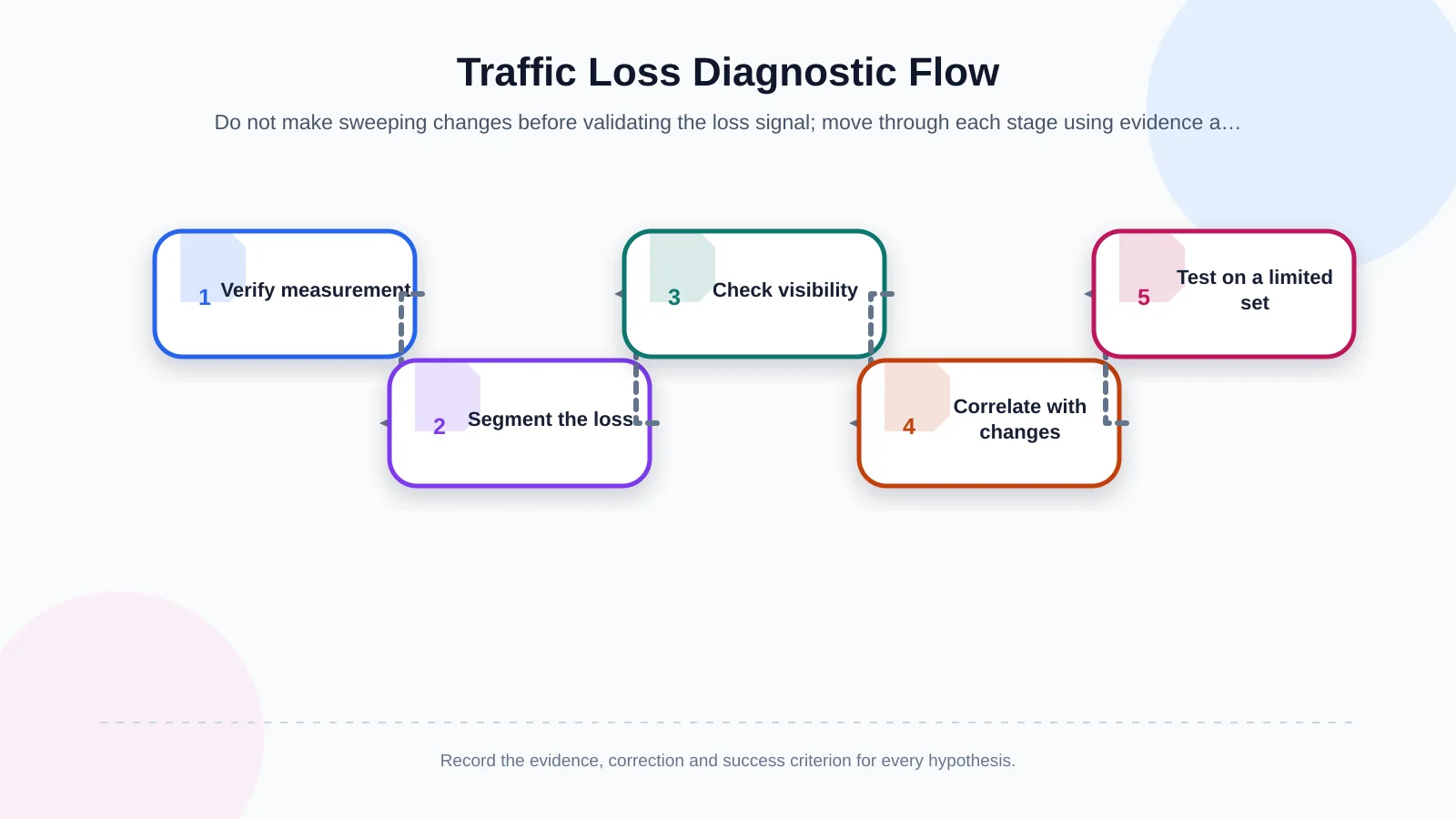
1. Verify measurement integrity
Confirm that the analytics tag runs across every important template. Test whether cookie preferences, the tag manager, cross-domain measurement or redirect chains interrupt sessions. Determine whether organic visits are being misclassified as direct or referral traffic. Sample critical pages with real-time testing, browser network records and deployment history. If the decline coincides with a measurement change, repair the data pipeline before making SEO changes.
2. Segment the extent of the loss
Compare Search Console data by page, query, country, device and search appearance. Separate branded queries from non-branded ones. Create distinct lists for pages with the largest absolute click loss and those with the steepest percentage decline. This prevents a dramatic fall on a low-volume page from taking priority over commercially important service pages that generate leads or revenue.
3. Check search visibility
Google’s documentation on debugging Search traffic drops identifies technical issues, security problems, spam actions, algorithmic changes and seasonality among the main possibilities. Review Page Indexing, Crawl Stats, Security Issues and Manual Actions alongside the loss timeline. Do not infer a cause from a single graph.
4. Correlate the decline with the change log
Record design launches, CMS updates, domain or hosting migrations, robots.txt edits, content removal and analytics releases in one shared log. Add deployment records, tickets and content-management revisions. Changes immediately preceding the decline are strong candidates, but correlation alone is not proof. Look for a mechanism connecting the change to the affected URLs or metrics.
5. Test the hypothesis on a limited set
For every finding, document the evidence, expected impact, proposed correction and success criterion. Apply the correction first to a small group of high-value URLs where practical. Monitor crawling, indexing and performance signals before expanding it. Controlled testing limits the risk that an ineffective bulk edit creates an additional loss.
Audit technical SEO and indexability
The purpose of a technical audit is not merely to produce a long error list. It is to establish whether search engines can reach critical content and index the preferred URL. Start with a sample of URLs important to revenue, lead generation and brand visibility. For each one, record its HTTP status, robots access, meta robots directive, canonical target, rendered HTML, internal links and XML sitemap status.
- Look for accidental noindex directives and robots.txt blocks.
- Identify soft error pages returning 200 responses, increases in 404s and server-side failures.
- Ensure canonical targets are live, indexable and genuinely equivalent to the source content.
- Check that primary JavaScript-generated content appears in rendered HTML.
- Compare mobile and desktop templates for missing content, links or structured data.
- Keep only preferred, current and indexable URLs in XML sitemaps.
Performance does not explain every ranking decline, but slow server responses, unstable interfaces and heavy client-side code can weaken both crawl efficiency and user experience. In corporate web design and custom web development, performance, mobile compatibility, accessibility, security and maintainability should be part of the same technical acceptance process. Treating them as separate post-launch tasks often allows small defects to become sitewide template problems.
Investigate losses after a redesign or site migration
A redesign may preserve the visual identity while silently changing URL structures, headings, content depth and internal links. If the domain, protocol, subdomain or directory structure changed, create a one-to-one mapping between old and new URLs. Redirecting unrelated legacy pages to the homepage does not satisfy user expectations and may lead search engines to treat those destinations like soft 404s.
Google’s guidance for site moves involving URL changes recommends mapping old URLs to their new counterparts, using permanent server-side redirects and monitoring both properties. Redirects should lead directly to the final destination. Remove chains, loops and irrelevant targets, then align canonical tags, internal links and XML sitemaps with the new addresses.
After migration, monitor the traffic and link value associated with old URLs, the indexing curve of new URLs and bot access in server logs. Do not reverse a migration solely because of normal fluctuations during the first few days. However, act immediately when critical pages are blocked, redirects fail or primary content is not being served. A rollback condition should be defined before launch so the team knows which failures justify it.
Analyse content, search intent and information architecture
If technical checks are clean, examine the decline at the level of content and search intent. Does the ranking page still provide the type of information the query implies? A user seeking a comparison may encounter only corporate promotion, while someone looking for technical detail may find superficial marketing copy. Instead of copying competing pages, identify the dominant result format, recurring user questions and the original evidence your organisation can contribute.
Updating content is not the same as making it longer. The right action may be to consolidate duplicate pages, clarify service scope, add expert insight or project evidence, correct outdated claims, and make the next step visible. Assign ownership and review dates to commercially important pages. Without content governance, overlapping pages and stale information tend to return after the initial recovery.
Internal linking should extend beyond the main navigation. Contextual links from strong, relevant pages to critical service pages help users continue their journey and help search engines understand relationships. Audit orphan pages, excessive click depth, multiple URLs targeting the same intent and contextual links removed during a redesign. Anchor text should describe the destination naturally rather than repeat an exact keyword mechanically.
Turn findings into a recovery plan
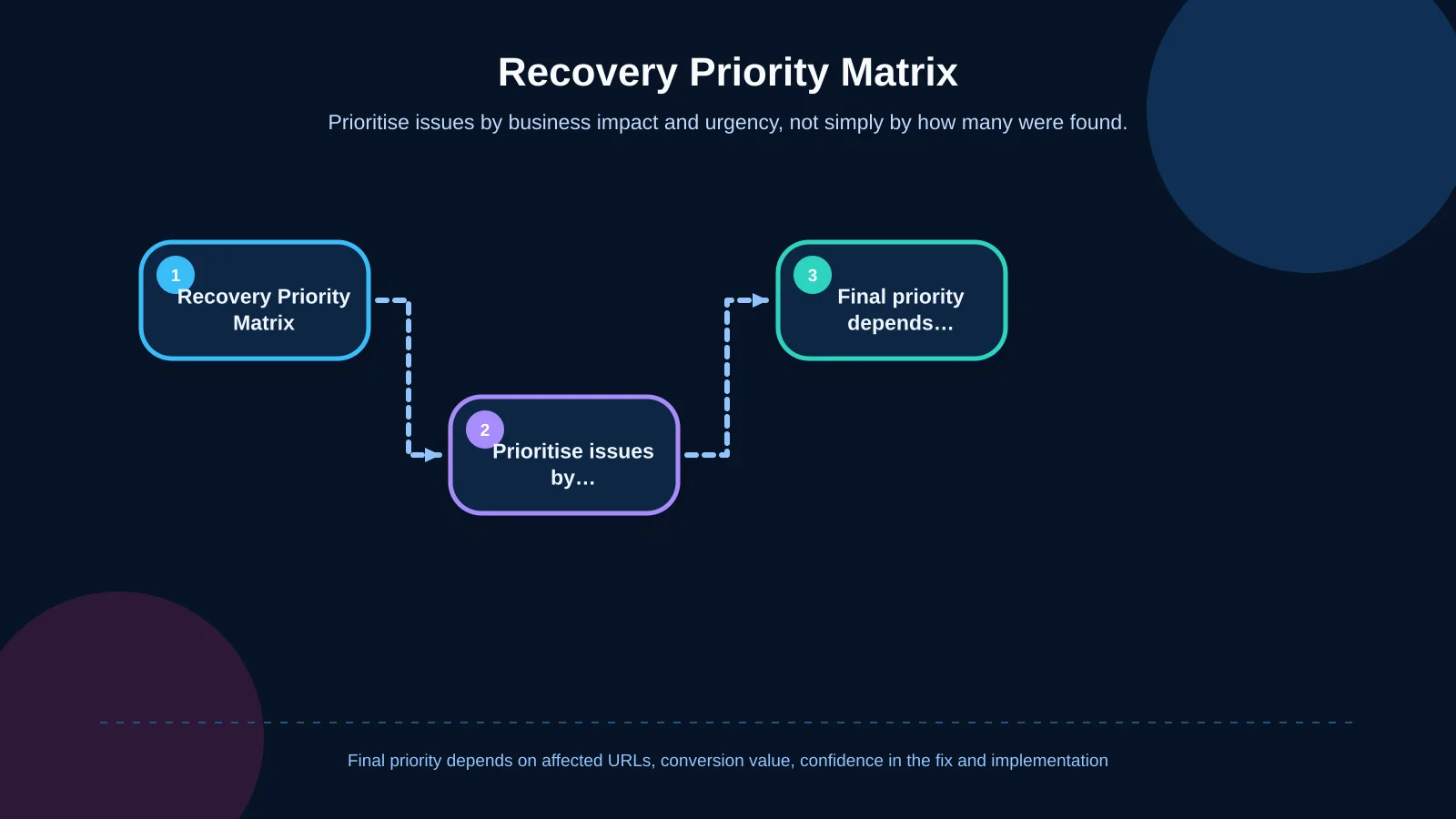
Instead of ending the audit with hundreds of undifferentiated issues, create a decision table organised by business impact. Consider affected organic traffic, conversion value, the number of URLs involved, confidence in the proposed fix, implementation cost and rollback risk. A sitewide indexing block demands greater urgency than a minor meta-description weakness.
- Emergency: measurement outage, sitewide noindex, robots block, server failure, broken redirect or security incident.
- High: incorrect canonical on critical pages, lost content, orphan URLs, mobile-template differences or intent mismatch.
- Medium: weak internal linking, title and snippet improvements, content overlap or performance debt.
- Monitor: seasonality, limited ranking volatility and recent releases without enough data.
Every action should have an owner, delivery date, validation method and rollback condition. The technical team verifies deployment, the content team protects meaning and coverage, marketing confirms commercial priority, and analytics validates measurement. The content management system should also provide controlled options for canonicals, redirects and indexing directives rather than making high-risk errors easy to publish.
| Level | Symptom | First action | Success signal |
|---|---|---|---|
| Emergency | Noindex, robots block or 5xx errors | Remove the barrier and verify measurement | Critical URLs are accessible |
| High | Incorrect canonical or redirect | Correct the URL mapping | Target URL is indexed |
| Medium | Weak linking or overlapping content | Improve architecture and content | Query visibility increases |
| Monitor | Seasonality or limited volatility | Compare segments regularly | The trend stabilises |
How should recovery success be measured?
Success is not limited to restoring total organic traffic to its previous level. Begin with leading technical indicators: error-response volume, blocked critical URLs, redirect accuracy, Googlebot access and the number of target pages indexed. Then assess outcome indicators such as impressions, average position, click-through rate, organic sessions, engagement, leads and conversions.
Measure recovery by page group and annotate important releases on performance charts. Do not allow increased branded demand to conceal weak non-branded service visibility. Separate weekly operational monitoring from monthly management reporting. Some technical corrections can be verified quickly, while recrawling and reassessment may take longer. The observation window should match the hypothesis rather than an arbitrary reporting deadline.
Build a sustainable prevention protocol
Once recovery is underway, introduce pre-release quality gates to prevent the same risks from returning. Confirm that staging environments are not indexable and that production is not accidentally blocked. Prepare redirect mappings for URL changes, mobile, performance and accessibility tests for template changes, and event and conversion acceptance scenarios for analytics releases.
Kumsal Agency is an Istanbul-based digital agency combining corporate web design, custom web development and digital brand consulting around business goals and real user needs. Its approach brings information architecture, content planning, user experience, mobile compatibility, performance, redirects, search access, analytics, content management and necessary integrations into one sustainable system. Organisations can request a technical, content and user-experience review by sharing the extent of their traffic or ranking loss, recent website changes and their most critical pages.