


Aydınlatma metni yükleniyor…
Search engine optimisation for B2B companies is a broader business objective than simply attracting large numbers of visitors. In manufacturing, engineering, technology and professional-services markets, the real value lies in appearing for the right industry-specific query, explaining a complex solution clearly and guiding a relevant decision-maker towards a credible next step. Success should therefore be evaluated not only through rankings or organic sessions, but also through the suitability of the companies reached and the qualified demand generated.
Leadership in industry-specific search does not mean holding first position for one keyword for a short period. It means consistently answering the questions buyers ask from their initial investigation of a problem through technical evaluation and supplier selection. Brand positioning, information architecture, expert content, web development, performance and measurement must work as one strategy to achieve that goal.
Why is B2B SEO different from consumer-focused SEO?
A B2B purchase rarely involves only one person. A technical specialist may assess whether a solution is capable enough, procurement may review commercial terms, an executive may examine business impact, and an IT team may investigate security and integration requirements. People in these roles can search for the same product using very different language, such as “industrial automation system”, “production-line efficiency solution” or “machine monitoring software with ERP integration”.
Long, technical queries with apparently low search volume are not necessarily low-value. On the contrary, they can reveal a specific requirement and strong evaluation intent. A B2B SEO plan must go beyond high-volume keywords to consider the decision-maker’s context, industry vocabulary, use case and buying stage. Without a balance between traffic objectives and sales suitability, a website may attract many visitors but produce few enquiries from the right companies.
The economics are also different. Search demand may be limited, yet one well-matched opportunity can justify a substantial content or platform investment. This makes relevance, clarity and evidence more important than indiscriminate reach. The objective is not to make every page appeal to everyone; it is to help the right stakeholder recognise that the company understands the problem.
Map industry search intent and decision-makers
Keyword research should begin with customer research rather than a spreadsheet exported from a search tool. Sales conversations, reasons for lost proposals, CRM records, support questions, product documentation and distributor feedback reveal the language customers actually use. Workshops involving marketing, sales, product and engineering teams can show how customers describe a problem, which objections delay a decision and what proof each stakeholder expects.
Queries can then be grouped by intent: recognising a problem, researching methods, comparing solutions, validating technical suitability and selecting a supplier. “How to reduce energy consumption?” indicates information gathering. “Energy-monitoring system for a food factory” points to a more defined solution need. “Energy-monitoring software ERP integration” may represent a user approaching technical evaluation.
Define the target role, central question, required proof and expected next step for every cluster. An operations manager may need evidence of efficiency gains, while an IT manager needs integration boundaries and security information. Recording these differences prevents the content plan from treating a buying committee as a single generic visitor.
From industry terminology to content architecture
Research findings should not be converted immediately into isolated blog titles. First establish a topic map connecting the company’s principal solutions, services, industries and use cases. Then select the most suitable page type for every query cluster. A commercially oriented term may belong on a solution or service page; a comparison query may require a guide; technical detail may belong in documentation; and implementation evidence may be best presented as a project or case study.
This process also exposes gaps between market demand and the current website. A company may have extensive product pages but no content explaining sector-specific applications. Alternatively, it may publish helpful articles without a clear route to the relevant solution, technical evidence or commercial conversation. The topic map should connect these assets while respecting the distinct purpose of each page.
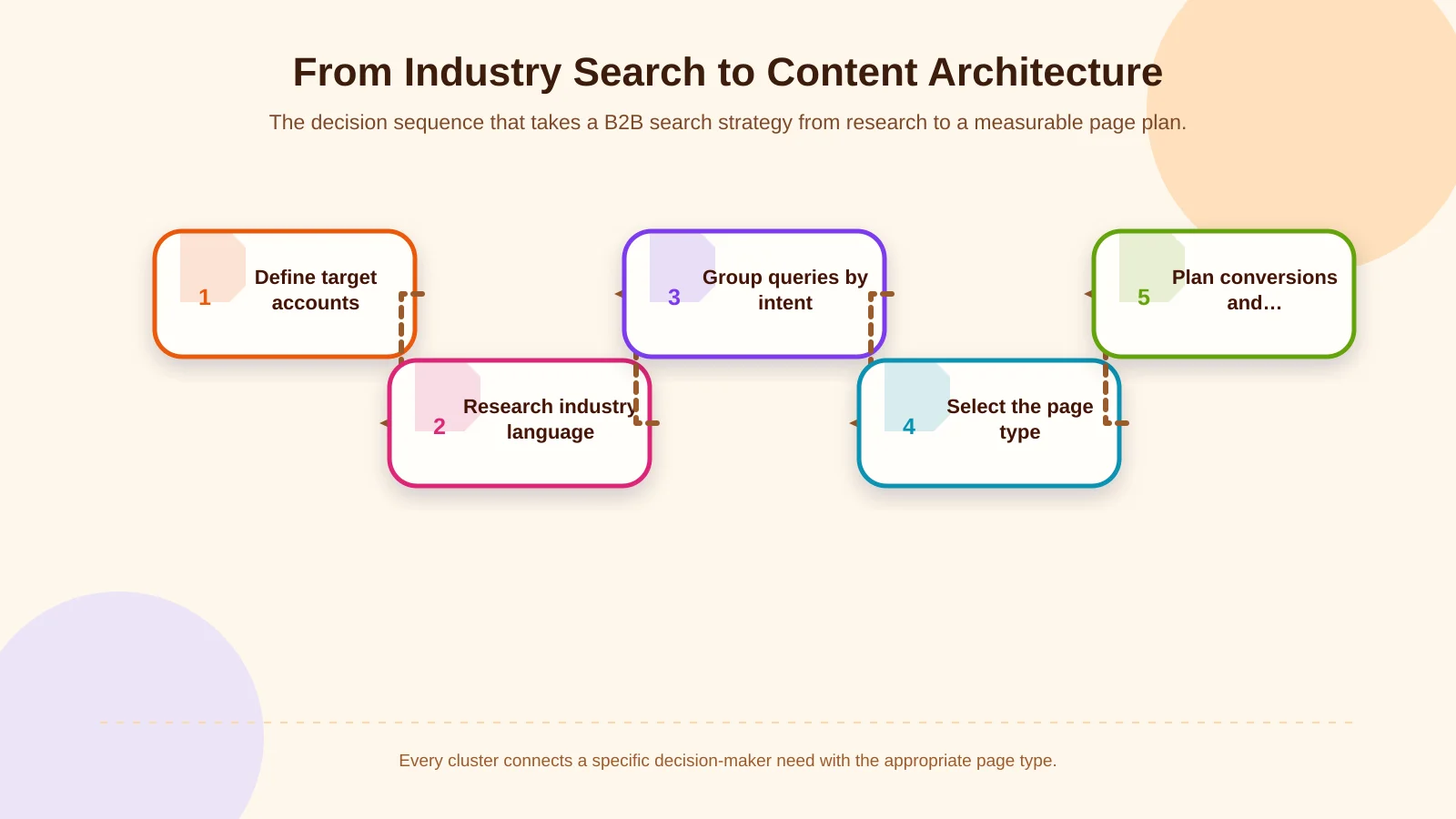
Five-step planning model
Start by defining target accounts and decision-making roles. Next, collect the industry terminology and real questions those people use. Third, group the queries by intent and buying stage. Fourth, map the clusters to existing or planned pages. Finally, define how those pages should link to one another and which conversion each one supports.
This sequence reduces the risk of publishing multiple weak pages that compete for the same term. It also gives marketing, sales and technical teams a shared basis for prioritising content. Before commissioning a new article, the team can ask whether an existing page should instead be expanded, consolidated or repositioned.
How does information architecture strengthen topical authority?
A strong B2B website is not merely a product catalogue placed beside a collection of disconnected blog posts. A principal service or solution page should bring together relevant industries, use cases, technical resources, projects and frequently asked questions through logical relationships. Descriptive URLs, clear navigation and contextually relevant internal links help both users and search systems understand how the pages relate.
Google’s SEO Starter Guide explains that logical site organisation can help users and search engines understand relationships between content. This is especially important on B2B websites, where a visitor may move from a broad solution page to a technical capability, an integration explanation and then a relevant project.
Navigation labels should use terminology familiar to customers, not only internal department or product names. Important pages should be reachable through meaningful links, and each link should help the visitor answer the next question in the evaluation process. A user-needs-led architecture also supports a maintainable content system because every new asset has a defined place and purpose.
How should content demonstrate genuine expertise?
Industry leadership develops by offering original information that helps someone make a decision, not by repeating a keyword throughout a page. An engineering company can explain operating principles, capacity limits, material options and compliance with standards. A software company can illustrate data flows, user roles, integration conditions and failure scenarios. A professional-services firm can make its methodology, delivery stages and success criteria concrete.
Every important page should go beyond answering “What is this solution?” It should explain who the solution suits, which problem it addresses, when it may not be appropriate, how implementation works, what inputs are required and which outcomes can reasonably be expected. Limitations and dependencies can increase trust because they allow buyers to assess fit before contacting sales.
Knowledge supplied by technical specialists should not be oversimplified into vague marketing language. Define specialist terms on first use, keep important qualifications intact and use examples to connect technical detail with business impact. Original diagrams, expert commentary, project context and verifiable technical data can make expertise visible. Google likewise identifies useful, engaging content as a central influence on search visibility and warns that excessive keyword repetition damages the user experience.
Match the page type to search intent
Targeting every query with a blog post can cause content overlap and weak conversion paths. A service page should communicate capability and scope; an industry page should address market-specific conditions; a product page should present technical features; a guide should support a decision method; and a case study should provide implementation evidence. When search intent matches the page’s job, users can reach useful information in fewer steps.
For example, someone searching for “website CRM integration” may need more than a conceptual definition. They may want to know how form fields will be mapped, how duplicates and exceptions will be handled, and how records will reach the sales team. A detailed resource such as How to Plan Website–CRM Integration: From Form to Sales Follow-up can support that research. A visitor ready to request a proposal, however, is better served by a commercial page with a visible scope, delivery approach, trust signals and clear contact route.
Technical foundations must make the content investment accessible
Even excellent content cannot deliver its expected value if search systems cannot reliably access it. Crawlable links, correct HTTP status codes, XML sitemaps, canonical choices, redirects, robots directives and unique page titles are fundamental controls. Critical content and links generated with JavaScript should also be tested for accessibility. On multilingual websites, language versions, URL conventions and cross-language relationships should be planned from the beginning.
Mobile compatibility and performance are not concerns for the development team alone; they directly affect a decision-maker’s experience. Heavy images, uncontrolled third-party scripts and shifting interface elements can make research and comparison difficult. The web.dev guide to Web Vitals treats loading performance, responsiveness and visual stability as core dimensions of user experience.
Technical quality should be considered throughout design and development rather than postponed until launch. Content templates need room for structured explanations, tables, media, calls to action and accessible forms. The content-management system should allow the responsible team to update titles, descriptions, internal links and page sections without undermining design or technical consistency.
Pre-publication technical checks
- Confirm that important pages are crawlable and eligible for indexing.
- Test that content, navigation and forms work fully on mobile screens.
- Align page titles, descriptions and canonical choices with each page’s purpose.
- Serve images at suitable dimensions and formats with meaningful alternative text.
- Test forms, analytics, CRM connections and consent mechanisms.
- Review 404 responses and redirects from retired or changed URLs.
These checks should cover both automated tests and realistic user journeys. A form that technically submits but fails to assign an owner in the CRM still breaks the commercial journey. Likewise, a redirect chain that eventually works can waste crawl resources and slow visitors.
Turn organic visits into qualified demand
A B2B visitor will not always request a proposal during the first session. Conversion design should therefore extend beyond one contact button. Visitors may be offered options such as reviewing technical documentation, viewing a relevant project, requesting a demonstration, speaking to a specialist or sharing an initial scope. The call to action should reflect the intent of the page: an early-stage guide reader may prefer a related checklist, while a solution-page visitor may be ready to schedule a conversation.
Forms should request information that the sales team will genuinely use. Company, role, area of need and project timing can support qualification, but unnecessary length creates friction. Connecting the form to the CRM, preserving the acquisition source and first landing page, assigning responsibility and creating a feedback loop make it possible to connect organic demand with sales outcomes.
The management interface matters as well. Marketing teams should be able to add industry pages, expert resources, project evidence and references without depending on development work for every update. Governance, permissions and approval stages can preserve quality while making the website responsive to changing market questions.
Which metrics should measure B2B SEO performance?
Average position alone is not a reliable management indicator. Measurement should be layered across visibility, search engagement, website behaviour, demand quality and commercial results. Google Search Console’s Performance report documentation explains that clicks, impressions, click-through rate and average position can be examined by dimensions including query, page, country and device. These metrics should be monitored for target query clusters and strategically important page groups.
Analytics should show which content paths organic visitors follow and which meaningful actions they complete. CRM reporting can then track marketing-qualified enquiries, sales-accepted opportunities, proposals and won business. Where appropriate and lawful, company-level signals can help teams assess whether the intended account profiles are being reached.
Growth in non-branded industry visibility is valuable, but if it does not generate interest from suitable companies, the team should reassess content intent, the proposition and the conversion path. Reporting should explain not only what changed but also which page should be improved and why. It should distinguish between a discoverability problem, a search-result messaging problem, an on-page experience problem and a commercial-fit problem.
| Layer | Example indicators | Question answered | Potential action |
|---|---|---|---|
| Visibility | Impressions, queries, position | Are we appearing for the right terms? | Expand topic coverage |
| Search engagement | Clicks, click-through rate | Does the result appear relevant to users? | Improve the title and description |
| Website behaviour | Content path, form starts | Is the visitor progressing through evaluation? | Refine the information architecture |
| Demand quality | Qualified enquiries, opportunities, proposals | Are we reaching the right companies? | Review targeting and proposition alignment |
| Commercial results | Won business, revenue contribution | Does the organic channel contribute to the business? | Update investment priorities |
Build a governance model for sustainable leadership
Industry visibility is not a one-off optimisation project. Product features, standards, customer questions and search behaviour change, so content must be reviewed and updated. Every important page should have a content owner, a technical reviewer, a review date and a success indicator. Marketing can contribute search data, sales can share objections heard in conversations, and technical teams can report product or implementation changes.
Quarterly reviews should consider consolidation, updating and redirection as well as new production. If very similar pages compete, they may be combined into a stronger principal resource. Pages with high impressions but low clicks may need clearer titles and search descriptions. Pages with traffic but little demand may need a sharper value proposition, better evidence or a more appropriate next step.
This operating model protects accuracy and prevents the website from accumulating outdated or duplicated material. It also turns SEO into a cross-functional learning system: search behaviour informs product messaging, sales feedback improves content, and commercial outcomes guide the next investment.
Develop B2B industry visibility through an integrated strategy
Leadership in industry-specific search cannot be reduced to a keyword list, a publishing calendar or a technical checklist. Research-led brand positioning identifies the right subjects. Information architecture guides the user. Expert content builds confidence. Strong software foundations support access and performance. Measurement enables the investment to improve over time.
Kumsal Agency is an Istanbul-based digital agency that approaches B2B brand positioning, user experience and technical infrastructure together. Its work can connect research-led digital brand consulting and content planning with responsive corporate web design, custom web development, content-management systems, forms, CRM connections and other required integrations. Technical search accessibility and measurement preparation are planned around the same business objectives.
To plan your B2B company’s industry search visibility, corporate website foundations and qualified-demand journey together, contact Kumsal Agency.