


Aydınlatma metni yükleniyor…
B2B content that is suitable for use as a source in AI-generated answers does four things well: it answers a real question clearly, states the conditions under which its claims apply, supports material information with traceable evidence, and gives the reader a practical next step.
This does not mean writing in a special language “for AI.” Short paragraphs, numerous question headings, keyword repetition or a long bibliography do not automatically make a page trustworthy. The priority is information that helps a person make a decision because it is clear, original and verifiable.
No publisher can guarantee a citation. A practical editorial method can, however, make uncertainty visible by organising important information around five elements: claim, context, evidence, boundary and next step.
What citable B2B content is not
Formatting changes cannot compensate for missing expertise or evidence. The following actions are not a GEO content strategy on their own:
- Splitting an existing article into shorter paragraphs
- Publishing a near-duplicate page for every long query
- Rewriting competitors with different wording
- Using unverified statistics without their original source
- Naming a process the company does not actually use
- Adding claims to structured data that are absent from the visible page
- Hiding instructions intended to manipulate an AI system
Google’s generative AI optimization guidance recommends unique perspectives, first-hand experience and useful content that goes beyond a generic summary of what is already online. It also warns that producing many pages mainly to capture query variations does not create lasting quality or relevance.
Microsoft’s Bing Webmaster Guidelines likewise warn against low-value republishing, artificially constructed language, scaled automation without editorial oversight and prompt-injection techniques intended to manipulate AI systems.
The goal is not to make a model “quote us.” It is to publish a useful resource whose author, scope and evidence can be evaluated.
Where does original value come from in B2B content?
Originality is not simply using a sentence that has never appeared before. B2B value comes from turning what an organization genuinely knows or can verify into decision support.
A verified process
Explain how the company actually performs the work, including steps, responsibilities, deliverables and constraints. Do not imply that every project produces the same outcome.
An anonymised real example
When a client cannot be named, an example may describe the sector, problem, scope, decision and only the outcomes that can be verified. Do not add an unmeasured improvement or invented testimonial.
Owned data or observation
Support records, project logs, surveys, tests or product usage data can add first-party value. Disclose the collection method, sample, period and gaps. A small set of observations should not be presented as the behaviour of an entire market.
Expert review
An expert can make general information applicable under specific conditions. Record their name, role and the sections they reviewed. Do not attribute claims outside their competence to them.
A decision tool
A checklist, calculator or matrix helps the reader apply information. Its fields, order of use and limitations must be explained. Giving a name to generic advice is not an original contribution.
The Kumsal Ajans CCEBN Matrix
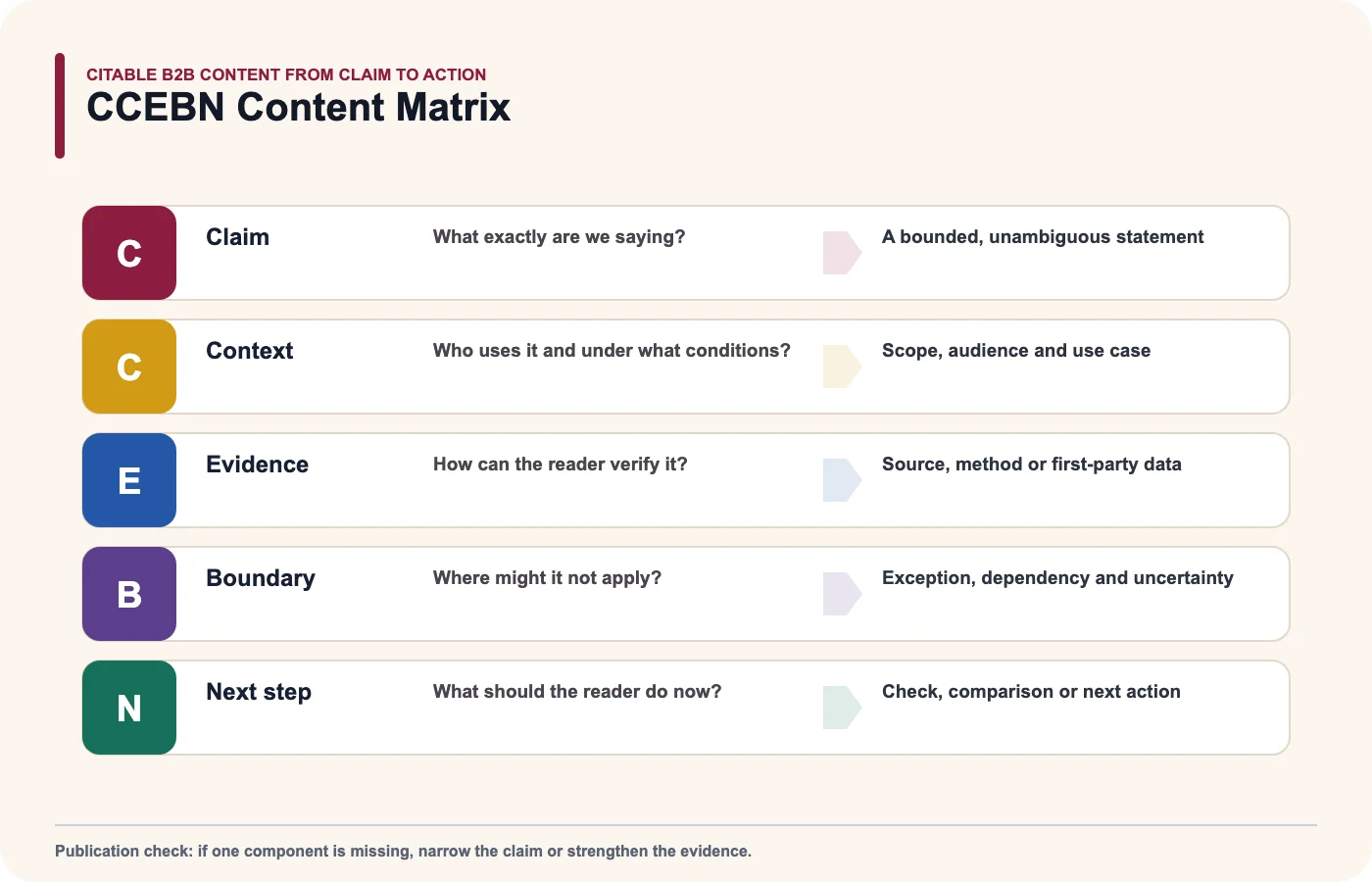
The CCEBN Matrix tests every important B2B information block with five editorial questions:
| Element | Editorial question | Expected output |
|---|---|---|
| Claim | What exactly are we telling the reader? | One clear answer, finding or recommendation |
| Context | For whom, when and under what conditions does it apply? | Audience, platform, scope and date |
| Evidence | How can a reader or editor verify it? | Primary external source or traceable first-party record |
| Boundary | When does it not apply, and what does it not guarantee? | Exception, uncertainty and responsibility limit |
| Next step | What can the reader do with it? | A check, decision, calculation or action |
The matrix is not a ranking formula. Every paragraph does not need five equally long parts. Its purpose is to reveal a material claim that lacks context, evidence or a visible limit before publication.
For the search foundation supporting this editorial method, see our guide to effective SEO techniques.
1. Write one clear, bounded claim
Generic statements such as “digital transformation is important” rarely change a decision. A useful claim answers something specific:
- “OAI-SearchBot and GPTBot do not serve the same purpose.”
- “When a B2B service page cannot list a fixed price, it should explain the scope variables that affect cost.”
- “A ranking guarantee is not a measurable SEO deliverable.”
The claim should be understandable in one sentence, but its certainty must not exceed the evidence. Review words such as “always,” “best,” “guaranteed” and “for every company.”
Separate fact, experience, interpretation and recommendation
Do not present the company’s preferred practice as an official platform rule.
- Fact: What an official source or verified record states
- First-party experience: A confirmed company process or observation
- Interpretation: An editorial conclusion drawn from evidence
- Recommendation: A possible next action under defined conditions
This distinction tells the reader how much weight each statement deserves.
2. Put context in the same information block
A true sentence can mislead in the wrong context. Platform behaviour, prices, timelines and performance outcomes need clear conditions.
Ask:
- Which country, language or platform does this concern?
- Which product, service or page type is being discussed?
- When was the information checked?
- Is the reader a beginner, technical owner or procurement decision-maker?
- What prerequisites must exist before the recommendation is applied?
For example, “The content must be indexed” should not be presented as a universal rule for every AI system. Name the specific search feature and place its official source nearby.
3. Place evidence near the claim
A list of ten links at the end does not show which claim each source supports. Put the source beside the material statement with descriptive anchor text.
For external claims, prefer:
- Official platform, institution or standards documentation
- Original research, dataset or legislation
- A reliable study with a disclosed method
- Secondary analysis or expert commentary
For company claims, use a dated interview note, approved process document, anonymised case ID, change record, documented owned dataset or reproducible first-party framework.
Kumsal Ajans’ confirmed GEO scope can include AI crawler accessibility, technical checks, brand and service visibility, priority queries, citations and competitor visibility. Prompt monitoring may be added where appropriate. This first-party statement does not mean every project has the same scope or a guaranteed outcome.
4. Make the boundary visible
A boundary does not weaken content; it prevents misuse. Common boundaries include:
- No outcome is guaranteed.
- An example applies to a specific sector or project condition.
- The data represents a limited sample.
- A platform feature may change.
- Price, time or scope cannot be fixed before discovery.
- Technical eligibility does not equal visibility or conversion.
“Allow the crawler,” for example, is incomplete without identifying the crawler’s purpose, the organization’s data-use policy, security implications and the fact that access does not guarantee visibility.
5. Give the reader an observable next step
“Create better content” is not actionable. A useful next step can be completed and verified:
- Extract numerical claims from the last twenty articles and mark their source status.
- Compare service-page guarantees with the actual contract scope.
- Conduct a 30-minute expert interview and preserve a dated record.
- Compare the user tasks of three similar pages and decide whether to consolidate them.
- Assign a 90-day review date to time-sensitive platform claims.
The next step turns a marketing statement into a decision tool.
Before and after: applying CCEBN
The following is an editorial example, not a client result.
Before
> GEO makes brands more visible in AI. With quality content and the right technical work, your brand will outperform competitors.
The terms “more visible” and “outperform” have no condition, measurement or evidence.
After
> GEO work can examine crawler access, brand and service mentions, visible citations and competitor presence across selected AI search surfaces. Record the platform, query group, date and measurement method before testing. Neither crawler access nor a content change guarantees visibility. Start by creating a dated baseline for five commercially important service queries.
The revised version replaces a performance promise with scope, limits and a practical action.
Build a claim–evidence record before drafting
Finding sources after an article is complete encourages writers to bend the wording around whatever evidence they can find. Plan material claims first.
| Field | Purpose |
|---|---|
| Claim ID | A stable code for the material claim |
| Draft claim | The wording being considered |
| Evidence type | Official source, research, interview, case or owned data |
| Source/artifact | URL or non-secret evidence identifier |
| Verification date | When the information was checked |
| Section | Where the claim will appear |
| Locale | English, Turkish or both |
| Boundary | Exception and non-guaranteed outcome |
| Status | Ready, missing, revise or remove |
Do not preserve an unsupported company-performance claim by merely softening it. Remove it until it can be verified, or recast it honestly as an opinion or recommendation.
Turn expert interviews into usable evidence
“What do you think?” often produces generic answers. Ask instead:
- Under what real project conditions does this problem appear?
- What are the first three things you check?
- Which common approach fails, and why?
- Which responsibility remains with the client or another team?
- What do you measure, and what can you not measure?
- Is there an anonymised decision example we can use?
- When does this advice not apply?
After the interview, the expert should verify the sections using their input and the material claims attributed to them. An automated summary is not expert approval.
Keep authorship and update information accurate
Google’s people-first content guidance includes original information, substantive answers, clear sourcing, author or publisher background and demonstrable expertise among its self-assessment questions. These are not individual ranking factors; they are useful questions about why a reader should trust the page.
Where appropriate, show the real author, reviewer and role; initial publication date; material update date; and publisher. Never invent a profile, credential or certification. Keep the person author and organization publisher as separate roles.
Use AI assistance with human accountability
Automation can assist with research candidates, interview-note structure, outlines, consistency checks and localization. Source verification, first-party experience, performance claims and final editorial responsibility remain human tasks.
Google’s guidance on generative AI content emphasizes accuracy, quality and relevance. It also recommends providing production context when readers would reasonably expect it.
Record which stages used automation, who opened and verified sources, who supplied first-party information, who approved material claims and who owns final editorial review. An AI tool should not be listed as the accountable editor or expert.
For continuing technical and editorial ownership, see our guide to website maintenance and SEO responsibilities.
Pre-publication checklist for citable B2B content
- Does each important section answer one clear user question?
- Is the main statement classified as fact, experience, interpretation or recommendation?
- Are audience, platform, period and conditions clear?
- Does each material external claim have a current primary source?
- Is company experience supported by a dated first-party record?
- Do numerical claims disclose method, period and sample?
- Are uncertainty, exceptions and non-guaranteed outcomes visible?
- Can the reader take an observable next step?
- Does the title accurately describe the task completed?
- Are author, publisher and update information correct?
- Does the localized version preserve sources and limitations?
- Has automation-assisted work been verified by a person?
If the answer is “no evidence,” hold the claim rather than forcing the page to publication.