


Aydınlatma metni yükleniyor…
Account deletion in a mobile app is not just a button added to the settings screen. The user’s request may begin in the app, but it continues through identity verification, active subscriptions, data held across multiple systems, retention requirements, anonymisation, notifications and operational records. Treating “Delete Account” as a single interface task therefore leaves much of the real product scope invisible.
A robust scope must help users understand what they are deleting, verify this sensitive action securely and process related data according to defined rules. Apple requires apps that support account creation to let users initiate deletion from within the app. Google Play expects both an in-app route and an accessible web resource for apps where users can create accounts. Account deletion is consequently a first-release product requirement, not a minor enhancement to add shortly before store submission.
Why is account deletion a standalone product requirement?
An account may be connected to profile details, sessions, preferences, uploaded files, orders, messages, support records and identities in third-party systems. A user’s confirmation does not necessarily mean every related record can or should be physically deleted at the same moment. Some information may need to be retained for legal obligations, fraud investigations, accounting or dispute handling. The product team must explain these distinctions clearly and translate decisions made by legal and data owners into enforceable technical rules.
Apple’s in-app account deletion guidance states that temporarily deactivating an account is not sufficient and that associated personal data must be included in the deletion scope. Google Play’s account deletion requirements also expect the request route to be easy to find and the web link to remain functional. Acceptance criteria must therefore go well beyond “the button works.”
In what order should the scoping process be completed?
Planning should begin by defining the boundaries of the account and its data before anyone designs screens. Product, design, mobile development, backend, security, legal and operations teams should contribute to the same decision record. This creates a testable end-to-end flow instead of a collection of gaps discovered near release.
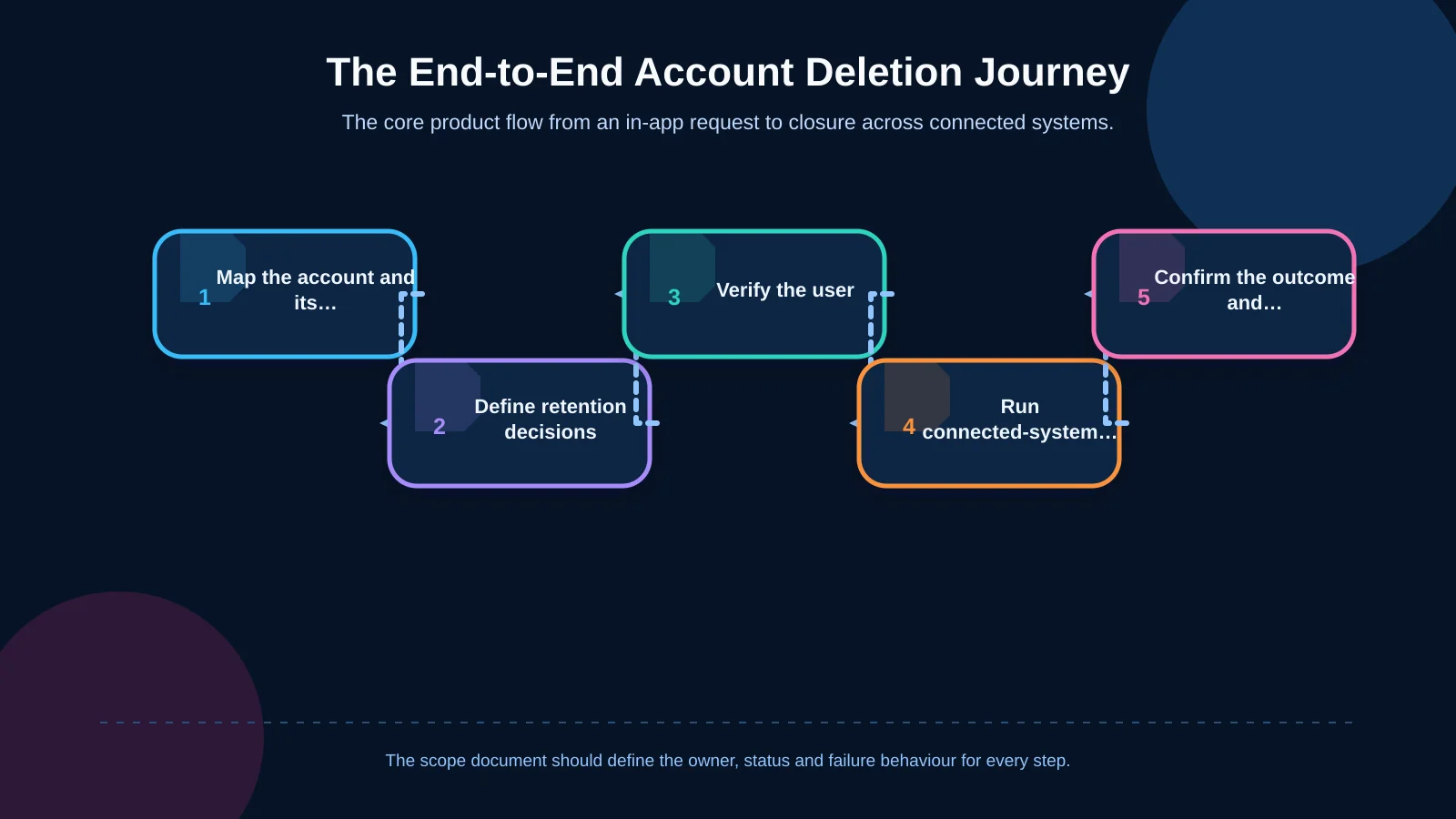
1. Define the account and create a data inventory
Document what an “account” means in your system. Can one person belong to several organisations? Can the last administrator of a family, dealer or team account delete themselves? Are social-login and email credentials merged under one identity? Is a background account created for guests? The answers establish who has deletion authority and how far the action reaches.
Then inventory every relevant location: the mobile API, primary database, file storage, CRM, support platform, analytics stack, notification service and backups. For each one, record the data owner, the field linking information to the user, the deletion or anonymisation method, the reason for retention and the technical owner. This system map should also document dependencies and expected behaviour when an integration is unavailable.
2. Separate deletion, anonymisation and retention decisions
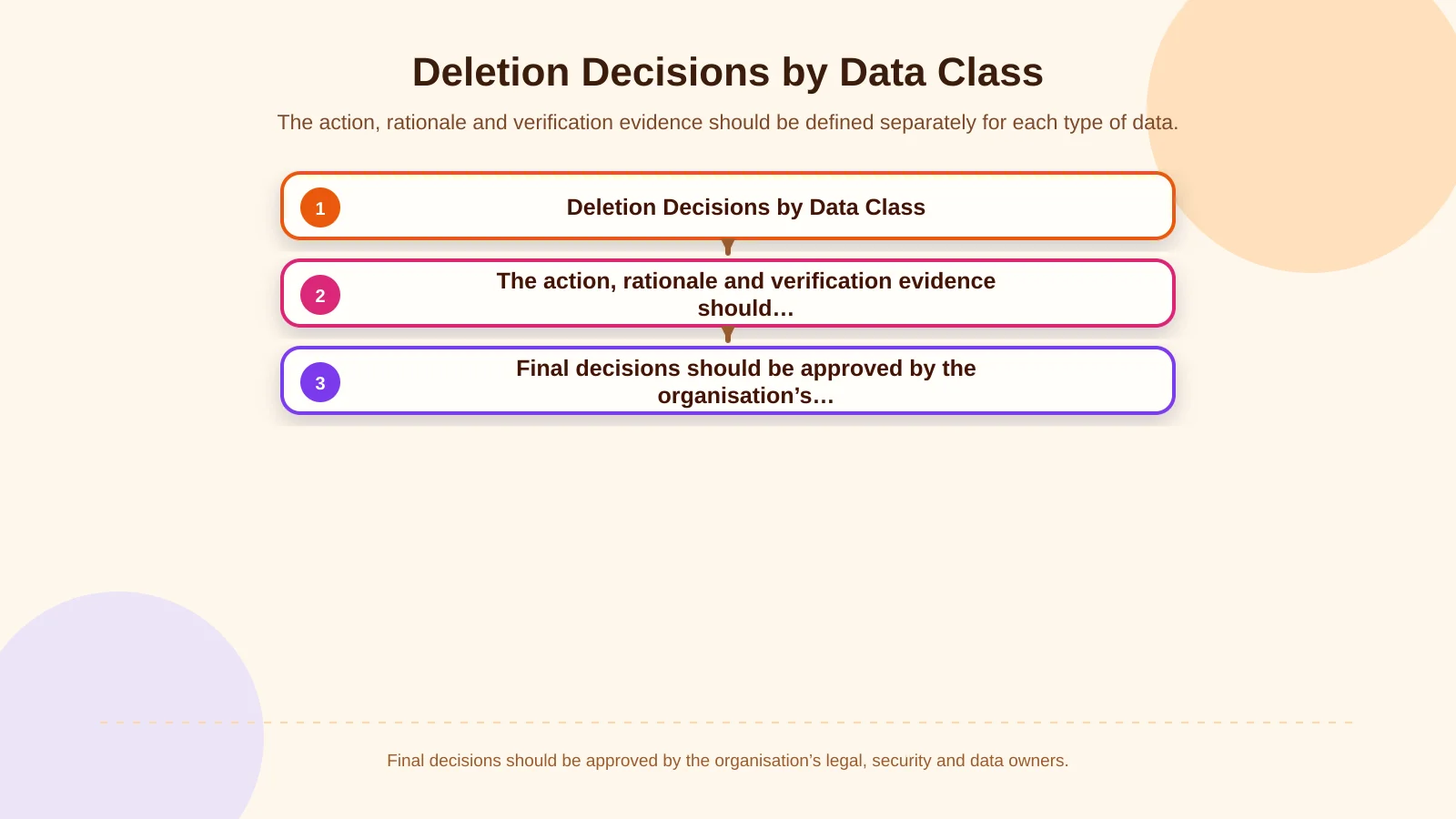
Not every data class receives the same treatment. A profile photo and marketing preference may be deleted; a financial transaction may need restricted retention for a defined period; an analytics event may be anonymised so it can no longer be linked back to the person. Replace vague requirements such as “delete everything” with a decision for every data class: action, rationale, duration, access restriction and responsible owner.
The European Data Protection Board’s guidance on individual rights explains that the right to erasure does not apply identically in every situation and that organisations should facilitate requests and document their responses. Product copy should therefore be precise without making misleading promises. Legal counsel and the organisation’s data owners must determine which data is deleted, what is retained, why it is retained and when the request will be completed. This article is not legal advice.
| Data class | Possible action | Control point | Evidence |
|---|---|---|---|
| Profile and preferences | Delete | Connected data stores | Task result |
| Analytics events | Anonymise | Reidentification risk | Anonymity test |
| Invoices and transactions | Retain with restrictions | Rationale and duration | Decision record |
| Support records | Delete or restrict | Dispute-handling need | Access log |
3. Design the user journey and verification
The option should be easy to find in the account or privacy area. The first screen should explain the consequences, followed by an explicit confirmation step. Depending on risk, verification may require re-entering a password, submitting a one-time code or confirming a recent authenticated session. Possession of an unlocked device alone is not always adequate assurance for such a high-impact action.
Avoid dark patterns. Do not bury deletion beneath unrelated menus, force users to contact support without a valid reason or turn an account-retention offer into a compulsory barrier. An optional reason can support product learning, but declining to answer must not block the request. Kumsal Agency’s React Native mobile app development approach brings user experience and technical requirements into a shared product scope for iOS and Android.
4. Define the waiting period and recovery policy
Some products complete deletion immediately; others allow a short recovery period to reduce accidental deletion or account-takeover risk. This period must not be arbitrary. Define whether signing in cancels the request, which verification is required for cancellation and whether the profile remains visible during the waiting period. A useful state model might include active, deletion pending, processing, completed and failed.
Continuing marketing messages or allowing new content creation during this period can contradict the user’s intent. Specify access, notification and data-creation rules for every state. Any promised completion date must reflect the genuine capacity of the systems and operations team.
5. Orchestrate deletion across connected systems
The mobile client should not attempt to delete data directly from every system. It should send a verified request to the backend, where a central process creates a request ID, queues work and collects results from connected services. Retries must be safe after network or service failures, while repeated submissions must not cause duplicate or inconsistent operations.
A CRM profile might be anonymised while a support ticket is retained with restricted access. Files may be removed from object storage while the search index requires a separate cleanup task. Track successful, pending and failed states for every subtask. Unfinished work should enter an operational queue rather than disappear when one service fails to respond. Authorised monitoring and exception-resolution interfaces can be planned as part of custom web development.
How should subscriptions and commercial records be handled?
Deleting an account and cancelling a subscription are not the same action. Auto-renewing subscriptions managed through the App Store or Google Play may continue after an account is removed from the application database. The deletion screen should detect an active subscription, explain the billing status and direct the user to the relevant store-management route. The organisation must decide how deletion proceeds while a subscription remains active by considering user rights, store requirements and its commercial model together.
Orders, invoices, payment disputes and fraud investigations are separate data classes. Even after account access ends, mandatory records should be visible only to authorised roles and must not be reused for unrelated purposes. When telling a user that an account has been deleted, provide an understandable summary of any limited retention.
How should feedback and user communication be designed?
Pre-deletion information should cover content that will be lost, ongoing transactions, subscription status, any waiting period and the recovery method. If users need an export option for important content, decide whether it operates before the request or during the waiting period. Show account-specific consequences instead of vague technical language.
After submission, the confirmation screen can display a unique reference and expected completion time. Email and push notifications should not expose sensitive data. Unusual requests should include a safe dispute route in case of account takeover. Send the completion notification only after the intended systems have actually finished processing the request.
A deletion-reason question can be brief and optional. If responses remain permanently linked to the deleted account, include them in the data inventory. Product measurement can instead use aggregated events that do not allow the person to be reidentified.
Security, audit trails and abuse controls
Account deletion is a high-impact operation. A recently changed password, new device, unusual location or repeated failed verification may justify additional checks. Excessive friction, however, can prevent legitimate users from exercising control over their accounts. Risk-based verification, support escalation and accessible alternatives should be designed together.
The audit trail must not become a new copy of deleted personal data. Retain only what is necessary, such as a request ID, timestamps, systems processed, result codes and authorised operational actions. Define access permissions and retention periods for these records separately. Protect the deletion endpoint with authorisation, rate limiting, replay protection and idempotency controls that make retries safe.
How should acceptance criteria and test scenarios be written?
Acceptance criteria must cover more than screenshots and the happy path. Test an incorrect password, expired code, offline device, duplicate request, active subscription, last administrator in a team account, failed CRM task and recovery-period cancellation. Include iOS and Android behaviour, accessibility, deep links and requests interrupted by an app update.
- The user can find account deletion within a reasonable number of steps.
- Consequences, subscription effects and retention exceptions appear before confirmation.
- The request is approved using a current, risk-appropriate authentication method.
- Every connected-system task is tracked, with failures retried or assigned to operations.
- Sessions and refresh tokens are invalidated when deletion is completed.
- Re-registration with the former identifier does not restore deleted information.
- The external web request route is mobile-friendly, accessible and functional.
Keep test data separate from production records, and assess deletion alongside backup and restoration policies. If a backup is restored, a suppression or repeat-deletion mechanism must prevent previously deleted accounts from reappearing.
Practical deliverables for the product scope
A useful scope document brings the user journey, interface states, data inventory, integration tasks and ownership model into one framework. Traceable deliverables make it easier for design, development, security and operations teams to produce the same intended outcome.
- An account-type, user-role and deletion-authority matrix
- A system-level data inventory and retention decision record
- User journeys for normal, high-risk and failed states
- The API contract, state model and safe-retry rules
- Subscription, order and commercial-record scenarios
- The operations queue, permission model and audit trail
- Acceptance tests for iOS, Android, backend services and integrations
- Updates to store declarations, privacy copy and support procedures
Every item does not need the same level of automation in the first release. Any manual step must still have an owner, completion target, evidence requirement and escalation path. This turns an MVP decision into controlled phasing rather than postponing hidden data risks indefinitely.
When is the account deletion scope complete?
The scope is complete not when the user can tap a button, but when the request is securely verified, connected data tasks finish traceably and the user receives accurate communication at the right time. Store policies establish the baseline; product quality emerges through data-lifecycle management, failure handling and clear operational ownership.
Kumsal Agency is an Istanbul-based digital agency that develops React Native applications for iOS and Android, custom web software and digital experiences by considering business ideas, user needs and technical requirements together. To scope your mobile app’s account deletion journey across user experience, data lifecycle and integrations, contact Kumsal Agency.