


Aydınlatma metni yükleniyor…
When buying a mobile app security test, comparing only the price or accepting a broad promise that “penetration testing will be performed” is rarely enough. Two proposals with the same label may differ substantially in the platforms examined, API coverage, user roles, testing methods, evidence delivered and post-remediation verification. A low-cost engagement can ultimately create greater risk and expense if it excludes the application’s most critical data flows.
A sound procurement approach treats the iOS and Android clients, back-end services, identity and access model, on-device data, integrations and business rules as one system. The proposal should state which components and versions will be examined, which roles will be used, how testing will be conducted and what constitutes an acceptable deliverable. This guide turns mobile app security testing scope into practical criteria that product, IT, security and procurement teams can compare consistently.
Why should security testing extend beyond the mobile app?
A mobile product is more than the package installed on a phone. It may exchange data with APIs, identity providers, notification services, administration panels, file stores, analytics platforms, payment providers and enterprise systems such as an ERP. A secure client cannot protect the wider system if an API lets one customer retrieve another customer’s record. Conversely, a properly authorised API does not eliminate the risk of credentials being stored insecurely on the device.
The OWASP Mobile Application Security Verification Standard provides control groups covering storage, cryptography, authentication, network communication, platform interaction, code quality, resilience and privacy. However, OWASP’s scope guidance explains that MASVS primarily addresses the mobile client and that remote endpoints require separate assessment. A proposal labelled “mobile testing” therefore should not be assumed to include API security.
Before requesting proposals, map the architecture, data flows, user roles and external systems. When iOS and Android clients are modelled alongside custom web software, APIs and corporate integrations—as in Kumsal Agency’s React Native mobile application development approach—it becomes easier to define realistic test boundaries and avoid gaps between suppliers or system owners.
Technical control areas to include in the proposal
Mobile packages, source code and platform behaviour
The proposal should confirm whether Android and iOS will be tested separately. Even with a shared React Native codebase, platform permissions, secure storage, build settings, network controls and native modules may behave differently. Record the application version, package or bundle identifier, test and production environments, debug features, signing configuration and supported operating-system versions.
Static analysis should be more than an automated scan. The review should address embedded secrets, excessive logging, insecure random-number generation, weak cryptographic use, sensitive screenshots, clipboard exposure, backup behaviour, deep links and WebView configuration. If source-code access is unavailable, the supplier should explain how that limits assurance and which checks will rely on black-box observation instead.
APIs, authentication and authorisation
Prepare an endpoint inventory, documentation, test accounts and representative roles for API testing. A password-policy check is insufficient. Registration, sign-in, multifactor authentication, password reset, device changes, account lockout, session renewal and logout should be assessed as connected journeys. Token lifetime, rotation, revocation and reuse of a stolen session must also appear explicitly in scope.
Authorisation should be tested across roles, objects and actions. Can a customer retrieve another customer’s document? Can a dealer view another dealer’s pricing? Can a field worker access an unassigned work order? Hiding a screen is not an access control: the server must verify the relationship among the user, role, resource and requested operation on every relevant request.
Data at rest and in transit
The testing team needs an agreed definition of sensitive data. Credentials, personal information, financial records, commercial pricing, location data, health information and employee documents may require different safeguards. On-device databases, files, caches, logs, notification content, screenshots and backups should be reviewed. Embedding a key in the application package is not equivalent to storing it in the platform’s protected key store.
Transport testing should cover TLS configuration, certificate validation, clear-text traffic, sensitive values in URLs or logs, and behaviour on untrusted networks. If certificate pinning is used, assess its implementation, failure behaviour and certificate-renewal process. Pinning is one control, not a substitute for secure session management, correct server configuration or disciplined operational ownership.
Device risks, business logic and third-party components
Rooted or jailbroken devices, screen capture, malicious keyboards, clipboard access, emulators, app cloning, reverse engineering and runtime manipulation do not carry equal priority for every product. A banking transaction and an internal announcements app have different threat models. The proposal should identify which device-level risks will be tested and explain any exclusions.
Business-logic testing targets weaknesses that automated tools often miss. Examples include reusing a one-time discount, bypassing an approval sequence, submitting an offline transaction twice, entering a negative amount, exceeding a limit or reopening a cancelled work order. Product owners should help define abuse cases. For payment and ERP integrations, test retries, concurrency, error handling, idempotency and access boundaries between systems.
Request an inventory of software development kits, analytics tools and open-source dependencies. Known-vulnerability scanning is useful, but the assessment should also establish how each component is configured, what data it can access and who owns updates. A dependency list alone does not explain the product’s supply-chain exposure.
Decision sequence for purchasing a security test
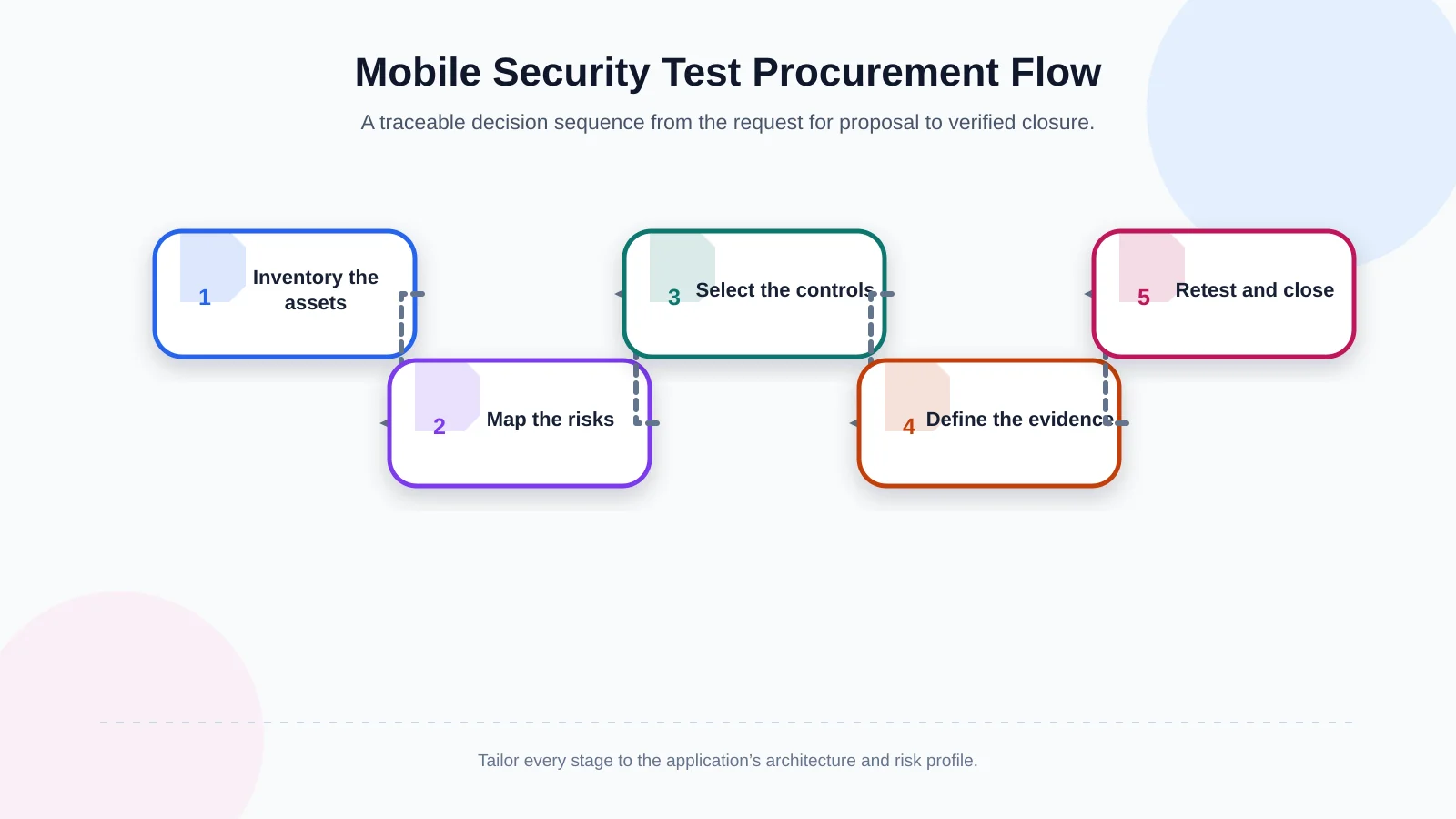
A reliable procurement process begins before the request for proposal. First, inventory application packages, APIs, environments, domains, third-party services and integrations. Next, identify business-critical data, transactions and plausible attacker capabilities. This connects every requested control to a relevant risk rather than producing a generic checklist.
Then define the testing profile. The OWASP Mobile Application Security Testing Guide provides technical processes and platform-specific tests for verifying MASVS controls. Record the referenced version, selected control identifiers and exclusions. “OWASP-compliant testing” is not a measurable commitment unless both the coverage and verification method are stated.
Finally, define access and acceptance criteria. Prepare accounts for every role, source-code access where applicable, a representative test environment, sample data, technical contacts and permitted testing windows. The deliverable should include not just a PDF, but also a coverage matrix, reproducible evidence, an executive summary and retest results.
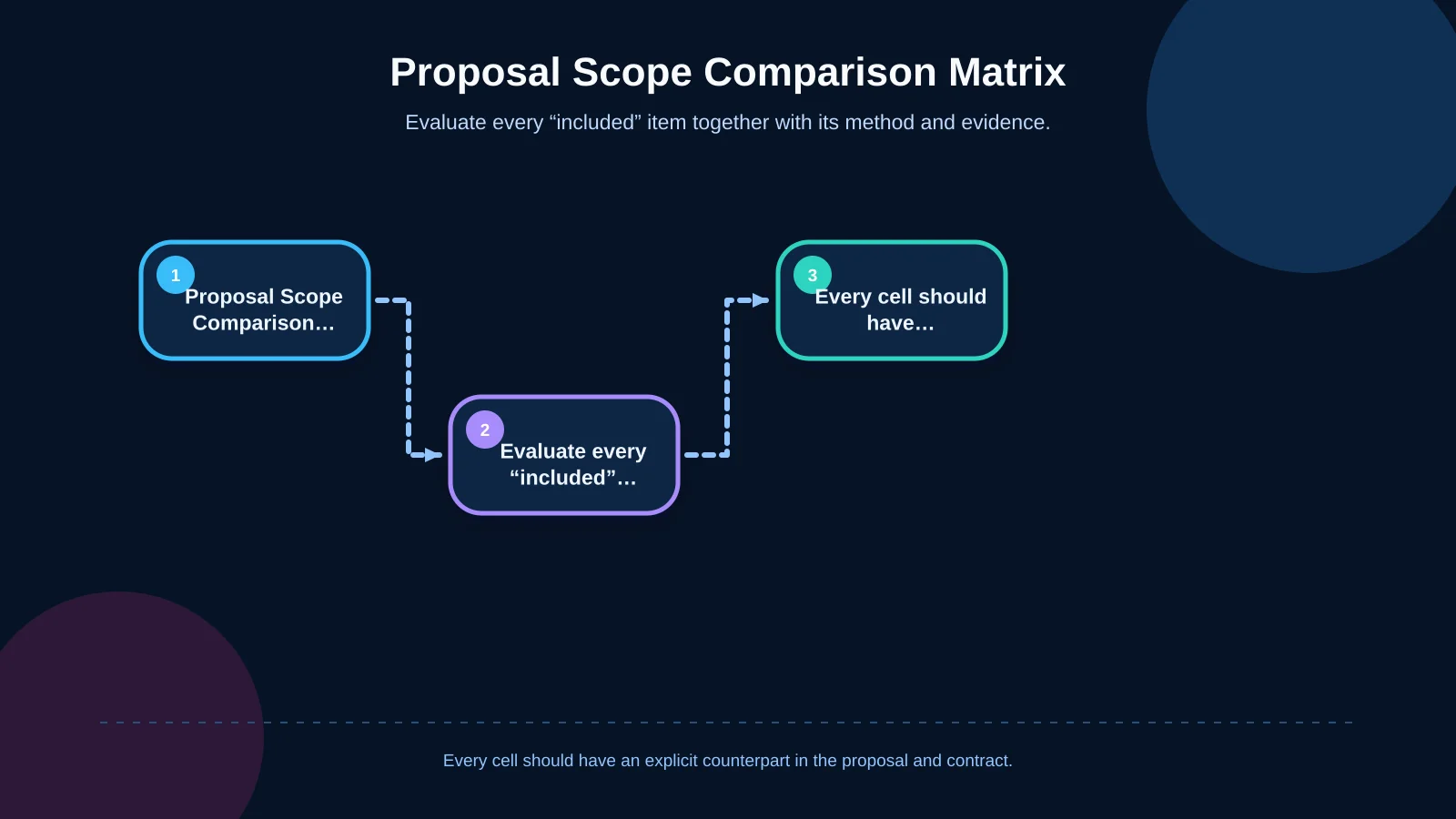
Proposal comparison matrix for like-for-like evaluation
For every line in a comparison table, record whether the item is included, excluded or optional, together with the method and expected evidence. An API test may appear to be included yet consist only of automated scanning, leaving role- and object-level access failures unexplored. A proposal may list both platforms while conducting dynamic testing on Android alone.
Clarify whether the engagement uses black-box, grey-box or white-box testing. Black-box testing reflects an external attacker’s visibility; grey-box testing uses limited accounts and documentation to exercise realistic journeys; white-box testing adds source code and architectural knowledge for deeper verification. These are visibility models rather than quality grades, and a critical enterprise product may benefit from a combination.
Consider the team’s mobile-platform, API and business-logic experience alongside estimated person-days. Tool names may provide useful context, but a tool list is not a test strategy. OWASP guidance likewise stresses that automated tools alone cannot verify MASVS requirements without understanding architecture, implementation and business behaviour.
| Control area | Question to ask | Expected evidence | Common gap |
|---|---|---|---|
| iOS and Android | Will both packages be tested separately? | Version-specific control record | Only one platform is examined |
| APIs and roles | Will every relevant role and object be tested? | Request and response evidence | Automated scanning only |
| Business logic | Will critical workflows be tested for abuse? | Scenarios and reproduction steps | Limited to technical vulnerabilities |
| Delivery and closure | How many retest rounds are included? | Closure report with finding status | Retesting terms remain unclear |
Reporting, severity and verifiable evidence
A useful finding includes a clear title, affected version and component, prerequisites, reproduction steps, technical evidence, expected and observed behaviour, likely impact and an actionable remediation recommendation. Real personal data should be masked in screenshots. Live credentials, passwords and reusable exploit material should not be placed in reports without appropriate safeguards. The contract should also define retention and secure deletion of raw evidence.
Severity should not depend on a generic score alone. Evaluate technical exploitability alongside the data exposed, number of affected users, transaction impact and compensating controls. The same weakness can create different business risks in a public customer app and on managed corporate devices. Executives need prioritised consequences; engineers need enough detail to reproduce and fix the issue.
The coverage matrix should show which tests passed, failed, were not applicable or remained out of scope. “No vulnerabilities found” is not equivalent to evidence that defined controls were verified. Reporting should make scope, completed checks, limitations and supporting evidence visible so stakeholders understand the level of assurance obtained.
How should retesting and remediation be defined?
Do not leave retesting as an ambiguous promise to repeat the original engagement free of charge. State the number of rounds, the period in which they may be requested and whether verification covers only reported findings or also adjacent flows affected by the fix. Agree in advance when a new feature, architectural change or later release becomes additional work.
Track the owner, target date, remediation version and verification result for every finding. Use clear outcomes such as closed, partially remediated, still open or risk accepted. Because a fix can break a neighbouring workflow, plan regression checks for critical changes. Release decisions should rest on accepted risks and retest evidence, not simply on delivery of the first report.
The NIST Secure Software Development Framework recommends integrating security practices throughout the software lifecycle and addressing the root causes of vulnerabilities. From this perspective, testing is not a one-time certificate; it creates feedback among requirements, development, verification, remediation and release management.
Contract and operational terms that should not be overlooked
Name every package, version, environment, API, role, integration and platform to be tested.
State whether source code, architecture documents and account access will be provided.
Define permitted production methods, testing windows, rate limits and the emergency stop contact.
Assign responsibility for creating, masking, retaining and deleting test data.
Specify how critical findings will be escalated without waiting for the final report.
Include report language, delivery format, evidence requirements, retest rounds and closure documentation.
Also assess confidentiality obligations, subcontractor use, where evidence will be stored, professional liability terms and incident communications. Tests that could disrupt production should require separate approval. Where practical, use an isolated environment with realistic configurations and representative data rather than exposing live customer information.
How does accurate scope change price comparisons?
Cost is driven less by screen count than by platforms, roles, endpoints, workflows, integrations, code-review depth, device diversity and retesting effort. An offline field application with five roles and hundreds of API operations cannot receive the same effort as a simple content app. Adding an asset inventory and sample abuse scenarios to the request helps suppliers price against comparable assumptions.
Evaluate the later cost of coverage gaps instead of choosing the lowest headline figure. Ordering iOS or API testing separately, repeating work because accounts were unavailable, or buying retesting as an add-on can erase the apparent saving. Score price together with coverage, method, evidence, duration, retesting and exclusions.
Plan mobile security testing with the development lifecycle
The best results come when security testing is not added as the final gate after the product is complete. Modelling roles, sensitive-data classes, API permissions, offline behaviour and integration failures during discovery can prevent defects before code is written. Code review, dependency checks and automated tests can continue throughout development, followed by an independent assessment before release.
Kumsal Agency develops iOS and Android products with React Native and connects them to custom web software, APIs, ERP platforms and other corporate systems. The objective is not simply to deliver application screens, but to manage roles, data flows, integrations, maintenance and sustainable security within a coherent architecture.
To define a security testing scope around your mobile application’s architecture, data flows, roles and integrations—and to assess the development work it may require—contact Kumsal Agency.