


Aydınlatma metni yükleniyor…
A mobile app launch is often imagined as a single defining moment when the finished product becomes available to everyone. In practice, making an app visible in an app store and giving every user access to every feature are separate decisions. Device diversity, real-world connectivity, server demand, third-party integrations and support requirements only become fully visible after genuine use begins.
There is therefore no universal answer to whether a mobile app should launch to all users at once. A low-risk product with proven infrastructure and prepared operations may be suitable for an immediate full release. An app that handles payments, location data, ERP transactions, high traffic or business-critical information may benefit from a pilot or staged rollout. The goal is not to delay growth, but to define the evidence required before expanding access.
What does launching to all users at once mean?
A full launch makes the app downloadable across its target market and provides access to its core features without pilot restrictions. This model can align with a major campaign, press announcement, contractual date or industry event. It can also cause demand, infrastructure load and support requests to rise within a very short period.
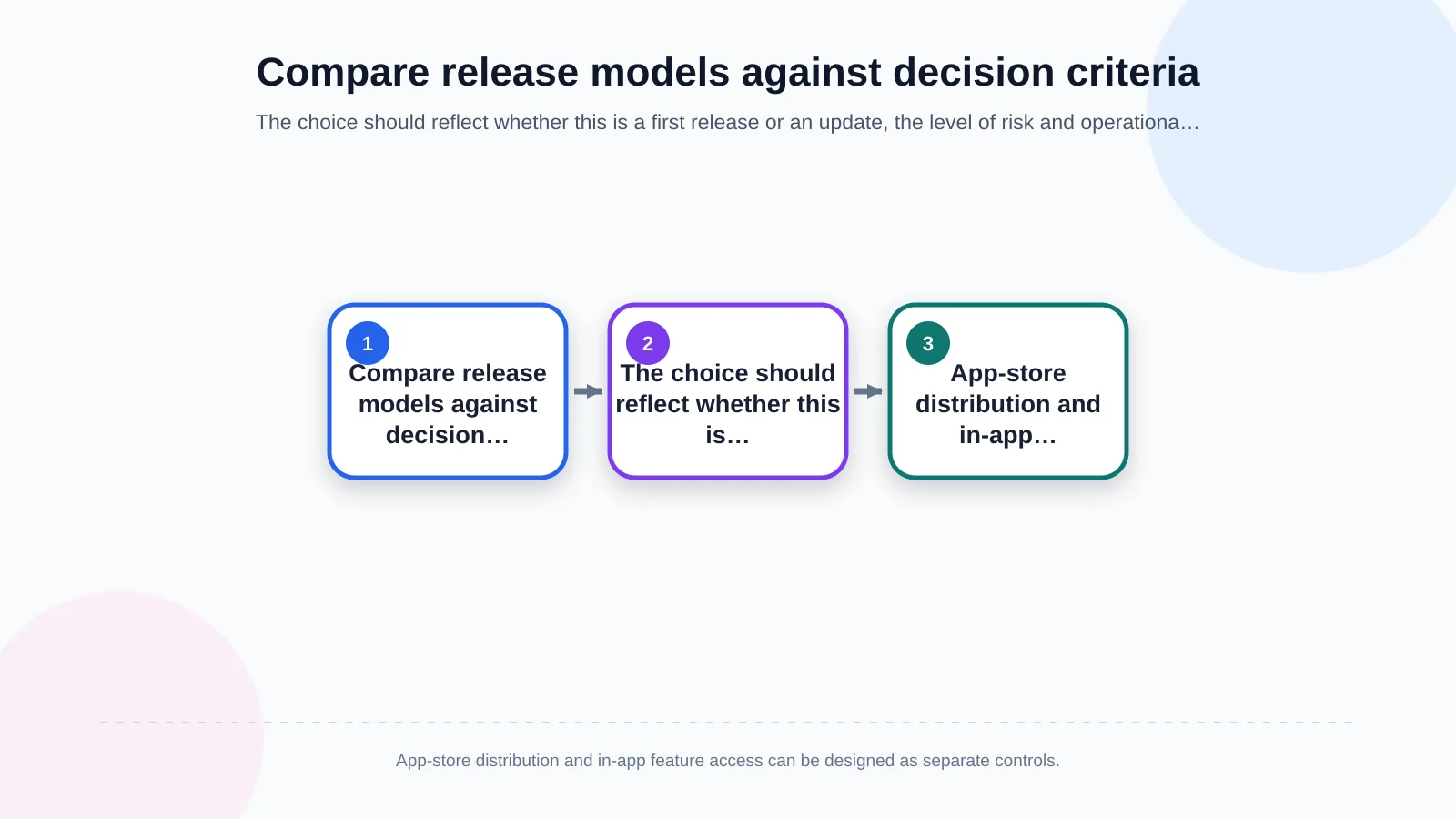
App-store distribution should be separated from feature access. An app may be publicly downloadable while a new module is enabled only for a selected segment. Conversely, store access may remain restricted while a pilot group tests the entire experience. The more useful question is not simply “Has the app launched?” but “Which users can perform which tasks, under what conditions?”
Why choose a pilot or staged rollout?
Test environments are essential, but they cannot reproduce every variable found in real use. Different operating-system versions, unreliable connections, unexpected user behaviour, device permissions and delays in third-party services can create new outcomes in production. A limited release allows the team to observe these uncertainties within a smaller area of impact.
A staged rollout is also an operational learning mechanism. It reveals where identity verification fails, whether notifications are understood, which screen causes abandonment and what questions reach the support team. The purpose is not merely to find software defects. It is to determine whether the product meets a real need in a clear, reliable and sustainable way.
Three core mobile app release models
| Model | Best suited to | Primary advantage | Key consideration |
|---|---|---|---|
| Limited pilot | First release with high uncertainty | Detailed qualitative feedback | Selecting a representative group |
| Staged rollout | Updates to a live product | Limits the area of impact | Close monitoring and pause controls |
| Full launch | Low risk and prepared operations | Fast market access | Sudden demand and support volume |
| Hybrid approach | Broad access with selected features | Flexible feature control | Version and feature-flag management |
Limited pilot group
In a pilot, the app is tested with a defined community such as employees, selected customers, dealers, one branch or invited early users. This gives a first-release product a controlled environment for learning. The group must represent the intended audience: a pilot made up only of technically confident employees may miss the difficulties experienced by real customers.
Staged rollout
In a staged rollout, access expands through predetermined percentages or segments. A business might start at one location, continue with several cities and then open the product across the market. Google Play’s staged rollout guidance explains how an update can reach a chosen percentage of users and how distribution can be halted if a problem appears. This mechanism applies to app updates rather than an app’s initial release.
Full simultaneous launch
A full launch is reasonable when technical uncertainty is low, capacity has been validated, support is prepared and communication is coordinated. A simple content app or a product already tested under comparable demand may be a suitable candidate. Even then, a full release does not remove the need for monitoring, incident response and rollback controls. Teams should still be able to disable critical features remotely and deliver urgent fixes.
How should you choose a mobile app launch model?
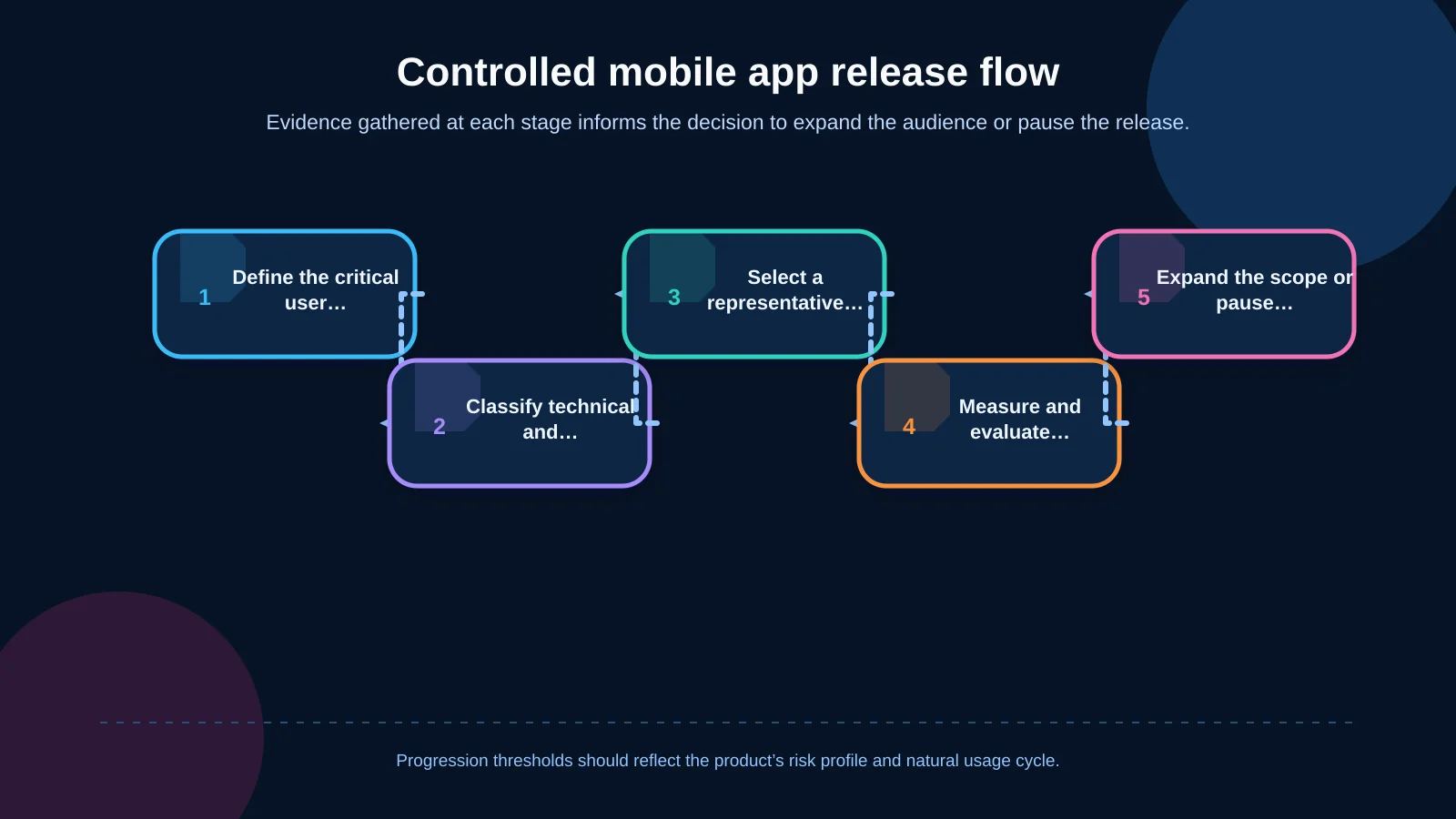
The decision should not belong to the software team alone. Product, operations, customer service, information security and marketing teams need to work from the same risk picture. A structured sequence turns the choice from an instinctive preference into a measurable decision.
- Define the target user and the critical task they must complete.
- Classify high-impact risks involving payments, identity, data loss and integrations.
- Set the initial volume that infrastructure and support teams can handle safely.
- Establish progression thresholds for technical health, user success and operations.
- Expand, pause or reverse the release according to the evidence.
This work should be completed before the release date. Otherwise, teams may start debating which signals matter only after an incident occurs. Written success, pause and rollback criteria make decisions faster, more consistent and easier to audit.
Which risks should determine the release scope?
User and experience risk
If users cannot complete registration, verification, search, ordering or booking, the problem is not merely cosmetic: the product has failed to deliver its value. During a pilot, teams should assess task completion, abandoned steps, accessibility issues and the quality of feedback together. Page views or download totals alone provide little evidence of successful use.
Technical and security risk
Crash-free sessions, response times, failed API calls, battery consumption and behaviour across device types should be monitored. For products processing personal data, payments or location, authorisation, logging and retention policies are also release conditions. Firebase Remote Config rollouts can support controlled feature exposure and comparisons between enabled and control groups using stability and business outcomes.
Operational and integration risk
A flawless mobile screen does not complete the service if ERP inventory is unavailable, CRM records are not created or support requests cannot be answered. Scenarios such as duplicate orders, delayed payment outcomes, expanding notification queues and failed data transfers must be tested. The mobile client, back-office software and external services should be treated as one operational chain, with clear ownership for retries, reconciliation and exception handling.
How should you select a pilot group?
A useful pilot group is not simply a collection of convenient participants. It reflects real usage conditions across user roles, device types, operating systems, locations, connection quality and frequency of use. Offline conditions may be critical for field employees; consumer apps may require both new and existing customers; enterprise products may need users with different authority levels.
Group size is not a success measure by itself. Repeating critical scenarios enough times is usually more valuable. The pilot should also cover the product’s natural cycle: an application used for monthly reporting cannot be judged from a few days of activity. Participants should know where to submit feedback, when support is available and how their data will be processed.
How should release stages and progression gates be designed?
A practical plan may include internal testing, a representative pilot, limited live use, expanded release and full availability. Scope, duration, accountable teams and progression criteria should be documented for every stage. Reaching a scheduled end date must not automatically authorise the next stage.
Store-level controls can help with updates. According to Apple’s phased release guidance, eligible updates can be distributed to users with automatic updates over seven days and the process can be paused under defined conditions. Users can still install the update manually from the store. Store distribution should therefore be combined with in-app feature flags and server-side controls.
Which metrics should you monitor during launch?
A single active-user figure cannot support a sound launch decision. Technical, experiential, operational and commercial indicators should appear in the same decision framework. Every metric needs an expected range, a reliable data source, an owner and a defined response time.
- Technical health: crash-free sessions, critical errors, API error rates and response times.
- User success: registration, first-value moment and core-task completion.
- Behaviour: abandoned steps, repeat use and permission refusal.
- Operations: support volume, resolution time and manual intervention.
- Business outcomes: qualified transactions, orders, bookings or completed workflows.
These signals should not carry equal weight. A small decline in registration may justify investigation, while data loss or an incorrect charge may require the release to stop after a single incident. Thresholds must reflect the product’s actual consequences rather than generic benchmarks.
Why do you need a pause and rollback plan?
A staged release reduces risk only if the team can stop it. Pausing distribution limits exposure among new users, but it does not automatically return users who already received an update to the previous version. Server-side controls, feature flags and backward-compatible APIs must therefore be planned independently of the client release.
The rollback plan should identify decision authority, the communication chain, features that can be disabled, data-correction procedures and the time needed to prepare a replacement build. It should also define how long older app versions will remain compatible with new services. The plan needs rehearsal in a test environment and, where feasible, through a controlled production scenario.
Plan React Native, integrations and scaling together
Teams seeking shared product logic across iOS and Android can consider React Native mobile app development. A shared codebase can simplify development and maintenance, but device permissions, notifications, store requirements and platform-specific behaviour still require separate testing.
Launch readiness extends beyond the mobile client. Custom web software, administration panels, ERP, CRM and third-party services must follow the same scaling plan. When an order or task originates on a phone, the team must know which system owns the authoritative record, how failed transfers are retried and who resolves inconsistent data. Kumsal Agency’s custom web development approach connects software architecture to business processes, roles, data and integration requirements.
Does a staged rollout slow down marketing?
A staged rollout does not have to weaken campaign impact. It aligns marketing activity with product readiness. Pre-registration, invitation-only access, location-based launches and waiting lists can manage demand while giving the team room to learn. Access conditions should always be communicated honestly and clearly.
If major media spending begins before product and operational gates are approved, a technical issue can quickly become a reputational problem. Feedback from pilot users can instead strengthen campaign language, use cases and responses to objections. Bringing user experience and digital brand consulting into launch planning early helps reduce the gap between the product promise and the experience users actually receive.
When can you consider a direct full launch?
A simultaneous launch may be appropriate when the product has limited functionality, avoids sensitive transactions, uses infrastructure tested at a similar scale and has sufficient support capacity. Legal or commercial conditions may also require access for everyone on the same date. The justification, however, should be documented readiness rather than an inflexible calendar.
A full launch remains high-risk without load testing, security checks, store approval, monitoring dashboards, named incident owners and prepared user communication. Products involving payments, healthcare, finance, field operations or real-time inventory will often produce better evidence by starting with a smaller representative audience.
Conclusion: Reaching everyone is the goal; launching to everyone at once is not a requirement
A mobile app’s success depends less on first-day downloads than on whether users can complete essential tasks safely and consistently. Pilots, staged rollouts and full launches are not competing philosophies. They are release tools selected according to product maturity, uncertainty and potential impact.
Kumsal Agency approaches mobile products through the business idea, user need, React Native development, data security, custom web software, ERP integrations and sustainable operation—not the interface alone. Work with Kumsal Agency to define the right pilot group, release stages, integrations and scaling plan for your mobile application.