


Aydınlatma metni yükleniyor…
In B2B software projects, the person who approves the purchase is often not the person who uses the system every day. A managing director may focus on return on investment, procurement on total cost, IT on security and integration, an operations manager on process control, and an end user on completing tasks with less effort and fewer errors. Researching only one of these perspectives can produce software that works technically but fails to gain adoption across the organisation.
B2B UX research should therefore not be built around a single, generic “customer” profile. The people who influence the decision, approve the budget, administer the system, provide data and perform daily work should be examined separately. The objective is not to add every request to the product. It is to bring different goals, workflows and constraints together in one evidence-led product plan.
Why does the difference between buyers and users matter?
Buying stakeholders usually evaluate organisational outcomes: Will the software reduce costs? Will it make the process traceable? When will the investment create value? Can it work with the existing ERP? Users encounter more immediate problems: Can they find the right record? Do they understand which field to complete? Can they undo a mistake? Must they enter the same data again?
Both perspectives are valid, but they are not interchangeable. Management may request a detailed approval structure to keep every order under control. Sales representatives may show that the same structure creates unnecessary delays for low-risk orders. The researcher’s job is not to choose between control and speed. It is to gather enough evidence to design a flow that changes according to risk.
Without this distinction, executive opinions may be mistaken for user needs, existing procedures may be digitised without being questioned, or control requirements may be overlooked in pursuit of convenience. Nielsen Norman Group explains that stakeholder interviews help teams understand business goals, success criteria and project context. They are valuable, but they do not replace research with actual users.
Start by mapping the role ecosystem
The first step is not merely to review the organisation chart. Map the decisions, dependencies and interactions around the product. In a B2B portal, the economic buyer, project sponsor, procurement specialist, IT security team, ERP owner, dealer manager, order-entry employee, finance approver and support team may all interact with the same system differently.
Record four points for every role: Which decisions do they make? Which tasks do they perform? Which data do they access or create? How do they judge success? This produces behavioural and responsibility-based groups that can guide research more effectively than broad personas defined mainly by job title.
Include people who may never use the interface directly. A compliance manager can influence retention policies without opening the application. A finance director can define credit-limit rules without placing an order. Support teams hold ticket and call data that reveals recurring user difficulties. The map should make clear how each influence could affect product decisions.
Create separate research questions for buyers and users
Applying the same interview script to everyone is rarely productive. Research with buyers can explore the investment case, expected business outcomes, budget and time constraints, risks, supplier-selection criteria, security requirements and acceptance conditions. Asking, “How will you know in six months that this investment has succeeded?” helps turn an abstract expectation into a measurable outcome.
With daily users, the goal is to understand behaviour in its real context. What triggers the task? Where does the information come from? Which side channels—such as spreadsheets, email or messaging—are involved? Where do users wait, and who helps when something goes wrong? Before asking how a process should work, ask the participant to demonstrate the last time they completed it.
The GOV.UK Service Manual recommends treating suggestions from people other than users as assumptions to validate through research. It also recommends studying those who deliver or support a service, as well as those who use it. This approach to learning user needs is especially useful in B2B projects, where executive requests can easily be confused with observed user behaviour.
How should B2B UX research be conducted?
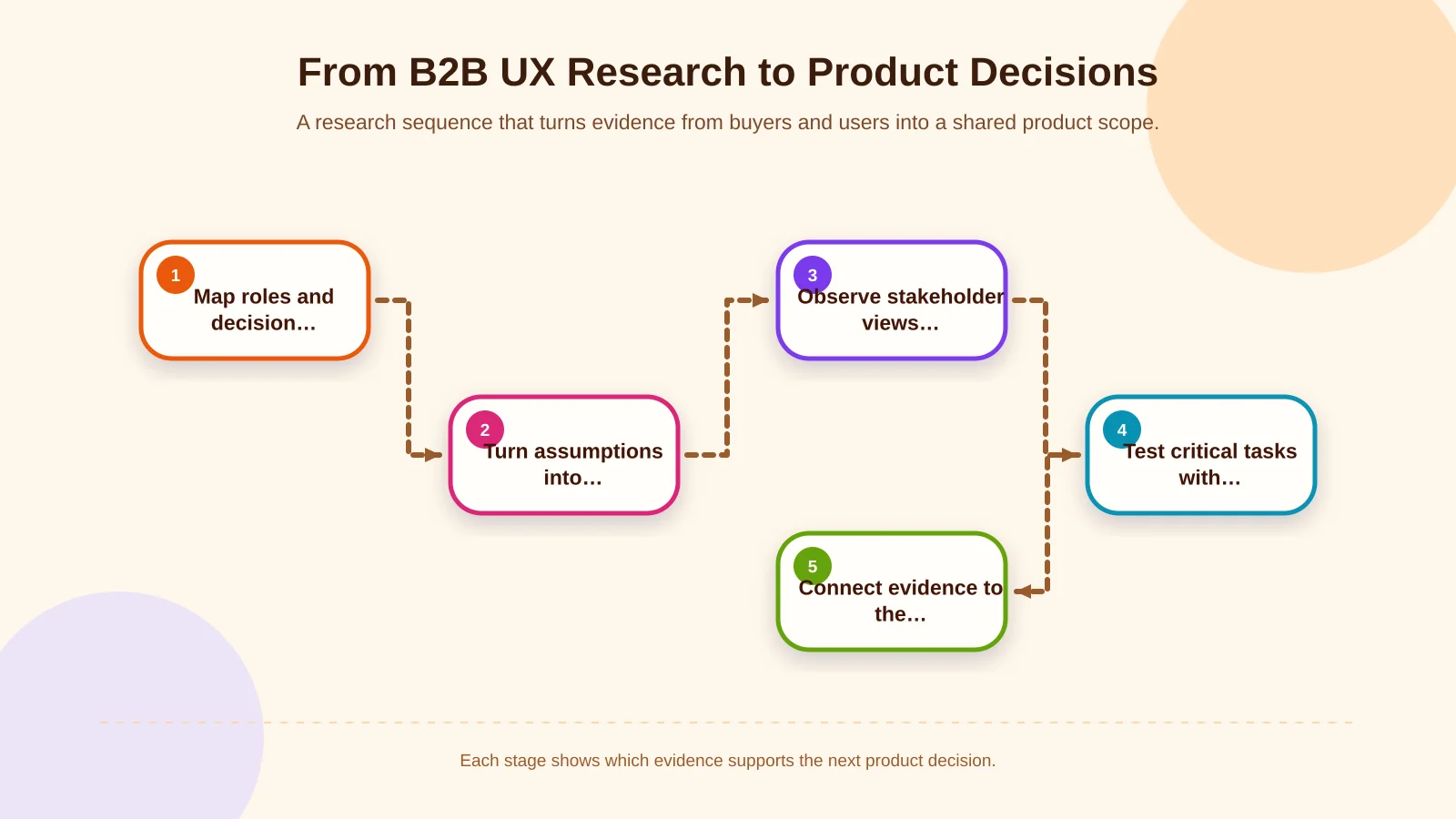
1. Identify decision-making and usage roles
List the project sponsor, economic buyer, technical evaluator, manager, operator and support roles. People with similar titles may work in very different processes, so recruit participants by task frequency, authority, location, device use and experience with exceptions—not seniority alone.
2. Turn assumptions into research questions
“Dealers want a mobile app” is an assumption, not a finding. Replace it with a neutral question such as, “Which tasks do dealer employees perform away from a desk, and where do current channels break down?” This prevents the team from using research merely to validate a solution it has already selected.
3. Combine interviews with contextual observation
Stakeholder interviews reveal investment goals and organisational constraints. User interviews, contextual observation and process walkthroughs expose gaps between the stated process and real work. Where possible, ask participants to complete a realistic task on their own device. Record the notes, files, messages and verbal approvals used around the screen as part of the workflow.
4. Test critical tasks with prototypes
Translate findings into low- or medium-fidelity prototypes. Test high-value tasks such as preparing a quotation, submitting a bulk order, granting approval, checking a shipment or correcting an error with realistic data. Do not explain the interface. Observe where the participant starts, which wording they misinterpret and whether they complete the task. For complex ordering scenarios, the guide to planning B2B bulk ordering offers a related example of validation, preview and error-handling decisions.
5. Connect evidence to product decisions
Record each finding with the affected role, task, evidence, business impact, recommendation and priority. Research should not remain inside a presentation. Link it traceably to product requirements, acceptance criteria, integration scope and the roadmap so the team can see why each decision was made.
What evidence should be collected from different stakeholders?
Decision-makers provide strategic objectives, budget limits, risk tolerance, regulatory obligations and definitions of investment success. IT and data teams clarify authentication, role permissions, systems of record, integration frequency, error management, logging and security requirements.
Managers reveal work allocation, approval points, performance monitoring and exception handling. End users reveal task steps, transaction volume, frequent errors, repeated data entry, delays and unofficial workarounds. Support tickets, analytics, training documents and existing screens provide secondary evidence that can confirm or challenge interview statements.
Evidence does not need to take one form. A manager’s statement that orders are completed late is an initial signal, not a conclusion. Test it against transaction times, reasons for waiting and direct observation. Usability can be assessed through task completion, time and error measures. GOV.UK’s usability benchmarking guidance recommends interpreting performance measures alongside user research.
| Stakeholder group | Primary focus | Evidence to collect | Decision influenced |
|---|---|---|---|
| Decision-maker | Investment and risk | Objectives, budget, success measures | Priorities and scope |
| IT and data team | Security and integration | Data sources, permissions, errors | Technical architecture |
| Operations manager | Control and exceptions | Approvals, work allocation, delays | Business rules |
| Daily user | Tasks and usability | Steps, errors, side channels | Workflow and interface |
| Support team | Recurring problems | Request type, frequency, resolution | Improvement priority |
How can conflicting needs become a shared product plan?
Conflict is not a research failure; it is often one of the most valuable findings. Management may want detailed control, users may want speed, IT may seek standardisation, and sales may require flexibility. Turning every request directly into a feature creates a complicated product. First identify the objective or risk behind each demand.
For example, procurement may ask for every order to receive managerial approval because it fears budget overruns. Users may ask to remove approval because routine orders spend too long waiting. A better response could be a role-based workflow triggered by order value, product group, credit status or exception conditions.
Prioritisation can use four dimensions: the frequency and criticality of the user task, contribution to business goals, operational or legal risk, and technical dependencies. This makes the reasoning visible and prevents the loudest stakeholder from automatically determining the roadmap.
How do research findings affect software scope?
Effective UX research changes more than screen layouts. Findings can influence roles and permissions, data fields, business rules, notifications, integration direction, offline behaviour, audit trails and management dashboards. If a user enters the same information into three systems, the core problem is not button placement; it is data ownership and integration design.
Research deliverables may therefore include a role matrix, current-state and target-state process maps, critical scenarios, user-need statements, requirements, prototypes, a risk register and a measurement plan. In custom web development planned around the organisation’s real processes, these outputs provide a shared reference between experience design and technical architecture.
For ERP-connected systems, the team must also decide which data is mastered by the ERP, which records the portal can write, what users see during synchronisation delays and who manages failed transfers. These decisions directly affect both user trust and operational sustainability.
Define success for buyers and users together
For buyers, success may mean lower transaction costs, greater process visibility, reduced compliance risk or measurable contribution to business results. For users, it may mean completing a task faster, making fewer errors, seeing an accurate status and progressing without support.
A shared measurement plan can combine task-completion rate, processing time, error and rework counts, support requests, manual interventions, adoption and total cycle time. Define a baseline, target, data source, responsible team and measurement period for each metric. Satisfaction alone is insufficient; support it with behavioural and operational indicators.
Common B2B research mistakes to avoid
- Interviewing only budget approvers and calling it user research.
- Treating the most experienced operator as representative of every user.
- Asking leading questions that defend the current solution.
- Studying normal flows while excluding returns, rejections, lost connections and permission errors.
- Accepting interview claims without checking them through observation, records or task tests.
- Leaving findings as general recommendations without priorities, owners or acceptance criteria.
- Treating research as a one-off activity at the beginning of the project.
Treat research as part of the product lifecycle
During discovery, learn the roles, problems and process context. During design, test critical flows with prototypes. In a pilot, observe real data, permissions and integration behaviour. After launch, use analytics, support records and further research rounds to assess whether the product continues to meet changing needs.
B2B responsibilities, regulations, pricing policies and integrations evolve. Maintain the research repository as a living decision record, including the date of each finding, the roles covered and the supporting evidence. An old finding should never be treated as a permanent truth.
Kumsal Agency approaches B2B software beyond the interface, planning around brand objectives, user roles, real business processes, data structures, security and integration needs. Its research-led digital brand consulting combines user experience, interface design and robust software infrastructure to shape B2B portals, ERP-connected systems, mobile applications and management platforms for each organisation.
To map buyer and user needs together, identify critical scenarios and define a tailored research and development scope, contact Kumsal Agency.