


Aydınlatma metni yükleniyor…
For an organisation managing more than 50,000 technical product records, the challenge is not simply moving every item into one database. The real task is to connect the commercial truth held in ERP, the technical content maintained by product teams and the different data requirements of each sales or publishing channel within one consistent architecture. When stock codes are stored in ERP, dimensional tables in spreadsheets, installation documents on file servers, images in separate folders and marketplace descriptions in individual dashboards, changes become difficult to trace. A product may show the latest specification on the corporate website while an outdated value remains in a PDF catalogue.
At this scale, PIM is not a replacement for ERP. It is the management layer that enriches, validates, versions and prepares product information for distribution. A robust architecture defines data ownership clearly, makes integration jobs safely repeatable and prevents a small number of invalid records from blocking every publication flow. For an introduction to the underlying concepts and system boundaries, see the product information management guide. This article focuses specifically on the architectural decisions required for 50,000 or more technical products.
How should a PIM data model support 50,000+ products?
The data model should not be created by copying the existing ERP product table into PIM field for field. ERP is usually authoritative for product codes, base descriptions, units, tax, cost, inventory, sales status and organisational data. PIM needs a more flexible structure for technical attributes, category relationships, variants, applications, documents, images, translations and channel-specific content. The design process should therefore begin by asking where each field originates, who may change it and which systems consume it.
The product core should contain an immutable internal identifier, the ERP product code and external identifiers such as GTIN where applicable. Treating identity and the marketing name as the same field is a serious modelling error. A product name may change by language or channel, while its unique identity must remain stable throughout the integration lifecycle. The GS1 Global Data Model organises attributes needed to list, order, store, transport and sell products. Even when GS1 adoption is not mandatory, its distinction between common definitions, category-specific attributes and local requirements offers a useful modelling principle.
Category, attribute and unit design
Technical catalogues should use attribute sets instead of adding hundreds of mostly empty columns to every product. A pump category may require flow rate, head and connection diameter, while an electric motor may require power, voltage, efficiency class and ingress-protection rating. Each attribute needs a defined data type, unit of measure, permitted values, multi-value behaviour, language dependency and channel visibility.
Values such as “10”, “10 mm” and “1 cm” should not be stored as unrelated text. Doing so undermines filtering, comparison and automated validation. Storing the numeric value separately from its unit makes conversions and channel-specific presentation safer. Controlled vocabularies are equally important: synonyms may be accepted during import, but the PIM should resolve them to an approved reference value.
Variants, relationships and digital assets
The variant model should separate the product family from the sellable stock-keeping unit. Shared specifications can be inherited from the family, while differentiators such as colour, diameter or voltage remain at variant level. Accessories, spare parts, alternatives, compatible products and parent–child assemblies should use defined relationship types rather than free-text references.
Images, technical data sheets, CAD files, certificates and manuals are more than file links. They should carry metadata including asset type, language, version, validity period, usage rights and associated products. This makes it possible to determine whether a document is current, whether it may be published in a specific market and which products are affected when it changes.
ERP–PIM field mapping and data ownership
The field dictionary prepared before integration must cover more than technical source-to-target mapping. Each row should identify the source field, target field, data type, transformation rule, requirement status, default value, system of record, business owner and conflict behaviour. The base unit may belong to ERP, the SEO description to PIM, inventory quantity to ERP and channel ordering to the commerce application. This prevents a PIM edit from being unexpectedly overwritten during the next ERP import.
In SAP environments, product master data is not one flat table. It spans sales, plant, storage, purchasing, units of measure, descriptions and other organisational contexts. The SAP Product Master API documentation likewise exposes separate product entities for reading, creating, updating, deleting and batch operations. The integration contract should therefore not stop at a generic “product card”. Organisation, plant and sales-area contexts need explicit mapping even when a different ERP platform is used.
Preventing conflicts in bidirectional data flows
Allowing both systems to update every field does not create flexibility; it creates ambiguity. A system of record should be assigned to each field or field group. ERP-owned values such as the product code, commercial status or base unit can appear as read-only in PIM. PIM-owned technical descriptions or channel images should return to ERP only where a defined business process requires them.
For exceptional fields that both systems can change, use version numbers, modification times and documented precedence rules. If timestamps determine priority, system clocks and time zones must be consistent. Conflict handling should also remain visible to users rather than silently selecting one value and losing the other.
Full and incremental synchronisation flow
A full synchronisation is appropriate during initial implementation or after a major model change. Day-to-day operations should use an incremental flow that transfers only changed records. Re-reading 50,000 products after every update places unnecessary pressure on ERP, network capacity and PIM validation services. Incremental processing alone, however, is not enough. Scheduled reconciliation must detect missed events, while a controlled full reload remains available for recovery.
The basic unit of synchronisation should be a versioned change rather than an unqualified product snapshot. Each message can carry a unique event ID, product identity, source version, changed fields, processing time and correlation ID. Processing must be idempotent so that receiving the same event twice produces the same result. A late event containing an older version must not roll back the current record; it should be rejected or routed for review.
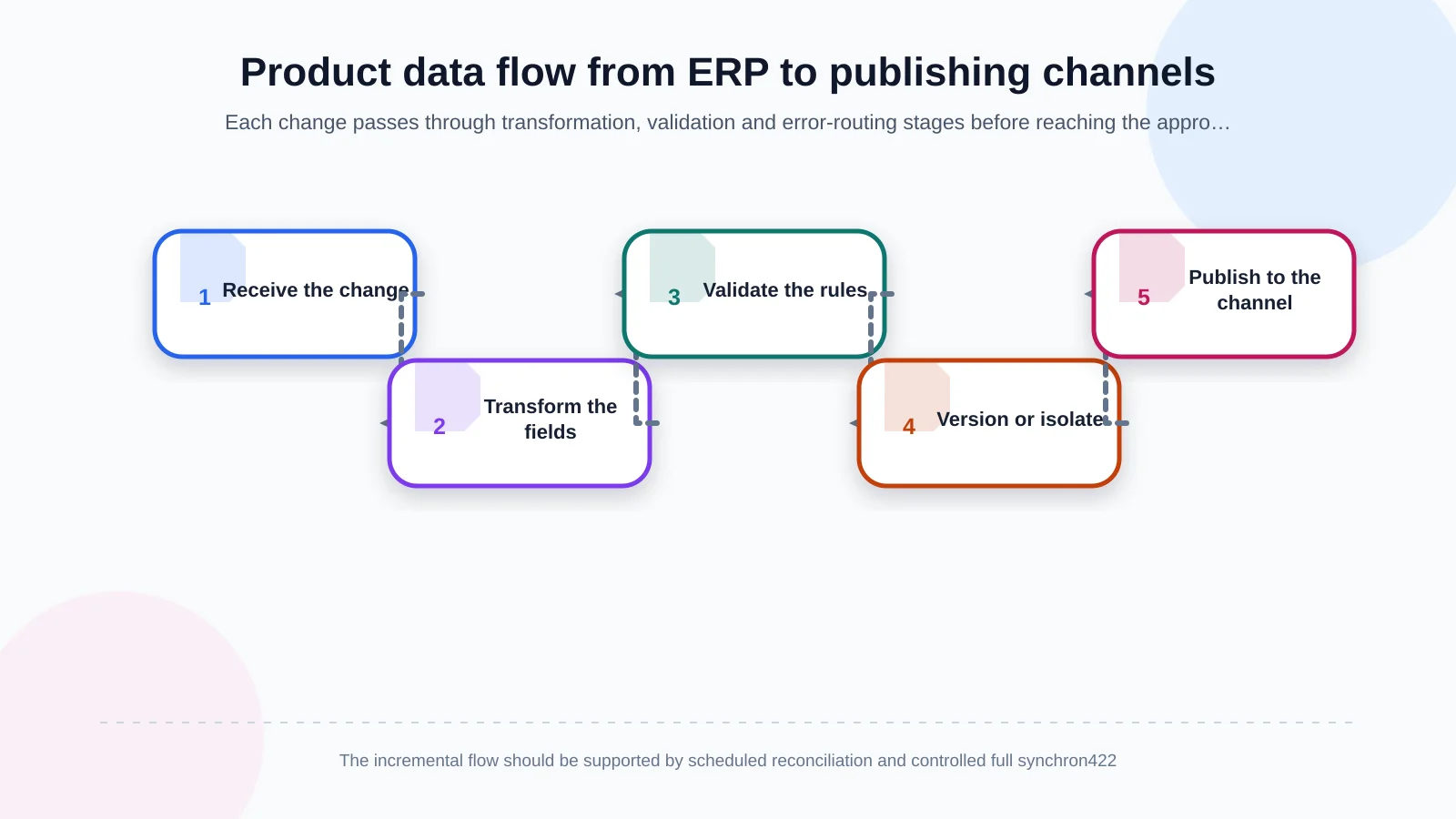
- Receive product and organisational changes from ERP.
- Transform fields according to the integration contract and normalise units.
- Run PIM schema, mandatory-field and reference checks.
- Version successful records and route invalid records to the error queue.
- Transform publication-ready products into the appropriate channel packages.
Performance and consistency in batch processing
Records should be divided into bounded batches, with concurrency limited according to ERP and PIM capacity. One defective record should not roll back thousands of valid items. Every job summary should report how many records were read, created, changed, skipped and rejected. Operations teams also need the start and finish times, last successful cursor, processed version range and safe restart point—not merely a generic “completed” status.
Performance testing should reflect real product complexity. A simple item with ten attributes is not equivalent to a configurable family containing hundreds of variants, documents and relationships. Throughput targets should therefore be evaluated by payload size and processing cost as well as product count.
Validation, error queues and reprocessing
Data quality is part of synchronisation, not a final check on the publishing screen. Schema validation checks data types, lengths and formats. Business rules verify category-specific mandatory attributes. Reference controls confirm that categories, units, languages and related products exist. Channel validation then evaluates destination-specific requirements such as title length, image availability and marketplace category mapping. A product may be accepted into PIM while remaining “not ready” for one particular channel.
A temporary connection failure should not be handled like an invalid unit of measure. Transient errors can be retried a limited number of times with increasing delays. Permanent data errors should enter an error queue with a reason code, a clear explanation and an assigned owner. Microsoft’s explanation of dead-letter queues describes keeping messages that cannot be processed in a separate queue so they can be inspected, corrected and resubmitted. The same principle applies to PIM integrations regardless of the underlying messaging infrastructure.
- Record every error with its product, field, source value and rule identifier.
- Route corrections to the correct data owner when the source must be fixed in ERP.
- Allow reprocessing to target one failed record or a selected batch.
- Limit retry counts to prevent infinite loops and unnecessary integration load.
- Close the original error after correction while preserving its relationship to the new attempt.
| Condition | Example | Automated action | Human intervention |
|---|---|---|---|
| Temporary connection failure | ERP timeout | Retry a limited number of times | Not normally required |
| Schema error | Invalid data type | Route to the error queue | Correct the field |
| Reference error | Unknown unit | Stop publication | Map the reference |
| Channel error | Missing mandatory image | Hold the channel publication | Complete the content |
Versioning, role management and audit trails
An incorrect certificate or dimensional value is not merely a content issue; it can affect quotations, production decisions and customer trust. The platform must record who changed each field, when it changed and why. Version history should expose changed fields, previous and new values, source system and approval state rather than only storing opaque snapshots. A rollback should create a new version instead of silently erasing history.
Permissions can be constrained by role, product group, organisation, language and operation. Technical teams may maintain specifications, marketing teams may manage channel copy and local teams may edit only their assigned language. Critical changes can require separate author and approver roles. Service accounts should remain distinct from personal accounts, API permissions should follow least-privilege principles and credentials should be rotated regularly.
Multichannel publishing architecture
The master PIM record should not be sent unchanged to every destination. A corporate website may require detailed specification tables and documentation, while a marketplace may impose a short title, a specific category code and mandatory image ratios. A print catalogue needs page templates and ordering rules; a dealer portal may require customer-specific visibility and lifecycle status. The architecture therefore needs transformation, validation and publication-status layers between the master model and each channel model.
API-based destinations can receive incremental updates from change events, while file-oriented channels may use scheduled XML, CSV or JSON exports. Storing the last successfully published version for each channel allows the system to send only changed products and identify the exact data package involved in a failure. Kumsal Agency designs these custom channel adapters, management interfaces and integration services around each organisation’s processes, user roles and operational requirements.
Defining channel readiness
A single “product complete” percentage is often misleading. Readiness should be calculated by channel and country. A product with complete technical attributes may still be unavailable for a German catalogue because its German description is missing. Another product without a marketplace category mapping may remain publishable on the corporate website. Mandatory fields, pending approvals, valid assets and channel rules should produce an explainable readiness result that tells teams exactly what is missing.
Implementation roadmap and success metrics
The programme should begin with a representative pilot category rather than converting every product at once. The pilot should include different attribute types, variants, documents, languages and ERP organisational contexts. First, profile the existing data to measure missing values, duplicate codes, free-text units and invalid relationships. Next, approve the target model, field ownership and integration contract. After pilot synchronisation, test failures, restarts, reprocessing and channel publication with real examples.
Success should not be measured only by the number of migrated products. Track mandatory-attribute completeness, validation-error density, average resolution time, ERP-to-PIM latency, failed publication rate, reduction in manual file operations and the proportion of traceable changes. Breaking these measures down by category, source system and channel shows where improvement is required.
Kumsal Agency brings product data modelling, ERP–PIM field mapping, full and incremental synchronisation, error queues, role-based access, audit trails and channel APIs into one architecture shaped around the organisation’s actual operations. Contact Kumsal Agency to assess your product volume, ERP structure, technical attributes and publishing channels, and to plan a PIM and integration architecture tailored to your business.