


Aydınlatma metni yükleniyor…
Choosing a mobile app payment model is a broader product decision than deciding which option to place on a pricing screen. A subscription can support recurring revenue, while a one-time payment gives users a clearer, more limited commitment. The right choice, however, depends less on market fashion and more on how often the product creates value, what the customer is actually buying and how that value will be sustained.
For that reason, asking “subscription or one-time payment?” is not enough. The product’s usage cycle, content or service renewal frequency, purchase motivation, support costs, platform rules and post-payment operations should be evaluated together. For some products, a hybrid model that combines both approaches may provide the best balance.
Start with the value your product delivers
First define the outcome users receive in exchange for payment. If they gain access to continuously updated content, cloud services, ongoing advice, data synchronisation or new features, value continues over time. A subscription may therefore fit the nature of the service. If customers buy a single tool, a permanent feature unlock, a defined content pack or a one-off transaction, a one-time payment can establish a more understandable expectation.
The billing period should not be disconnected from the value cycle. If users pay every month but cannot identify a continuing benefit, update or service, the reason for subscribing becomes weak. Conversely, offering a service that requires continuous infrastructure and support for a single fee may become financially unsustainable.
Turn user needs into measurable statements
Replace a broad claim such as “our app is useful” with a description of the task users complete and how frequently they complete it. Following a daily exercise programme, producing monthly reports or accessing an evolving learning library creates repeated value. Preparing one document, downloading a route pack or permanently unlocking a professional tool may represent discrete value.
- How frequently does the user complete the app’s core task?
- Is the value regularly renewed through content, data or human work?
- What service genuinely stops when the customer stops paying?
- Does the product have continuing infrastructure, licensing or support costs?
- Is the purchased entitlement permanent, time-limited or consumption-based?
When does a subscription model make sense?
A subscription gives the customer access to continuing value for a defined period. Content platforms, software services, cloud storage, recurring analysis, membership benefits and continuously updated professional tools may suit this structure. It can support revenue continuity for the business and spread the cost of access for the user.
A subscription is more than an automatically renewed charge. Teams must manage plan status, renewals, failed payments, cancellations, resubscriptions, upgrades, downgrades and expired entitlements. Google’s official subscription lifecycle documentation illustrates how purchases can move through different states because of renewals, payment problems and other events. The app and backend must interpret those states consistently.
Advantages of subscriptions
- They can align recurring revenue with a continuously delivered service.
- They allow plans and access tiers for different usage levels.
- They help product teams observe long-term engagement and retention.
- They can help finance ongoing investment in content, infrastructure and support.
Responsibilities that are easy to overlook
Before purchasing, users should understand the subscription terms, renewal schedule and included features. Treatment of cancelled or failed subscriptions is also a product rule: does access end immediately, is there a grace period and is local data retained? Support teams may require an administration interface and reliable transaction records to investigate these situations.
Success should not be measured only by new subscriber numbers. Trial conversion, renewal, plan changes, cancellation reasons, recovery and active usage should be considered together. Revenue may look healthy when inactive customers remain subscribed, but the underlying value relationship may already be weakening.
When is a one-time payment more suitable?
A one-time payment means that the customer pays once for a clearly bounded product or entitlement. Permanent feature unlocks, content packs, individual reports, event tickets, physical goods and services consumed outside the app are different purchase scenarios. “One-time” does not necessarily describe the same technical payment type in every case.
This model can feel more natural for products used infrequently and requiring little continuing service. The purchase is easier to understand, and customers do not need to worry about automatic renewal. Revenue may decline when new-user acquisition slows, however. A product promising permanent access must also plan how future maintenance, security and platform-compatibility costs will be covered.
Strengths and limitations of one-time payments
- They can create a clear relationship between price and entitlement.
- They reduce renewal and cancellation workflows.
- They may feel more appropriate for products used occasionally.
- Repeat revenue depends on new sales, add-on packs or upgrades.
- A mismatch can develop between one-off revenue and long-term support expectations.
Refunds, purchase restoration, device changes, transaction verification and duplicate-charge prevention remain relevant. Teams must clearly model whether the entitlement belongs to the product account, the app-store account or a verified relationship between them.
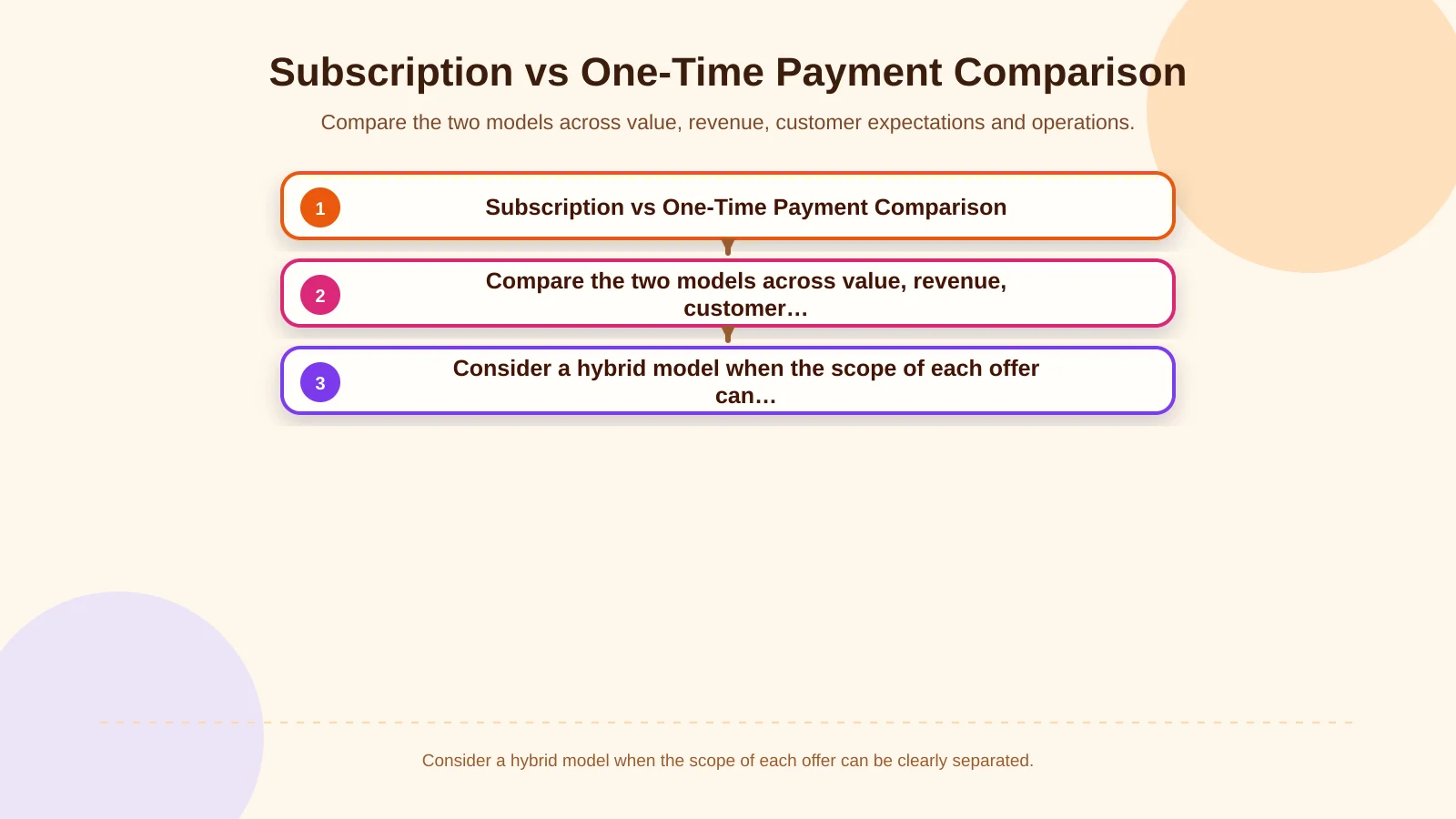
Subscription vs One-Time Payment Comparison
The decision should not be reduced to recurring versus upfront revenue. The following dimensions reveal how closely each model fits the product.
| Criterion | Subscription | One-time payment |
|---|---|---|
| Value structure | Continuous or regularly renewed | Bounded or permanent |
| Revenue pattern | Dependent on renewal and retention | Dependent on new sales and add-on packs |
| Customer commitment | Periodic and renewable | Single and more limited |
| Operations | Cancellation, renewal and plan changes | Delivery, restoration and refunds |
| Best-fit scenario | Cloud services, updated content and memberships | Permanent features, individual packs and one-off outputs |
User value and usage frequency
A frequently used, continuously renewed product leans towards subscription. A product used occasionally, delivering one output or granting permanent rights leans towards a one-time purchase. High usage alone is insufficient: customers must receive new or continuing value during every paid period.
Revenue continuity and cost structure
Subscriptions may create more predictable revenue but require churn and failed-payment management. A one-time purchase can bring revenue forward, while future funding remains dependent on new sales. Recurring costs such as servers, third-party services, content production and customer support should be matched with the revenue structure.
Purchase threshold and trust
Without automatic renewal, a one-time payment may present less psychological risk, although a high upfront price can have the opposite effect. A subscription spreads the cost but can undermine trust when its conditions are unclear. Plan names, feature boundaries, renewal terms and cancellation information all influence conversion.
Operational and technical requirements
Subscription entitlements need ongoing verification and state changes must propagate through connected systems. For one-time purchases, delivery, consumption status and restoration become central. Both models may need server-side verification, transaction identifiers, error records, support tooling and reconciliation.
Five-Step Payment Model Decision Process
Test payment assumptions with small user groups during product discovery. This sequence keeps commercial expectations and technical realities within one decision framework.
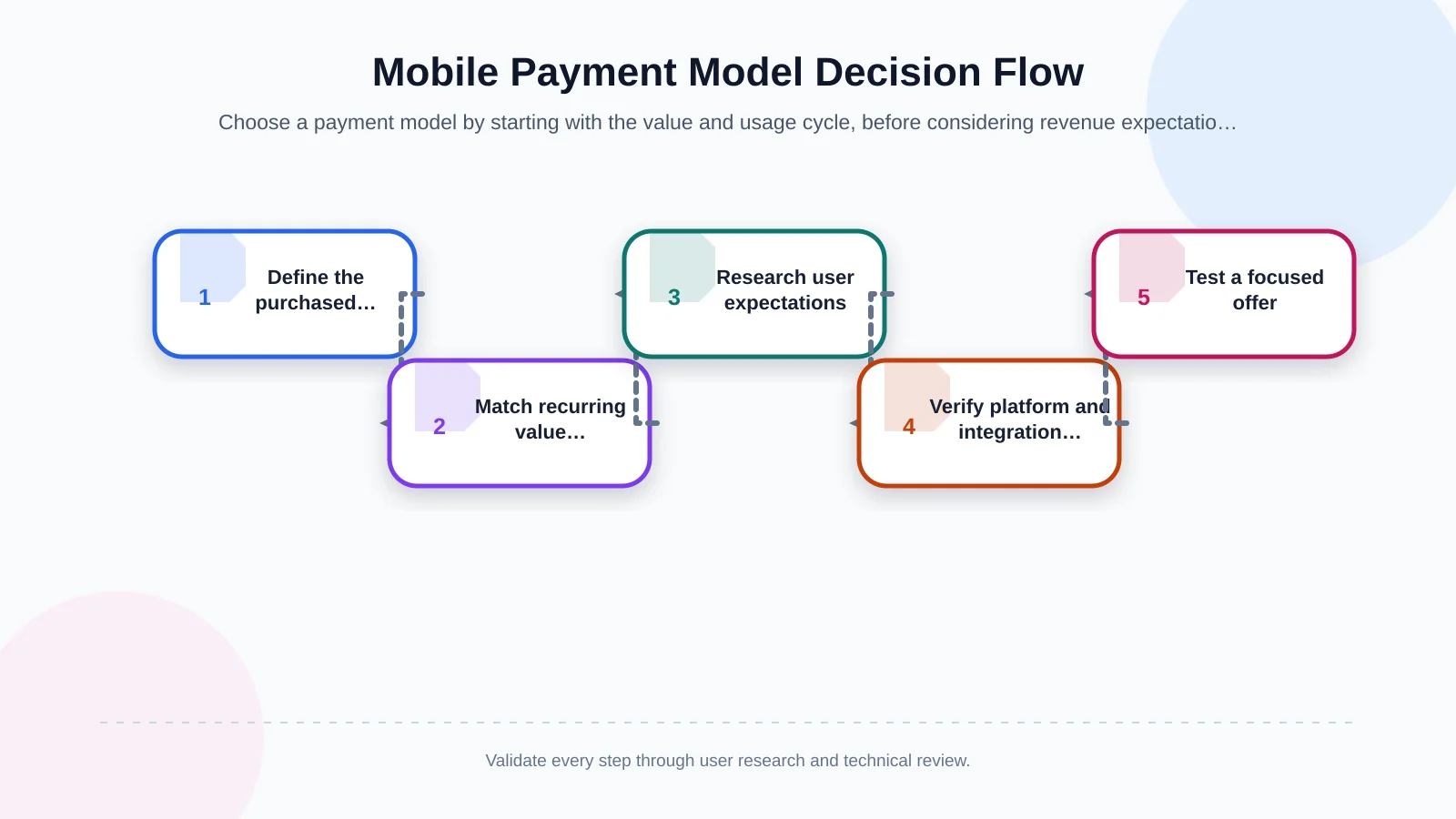
1. Define the purchased value
Write down whether customers buy content, functionality, time, capacity, a physical product or a service. Define precisely when access begins and ends.
2. Match recurring value with recurring costs
If value renews monthly but nearly all costs occur at the beginning, a subscription may not be necessary. If service delivery creates continuing infrastructure and team costs, test whether a one-time fee can support them.
3. Research user expectations
Use interviews, prototype tests and behavioural data to learn which payment logic users understand. Do not ask only which option they prefer; explore usage frequency, expected outcomes and reasons for abandoning a purchase.
4. Verify platform and integration requirements
Review store-payment requirements before designing products that sell digital content or in-app features. Apple’s App Review Guidelines cover rules for unlocking digital functionality and offering subscriptions. Google Play’s Payments policy explains conditions for digital purchases in apps distributed through Play. Requirements can vary by region and product type, so recheck the current versions before release.
5. Test a focused offer and measure it
Launch a verifiable offer instead of unnecessary plan complexity. Measure purchase starts, successful transactions, abandonment, usage, renewals and support requests to assess whether the model matches delivered value.
When should you consider a hybrid payment model?
Subscriptions and one-time payments can complement each other. An app might offer a subscription to an updated content library while selling a specialist course separately. A permanent core tool could be paired with subscription-based cloud synchronisation and team features. This flexibility also increases catalogue and entitlement complexity.
Customers should never feel that they are paying twice for the same value. Package scope, the treatment of existing rights after plan changes and continued access to one-time purchases after subscription cancellation must be explicit. Apple’s guidelines allow subscriptions to coexist with individual offerings in appropriate cases, but each implementation should be assessed against current rules.
Technical architecture extends beyond the payment screen
A payment integration is not simply a functioning store button. The mobile client, app store, backend services, user accounts, entitlement system and administration panel must share the same transaction truth. Transactions should be verified server-side, duplicate notifications handled safely and temporary connectivity failures prevented from creating inconsistent access.
The catalogue should map every plan or individual product to its platform identifier, access scope and state rules. Teams must decide which rights apply when users change devices, restore purchases or sign in on another platform. These requirements directly shape the API and data model.
Operational team requirements
Support and finance teams need to inspect transaction status, entitlements and errors without unnecessary access to personal data. Role-based permissions should control who can issue refunds or resolve access discrepancies. Audit logs, transaction histories and reconciliation reports make the operation manageable.
Planning payments in a React Native mobile app
React Native enables teams to share a substantial portion of product logic across iOS and Android. Store products, purchase flows and platform-specific states must still be tested separately. A shared codebase does not remove policy or lifecycle differences between platforms.
Kumsal Agency approaches React Native mobile app development for iOS and Android by considering the business idea, user needs and technical requirements together. Payment models are planned alongside user journeys, API architecture, secure data handling, administration interfaces and test scenarios. Custom web software, e-commerce, ERP and payment integrations can also be evaluated within the same system context.
Pre-release test scenarios
- Successful, cancelled and abandoned purchase flows
- Declined payments, pending transactions and interrupted connections
- Subscription renewal, cancellation, expiry and resubscription
- Entitlement changes after plan upgrades or downgrades
- Delivery and restoration of one-time purchases
- Duplicate notifications without duplicate entitlements
- Different device and user-account combinations
Making the final sustainable choice
A subscription can be effective when value and costs continue over time. A one-time payment may be clearer for bounded, permanent or infrequently used value. A hybrid approach can address different needs, but unclear package and entitlement rules will complicate both user experience and operations.
Define the value cycle before optimising for revenue. Then assess user expectations, platform requirements, technical architecture and operational responsibilities together. To plan your app’s payment model, user journeys and integrations as one coherent product system, contact Kumsal Agency.