


Aydınlatma metni yükleniyor…
Corporate websites, e-commerce platforms and custom web applications are more than the public pages visitors see. Administration panels, APIs, databases, file stores, third-party services and operations teams all occupy different trust boundaries within the same system. A weakness in any one of them can lead to hidden spam links, exposed customer data, altered records or service disruption.
Web security therefore cannot be completed by placing a single product in front of a server. A Web Application Firewall (WAF), secure software development, application–database isolation, least-privilege access, maintained components, centralised logging and tested backups must work together. The objective is not to promise absolute security. It is to reduce the likelihood of compromise, limit how far an incident can spread and support controlled recovery and continued operation.
How do hacklink and SQL injection risks arise?
In a hacklink attack, an intruder places links on a compromised website to manipulate another domain’s search visibility. These links may appear on public pages, but they can also be hidden in theme files, database content, JavaScript or output delivered only to search-engine crawlers. The same access may be used for malicious redirects, phishing or persistence.
Hacklink is not a vulnerability in itself. It is usually the outcome of another weakness: an outdated content management system, a vulnerable plugin, a compromised administrator account, unsafe file uploads, a leaked access key or unnecessarily broad write permissions. Deleting the visible links does not remove the entry point or persistence mechanism. The affected accounts, files, scheduled tasks and records must also be investigated.
SQL injection occurs when untrusted input changes the meaning of a database query instead of remaining a data value. A successful attack may expose, modify or delete records, or bypass access controls. The OWASP SQL Injection Prevention Cheat Sheet recommends avoiding dynamic queries built through string concatenation and using parameterised queries. A WAF can help stop a malicious request, but the primary control is still safe query construction.
How does layered web security architecture work?
In a layered architecture, every control has a defined purpose and an acknowledged possibility of failure. Internet traffic may first reach a WAF through a CDN or reverse proxy. Approved requests then pass to the application tier over only the required ports. The application connects to the database through a private network, using a dedicated service identity with restricted permissions. Administrative access is separated from visitor traffic and protected through strong authentication, approved networks or a secure access gateway.
Trust should not be granted merely because a component sits inside the corporate network. The NIST Zero Trust Architecture guidance states that users and assets should not receive implicit trust based on network location. Authentication and authorisation must be evaluated before access to a resource is granted. Applied to web architecture, this means even an application server should not have unrestricted access to every database table or administrative function.
From attack surface to controlled access
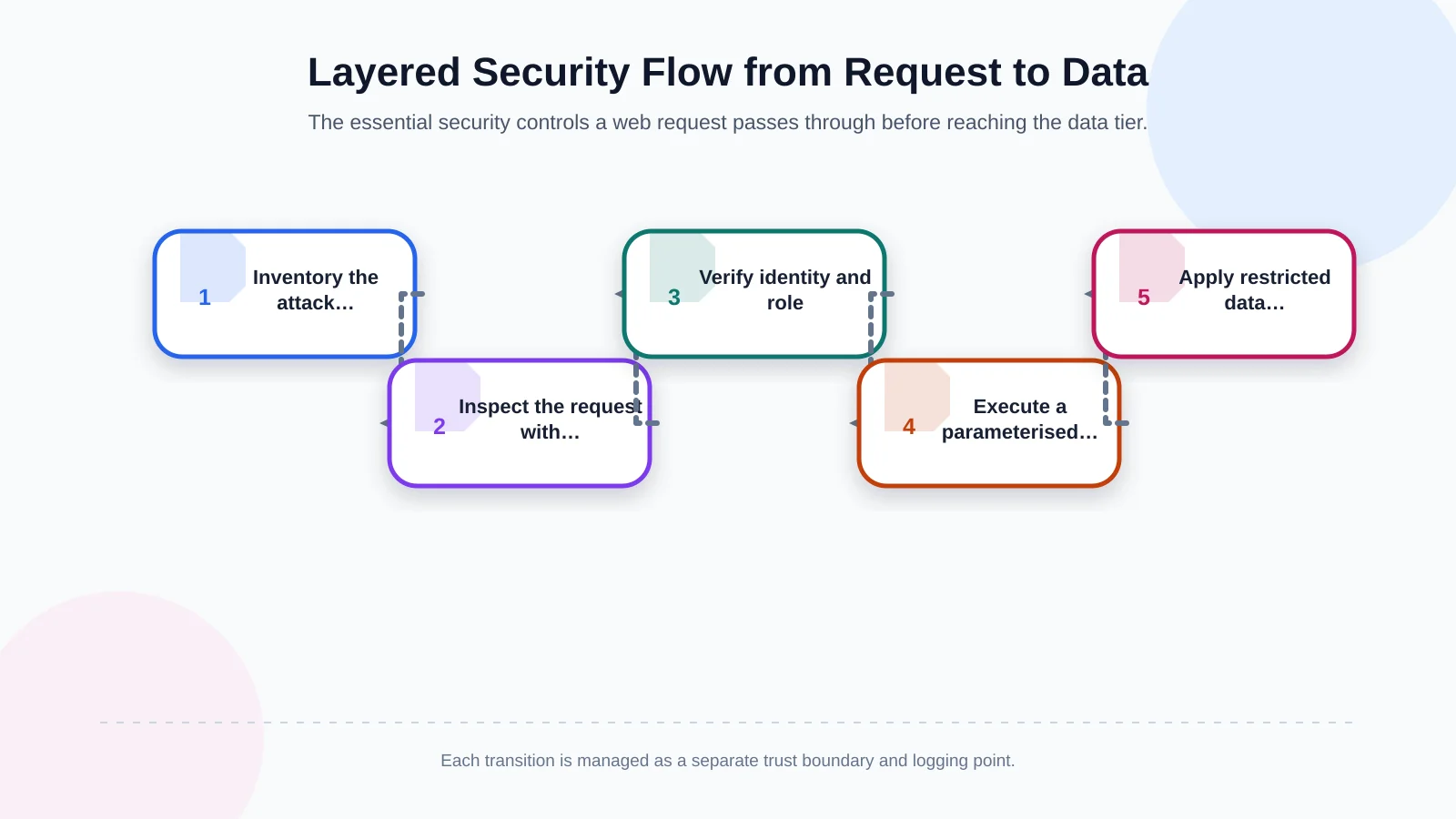
A well-designed flow controls each transition between the public entry point and the data tier. The process begins with an inventory of domains, subdomains, API endpoints, administration panels and upload functions. The WAF policy is then validated in monitoring mode, tuned around legitimate application behaviour and moved into blocking mode for critical rules through a controlled change process.
The application performs identity and role checks according to its own business rules. Its data-access layer uses parameterised queries, while the database account is authorised only for the operations that service requires. Finally, WAF alerts, authentication events, application logs and database activity are sent to central monitoring with synchronised timestamps. This makes it possible to reconstruct an event chain instead of assessing isolated warnings without context.
What protection does a WAF provide, and where does it fall short?
A WAF inspects HTTP and HTTPS requests for known attack patterns, unusual client behaviour and policy violations. It can block or alert on SQL injection attempts, some cross-site scripting patterns, protocol anomalies, malicious bots and abnormal request rates. Virtual patching can also temporarily restrict a specific request pattern while an application fix is being developed, tested and deployed.
However, a WAF cannot always distinguish a stolen but valid administrator password, a flawed role model, abuse permitted by application logic or a malicious file introduced through another channel. To inspect encrypted traffic, TLS termination must be positioned correctly. The architecture must also preserve the genuine client IP through trusted headers and prevent direct access to the origin. Otherwise, attackers may bypass the WAF and contact the application server directly.
The OWASP guidance on Web Application Firewalls treats a WAF as part of broader planning, operations and application-security processes. A deployment can lose value when its rules remain outdated, false positives go unreviewed or default settings are never tuned. Rule changes should therefore be versioned, exceptions should have a documented reason and expiry date, and protection should be retested after releases.
How should application and database isolation be designed?
Keeping the database off the public internet is a baseline requirement, not a complete isolation strategy. The database should operate in a separate network segment and accept connections only from identified application services. Development, testing and production environments should use separate networks, credentials and datasets. Routine developer work should not require direct production database access; exceptional access should be time-limited, justified, logged and reviewable.
A separate database identity for each application or service limits the impact of compromise. A read-only reporting service should not have write permission. A content service should not automatically access user-management tables, and a web application should not connect with database-administrator privileges. Secrets should not be stored in source code or exposed in configuration repositories. They should be delivered through a secrets-management system and rotated on an appropriate schedule.
Network isolation and role-based authorisation are complementary. Network policy determines which component may establish a connection; the database role determines what that component may do after connecting. User roles inside the application form another control layer. Together, these boundaries help prevent the compromise of one administrator account or application service from becoming unrestricted control of the entire data tier.
Control layers and the risks they limit
Security controls are positioned at different stages of an attack. The WAF challenges suspicious traffic at the perimeter. Secure coding prevents input from becoming an executable command. Least privilege reduces the data and operations available after successful exploitation. File-integrity monitoring and correlated logs reveal unauthorised changes. Isolated backups provide a recovery path after deletion, corruption or ransomware.
Each control needs an owner, scope and verification method. Instead of recording only that “a WAF is installed,” teams should document which domains it protects, whether direct origin access is closed and whether critical rules operate in blocking mode. Instead of stating that “backups run,” they should track restoration test dates, recovery objectives and whether backup credentials are independent of production identities.
| Control | Primary purpose | Risk reduced | Limitation when used alone |
|---|---|---|---|
| WAF | Filters suspicious HTTP requests | Known attack patterns | Does not fix vulnerable code |
| Parameterised queries | Separate commands from data | SQL injection | Do not correct permission errors |
| Network and role isolation | Restricts access | Spread of a compromise | Does not repair insecure code |
| Logging and integrity monitoring | Makes changes visible | Late discovery of hacklinks | May not stop an active attack |
| Isolated backups | Provide a recovery path | Data loss and corruption | Do not close the entry point |
Secure development prevents SQL injection at its source
Parameterised queries are the primary technical defence against SQL injection. When query structure and user-supplied values are transmitted separately, input cannot change the command’s intended meaning. An object-relational mapper does not guarantee safety by itself: raw queries, dynamic sorting fields and filter builders still require review. Where identifiers such as table or column names cannot be bound as parameters, the application should select them from a closed allowlist.
Server-side validation should cover data type, length, format and business rules. Blacklists that merely reject supposedly dangerous characters are unreliable because alternative encodings and syntax can bypass them. User-facing error messages must not disclose queries, table names or connection details. Diagnostic information should instead be stored in access-controlled logs with suitable retention and redaction.
Defining security requirements before development reduces dependence on patches added late in delivery. In custom web software and corporate website projects, the data model, user roles, integrations and operational responsibilities should be designed together. Code review, dependency scanning, security testing and release checklists can then become repeatable parts of the delivery lifecycle rather than emergency measures introduced after an incident.
How can logging and integrity controls reveal hacklinks?
Hacklink compromises may remain unnoticed until search traffic declines or a search engine issues a warning. Indicators include unexpected outbound links, newly created administrator accounts, altered scheduled tasks, unauthorised changes to themes or application files, unusual uploads and different content being served to crawlers. Visually inspecting the home page alone will not expose changes hidden in templates, databases or conditional output.
File-integrity monitoring should compare changes in critical directories with authorised releases. Content management audit records should identify the user, time, source IP, affected object and result of each action. When WAF alerts, login events, application errors and unusual database activity are correlated in a shared monitoring layer, the reconnaissance, access and modification stages of an attack can become visible earlier.
An alert is useful only when ownership is clear. For critical events, organisations should define the responsible team, response target, evidence-preservation method and communication path in advance. Before removing a suspicious link, responders should assess scope and investigate compromised accounts, malicious files, persistence mechanisms and affected records. Otherwise, the visible symptom may disappear while the attacker retains access.
Backups and incident response belong in the architecture
Backups should include databases, user-uploaded files, critical configuration and the version information required for restoration. Keeping at least one copy separate from production identities and deletion permissions reduces the chance that an attacker can destroy both the live environment and every recovery copy. Encryption, retention and access logging should be aligned with the sensitivity and regulatory needs of the data.
A backup that cannot be restored provides no operational protection. Regular restoration exercises should therefore take place in an isolated environment, measuring data consistency, file integrity and the time needed to bring the application online. The incident response plan should assign decision owners for temporarily tightening WAF rules, isolating affected services, rotating credentials, deploying a known-good version and returning the service to production under controlled observation.
How can you build a sustainable security roadmap?
Begin by inventorying internet-accessible assets, software versions, administration routes, data flows and third-party dependencies. Prioritise findings according to business impact and realistic exposure. A publicly reachable database, shared administrator account or dynamically concatenated SQL query deserves attention before cosmetic configuration improvements.
Short-term work may include critical patches, multifactor authentication, WAF visibility and backup verification. Medium-term measures can introduce network segmentation, service identities, role-based access and centralised logging. Over the longer term, security testing should become part of the development lifecycle, meaningful measures should reach management reporting and the threat model should be updated whenever the architecture or business process changes.
Every organisation has a different technology stack, data profile and operational capacity. A generic checklist should therefore be adapted to actual application dependencies, ownership and recovery requirements. Kumsal Agency combines corporate web design and custom web software expertise with a focus on data security, customer privacy, strong software infrastructure and sustainable management. Work with Kumsal Agency to assess your current attack surface and isolation needs, then define a security architecture and development roadmap appropriate to your scope.