


Aydınlatma metni yükleniyor…
A franchise website is more than a corporate showcase for locations, products and brand history. For a brand seeking to expand its network, it is a digital decision environment where prospective franchisees can understand the business model, assess their suitability, find credible answers and submit an application. The experience for franchise candidates should therefore have its own content hierarchy, calls to action and measurement plan rather than simply reusing the customer journey.
A well-planned franchise web experience does not pursue application volume at any cost. It makes qualification criteria visible, helps candidates develop realistic expectations and turns submitted information into structured data that the development or operations team can evaluate. Achieving this requires research, content strategy, user experience design, custom software, data security and system integration to be planned as one connected service.
Why do franchise candidates need a separate user journey?
A customer typically evaluates a product, price, location or service quality. A prospective franchisee is considering a long-term commercial relationship. The brand’s history, operating model, investment scope, location requirements, day-to-day responsibilities, training, support and application criteria are interconnected parts of that decision.
This visitor may not decide in one session. They may return on different days, compare models, download documents and discuss the opportunity with family members, advisers or business partners. The website should preserve clarity throughout that extended research process and help candidates resume their journey without forcing an immediate commitment.
The first objective is therefore not to make a “Apply now” button as prominent as possible. It is to answer essential questions in a credible sequence. The US Federal Trade Commission’s guidance for prospective franchisees similarly encourages investors to review disclosure documents, investigate the opportunity, ask questions and examine agreements carefully. Although legal requirements differ by jurisdiction and local legal advice remains essential, the guidance illustrates the importance of transparent, verifiable information in a high-stakes investment decision. Further context is available in the FTC’s guide to buying a franchise.
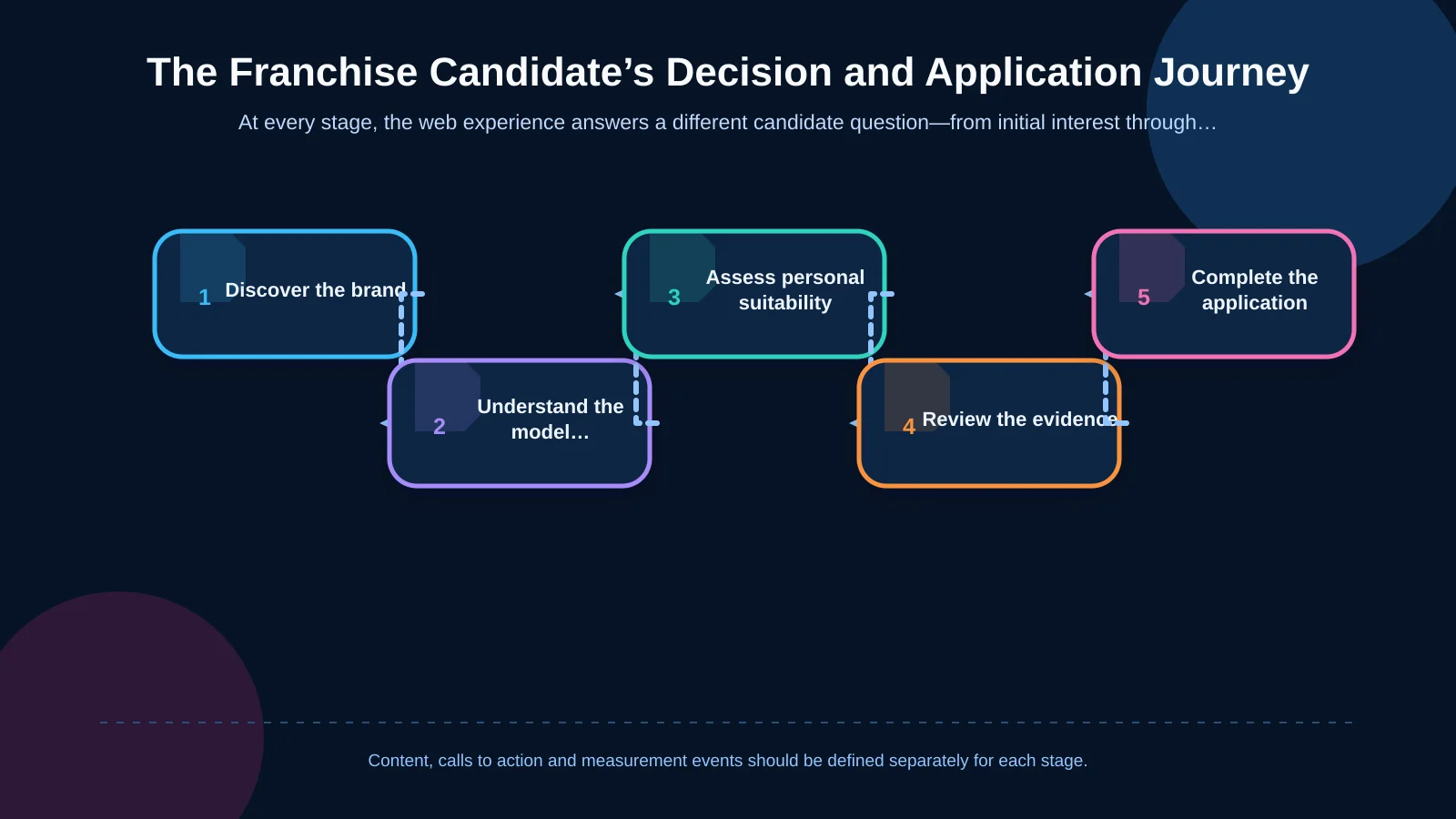
The journey commonly moves through awareness, model understanding, self-assessment, evidence review, application and evaluation. Each stage requires different content and a different action. A visitor arriving from a social campaign may need a concise introduction, while someone already familiar with the brand may want to go directly to investment components, territory requirements or the support programme.
How should content architecture support the investment decision?
The order of a franchise page should reflect the candidate’s questions, not the order in which the brand prefers to talk about itself. The opening section should explain the sector, the franchise model and the profile of candidate the opportunity is designed for. A clear proposition and next step are more useful than an ambiguous promise of growth.
The page can then cover brand history, how the system operates, what the investment includes, location expectations, training and operational support, candidate criteria, process stages and frequently asked questions. If the required investment cannot be represented by one fixed amount, explain the variables that affect it. Store size, city, fit-out, equipment, staffing and working capital can all be framed clearly without making unsubstantiated revenue or return claims.
How should trust evidence be presented?
Statements about the number of locations, years in operation, training model or logistics capacity should be current and verifiable. Where appropriate, the website can include franchisee perspectives, representative locations, the operations team’s expertise and examples of support materials. Success stories must not imply that every candidate will achieve the same commercial outcome.
Content governance matters as much as presentation. Assign an owner, review date and approval process to every material claim. Investment ranges, market availability and application criteria can change; outdated information creates unsuitable enquiries and undermines confidence before the first conversation takes place.
Should you use one landing page or a candidate content hub?
A focused landing page may be sufficient for a straightforward proposition with one model and a short decision journey. A dedicated candidate hub is usually more appropriate when the brand has several concepts, investment levels, countries, documents or location formats. Model details, territory criteria, process information, FAQs and application pages can then address distinct search intentions while remaining connected.
This is not separate from the wider discipline of corporate web design. It is a specialist scope in which brand communication and candidate tasks meet within the same information architecture. Navigation should let consumer audiences and prospective franchisees reach the right route without confusing their goals.
How should the franchise application flow be designed?
The purpose of an application form is not to collect every potentially useful detail on one screen. It should request the minimum information required for an initial assessment while respecting the candidate’s time and privacy. Contact details, preferred investment region, approximate investment range, relevant experience and intended timeline may provide a practical starting point. Fields that do not contribute to the evaluation method should be removed.
If a long application is genuinely necessary, divide it into logical steps. Candidates should be able to see their progress, understand why particular information is requested and know what will happen after submission. Use persistent field labels, format guidance and error messages that explain how to correct a problem. The W3C forms accessibility tutorial recommends requesting only necessary information and supporting controls with clear labels, instructions and understandable feedback.
- Use controls and touch targets that are easy to operate on mobile screens.
- Provide a review step so candidates can check important details before submitting.
- Preserve completed information if a technical or validation error occurs.
- After successful submission, display a reference number and explain the expected response.
- For document uploads, state accepted file types, size limits, progress and upload status.
A generic “Your form has been received” message is rarely enough. The confirmation should describe the next stage, the likely contact channel and any information the candidate should prepare. If email verification, appointment selection or additional documents are required, manage them through a consistent notification system.
How should data flow from application to evaluation?
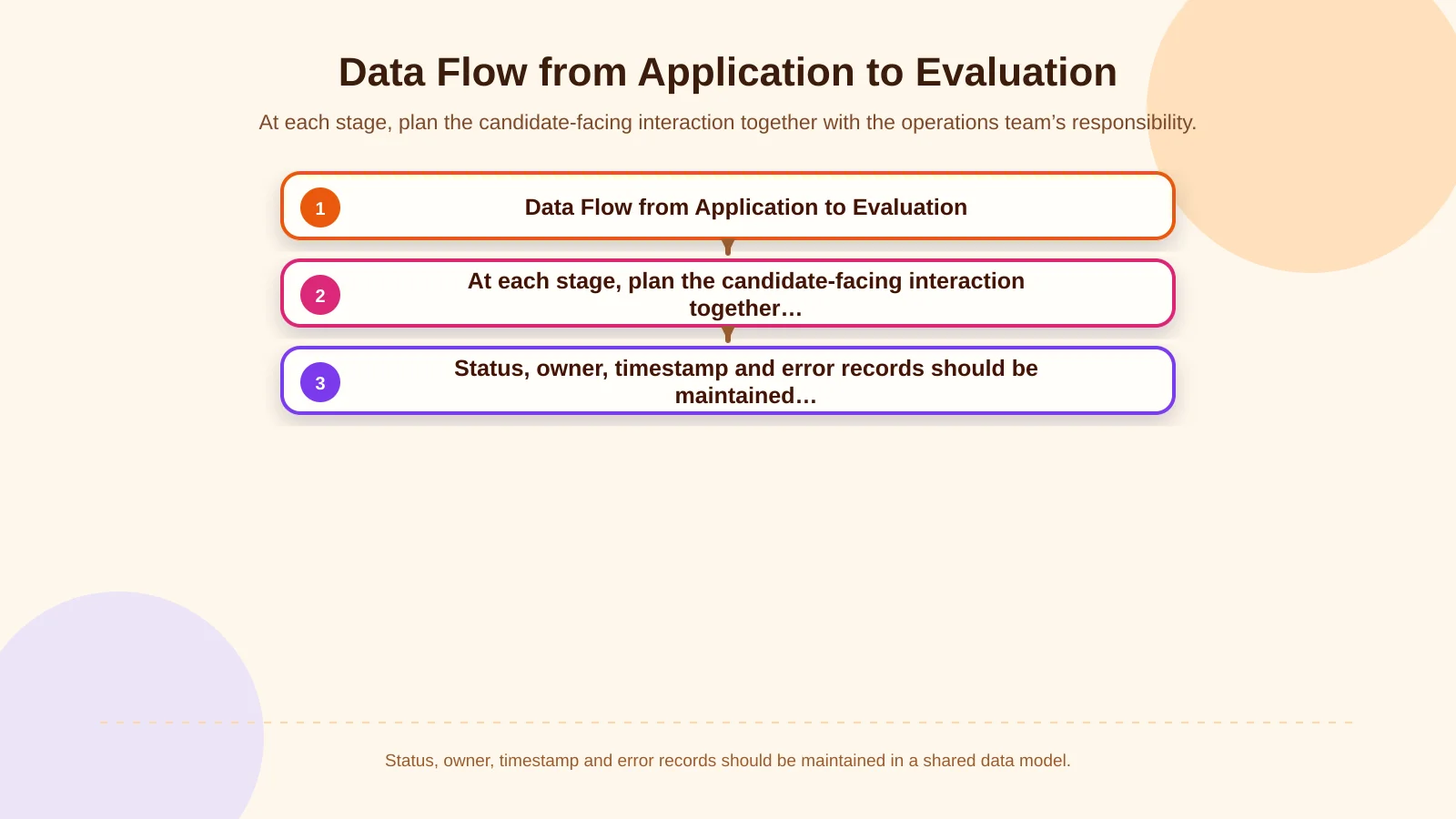
Sending form submissions to a shared inbox does not create a traceable process for a growing franchise network. Applications should enter the CRM or evaluation platform through structured fields that record source, campaign, preferred region, investment range and current status. Rules for duplicates, ownership, status changes and access to internal notes should be agreed before development.
This is where custom web development can support candidate portals, evaluation dashboards, role-based permissions and integration with existing systems. Franchise teams do not all use the same workflow. One brand may require regional approval, while another separates financial screening, an online interview and location analysis between different owners. The software should make the real operating process visible, manageable and auditable.
| Stage | Candidate experience | Operations action | System record |
|---|---|---|---|
| Application | Completes the form | Eligibility review begins | Source and candidate profile |
| Initial assessment | Receives a status update | An owner is assigned | Status and timestamp |
| Interview | Selects an appointment | Notes and outcome are entered | Interview record |
| Documentation | Uploads documents securely | Authorised team reviews them | Version and audit log |
| Decision | Sees the next step | Approval or rationale is recorded | Final status |
When does an onboarding portal make sense?
A candidate portal becomes valuable when the post-application journey includes multiple documents, interviews, tasks and approvals. Candidates can view their status, outstanding actions, appointments and shared documents in one place. The operations team can work from a central record instead of fragmented email threads.
The scope should include access roles, document versions, audit logs, notification rules and account closure. It should also define what candidates can edit after submission, which changes require renewed review and how inactive applications are archived or deleted.
Integration failure scenarios must also be designed
A CRM connection should not be tested only for successful transfers. If the destination is unavailable, the application may need to be held securely in a queue, retried according to defined rules and surfaced to the responsible team without creating duplicate records. Field mapping, system ownership, synchronisation frequency and reconciliation responsibilities should be documented.
The candidate should never be told that an application succeeded unless the system can preserve it reliably. Operational alerts should contain enough context for investigation without exposing unnecessary personal data. Failed transfers, retries and manual interventions also need timestamps so teams can distinguish technical delays from slow follow-up.
How should personal data security shape the application experience?
Franchise applications can contain financial capacity, professional history and uploaded documents in addition to contact information. During discovery, define why each item is collected, who may access it, where it will be transferred and how long it will be retained. Collecting data simply because it might be useful later weakens trust and makes governance more difficult.
For activities subject to Turkey’s KVKK, the privacy notice should address the data controller’s identity, processing purposes, recipients and transfer purposes, collection method, legal basis and the data subject’s rights. The Turkish Personal Data Protection Authority’s guidance on the obligation to inform states that this information should be provided when personal data is obtained. A privacy notice and explicit consent should not be presented as interchangeable concepts. Legal wording must be prepared for the brand’s actual processing activities with appropriate professional advice.
Technical controls should include encrypted transmission, secure uploads, role-based access, audit records, updates and tested backups. Instead of letting every administrator view every candidate record, apply the lowest access level required for each role. Before launch, test the interface, APIs and authorisation rules, and define responsibilities for data breaches, incorrect transfers and account misuse.
Which metrics should measure a franchise web experience?
Total application volume alone does not show whether the experience is succeeding. Track qualified-candidate rate by traffic source, form start and completion rates, field-level errors, applications accepted for evaluation, time to first contact and losses between stages. Together, these signals help reveal whether a problem originates in campaign targeting, missing information, form friction or operational delay.
Event names and conversion definitions should be agreed before development. Useful events may include viewing investment requirements, opening an FAQ, starting the form, completing a step and submitting successfully. Personal information and free-text answers must not be sent to analytics tools. Marketing and evaluation teams should use shared reporting to identify campaigns that generate qualified candidates, not merely large numbers of submissions.
How should the project process be planned?
A successful project does not begin with a visual refresh of the existing page. Discovery should include interviews with prospective or recent applicants, evaluation teams and franchise operations managers. Review why previous applications were rejected, which questions candidates repeatedly ask, where employees rely on manual work and what data problems exist in current systems.
The team can then define the candidate journey, content matrix, sitemap and data flows. Wireframes and prototypes allow the page hierarchy, application steps and mobile behaviour to be tested before coding. The approved experience is developed through a brand-specific interface, content management tools, portal functions and integrations. Verification should cover functionality, accessibility, performance, security, common devices and realistic error scenarios.
After launch, monitor qualified-application rates, behaviour patterns, integration logs and team feedback. Update content ownership, remove unnecessary form friction and resolve recurring handoff failures. This continuous process turns the website from a one-time promotional asset into a measurable component of the franchise growth strategy.
Conclusion: Aim for better applications, not simply more
A dedicated franchise candidate experience balances persuasive brand communication with the transparency required for an investment decision. Its information architecture answers questions in sequence, an accessible form collects useful data, and the portal and CRM workflow help the evaluation team act consistently. Security and measurement make the overall system sustainable.
Kumsal Agency strengthens franchise brands’ digital positioning by combining research-led consulting, creative web design and custom software. To plan a candidate experience and application process around your franchise brand, contact Kumsal Agency.