


Aydınlatma metni yükleniyor…
The most practical way to plan corporate website content is to treat each page as more than a menu label. Every page should be a tracked work item with a purpose, target audience, user question, core message, required copy and visuals, call to action, owner, language status, and approval state. A page-by-page content matrix puts this information in one place, making gaps visible before they disrupt design or launch.
In Kumsal Ajans projects, the page list and the purpose of each page are defined during the design stage. If content creation is not included in the purchased service scope, the client prepares the content. Copy, images, documents, and legal materials are collected as a batch, while the client approves factual accuracy, brand voice, and final publication. Delayed content extends the publication timeline.
This guide turns those working boundaries into a content matrix that a project team can use directly.
What Is a Website Content Matrix?
A content matrix is a working table that lists the pages of a website and the content components required to complete each one. A sitemap may show relationships between pages such as Home, About, Services, and Contact. A content matrix explains why those pages exist and who must prepare what before they can be published.
For example, a row labelled “Services” should contain more than the page name. It should identify the intended reader, the problem the page must address, the scope information that needs to be explained, required evidence or documents, the visual assets, the next action, and the person responsible for approval.
This distinction makes three questions visible:
- Are the copy and visuals required for design ready?
- Who prepares and approves each item?
- Are the Turkish and English versions at the same level of completeness and freshness?
A content matrix does not produce good copy by itself. It creates a shared operating record that helps the team manage missing information, unclear ownership, and scattered approvals.
How Should Page Purpose Be Defined During Design?
Instead of building the page list by copying competitor navigation, begin with the tasks users need to complete. Ask three questions for every proposed page:
- Who will visit this page?
- What question or need brings them here?
- What should they understand or be able to do after reading it?
The purpose of a service page is not simply to display a service name. The intended reader should be able to understand the scope, process, boundaries, deliverables, and suitable next step. An About page should not be limited to a corporate history; it should explain who the company is, how it works, and why it is a credible counterpart using verifiable information.
Google's SEO Starter Guide explains that organizing a site logically can help users and search engines understand how pages relate to one another. That does not mean the structure should be designed only for search engines. Each page still needs a real user task and a business purpose.
To define the wider project scope before the design stage, use the target audience, functionality, and content questions in the website requirements document guide.
Who Should Prepare Website Content?
Content ownership should be an explicit item in the proposal and project scope. In the Kumsal Ajans model, the client prepares the website content when content creation has not been purchased as part of the service. An agency delivering design or development does not automatically become responsible for producing company facts, service details, legal copy, or translations.
It is useful to assign one content coordinator on the client side. This person does not need to write every sentence. They can collect material from different departments, track missing items, and consolidate approval. Human resources may provide careers information, sales may provide service details, technical teams may verify product specifications, and an appropriate specialist may supply legal material. The content coordinator delivers the current approved version to the project team.
At least three roles should be distinguished for every row in the matrix:
- The person who provides the facts or source material
- The person who prepares the copy or visual
- The person who gives final approval for accuracy, brand voice, and publication
In Kumsal Ajans projects, the client approves factual accuracy, brand language, and final publication. “Received from the client” and “approved for publication” must therefore remain separate states.
How Should Copy, Images, Documents, and Legal Materials Be Collected?
Distributing content across chat messages, multiple email threads, and ambiguously named files makes version control difficult. In Kumsal Ajans projects, copy, images, documents, and legal materials are collected as a batch. For that method to work, the required fields and delivery location should be agreed in advance.
Record the following for every content item:
- Related page and section
- Type: copy, photograph, video, PDF, logo, table, or legal text
- Current version of the file or copy
- Source and permission to use it
- Person who prepared it
- Person responsible for final review
- Turkish and English status
- Missing information or revision note
- Delivery and approval date
Keep legal material separate from general marketing copy. Privacy notices, cookie information, terms of use, or sector-specific requirements may need review by an appropriate specialist. The agency placing legal copy on a page should not be presented as having approved its legal adequacy.
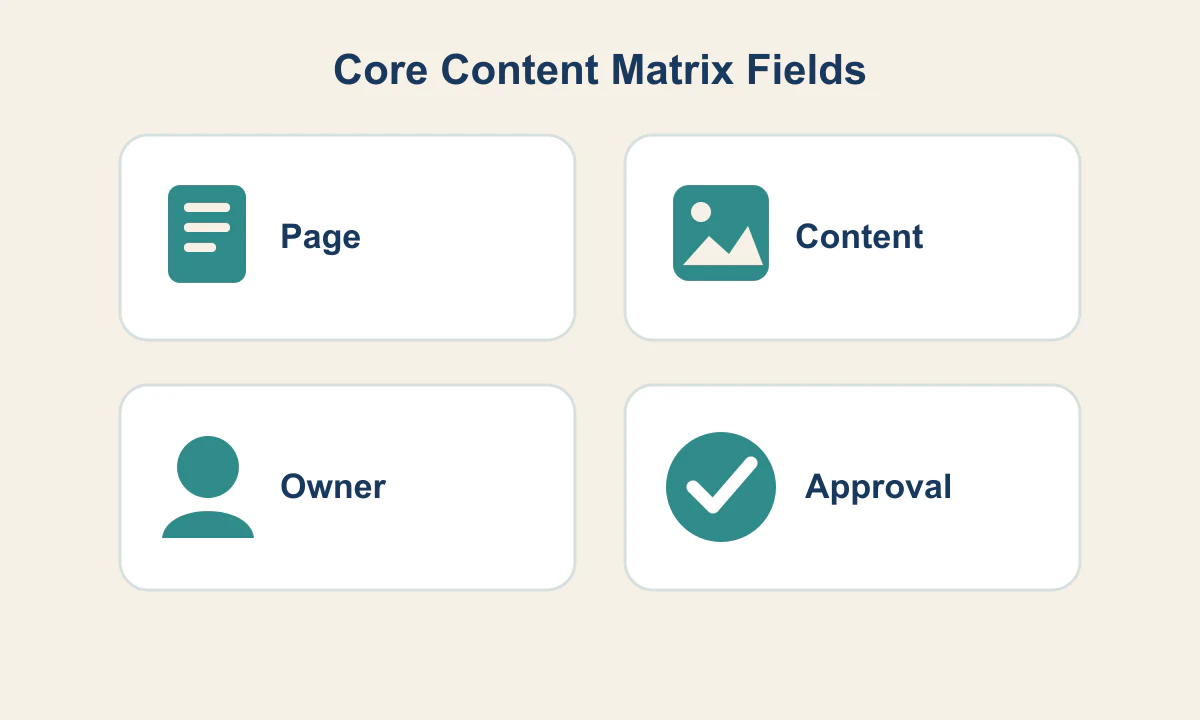
Which Fields Should a Page-by-Page Content Matrix Include?
The following columns provide a practical starting point for a corporate website:
| Field | Question to answer |
|---|---|
| Page name | Which page does the item belong to? |
| Page purpose | Why does this page exist? |
| Target reader | Who is expected to use it? |
| User question | What answer is the reader looking for? |
| Core message | What should the reader remember? |
| Required copy | Which headings and explanations are needed? |
| Evidence or support | Is there a project, document, process, feature, or verifiable fact? |
| Visuals and documents | Which image, video, logo, PDF, or table is required? |
| Call to action | What should the reader do next? |
| Content owner | Who prepares the item? |
| Client approval | Are facts, brand voice, and publication approved? |
| Language status | Are the Turkish and English versions ready and current? |
| Due date | When is it needed for design and publication? |
| Status | Is it waiting, in progress, under review, in revision, or approved? |
Not every project needs every column. Preserve the fields that expose ownership and publication blockers. A “complete” status should mean more than the file being delivered; it should show that final client approval has been received.
What Content Is Needed for Different Page Types?
Home page
Define the company's central value, priority services or product groups, main audience needs, trust elements, and the pages users should visit next. Treat the home page as a useful overview and navigation point rather than a place for the full company history.
About page
Prepare verifiable company history, expertise, working approach, team or organizational information, and any relevant documents. Prefer concrete information over unsupported terms such as “leading,” “best,” or “unique.”
Service or product pages
For each page, define the target problem, scope, process, deliverables, exclusions, genuine frequently asked questions, and appropriate next step. Avoid reproducing the same generic text under different service names. Each page should address a distinct user task.
Projects and references
Confirm permission to use client names, logos, visuals, project scope, and outcomes. Do not state unmeasured increases in performance, sales, or search visibility. If permission is unavailable, do not create a fictional story that appears to be a real case study.
Contact pages and forms
Record the purpose of the form, required fields, responsible recipient, success and error messages, necessary privacy information, and alternative contact channels.
How Should Visuals and Documents Be Inventoried?
Leaving visuals until the end can result in empty layouts, temporary stock images, and launch delays. Define the purpose of each visual: explaining a service, introducing a team, showing a process, documenting a product, or providing decorative support.
The W3C alt decision tree approaches alternative text according to the function and information conveyed by an image. The content matrix should therefore record not only a filename, but also what the visual does on the page and what alternative text decision is required. A decorative background and an informative process diagram should not be handled in the same way.
Check the source, right to use, suitable resolution, current version, and language variant of each asset. If an infographic contains Turkish text, placing the same file on the English page does not provide an English experience. A localized visual should be prepared separately.
How Should Content Approval Be Managed?
Instead of relying on a single “approved” message, record what has actually been approved. Factual accuracy, brand voice, image usage, and readiness for publication may be separate checks. In Kumsal Ajans projects, the client holds final approval for information, brand language, and publication.
A practical flow can be organized as follows:
- Source information and assets are delivered as a batch.
- Missing fields are marked in the content matrix.
- Copy and page layout are reviewed in the design context.
- The client corrects inaccurate or outdated information.
- Turkish and English versions are checked separately.
- The approver and approval date are added to the matrix.
- Only the approved version moves to publication preparation.
Use dates or clear version labels during revision. Otherwise, previously rejected copy may return to the page or outdated contact information may be published.
How Should Turkish and English Content Be Tracked Together?
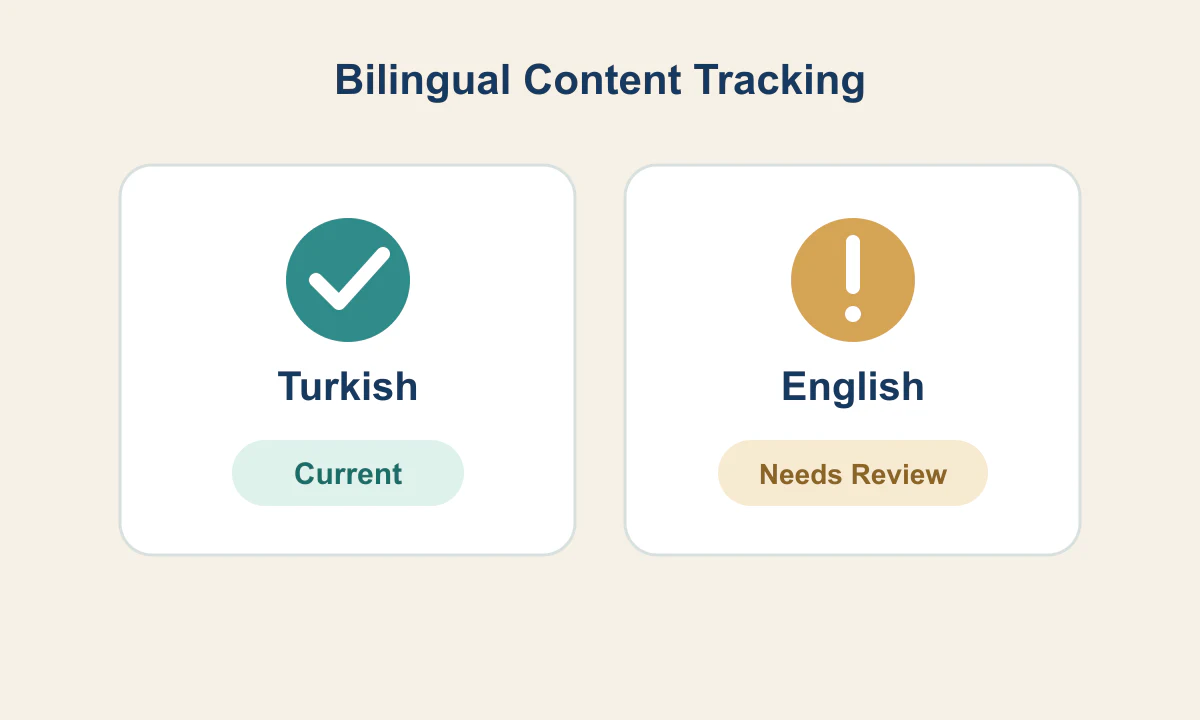
An update to Turkish content should not be assumed to update the English page automatically. Under the confirmed Kumsal Ajans working boundary, the client is responsible for tracking the freshness of the English version. The content matrix should make that responsibility visible through separate status, last-updated, and approval fields for each language.
Google's guidance on localized page versions recommends separate URLs for language versions and methods for indicating their relationship. Technical linkage may be correct while the English content remains outdated. Technical language mapping and editorial freshness must therefore be treated as separate controls.
If a translation is not ready, the project may consider temporarily hiding that language option instead of sending the user to an unrelated or outdated page. URL, slug, and language-switch decisions are covered in more detail in the multilingual website planning guide.
How Does Delayed Content Affect the Project Timeline?
Content is not merely a final asset needed on launch day. Copy length, heading count, image proportions, tables, and form requirements can affect design decisions. A layout built around incomplete placeholder content may need to be revised when the real material arrives.
In the confirmed Kumsal Ajans process, delayed content extends the publication timeline. There is no fixed formula for the number of additional days. The effect depends on the number of incomplete pages and the amount of review, revision, and approval still required. The matrix can therefore mark whether each item is needed for design, development, or publication.
Make these dependencies visible in the schedule:
- Navigation and page-scope approval
- Real copy and visuals required for design
- Form fields and legal material
- Approval of the primary Turkish content
- English localization and client review
- Final publication approval
Instead of recording a general note that “content is late,” update the affected page, owner, blocker, and revised target in the shared record.
Fictional Working Scenario
The following example is not a real client case. It is a fictional scenario created solely to show how the content matrix can be used.
Assume a corporate website includes a home page, five service pages, About, Careers, and Contact. At the start of design, only the home-page copy and several general photographs have been delivered. Service scope, team information, careers form fields, and English copy are missing.
Rather than keeping a general “content missing” note, the team creates a row for each page. Service information is assigned to the sales owner, team information to human resources, and form fields to the project owner. Turkish preparation, client approval, and English status are tracked separately. The team can now see which pages can enter design, which ones block publication, and where approval is waiting.
This scenario makes no promise about a specific duration or result. It only demonstrates how to convert an unclear delay into manageable work items.
Copyable Content Matrix Example
| Page | Purpose | Required content | Owner | TR status | EN status | Client approval | Due date |
|---|---|---|---|---|---|---|---|
| Home | Summarize the company and primary services | Core message, service summary, visuals, CTA | To assign | Waiting | Waiting | Waiting | — |
| Service 1 | Explain scope and process | Problem, scope, process, deliverables, FAQ | To assign | Waiting | Waiting | Waiting | — |
| About | Present the company with verifiable facts | History, approach, team, documents | To assign | Waiting | Waiting | Waiting | — |
| Contact | Route enquiries to the right channel | Address, telephone, form fields, legal text | To assign | Waiting | Waiting | Waiting | — |
The team can extend this table with fields for user question, core message, visual source, usage rights, CTA, revision notes, and approval date.
Final Content Matrix Checklist
- Does every page have a target reader and purpose?
- Is the main user question for each page defined?
- Are required copy, visuals, documents, and forms listed?
- Are the information provider, content creator, and approver separate where necessary?
- Has the client checked factual accuracy and brand voice?
- Are visual sources, usage rights, and alternative-text purposes recorded?
- Are Turkish and English states tracked separately?
- Is the appropriate specialist and client approval defined for legal material?
- Does the record show which project stage is affected by a missing item?
- Is only the approved version allowed to move to publication?
Google's guidance on helpful, people-first content focuses on helping the intended audience complete its goal and providing original, reliable value rather than writing to a supposed preferred word count. Use the content matrix to make each page genuinely answer a user need, not to count keyword repetitions.
Conclusion: Manage Content as a Project Workflow, Not a File List
Corporate website content is more than a set of documents waiting to be uploaded. Page purpose, user questions, verifiable company information, visuals and documents, calls to action, language versions, ownership, and client approval need to be managed together.
In Kumsal Ajans projects, page purposes are defined during design. When content creation is not included in the purchased service, the client prepares the content. Materials are collected as a batch, and the client approves factual accuracy, brand voice, and final publication. The client also tracks whether the English content remains current after Turkish changes. Missing or delayed content extends the publication timeline.
A page-by-page content matrix makes those boundaries visible and trackable. To understand how scope, design, content, and delivery responsibilities come together, explore the guide to how a web design agency works.