


Aydınlatma metni yükleniyor…
There is no universally accurate number for how long a corporate website takes. Elapsed time depends less on page count alone than on requirements clarity, unique templates, content production, locales, integrations, decision speed, test coverage and launch dependencies.
A useful proposal does more than answer “how many weeks?” It shows which work depends on what, who must supply and approve each input, and how the completion date is recalculated when scope changes. This guide offers a planning method, not a fixed-duration guarantee.
Why Page Count Is Not Enough
A twenty-page site using one content template is not equivalent to an eight-page site with dealer applications, product filtering, localized content, CRM delivery and custom permissions. Estimate these units together:
- Unique page and component types
- Content models, fields and editorial roles
- Content ready for use, rewriting or migration
- Locales and localization approvals
- Forms, CRM, ERP, payment, maps or other integrations
- Mobile, accessibility, performance, security and browser tests
- Domain, hosting, email, analytics and launch transition
- Number of decision makers and review windows
Use the website requirements document guide to define the scope before estimating duration.
The Kumsal Corporate Website Critical-Path Schedule
The Kumsal Critical-Path Schedule is an original planning framework that treats the website as connected deliverables rather than a simple phase list. It is not a statistic or delivery promise. Every row records the work package, prerequisites, owner, effort, elapsed window, approver, acceptance evidence and effect of delay.
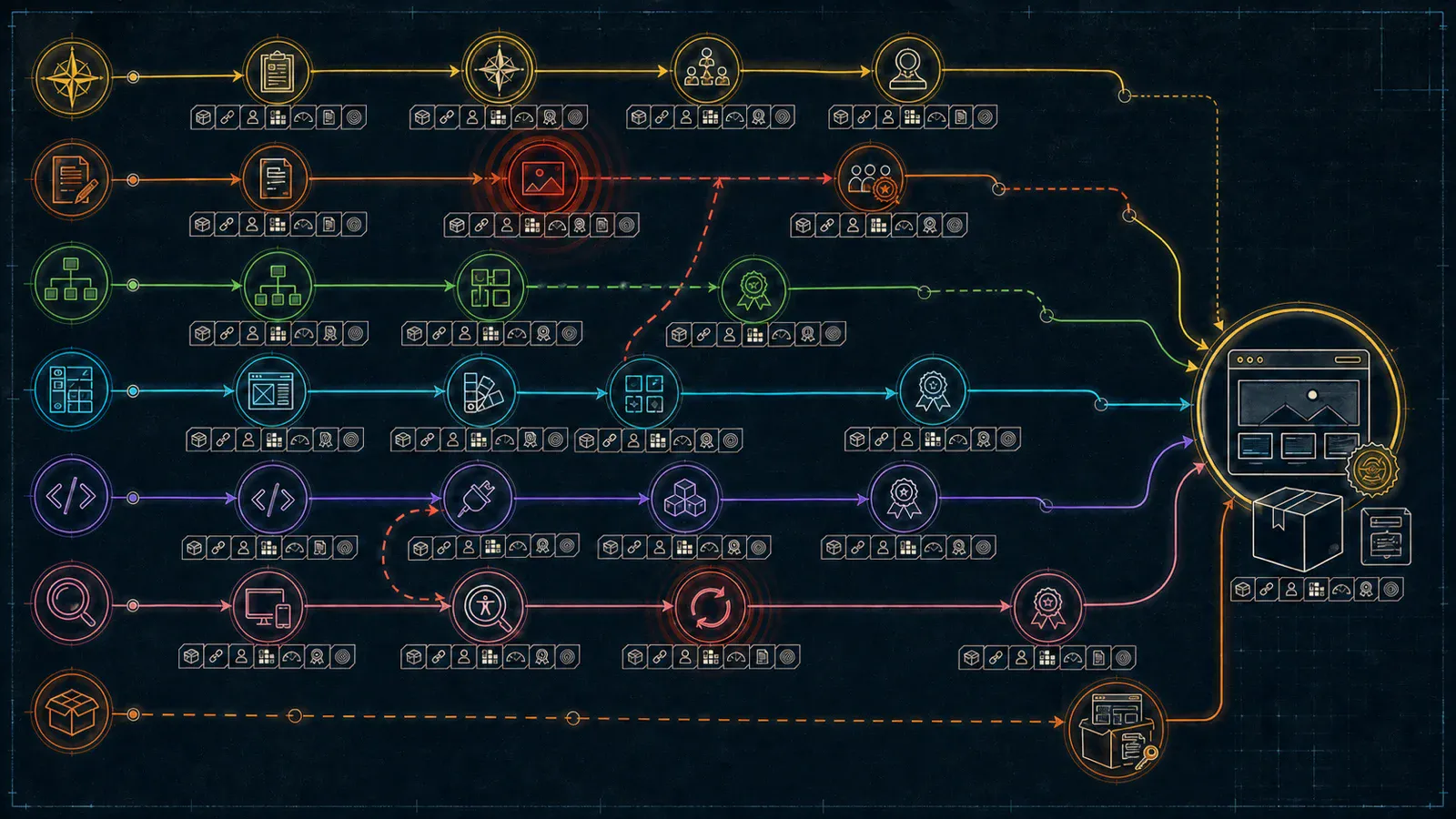
In general project planning, the critical path is the dependent sequence that directly influences completion. The U.S. Government Accountability Office Schedule Assessment Guide describes reliable schedules as capturing all work, sequencing activities logically, considering resources and the critical path, analysing risk and maintaining the schedule. The framework below applies those principles to practical website deliverables; the organisation-specific duration still has to be estimated.
1. Decision and scope path
Settle priority audiences, tasks, locales, content types, integrations, technical constraints and success measures. Work proceeds on assumptions when decisions are left for “later”. Every open decision needs an owner and due date.
2. Content path
Classify current pages as retained, consolidated, rewritten or retired. Assign ownership for new copy, service or product data, authentic visuals, documents, legal material and localization. Content is not filler added after design; it shapes page structures and components.
Use the corporate website content matrix to record the audience, evidence and owner for each page.
3. Information architecture and journey path
Define navigation, hierarchy, URL approach, primary user tasks and actions. Locking architecture without the inventory can omit pages; designing screens without architecture can produce repeated work.
4. Design-system and template path
Approve visual direction, typography, colour, accessibility boundaries, core components and representative templates. Separate reusable systems from genuinely unique layouts. Approval should cover content, task, state and device scenarios—not taste alone.
5. Development and administration path
Turn approved data models, templates and components into a working platform. Editorial roles, draft and approval flows, error states, validation, search, filters or account features become separate packages when in scope. “An admin panel is included” does not define its fields or permissions.
6. Integration and migration path
Prepare third-party access, API documentation, test accounts, data mapping, error behaviour and accountable owners. Access from another supplier or security and legal approval may be externally controlled dependencies. Test representative content and URLs before bulk migration.
7. Test, acceptance and launch path
Test content, devices, browsers, accessibility, performance, security, form delivery, analytics, SEO migration and locale relationships. Allow time for correction and retesting. Accept launch when DNS, TLS, backups, rollback, access and accountable teams are ready.
How Is the Duration Calculated?
A practical planning expression is:
Estimated elapsed time=production on the critical path + planned review windows + externally controlled lead times + risk allowance.
Do not confuse effort with elapsed time. A design may require eight hours of production but still wait several days for consolidated decisions. Record for every package:
- Deliverable and acceptance measure
- Inputs required before work starts
- Producer and decision owner
- Estimated effort and elapsed window
- Predecessor and successor dependencies
- Review and revision boundary
- Risk, alternative and replanning rule
Adding every task duration is also misleading because independent work may run in parallel. Conversely, work that appears parallel may wait on the same content or approval. Read completion from the dependent path that governs the finish, not from a simple sum.
Three Scope Scenarios
Basic corporate information site
A small set of templates, approved single-language content, a simple contact form and limited migration can produce a shorter critical path. Requirements, design, development, testing and launch still remain necessary.
Multilingual lead-generation site
Multiple locales, service content, distinctive forms, CRM delivery, localization approval and SEO migration can make content and integration the governing paths. Finished visual design is not the same as a finished project.
Corporate platform with custom functions
Dealer or customer accounts, documents, applications, product data and operational integrations require discovery, data models, roles and exception scenarios. Estimate this separately from a basic corporate site and consider phased releases.
These are scope examples, not schedule promises. Two projects with the same label can have different completion times when content readiness and decision structures differ.
How Can Content and Approval Waiting Become Visible?
Assign a preparer, verifier and final decision owner to every content group. “Client approval” is not one task: brand, product, legal, HR, sales and technical teams may verify different material. One project owner must consolidate conflicting comments.
Put review windows—not only meeting dates—on the schedule. A template review completes when consolidated comments arrive by the agreed date. Define in advance how a missed decision moves dependent work. If silence is to have a contractual meaning, it must be explicitly and appropriately agreed.
How Do Change Requests Affect the Schedule?
A request may correct an acceptance defect, clarify work already in scope or add new scope. First identify all affected deliverables. A new locale, integration, role or template adds more than its own production; it can also change content, testing, training and launch work.
The change record should state the request, reason, affected packages, time and cost effect, decision and revised baseline. Approve the new critical path visibly instead of silently compressing the remaining schedule.
How Can the Project Move Faster Without Removing Quality?
- Name the decision owner and feedback method at the start.
- Prepare real content structures for priority pages early.
- Approve representative templates instead of every page mock-up.
- Request integration credentials and test accounts immediately.
- Run stable components in parallel; avoid building volatile screens too early.
- Separate first-release needs from later improvements by value and risk.
- Test and accept by stage instead of relying on one final test.
- Consolidate feedback through one owner and resolve conflicts explicitly.
Removing accessibility, security, backup, testing or SEO transition may appear to save time while merely moving risk beyond launch.
Timeline Questions to Ask in Every Proposal
- Which scope and assumptions support the date?
- Which content, access and decisions are required to start?
- Which packages form the critical path?
- Which client and third-party dependencies exist?
- How many review and correction rounds are included?
- How are late feedback and scope changes replanned?
- Are testing, correction, content entry and training included?
- What defines launch acceptance and rollback?
- Which items are explicitly deferred beyond the first release?
Compare final access, test, SEO and support deliverables with the corporate website handover checklist.
Conclusion
A corporate website timeline is not just the agency’s design speed. Scope, content, architecture, templates, development, integration, migration, testing and approvals belong in one dependency plan. A Critical-Path Schedule makes the responsibilities and risks behind a date comparable.
To assess your project scope and a realistic delivery plan, contact Kumsal Agency’s web design team.