


Aydınlatma metni yükleniyor…
An organisation searching for web design services in Arnavutköy may need more than a brochure site using corporate colours. In logistics, production, technical service, installation, wholesale or project-based work, a visitor first needs to determine whether the organisation is a plausible fit. Which service is available, which area is covered, what sits outside scope, which evidence can be reviewed and what information is required for pricing?
Generic statements about being fast, high quality and solution-oriented do not answer these questions. At the same time, a website should not expose every operational detail, customer record or sensitive capacity figure. This guide describes a B2B website system that presents scope accurately, matches claims with evidence, protects commercially or operationally sensitive information and delivers a suitable request to an accountable team.
Why is operational scope a relevant question in Arnavutköy?
The Arnavutköy Municipality 2025–2029 Strategic Plan states that the Yavuz Sultan Selim Bridge and Istanbul Airport strengthened the district's transport infrastructure and logistics capacity. It records that large projects influenced economic and commercial activity, new settlement areas and logistics infrastructure, while also expanding the municipality's service field and responsibilities (Arnavutköy Municipality 2025–2029 Strategic Plan).
These official statements do not prove that every organisation in Arnavutköy is a logistics company, works with the airport or has substantial capacity. The coverage, authority and operating capability of a particular organisation must come from its own verified records. The narrower design task is to separate “where are we located?” from “where and under which conditions can we deliver this service?” when operational capability affects a buyer's decision.
Are physical location, service area and operating corridor the same?
No. A verified office or facility address is a physical location. A service area is the geography in which an organisation accepts a particular type of work. An operating corridor is a narrower model defined by route, delivery, field team, time window, vehicle or other business rules. Advertising geography is different again: showing an advertisement in a district does not prove a branch there or universal coverage.
The website should not collapse these concepts into one map or an unsupported “we serve everywhere” statement. Whether a service is remote, on site, at a facility, delivered or project based changes both the public information and proposal fields. Where fit cannot be determined publicly, explain the assessment method rather than promising acceptance.
The Kumsal six-record scope-to-proposal system
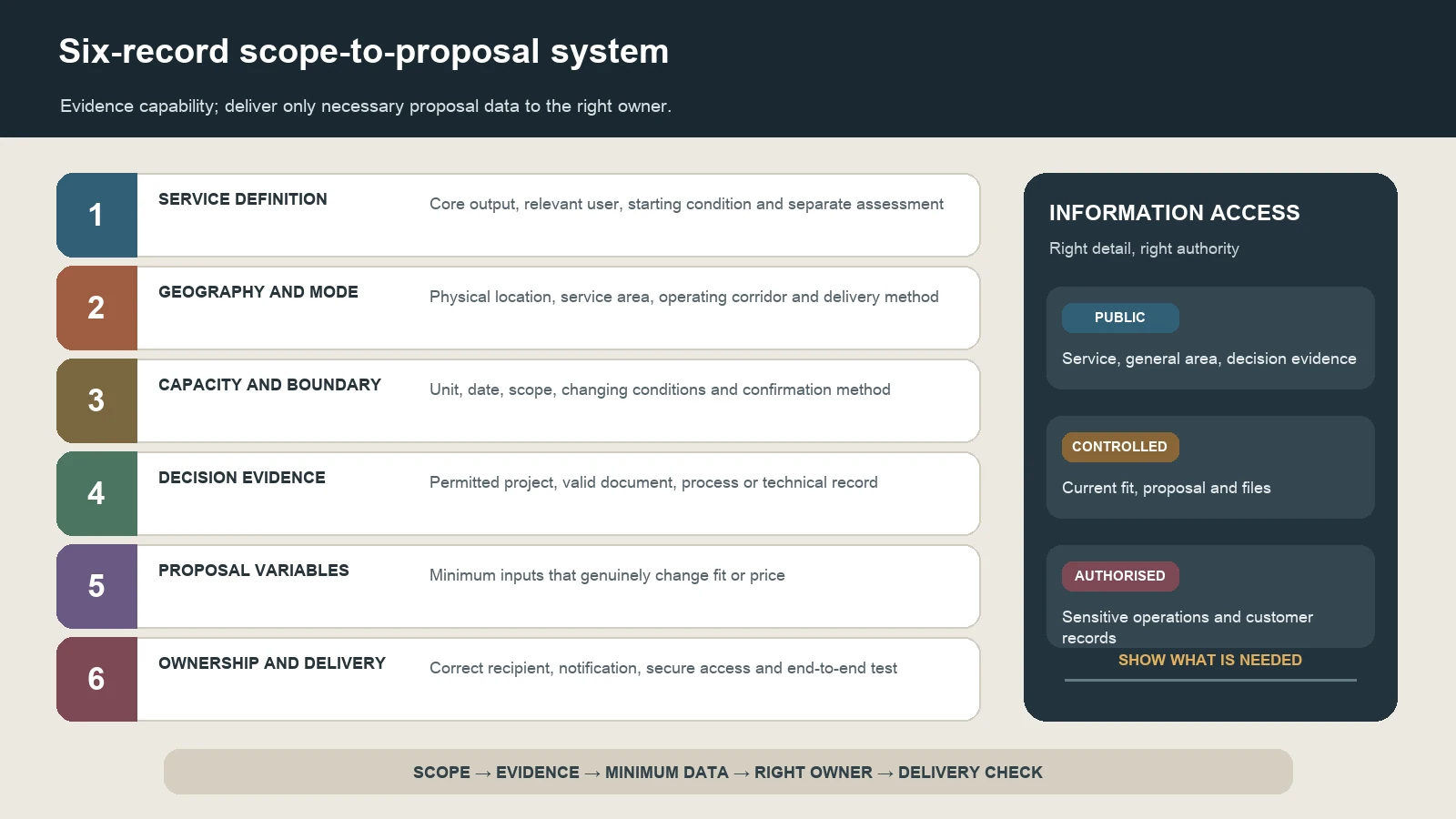
This original framework connects six records: service definition, geography and delivery mode, capacity and boundaries, decision evidence, proposal variables, and ownership with verified delivery. Visitors see only the information needed for their decision; the receiving team retains the page context when assessing the request.
1. Write the service definition around a decision question
“Logistics solution”, “industrial service” or “corporate consultancy” is not a sufficient scope. Explain the core output, relevant user, starting condition and cases requiring separate assessment. Where service variants need different documents, teams or pricing methods, organise them as distinct pages or explicit subsections.
Do not decide page separation from keyword count. When question, scope, evidence, process and action are the same, improve one strong page rather than producing copies with different sector or district names. Record a content owner and review date for every material service statement.
2. Separate geography from delivery mode
Where does the service happen: at the customer's site, at the provider's facility, remotely, by delivery, or within a particular route or area? One organisation may use several modes, but not every service is necessarily available through each one.
A map should show information that changes a decision. For physical visits, provide a verified address, entrance, operating arrangement and access information. For field service, state the real area and any survey or confirmation step. For route-based work, describe the origin–destination type and exclusions that can safely be public. If security or contract terms prevent publication of detailed routes, give a general scope and reserve exact fit for authorised assessment.
3. Present capacity and boundaries in a verifiable form
Capacity is not merely a large number or an “unlimited” label. Time, equipment type, order profile, site conditions, product or cargo characteristics, season, regulation and current workload may all change it. The public page should explain the boundary needed for a decision, while current availability and exact fit come from live operational records.
When publishing a number, record its unit, date, scope and source. Expose commercial data, security information, customer names or personal data only with explicit authority and a genuine need. Avoid expansive claims such as accepting every volume, serving everywhere or providing uninterrupted capacity.
4. Match each claim with decision evidence
The buyer needs context-appropriate evidence for “can this organisation do the work?” Depending on the service, that may be a permitted and explained project example, an equipment or team category, a current authorisation, a quality process, applicable insurance, delivery and acceptance method, a public part of a safety procedure or a technical document.
Use a certification mark only when the certificate genuinely belongs to the organisation, applies to the stated scope and remains valid. Maintain permission records for customer logos and project details. When evidence is unavailable, do not fill the gap with stock photography or an unreferenced counter; explain the process and assessment boundary honestly. Use the corporate website content matrix to manage audience, decision question, evidence and action for each service page.
5. Define proposal variables before the request
A form containing only name, telephone and message can force the team to request every useful detail again. The opposite extreme—asking for unnecessary documents and operational details at first contact—creates friction and data risk. Apply data minimisation and select only variables that genuinely change fit or price.
Depending on the service, these might include origin and destination area, work type, size or quantity range, time window, site conditions, delivery or installation need, existing system, language, document type and response method. Do not request sensitive files through a general first-stage form. If secure upload and an authorised recipient are required, create a separate controlled stage. Use the website requirements document guide to turn project needs into a shared record.
6. Verify ownership, delivery and outcome
Every service and request type needs an accountable owner. General proposals, urgent operations, existing-customer support, supplier submissions, job applications and press enquiries should not fall uncontrolled into one mailbox. Form choices can determine recipients, but the automation still requires recurring tests.
A success message does not prove delivery. Test the panel record, email, CRM, notification, attachment, spam filter and authorised access end to end. Separate test records from production data and avoid unnecessary duplication of personal information. Apply the delivery scenarios in the website form monitoring guide.
The framework's original value is to manage a corporate site as a traceable scope-to-proposal system connecting service fit, publishable evidence, pricing inputs and accountable delivery rather than as a collection of generic promotional pages.
How should sensitive operational information be protected?
Transparency does not require publishing every record. Present decision information at the correct level of detail and within an explicit access boundary. Information can be classified as public, available to an authenticated customer or restricted to authorised staff.
For example, the service category and general area may be public; current availability may require a proposal check; customer pricing may appear in a portal; and detailed security procedures may remain internal. For file upload, define allowed type, size, retention period, access role and deletion method. Sensitive records should not remain uncontrolled in email attachments or public media folders.
How should Turkish and English capability information remain aligned?
Service scope, area, boundaries, document status and proposal variables must be materially equivalent in both languages. The English page need not be a word-for-word translation, but it cannot add capacity, coverage or delivery timing absent from the Turkish record. Use natural industry English and explicit units.
Link every TR/EN pair through a content owner, source record and review date. Map form choices to controlled back-end values and test emails, CRM fields and automatic responses. The language selector should open the true counterpart, canonical should be self-referential for each locale, and hreflang relationships should be reciprocal.
How should web design companies in Arnavutköy be compared?
Give candidates the same scenario: three service types, two delivery modes, area-dependent fit, public and restricted evidence, five proposal variables, two languages and separate receiving teams. Ask each agency to demonstrate how this becomes pages, CMS fields, access roles, forms and an acceptance test.
Review these deliverables separately:
- Service, user and decision-question inventory
- Scope, area, delivery mode and exclusion fields
- Source, date and approval of capacity claims
- Permission records for documents, projects, logos and customers
- Public, restricted and sensitive information classes
- Proposal variables, form rules and secure file flow
- Recipient, notification and backup ownership by request type
- TR/EN content, form, canonical and hreflang pairing
- Device, accessibility, security and performance tests
- Publication, backup, training, maintenance and new-development boundaries
Ask what tangible delivery and acceptance test sits behind terms such as SEO-friendly, high-converting, very fast, fully secure or unlimited support. A visual mock-up alone does not prove that capability data will stay current or that a proposal reaches the correct person.
What determines web design cost in Arnavutköy?
The district name does not determine price. Distinct page types, service and area records, languages, content and evidence preparation, document management, forms, file upload, CRM or ERP integrations, user roles, accessibility, security testing, data migration, training, hosting and maintenance responsibilities do.
A five-page brochure site is not the same project as a system that evaluates service-area fit, collects documents securely and routes proposal records to different teams. Separate third-party licences, map or messaging services, usage-based costs, routine maintenance and new-feature development in the proposal.
How should success be measured?
Do not rely on form count alone. Observe whether users reach the suitable service page, understand scope, complete the proposal form, produce a delivered record and give the team enough information to assess it. Useful signals include:
- Suitable entry queries for service and area pages
- Reasons for out-of-scope requests
- Form validation errors and abandoned fields
- Actual delivery, first-seen time and first response
- Recontact caused by missing information
- Suitable, wrong-service, wrong-area, existing-customer and spam classes
- TR/EN scope and form consistency
- Time taken to reflect a capability or document change on the page
These are not guarantees of sales or profitability. Interpret enquiry quality alongside price, capacity, season, channel, sales process and operational decisions. Process personal and commercial data only for the necessary purpose and period.
Conclusion: manage the corporate website as a scope-to-proposal record
For an organisation operating in or serving Arnavutköy, web design should not turn airport, logistics or rapid-growth language into a generic sales promise. Real services, geography, capacity boundaries, evidence, proposal inputs and accountable recipients belong in one governed system.
The existing Turkish and English slugs remain unchanged, so this refresh requires no 301. When populated with verified operational data, the six-record scope-to-proposal system allows web design providers in Arnavutköy to be compared through maintainable data structures, evidence governance, secure request flow and measurable acceptance conditions rather than general quality and ranking claims.