


Aydınlatma metni yükleniyor…
A hotel, meeting venue or event provider searching for web design services in Bakırköy may need more than a gallery of impressive room photographs. A corporate organiser needs to assess date fit, room options for the expected group, technical setup, accommodation and arrival connections, package inclusions and the information required for a proposal. When these details are fragmented, the organiser must ask every question again and the provider receives incomplete, incomparable requests.
At the same time, an apparently open day on a calendar is not a confirmed booking. Capacity is not one fixed number: seating layout, stage, service zones, accessible routes and safety conditions change the usable room. This guide treats an events and accommodation website as a governed decision system connecting fit, current capacity, verifiable venue evidence, package boundaries, a minimum group brief and accountable proposal delivery.
Why are events and group proposals a relevant task in Bakırköy?
The Bakırköy Municipality 2025–2029 Strategic Plan records a high number of daily visitors and an active commercial environment. It also identifies cultural centres, museums, galleries and theatres, Istanbul's tourism potential, and developed hotel and accommodation options serving fairs and congresses among local opportunities (Bakırköy Municipality 2025–2029 Strategic Plan).
This official context does not prove that every organisation in Bakırköy hosts events, offers accommodation or has a particular room capacity. A specific organisation's spaces, availability, technology, packages and service coverage must come from its own current records. The narrower design task is for organisations that do serve events or group stays to manage interdependent and changing information from discovery through proposal.
Is a group proposal the same as an individual room booking?
No. An individual booking can often show room type, dates, guest count, price and cancellation terms through a standard journey. A group or event request may connect room layout, daily programme, attendee profile, accommodation allocation, food and beverage, technical equipment, accessibility, security, transfers and supplier conditions.
Do not combine both journeys behind one undifferentiated “book now” action. Individual reservations may proceed to a booking engine, while a group request goes through assessment by event sales or a proposal team. Request submitted does not mean that a date is held or an agreement exists. Explain tentative hold, confirmation, payment and cancellation as distinct stages.
The Kumsal six-record event-to-group-proposal system
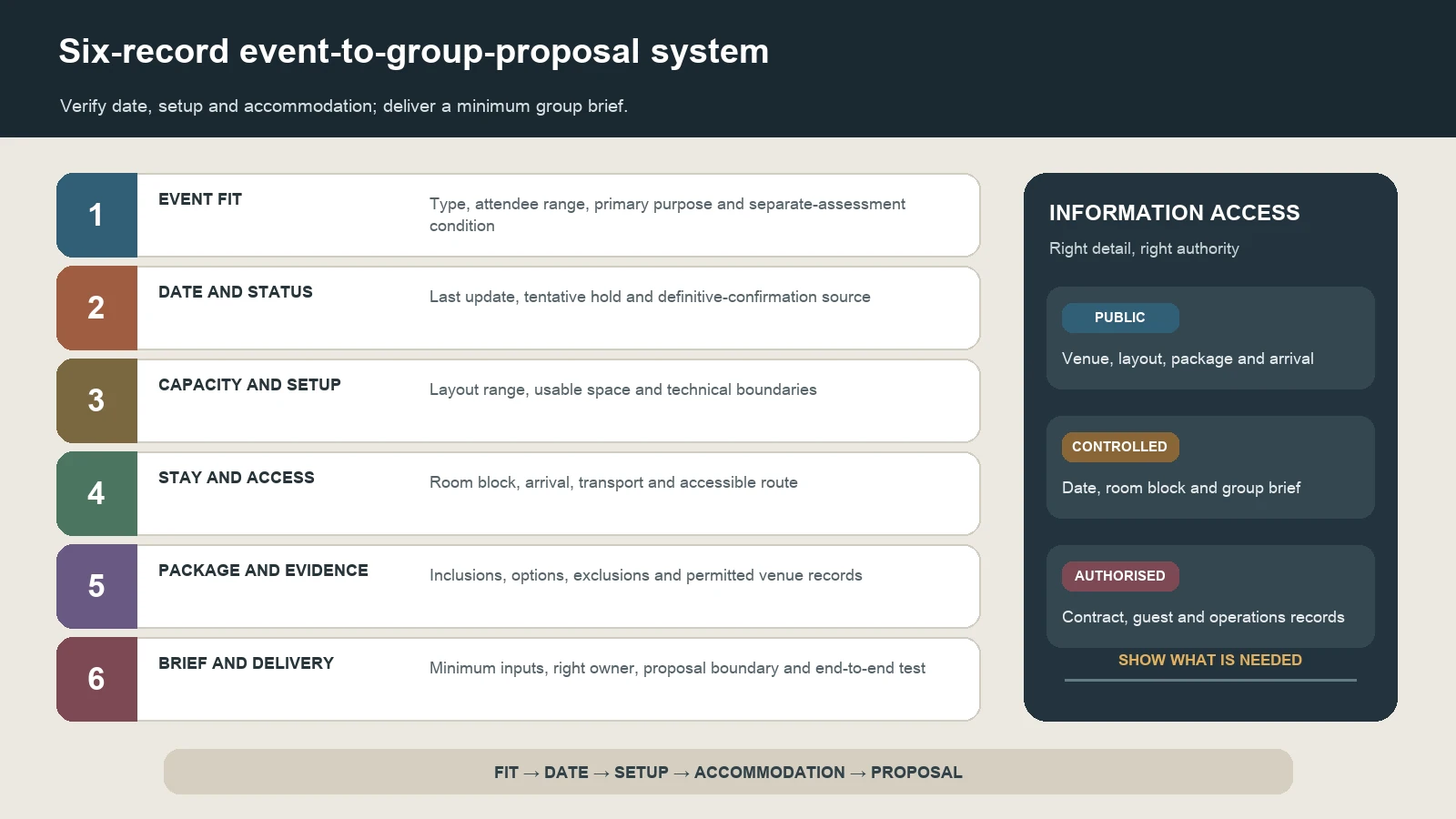
This original framework connects six governed records: event fit, date and status, capacity and setup, accommodation and access, package boundary and evidence, and group brief with delivery confirmation. Its purpose is not to collect every possibility in a long form. It helps visitors understand the right option and gives the organisation a comparable request that reaches a real owner.
1. Bound event type and fit
“All types of events” is not a decision-ready scope. A meeting, congress, training session, launch, exhibition, dinner, residential group or social event may require different space, timing, staff, permissions and service rules. For each type, explain the likely attendee range, primary use, starting conditions and situations requiring separate assessment.
If a service is unavailable directly but can be supplied by an external provider, make that distinction visible. Do not create multiple pages by changing only a district or event name when the user question, evidence and action remain the same. Use the corporate website content matrix to govern service, audience, decision question, evidence and action ownership.
2. Separate date, availability and status source
If a calendar has no real-time system connection, do not present an available label as final. Explain the last update, what the visible status means and who provides definitive confirmation. Demand, preparation time, same-day setup, accommodation inventory and supplier availability can change the answer.
Internal states may include request received, tentative hold, proposal issued, awaiting approval, contracted and closed. Show visitors only the simple status needed for their decision. Assign a system of record across the public form, sales record and operations calendar to prevent conflicting commitments.
3. Present capacity with setup and usable space
A room does not have the same capacity in theatre, classroom, banquet, reception or boardroom layout. Stage, production control, exhibition stands, service aisles, sightlines, emergency exits and accessible circulation change usable capacity. Replace one “500 guests” label with verified ranges by layout, a plan and confirmation conditions.
Photography presents atmosphere; it does not prove dimensions or suitability. Current floor plans, ceiling height, door and lift dimensions, fixed equipment, loading access, accessible routes and publishable technical details should come from accountable records. When a space changes, the page, proposal template and sales document should update from the same source.
4. Plan accommodation, arrival and access as separate components
The venue and accommodation may share one property, sit in different facilities or not be offered together. Room block, nights, single or double occupancy, arrival and departure, breakfast, guest list and specific requirements are separate group-proposal records. A public page should not promise exact room inventory; current fit must be confirmed in the authorised system.
The address, map, entrance, public transport, parking, drop-off, loading point and accessible route should agree. Replace an unqualified “near the airport” statement with verified transport options; do not guarantee journey time when it depends on traffic and time of day. Physical access and service coverage must remain materially equivalent in Turkish and English.
5. Explain package boundaries and decision evidence
An all-inclusive meeting package is not comparable unless it defines whether the room, setup, core technology, internet, refreshments, meals, accommodation, transfers, staff, tax and third-party services are included. Separate inclusions, options, exclusions, minimum numbers and variables that change the price.
Decision evidence can be permitted and current: genuine venue photography, floor plan, equipment list, sample menu, accessibility information, anonymised setup example or a verified service record. Do not present stock imagery as the real room; keep permission records for customer logos and event images. If prices are public, state date, tax, group size, currency and scope, then explain which variables determine the final proposal.
6. Deliver the minimum group brief to the right owner
The first form should request only information needed for assessment: event type, preferred and alternative dates, attendee range, setup, accommodation requirement, essential technical needs, budget approach, decision date and contact method. Do not request sensitive attendee lists, identity documents or contracts through a general form.
Event sales, group reservations, technical teams and existing-customer operations may require different recipients. A success message does not prove delivery; test the CMS record, email, CRM, notifications, attachments, spam filtering and backup recipient. Apply the delivery scenarios in the website form monitoring guide.
The automatic response should state that the record was received, the expected response method, and that this does not create a date hold, booking or contract. Use the website requirements document guide to align project fields, roles, integrations and acceptance conditions.
The framework's original contribution is to move an event website beyond a gallery and generic form into a traceable proposal-preparation system connecting changing fit, layout-based capacity, related accommodation, explicit packages and confirmed group-request delivery.
How should multilingual event information remain aligned?
Room names, capacities, layouts, equipment, accommodation, package boundaries, tax and confirmation method must be materially equivalent in Turkish and English. The English text can be independently localised, but it cannot add a room, transfer, language service, availability or outcome absent from the Turkish record.
Make units, dates, times and currencies explicit. Map form choices in both languages to controlled back-end values; test automatic responses and recipients. The language selector should open the true counterpart, canonical should be self-referential for each locale, and hreflang relationships should be reciprocal.
How should web design companies in Bakırköy be compared?
Give candidate agencies the same scenario: three event types, two rooms, four layouts, two possible dates, a room block, technical options, two languages and separate sales and operations recipients. Ask each provider to demonstrate how this becomes pages, content fields, calendar data, forms, permissions and acceptance tests.
Review these outputs separately:
- Event type, suitable audience and exclusions inventory
- Date, status, last update and definitive-confirmation owner
- Layout-based capacity, plan, technical boundary and accessible route
- Venue, room, arrival and external-supplier relationships
- Package, options, exclusions and price variables
- Source and permission records for photos, plans, logos and cases
- Minimum brief fields, sensitive-data boundary and secure second stage
- Recipient, notification and backup ownership by request type
- TR/EN content, form, canonical and hreflang pairing
- Mobile, accessibility, performance, security and real-delivery tests
- Publication, training, maintenance and new-development responsibilities
Ask for the concrete deliverable and acceptance test behind SEO-friendly, high-converting, fully secure, real-time availability or unlimited support. A gallery does not prove that calendar data is current or a group request reaches event sales.
What determines web design cost in Bakırköy?
The district name does not determine cost. Relevant factors include original page and venue types, calendar connection, capacity and package records, content and photography production, language count, individual booking engine, group form, CRM or operations integration, secure file flow, user roles, accessibility, testing, training, hosting and maintenance responsibility.
A static brochure is not the same scope as a system that compares room layouts, collects group accommodation requirements, manages availability states and routes requests to different teams. Separate booking, payment, mapping, messaging, email and other third-party licences; usage-based charges; routine maintenance; and new development.
How should success be measured?
Success is not form volume alone. Measure whether visitors find a suitable event and room, understand capacity and package boundaries, provide an adequate brief, achieve real delivery and give the responsible team enough context for assessment. Example indicators include:
- Intent alignment of queries reaching event and venue pages
- Access to layout, capacity, accommodation and package information
- Form error and abandonment points
- Actual delivery, first-view and first-response timing
- Repeat contact caused by missing date, number, setup or budget information
- Classification of suitable, over-capacity, unavailable-date, individual, existing-customer and spam requests
- Time taken for calendar or package changes to reach the page
- TR/EN consistency of capacity, package and form fields
These measures do not guarantee event sales, occupancy, revenue or ranking. Interpret them with price, date, capacity, sales process, alternative venues and customer decisions. Process personal and commercial data only for the necessary purpose and period.
Conclusion: Manage the event website as a proposal-preparation record
For a hotel, meeting venue or event provider operating in or serving Bakırköy, web design should not convert active commerce or tourism into a generic sales promise. Actual event fit, current date status, layout-based capacity, related accommodation, explicit packages and accountable request delivery should share one governed system.
The current Turkish and English slugs remain unchanged, so this refresh does not require a 301 redirect. Once the six-record event-to-group-proposal system is populated with verified organisational data, web design providers in Bakırköy can be compared through information ownership, integration, accessible decision support, real delivery testing and measurable acceptance conditions rather than aesthetic and ranking promises.