


Aydınlatma metni yükleniyor…
When looking for web design in Pendik, your first decision should not be a colour palette, theme or agency name. Start by defining what each user must understand or accomplish. A manufacturer may need product discovery and technical enquiries; a local service business may prioritise calls, directions or appointments; a corporate organisation may need credibility, recruitment and multilingual journeys. The label “corporate website” does not define all of these requirements.
This guide does not rank providers or present a generic price. It helps you create a scope that can be sent to several candidates so their proposals can be compared across pages, content, functions, integrations, testing, ownership and support.
Why should web design in Pendik not use one generic template?
The Pendik District Governor's official profile describes the local economy across industry, trade, agriculture, livestock, tourism and services, while also noting transport links and small-to-medium industrial organisations (Pendik District Governor: geography and economy). This does not mean every business in Pendik has the same characteristics. It shows why a page pattern that merely changes the district name cannot explain different sales and service models.
Local relevance does not come from repeating “Pendik”. It comes from explaining what information a customer, visitor, procurement team or business partner needs, what action the website supports and where an enquiry goes after submission.
Define website scope from the operating model
The examples below are discovery prompts, not claims about every business in the district.
| Business or operating model | Primary user task | Website components that may be needed | Trust and verification content |
|---|---|---|---|
| Local service | Understand suitability, ask a question, find the location or book | Service pages, clear contact routes, map, booking or enquiry form | Service area, process, responsible contact and current business details |
| B2B manufacturing or supply | Assess product fit, obtain technical information and request a quote | Category/product structure, filters, documents and quotation workflow | Approved capability information, certifications, delivery and quality process |
| Retail or catalogue | Compare products and find availability or a buying route | Catalogue, search, filters, store details or commerce flow | Current product data, delivery/returns and secure-payment information |
| Tourism or accommodation | Check suitability, location, facilities and booking route | Multilingual content, gallery, map and booking flow | Authentic media, current terms, cancellation and contact information |
| Professional or corporate service | Evaluate expertise, scope and working method | Services, team, approach, resources, evidence and proposal pages | Verifiable experience, clear scope, author or expert and company details |
This is not a feature checklist. If booking takes place in an external platform, the website may only need to create a clear and secure transition. If pricing is not public, an authorised quotation journey may fit better than e-commerce. Scope must follow the real business rule.
The Kumsal five-layer local website scope matrix
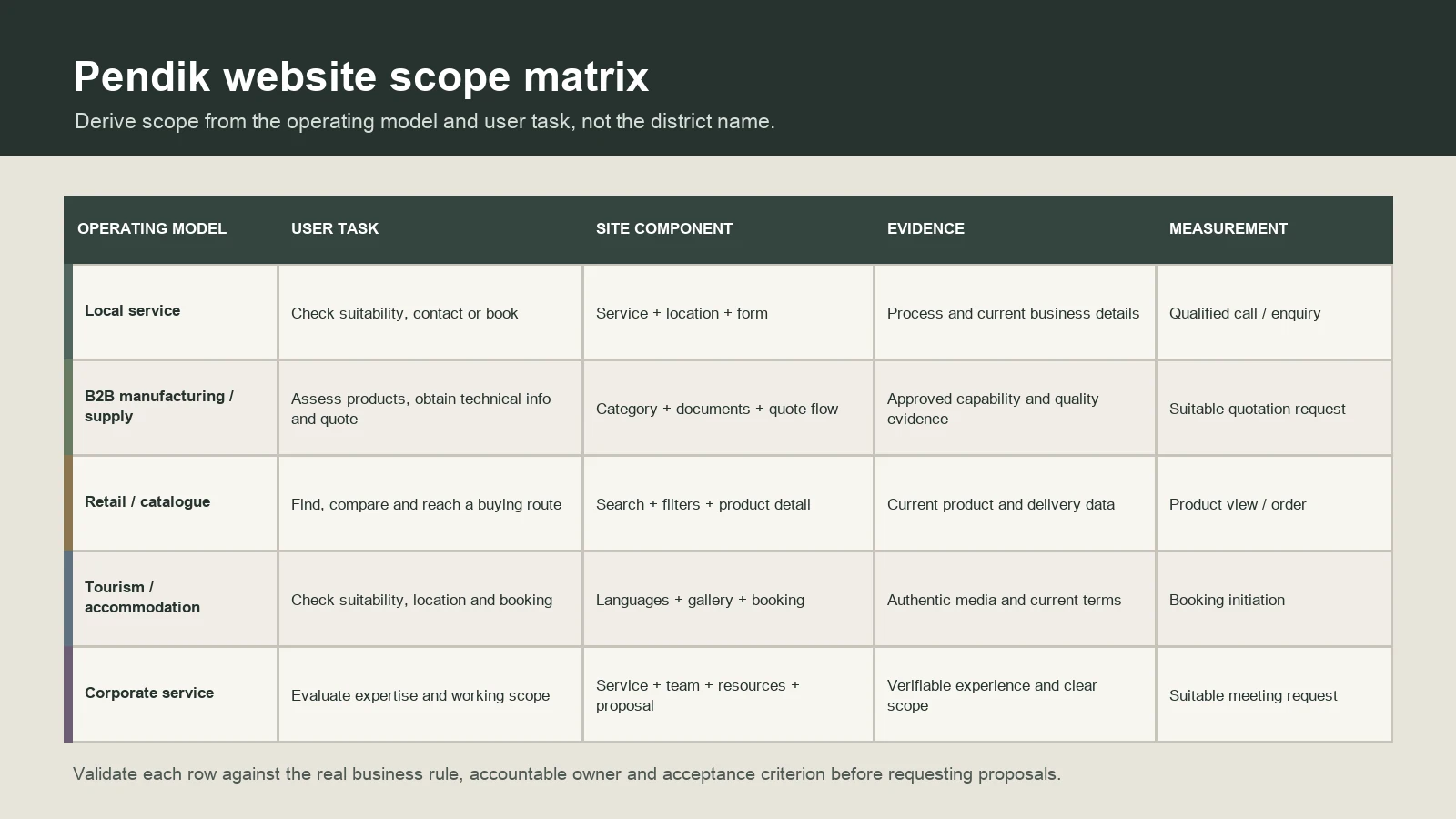
Before adding a feature to the requirements list, answer five questions in order:
- Operating model: What does the business provide, and how does the commercial or service process begin?
- User task: Which decision or action must a visitor complete?
- Website component: Which page, content item, form or integration is actually required for that task?
- Evidence: Which current and verifiable information does the user need before acting?
- Measurement: Which event represents task completion, and who evaluates enquiry quality and outcome?
This sequence turns broad terms such as “modern”, “corporate” or “SEO-friendly” into testable deliverables. A request for a “website that generates customers” cannot be accepted or measured until the target audience, enquiry fields, recipient, success state, notification, CRM behaviour and qualified-enquiry definition are known.
How should you build the page architecture?
Build the page inventory from user tasks rather than copying competitors. A corporate foundation may begin with home, company, service or product, evidence, resources and contact areas. The following questions may introduce additional templates or functionality:
- Are products presented on one page or through categories and details?
- Are technical files public or available after a request or sign-in?
- Does the organisation manage several locations, teams, brands or service areas?
- Do Turkish and English pages have identical or different coverage?
- Which system receives appointment, booking, application or quotation data?
- How will current URLs, media and search visibility be preserved?
Use the guide to preparing a website requirements document before requesting proposals.
What does genuine local relevance require?
Local visibility is not achieved by placing a district name in a heading. The actual service area, current address and contact details, delivery model and decision-supporting content should agree. A provider should not invent an office, client relationship or local track record that it cannot verify.
Avoid publishing many near-identical neighbourhood pages. A location page should contribute useful information about access, delivery, booking, team responsibility or regional scope. If the only change is a place-name variation, the page does not help the reader make a different decision.
What should a Pendik web design proposal specify?
A comparable proposal should identify at least:
- Discovery, requirements and project management
- Unique page templates and the design system
- Ownership of copy, media, translation and data entry
- Administration, roles and approval workflows
- Forms, search, filters, accounts, payments or booking functions
- CRM, ERP, email, mapping and other integrations
- Migration of content, records, media and URLs
- Mobile, browser, accessibility, performance and security testing
- Domain, hosting, account ownership, source code and data handover
- Boundaries between warranty, maintenance, support and new development
The district name does not determine project price. Unique templates, content volume, functions, integrations, languages, migration and quality requirements do. Review the 12 work packages that shape web design pricing for a more detailed scope worksheet.
How should you compare a web design company or agency?
A portfolio can demonstrate visual work, but it does not fully explain delivery, technical ownership or support. Ask every candidate for evidence against the same scope:
- Roles assigned to the project and the primary contact
- Deliverables for discovery, design, development, content and testing
- Verifiable work of similar complexity
- Design approval and scope-change method
- Ownership of source code, data, domains and third-party accounts
- Launch, rollback and handover plan
- Separation of defects, maintenance, support and new development
- Measurement and reporting method used after launch
“Guaranteed rankings”, “certain sales growth” and performance percentages without context are not comparison evidence. Use the website proposal comparison scorecard to apply consistent criteria.
How should the project be phased?
A robust web design project starts with discovery and scope. Information architecture, content inventory, wireframes, visual design, development, integrations, data entry and testing then follow. Each stage needs a defined output and approval owner.
Before launch, test forms, email notifications, mobile layouts, links, language routes, redirects, analytics events, user roles and integrations through realistic scenarios. Handover terms should cover the domain, hosting, source code, database, media and third-party service access.
For a larger project, prioritising core user tasks in the first release can be more manageable than forcing every feature into one launch. This is not a reduction in quality. It makes priorities, dependencies and acceptance conditions explicit while later phases remain planned.
Conclusion: Choose the scope before choosing the provider
When selecting web design in Pendik, evaluate your real user tasks rather than generic promises attached to a district name. Define product discovery, appointments, quotations, bookings, multilingual content and integrations at the level of pages, owners, evidence and measurement.
The existing Turkish and English slugs remain unchanged, so this refresh needs no 301 redirect. Before discussing a project with Kumsal Ajans, prepare a short summary of goals, users, content, functions and current technical assets. The recommended solution and proposal can then follow the actual project rather than a location label.