


Aydınlatma metni yükleniyor…
The quality of a new logo does not depend solely on the creativity of the design team. The outcome is also shaped by the quality of the brief, clarity around decision-making authority and the way revisions are evaluated. When comparing logo design agencies, looking only at portfolios or fees is therefore not enough. You should also examine how each agency approaches research, strategy, creative development, presentations, testing and final delivery.
A well-planned process reduces subjective requests such as “Make it more striking.” Instead, the discussion focuses on the audience the brand needs to reach, the perception it wants to establish, the environments in which the logo must work and the design decisions that support its position. The brief then becomes more than an order form: it provides a shared decision-making framework for the company and the agency.
Why is the logo brief fundamental to the design process?
A logo brief is a working document that explains who the brand is, whom it serves, how it differs from competitors and what the new visual identity must accomplish. It should not merely list preferred colours or symbols. Its purpose is to define the business and brand problem, project scope, usage conditions, constraints and criteria for success.
The reason for commissioning or redesigning the logo should be the starting point. Perhaps the existing identity does not perform well on digital screens, the brand is entering a new market, or the company’s products and services have evolved. If the problem remains vague, an agency may still produce several attractive concepts, but stakeholders will struggle to determine which concept solves the right problem.
The Design Council’s Double Diamond describes a process of discovering and defining a problem before developing and delivering a solution. Applied to a logo project, this means investigating the brand, its users and the competitive context before turning internal assumptions into visual decisions.
What should a logo design brief include?
Brand position and business objective
Explain the company’s products or services, market position, value proposition and intended direction in concise language. “We want to look modern and innovative” is too broad on its own. Clarify whether innovation is expressed through technology, customer experience, product development, accessibility or the business model. Evidence makes an abstract attribute more useful to a designer.
The commercial reason behind the project also matters. The company may be preparing a new brand for launch, creating a shared identity after a merger, supporting international growth or changing an outdated perception. Similar aesthetic preferences can lead to very different design choices when the underlying objectives differ.
Audience and intended perception
Do not define the audience using age, city and income alone. Identify the decision-maker, the context in which they encounter the brand, the criteria they use to choose and the concerns they may have. A corporate procurement manager and an individual consumer may look for different signals of trust, expertise or accessibility.
Limit the intended perception to three to five qualities. A focused description such as “expert, approachable and clear” offers more direction than a long list of adjectives. Add evidence for each quality: what does the business actually do that demonstrates expertise or approachability? The design team can then translate those ideas more consistently into typography, form, colour and composition.
Competitors and opportunities for distinction
Include direct competitors, substitute solutions and the visual conventions of the sector. The goal is neither to copy competitors nor to look different at any cost. It is to understand which conventions help audiences recognise the category and which ones make every company appear interchangeable.
You can share brands you admire, but explain precisely what is relevant about each example. It might be the simplicity of the logo, the typographic treatment, the flexibility of the identity system or its performance across digital channels. An instruction such as “Make it look like this” can restrict original thinking and introduce intellectual-property risks.
Applications and technical requirements
A logo should not be judged only as a large image on a presentation slide. List the real touchpoints where it will appear: the website header, mobile app icon, social profile, email signature, signage, vehicle graphics, packaging, exhibition stand or product interface. Constraints such as very small sizes, single-colour production and dark backgrounds need to be known before concepts are developed.
Depending on the project, the scope may include a primary logo, horizontal and vertical arrangements, a symbol, wordmark, icon, monochrome versions and adaptations for different writing systems. If the logo will anchor a broader digital identity, the brief should also address its relationship with colour, typography, motion, imagery and interface components.
Scope, schedule and deliverables
Document how many creative directions will be presented, how many revision rounds are included, when presentations and feedback are due, who will make the final decision and which files will be delivered. Required outputs may include editable vector artwork, print and screen formats, colour specifications, minimum sizes, exclusion zones and a concise usage guide.
Trademark clearance is separate from approval of the design. The World Intellectual Property Organization explains that a trademark is a sign capable of distinguishing the goods or services of one enterprise from those of others, and that registration takes place through national or regional offices. Before final adoption, arrange appropriate professional searches and legal advice in the relevant jurisdictions. The WIPO Global Brand Database can support an initial search, but national and regional registers may also need to be checked.
How should you evaluate logo design agencies?
Look beyond polished portfolio images and examine the problem and reasoning behind each project. Does the agency research audiences? How does it define brand position? Can it explain why a concept is suitable? Does it test identity elements in realistic applications? A portfolio that repeats the same visual treatment for every client is very different from one that demonstrates a brand-specific approach.
Compare proposals using a consistent set of criteria:
- The scope and depth of research and strategy
- The roles of the project team and the involvement of an Art Director
- The quality of the proposed creative directions and application examples
- The number of revision rounds, feedback method and terms for additional work
- Final files, usage guidance, licensing and transfer of rights
- The ability to extend the identity across relevant digital channels
The lowest fee is not always the most economical option. Insufficient research, undefined deliverables or apparently unlimited but poorly directed revisions can create additional costs and delays. Equally, an unnecessarily broad identity programme may not suit the organisation’s current needs. The scope should balance the required brand system with the available budget, schedule and internal capacity.
| Vague comment | Specific problem | Evaluation criterion | Expected action |
|---|---|---|---|
| Make it more corporate | The identity does not convey enough expertise | Brand position | Review the typography and layout |
| I don’t like the colour | It conflicts with the intended perception | Audience relevance and distinction | Test the rationale for the colour |
| The logo is too complicated | Details disappear at small sizes | Scalability | Simplify the form |
| Make it a little bigger | The header composition feels unbalanced | Channel application | Adjust the proportions and spacing |
How can revisions move beyond personal taste?
Connect every comment to the brief
Comments such as “I don’t like it,” “Make it more corporate” or “Give it more energy” do not provide an actionable direction. Relate feedback to the audience, brand position or a usage scenario. “The fine lines disappear at mobile-app icon size” identifies a testable problem. Instead of saying that a colour does not feel warm enough, discuss whether it supports the intended sense of trust or accessibility and whether it provides sufficient distinction within the category.
Provide one consolidated, prioritised response
When several managers send comments independently, the agency receives contradictory requests and revision rounds multiply. An internal project owner should consolidate the feedback before sharing it. Separate required changes from questions that need investigation and optional preferences. Final decision-making authority should be established at the beginning of the project.
Each review round can also have a defined purpose. The first may evaluate strategic direction and concept; the next may address form and typography; the last may refine colour and application details. This keeps approved decisions from being reopened without a clear reason. If a new business objective, audience or application emerges, acknowledge that it may represent a scope change rather than a routine revision.
Test concepts in realistic scenarios
Do not compare every option on the same generic mockup. Examine it in the contexts that matter to the brand: small screens, light and dark backgrounds, single-colour production, motion and multilingual layouts. The environment in which customers encounter the logo deserves as much attention as the management team’s preferences.
A scorecard based on the approved brief can make decision meetings more productive. Criteria might include distinctiveness, audience relevance, legibility, scalability, versatility and consistency with the brand position. Scoring is not intended to produce a mechanical winner. It helps reveal why stakeholders disagree and which assumptions need to be tested.
What does a structured logo project look like?
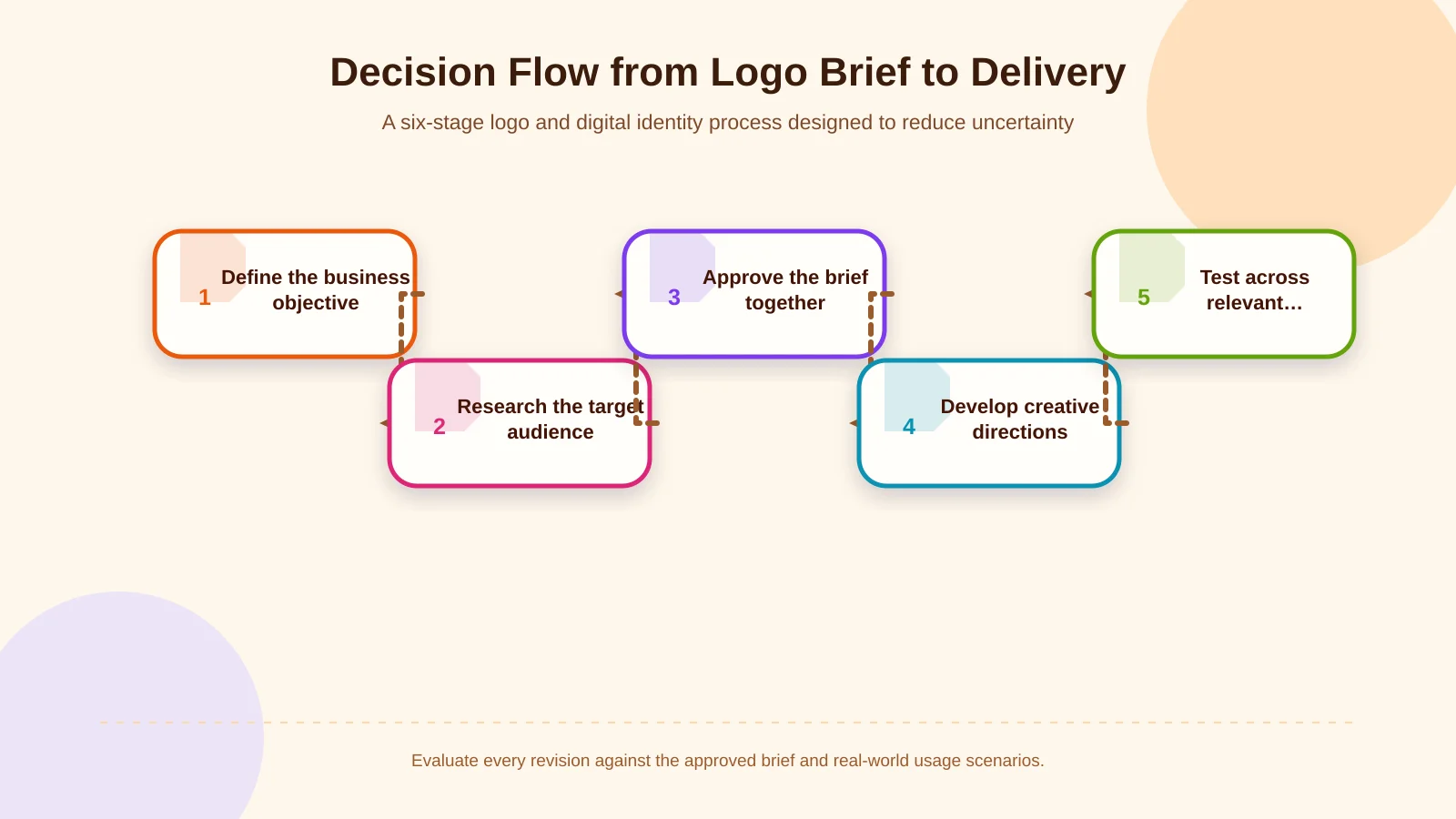
A typical process includes discovery and research, approval of the brief, definition of the visual direction, development of creative concepts, testing across real touchpoints, structured revisions and delivery of final assets. Although this sequence appears linear, findings from testing may require the team to revisit an earlier decision. That iteration is useful when it remains tied to agreed objectives.
Kumsal Agency approaches the process through two complementary capabilities. Its research-led Digital Brand Consultancy defines the brand’s digital position, visual direction, experience principles and communication system. Its Art Director-led Digital Design approach turns that strategic framework into original creative concepts, a coherent digital identity and applications for campaigns, content and motion.
Within this approach, the logo is not treated as an isolated graphic. It becomes the starting point for a system designed to work consistently across websites, social media, digital products, presentations and campaigns. Revisions consequently address not only the appearance of the mark but also the effectiveness of the identity across these touchpoints.
Final checklist before approval
- Does the selected direction support the business objective and brand position defined in the brief?
- Is it clear, distinctive and credible for the intended audience?
- Does it remain effective at small sizes, in one colour and on light and dark backgrounds?
- Have all required logo variations and digital applications been defined?
- Have the correct file formats, colour values and basic usage rules been delivered?
- Have appropriate trademark searches and legal reviews been completed for the name and mark?
- Does the contract clearly state the terms governing usage and intellectual-property rights?
The key to working effectively with a logo design agency is not telling designers exactly what to draw. It is explaining the problem the identity must solve. A clear brief improves the relevance of the concepts, while evidence-based feedback reduces delays and conflicts driven by personal preference. To plan a logo and digital identity process around the right brief and clear revision stages, contact Kumsal Agency.