


Aydınlatma metni yükleniyor…
Logo design prices can vary dramatically because “logo design” does not describe the same body of work in every proposal. One provider may offer a few visual options, while another project may include brand research, positioning, creative direction, original concept development, application testing, usage rules and a comprehensive set of production-ready files.
That is why asking only “How much does a logo cost?” rarely produces a useful comparison. You also need to define the problem the identity must solve, where the logo will appear and how the system should support the brand as it grows. This guide explains the factors behind logo design pricing and the criteria businesses should use when selecting a logo design company.
Why Do Logo Design Prices Vary So Much?
There is no single price that suits every organisation. A new business operating through a small number of digital channels will not have the same requirements as a company managing multiple products, branches, countries or sub-brands. As the research depth, number of stakeholders, project duration and range of applications increase, so do the expertise and working time required.
The difference is not simply the number of hours a designer spends drawing. A professional engagement includes less visible work: asking the right questions, identifying opportunities for differentiation, discarding weaker ideas, testing the chosen direction at different sizes and turning it into a system that teams can use consistently.
Research and strategic preparation
A logo developed without examining audience expectations, category conventions, competitor identities and the brand’s future plans may look attractive but still fail to be distinctive. Research connects design decisions to business and communication goals rather than personal taste alone.
This stage may clarify the brand promise, personality, values, positioning and priority touchpoints. It also establishes whether the business needs an isolated mark or the foundation of a broader identity system. For a new brand or rebrand, this preparation can prevent subjective disagreements later in the project.
Original concepts and creative development
The number of original concepts should not be confused with variations created by changing a colour or typeface. An original concept represents a genuinely different idea, visual logic and brand narrative. Sketching, selection, typography research, form development and practical testing for each direction all influence the project workload.
More concepts do not automatically mean better results. A focused set of well-researched directions is often more valuable than many loosely developed options. The proposal should explain what counts as a concept and how each direction will be presented.
Revision scope and decision-making
Revision means improving a selected creative direction in response to feedback; it does not usually mean restarting the entire project during every round. The proposal should state how many revision rounds are included, who will consolidate feedback and how requests outside the agreed scope will be handled.
In corporate projects with several decision-makers, presentation, meeting and approval time must also be planned. A clear internal owner can reduce contradictory feedback, delays and unnecessary rework.
Applications and logo variations
A logo rarely appears only in a website header. Social profiles, mobile app icons, packaging, signage, vehicles, presentations, email signatures, video openings and small product labels create different constraints. Horizontal and vertical configurations, symbol-only versions, monochrome artwork, and options for light or dark backgrounds can all expand the scope.
These variations should be designed as a coherent family rather than produced as last-minute exports. Testing them early reveals whether the identity remains recognisable across real environments.
Deliverable files and usage guidance
A professional handover should distinguish editable master files from exports intended for web, office software and print. Adobe’s logo design guide explains the importance of retaining a master file and exporting formats such as SVG, PDF, PNG and JPG for their appropriate uses. Vector artwork is particularly important because it can be resized without losing quality.
The price may also reflect the depth of the usage guide. A basic guide might cover clear space, minimum size and colour versions, while a broader identity guide can include typography, imagery, layout principles, motion behaviour and examples for key touchpoints.
What Should a Logo Design Proposal Include?
A comparable proposal should show what will be produced for the quoted fee—not only the total price. If the process, responsibilities and handover are unclear, an inexpensive offer can later create extra costs, delays or usage problems.
- The scope of discovery, stakeholder interviews and brand research
- The number of original creative directions or concepts
- How concepts will be explained and presented
- Included revision rounds and terms for out-of-scope changes
- Logo configurations, colour system and typography recommendations
- Deliverable formats such as AI, SVG, PDF, EPS, PNG and JPG
- RGB, CMYK, Pantone or other required colour specifications
- A basic usage guide or comprehensive brand guidelines
- Licensing, usage rights and ownership-transfer terms
- Schedule, approval points, responsibilities and payment plan
Check whether every item serves a real need. A small digital-first brand and a company with packaging, retail locations and a vehicle fleet do not require identical deliverables. The best proposal is not necessarily the one with the longest list; it is the one that matches the organisation’s actual applications and growth plans.
How Should the Logo Design Process Work?
A healthy process includes defined decision points from discovery to final delivery. Explaining these stages in advance helps the design team maintain focus and enables the client to assess the right questions at the right time.
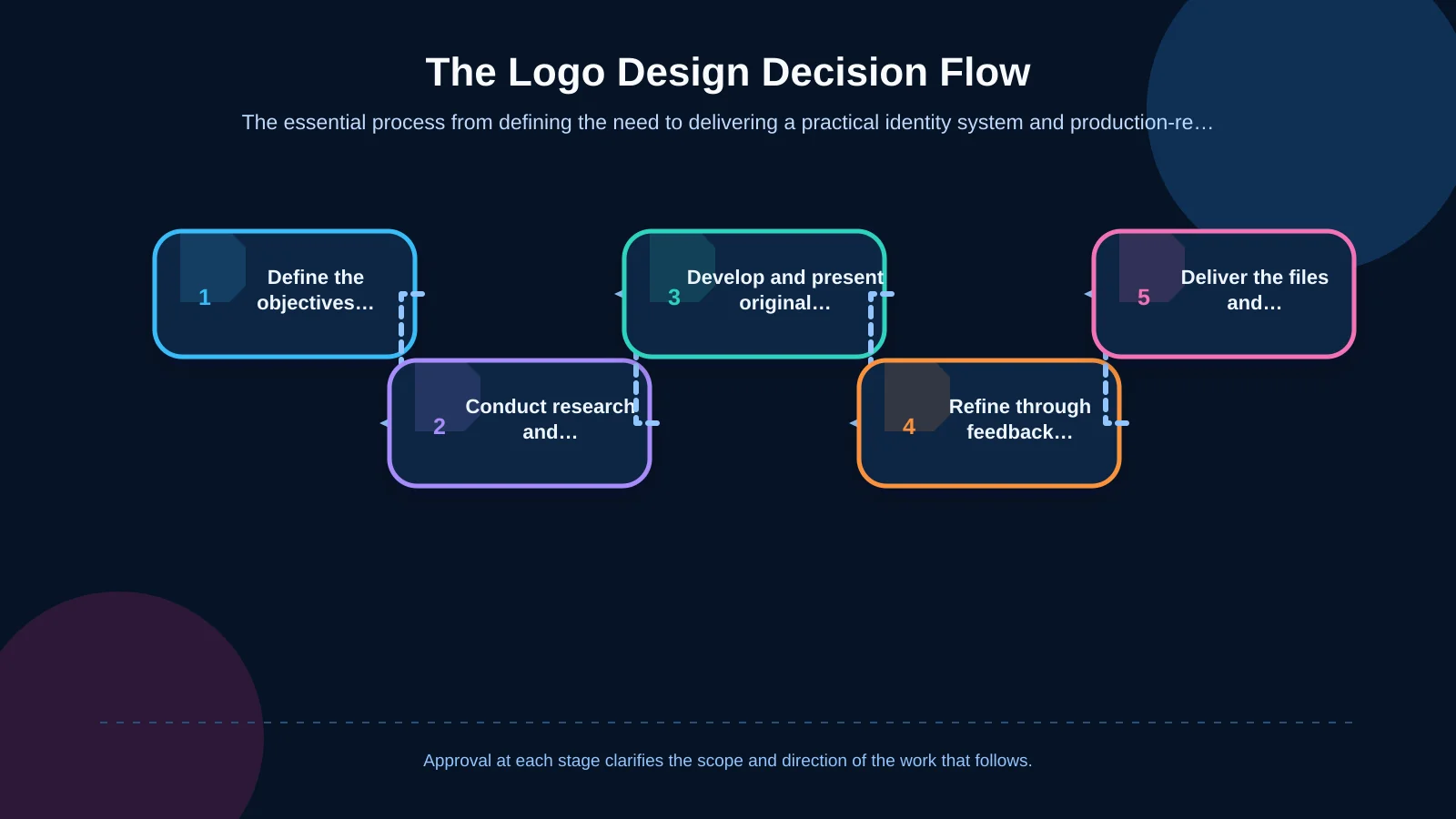
1. Define needs and objectives
The team discusses the business, audience, competitors, current perception, growth plans and intended applications. The requirements of a new identity are distinguished from those of a rebrand. Success is defined through relevance, recognition, flexibility and consistency—not simply whether stakeholders like a design at first sight.
2. Research and establish the visual direction
Category codes, competitor similarities and audience context are examined. The team then defines a visual direction describing how the brand should look and feel. Agreeing on this direction gives designers and decision-makers a shared frame of reference before detailed concepts are developed.
3. Develop and present concepts
The ideas with the strongest relationship to the strategy are developed from the initial sketches. A presentation should show more than a large logo on an empty page. It should explain the concept, typography and colour decisions, supported by examples in relevant contexts. This moves the discussion from “Do we like it?” to “Does it meet the brand’s goals?”
4. Revise and test applications
The selected direction is refined using consolidated feedback. It is tested on small screens, in single-colour production and against light and dark backgrounds. Problems such as disappearing details, inaccessible colour combinations or an indistinct symbol at small sizes should be resolved before approval.
5. Deliver and roll out the identity
The approved system is handed over with clearly named files and usage rules. The rollout across the website, social platforms, campaigns and corporate documents can then be prioritised. This ensures the logo becomes an active part of a consistent brand experience instead of remaining an unused file in an archive.
How to Choose the Right Logo Design Company
A portfolio is an important starting point, but it should not be the only selection criterion. Look for teams that understand different brand problems and develop appropriate solutions, rather than applying the same visual formula across unrelated industries. Where possible, examine the reasoning and range of applications behind the finished images.
Question the strategic approach
Does the team ask only about preferred colours and example logos, or does it investigate business goals, audiences, competition and future growth? The questions a logo design company asks are often as revealing as its initial answers. Research should function as the basis for creative decisions, not as a separate formality.
Evaluate creative expertise and team structure
Find out who will manage the engagement, develop the design and attend presentations. Art Director leadership can help connect strategic objectives, creative quality and consistency across applications. At corporate scale, coordination among strategy, design, project management and production specialists becomes especially important.
Check process transparency
The contract should clearly define the schedule, milestones, feedback method, revision rounds and conditions for scope changes. Defined stages usually support better decisions than a vague promise of “unlimited revisions.” The team should also state which delivery dates depend on client feedback and approval.
Discuss originality and legal checks
A logo and a registered trademark are not the same, but distinctiveness and possible similarities should still be considered during development. The World Intellectual Property Organization describes a trademark as a sign capable of distinguishing one organisation’s goods or services from those of others and explains the role of registration in legal protection.
WIPO’s information on trademarks and the Global Brand Database offers a useful starting point for preliminary research. Its guidance on developing and protecting an online brand also highlights why brand creation and protection should be considered together. A qualified trademark professional should conduct any comprehensive clearance or registration assessment.
Assess whether the identity can extend across touchpoints
As a brand grows, its identity must remain coherent across websites, e-commerce, campaigns, social content, motion design and production. A team that can translate the visual language into these environments may offer greater long-term value than one focused only on producing the initial mark.
What to Consider Beyond Price When Comparing Proposals
If two proposals have different totals, first align their scope. One may offer only a logo file, while the other includes research, several original directions, application testing, guidelines and adaptations for multiple touchpoints. Comparing those prices directly would be misleading.
- Strategic alignment: Is the design connected to business goals and audience needs?
- Originality: Is the idea developed specifically for the brand rather than sourced from a template?
- Usability: Will the logo be tested from small digital interfaces to large-format production?
- Transparency: Are the schedule, revisions, deliverables and rights clearly defined?
- Continuity: Can the team extend the identity into future digital and physical applications?
A low initial price can lead to higher total costs if essential files are missing, usage rights remain unclear or the work has to be redesigned. A high price alone is not a guarantee of quality either. The decision should be based on evidence of capability, clarity of method and alignment between the proposed scope and the organisation’s needs.
| Checkpoint | Question to ask | Sign of a strong proposal | Warning sign |
|---|---|---|---|
| Strategy | What research supports the decisions? | Audience and positioning are clearly defined | Decisions rely only on visual preference |
| Concepts | How many original creative directions are included? | The idea and reasoning behind each direction are explained | Colour changes are counted as separate concepts |
| Process | How are revisions and approvals managed? | Rounds, owners and schedule are clearly defined | Revisions are unlimited but poorly defined |
| Delivery | Which files and variations are provided? | Vector, web and print files plus usage rules are included | Only a low-resolution image is supplied |
| Continuity | Can the identity extend across other touchpoints? | A system is established for digital and physical applications | The logo remains disconnected from its applications |
How to Plan a Logo Design Budget
Start by listing where the identity will be used over the next few years. Will it appear only on a website and social media, or also on packaging, retail spaces, exhibitions, apps, video and materials used across several markets? This inventory reveals which logo configurations, colour specifications and guideline details are necessary.
You can then separate the engagement into a core logo, a visual identity system and application production. Priority deliverables can form the first phase, with campaign templates or motion assets scheduled later. However, the core system should anticipate future needs to reduce fragmented, inconsistent production.
Include more than the design fee in the budget. Typeface licences, trademark advice, print proofs and replacement of existing materials may all create transition costs. Making these items visible early provides a more realistic understanding of the total investment.
How Kumsal Agency Approaches Logo and Digital Identity Projects
Kumsal Agency treats a logo not as an isolated symbol but as part of an identity system aligned with the brand’s digital position and visual direction. Its research-led Digital Brand Consultancy establishes a framework for positioning, experience principles and the communication system.
Through an Art Director-led Digital Design approach, brand-specific creative concepts can be developed into systems for digital identity, campaigns, social content and motion design. Where required, the same visual language can extend into web design, e-commerce and production touchpoints, supporting a consistent brand experience.
A sound logo investment begins with defining the right scope rather than selecting the lowest quotation. Share your brand objectives, required applications and project expectations with Kumsal Agency to discuss a tailored logo and digital identity engagement.