


Aydınlatma metni yükleniyor…
Choosing a digital agency is not a search for the longest service list or the lowest price. It is a structured decision: find a partner that understands the business objective, can demonstrate the required expertise, defines deliverables clearly, and leaves the client in control of accounts and data.
Before contacting agencies, define what needs to change, which capabilities already exist internally, and which gap the agency should fill. Without that preparation, materially different scopes can look comparable and the reasons behind price differences remain unclear.
What Is a Digital Agency?
A digital agency is a specialist service organisation that provides some combination of website design, software development, search visibility, content, social media, digital advertising, design and measurement. Agency models differ: some specialise deeply in one channel, some coordinate strategy and production, and others focus on web or software delivery.
There is therefore no single “best digital agency” for every organisation. The right fit depends on the problem, internal team, decision speed, budget and preferred working model. For a detailed scope overview, read our guide to digital marketing agency services.
How Should You Define the Need Before Starting Your Search?
A useful brief starts with the business problem rather than a shopping list of channels. Answer five questions:
- Which outcome must change? Qualified enquiries, sales, applications, brand preference, user experience or operational efficiency.
- For whom? The target user, decision-maker, sector and market.
- What is blocking progress today? A weak offer, insufficient content, a technical issue, unreliable measurement, low trust or fragmented channel management.
- What already exists internally? Content capacity, design, sales follow-up, technical access, analytics knowledge and approval ownership.
- Which gap should the agency fill? Strategy, specialist execution, production capacity, technical delivery, measurement or coordination.
Turn the answers into a one-page selection brief covering the objective, current state, priority audience, expected deliverables, key dates, budget range, existing systems and decision process. Giving every agency the same problem makes their proposals meaningfully comparable.
Which Type of Agency Fits Your Need?
| Need | Potential fit | Evidence to request |
|---|---|---|
| Deep expertise in one channel | A specialist SEO, performance, social or content team | Channel-specific process, specialists and measurement examples |
| Coordination across several channels | An integrated or full-service agency | Cross-channel planning and a unified reporting model |
| A website or custom software project | A digital agency with design and engineering capability | Technical team, testing, security, maintenance and handover process |
| Strategic support for an internal team | A senior consultancy-led team | Decision framework, working sessions and implementable outputs |
| A time-bounded campaign | A project-based creative and media team | Schedule, production capacity, media plan and close-out deliverables |
Focus less on the label the agency uses and more on who will perform each required task. “Full service” does not guarantee every discipline is in-house. If subcontractors are involved, ask how roles, responsibility and quality control will work.
Eight Criteria for Choosing a Digital Agency
1. Understanding of the problem and objective
A strong first conversation begins with questions about your business model, audience, sales process and current evidence. If a ready-made package appears before the problem is defined, scope mismatch is a serious risk.
2. Relevant expertise and delivery team
Evaluate the people who will do the work, not only the agency brand. Where strategy, content, design, media, software or analytics are in scope, the proposal should identify the responsible roles, relevant experience, expected availability and communication model.
3. Quality of portfolio evidence
A wall of client logos says less than a clear explanation of a similar problem. Ask about the starting point, the agency's contribution, constraints and evaluation method. Where confidentiality limits disclosure, the agency can still explain its process or provide anonymised examples.
4. Strategy and working method
Ask what the first 30–90 days would contain, why tasks appear in that order, and which inputs are required. A method should expose how decisions are made; it should not impose the same template on every client.
5. Deliverables and scope boundaries
Translate broad labels such as “monthly management” into concrete outputs. Clarify the brief, research, creative variations, technical work, approval rounds, reports, meetings and optimisation actions included. Written exclusions and change rules reduce avoidable disputes.
6. Measurement and reporting
Ask which decision each report is designed to support. Reach and clicks need context from qualified enquiries, sales, applications or another verifiable business outcome. When data quality is weak, the first deliverable may need to be a measurement plan and a list of known limitations.
7. Communication and project governance
Define the day-to-day contact, meeting rhythm, approval window, urgent channel and change process. Ask whether the senior team in the pitch will remain involved after the work starts.
8. Ownership of accounts, data and source files
Agree ownership and access for advertising accounts, analytics properties, the domain, social profiles, creative source files, content and reporting data. Google's documentation explains that linking an existing client account to a Google Ads manager leaves the client account and its history intact, while Analytics supports separate user permissions at account or property level. These models make role-based access possible without sharing one password. (Google Ads manager-account linking; Google Analytics user access)
How Can You Compare Agency Proposals?
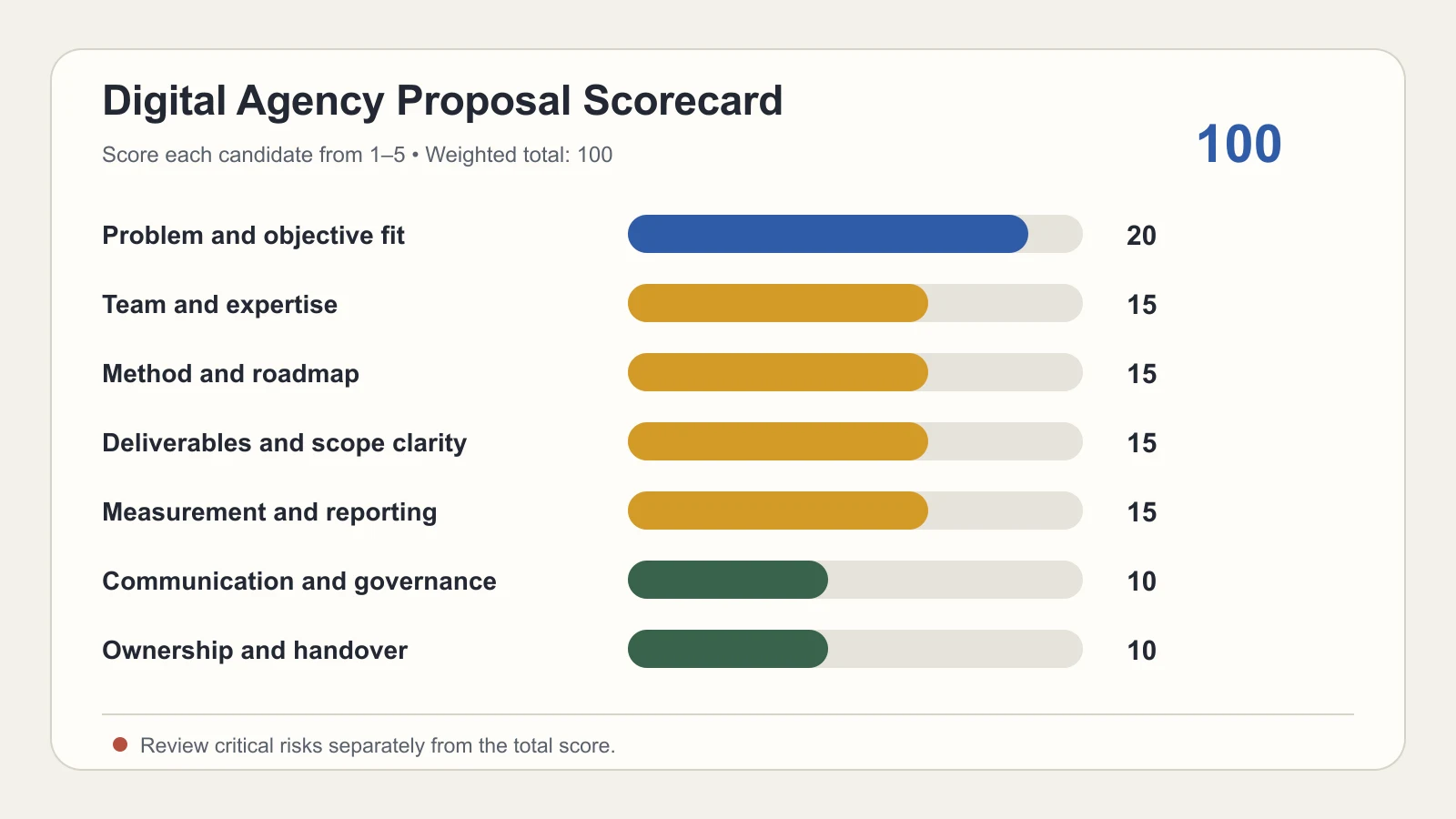
The Kumsal Agency evaluation matrix turns differently presented proposals into a common comparison. Adjust the weights to your risk profile, but assess every candidate with the same questions and evidence standard.
| Criterion | Weight | Evidence question |
|---|---|---|
| Problem and objective fit | 20 | How does the proposal connect to the business outcome? |
| Team and expertise | 15 | Who will do the work, and what relevant experience do they have? |
| Method and roadmap | 15 | What are the first stages, dependencies and decision gates? |
| Deliverables and scope clarity | 15 | What is included and explicitly excluded? |
| Measurement and reporting | 15 | Which evidence will support which decision? |
| Communication and governance | 10 | How will approvals, meetings, changes and urgent issues work? |
| Ownership and handover | 10 | Who retains accounts, data and source files? |
Score each criterion from 1 to 5, multiply by its weight and divide by five. Do not let the total replace judgement. Record any low score in a critical area as a separate risk; strong creative work, for example, does not cancel weak data ownership.
Twelve Questions to Ask an Agency
- What do you believe is the primary problem in this brief?
- Which outputs and decision points would you propose for the first 90 days?
- Who will perform the day-to-day work, and how are seniority and roles divided?
- Which services are in-house and which rely on subcontractors?
- Which data, content, access and approvals will you need from us?
- Which business outcome and intermediate indicators will define progress?
- How will you identify and report measurement limitations?
- How are scope changes and additional work priced?
- In whose name will accounts, analytics, the domain, creative and source files remain?
- What exactly will be handed over when the engagement ends?
- Describe an approach that did not work in a comparable project and what you learned.
- Under which conditions would you decline the work or recommend a smaller scope?
What Should the Contract and Handover Plan Cover?
The proposal describes the commercial shape; the contract assigns responsibility and risk. Obtain appropriate legal advice for the agreement. Operationally, document at least:
- Scope, deliverables, timing and exclusions
- Agency and client responsibilities and approval windows
- Fees, media spend, third-party costs and change requests
- Ownership of accounts, data, the domain, content and source files
- Confidentiality, data access, permission levels and secure credential transfer
- Termination, notice periods, live campaigns and the closing report
- Handover of site files, databases, media, ad accounts, analytics and documentation
When changing providers, use a short period of parallel working where possible. Do not begin a live migration or major intervention until current site files, the database and critical access have been confirmed and backed up. After transition, test site access, forms, email delivery, SSL, DNS, redirects, database connections and essential functions.
Red Flags During Agency Selection
- Guaranteed results or rankings before the current state and evidence are reviewed
- A proposal without named deliverables, responsible roles, exclusions or measurement
- A requirement to create advertising, analytics or domain accounts solely in the agency's name
- Case studies that do not distinguish the agency's work from other conditions
- The same standard package recommended for every problem
- Reports that count activity but provide no interpretation or next action
- Unclear handover terms for access and source files
- Repeated refusal to introduce the actual delivery team
A red flag does not always require immediate rejection, but it should be resolved through evidence, a contract clause or a clear operating rule before appointment.
How Should You Make the Final Decision?
A shortlist of three to five candidates is usually manageable for detailed comparison, but consistency matters more than the number. Apply the same brief and scoring method, record critical risks separately, and hold a final conversation with the people who will actually deliver the work.
Do not base the decision only on presentation polish or total price. Evaluating objective fit, evidence, team, scope, communication, measurement and ownership together gives you a clearer basis for choosing a sustainable working relationship. If you would like help defining the requirement, contact Kumsal Agency.