


Aydınlatma metni yükleniyor…
Choosing a social media agency requires more than reviewing a few sample posts. A sound partnership clarifies the business goal, the channels that are actually needed, who owns content and moderation, who retains account access, and which decision the reporting will change.
\n
Social media consulting and agency selection represent different search tasks. Consulting may give an internal team strategy and process support. An agency engagement can also include content, design, publishing, community management or campaign execution. This article focuses on comparing agency proposals before committing.
\n
What does a social media agency do?
\n
A social media agency can plan, produce, publish and evaluate a brand’s communication on selected channels. Agencies do not all provide the same service. Some offer a content calendar and design; others combine strategy, production, moderation, advertising management, reporting or crisis preparation.
\n
The phrase “social media management included” is not enough. The proposal should state the number of channels, monthly content volume, video and shoot scope, revision rounds, response windows, advertising-budget treatment and source-file handover.
\n
Prepare a brief before contacting agencies
\n
A useful brief includes more than the sector and a logo. Answer these questions:
\n
- \n
- What is the primary outcome: awareness, qualified demand, customer support, recruitment or community trust?
- \n
- Which product, service or audience has priority?
- \n
- Which existing content helped, and which created problems?
- \n
- Who approves work, which brand rules apply and what is the publishing rhythm?
- \n
- Who will own the accounts, advertising assets and archives?
- \n
A brief makes agencies answer the same question. Otherwise the most detailed-looking proposal may simply price a different deliverable.
\n
\n
Seven areas for comparing proposals
\n
1. Strategy and channel selection
\n
A business does not need to be on every platform. The agency should connect channel recommendations to audience behaviour, production capacity and the intended outcome. Ask what additional production and moderation load “all-platform management” creates.
\n
2. Content and creative production
\n
The proposal should separate copy, design, short video, shoots, stock or image rights, captions, format adaptations and revisions. Ask how topics are sourced, evidence is checked, approvals are handled and source files are delivered.
\n
3. Community and message management
\n
Who answers comments and messages, during which hours and with what escalation authority? If the agency moderates, define response templates, tone, qualified-lead criteria and crisis escalation. Publishing content and managing community communication are separate deliverables.
\n
4. Advertising and media budget
\n
Keep organic content fees, advertising management and media spend as separate lines. Ask which role the agency receives in the ad account, how many meaningful creative variations are included, who controls conversion measurement and how access is returned. See the Instagram advertising consulting guide for the paid-work distinction.
\n
5. Reporting and decision support
\n
A report should not only list follower and reach numbers. Review the content objective, qualified engagement, messages or form behaviour, customer feedback and the next test together. State who interprets the report, how often and in which meeting.
\n
6. Account and file ownership
\n
Keep ownership of Instagram, Facebook, the ad account, domain, content archive and source files with the business where possible. Give the agency role-based access rather than a shared personal password. Connecting a professional Instagram account to a Facebook Page can provide shared message management and other business tools, so decide in advance whose account will hold the connection (connecting an Instagram account and Facebook Page). Define access removal, file handover and historical-report transfer at the end of the contract.
\n
7. Team and working method
\n
The proposal should show the roles doing the work: strategist, editor, designer, video team, moderator and advertising specialist. Meeting rhythm, urgent communication, leave cover and revision limits matter as much as the portfolio.
\n
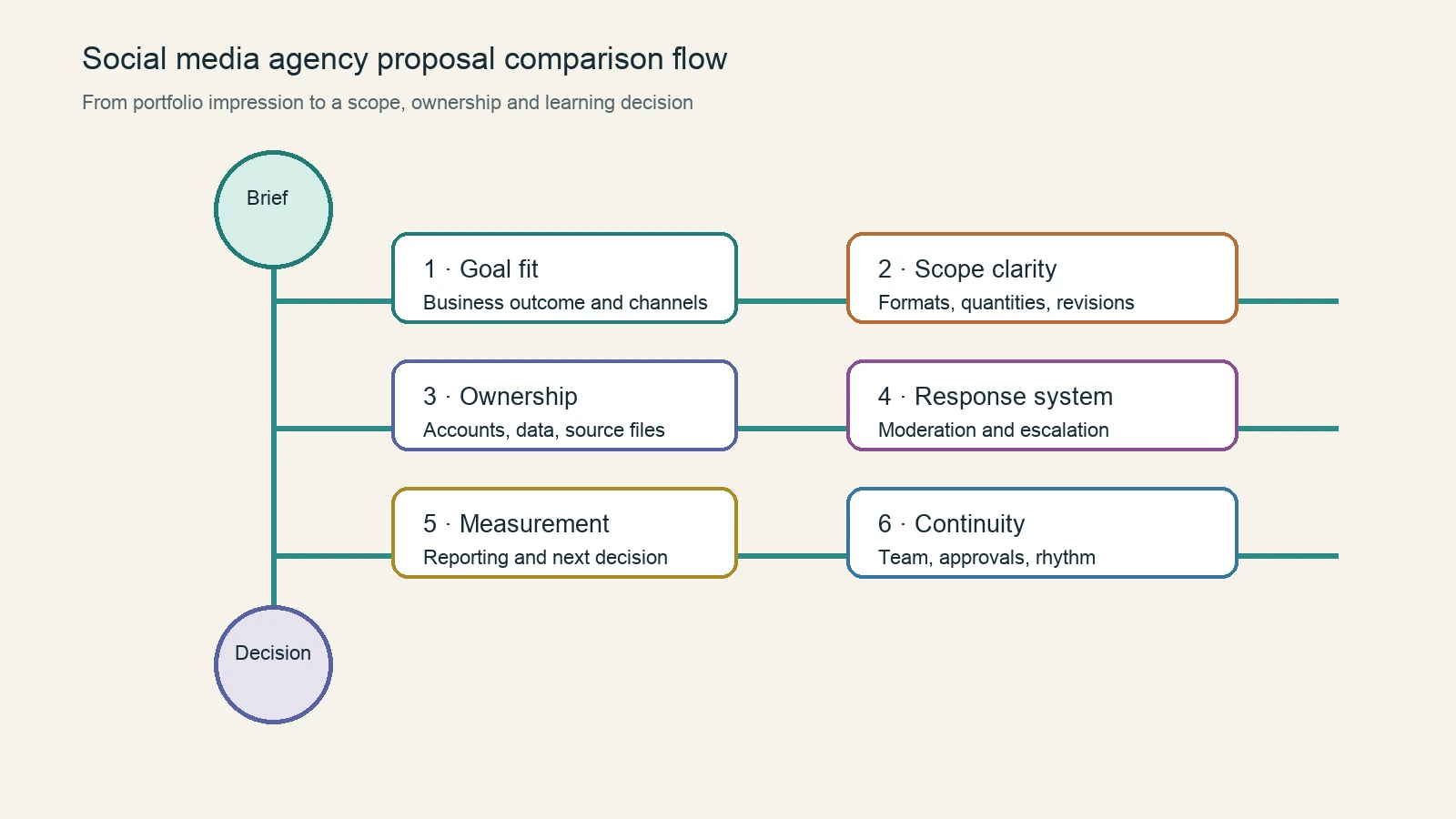
The Kumsal proposal comparison matrix
\n
Record evidence side by side under six headings:
\n
- \n
- Goal fit: Is the recommendation tied to the actual business outcome?
- \n
- Scope clarity: Are channels, formats, quantities and revisions defined?
- \n
- Ownership: Does the client retain accounts, data and source files?
- \n
- Response system: Are moderation and crisis owners clear?
- \n
- Measurement: Does reporting explain the next decision?
- \n
- Continuity: Can the team and approval process sustain the monthly rhythm?
- \n
The highest score is not automatically the right agency. The better choice is the proposal that fits the business’s risk and capacity.
\n
\n
When is consulting a better fit than an agency?
\n
If your internal team creates content and handles customer communication but needs outside expertise on goals, channels, measurement or process design, consulting may fit better. If you want to outsource daily production, design, video, moderation and campaign execution, review agency scope. If both are purchased, document deliverables and budgets separately; see the social media consulting scope.
\n
Conclusion
\n
A good social media agency does not promise virality or guaranteed sales. It makes goals, scope, ownership, production quality and the learning cycle visible. With a clear brief and comparable proposals, the decision moves from portfolio impression to a sustainable operating model. Explore the digital marketing library for related topics.