


Aydınlatma metni yükleniyor…
Instagram advertising consulting is broader than adding budget to a post or publishing one image across several placements. A sound engagement translates the business goal into a campaign objective, establishes account and data ownership, defines the audience approach, adapts creative to placements, reviews the post-click experience and turns results into the next production decision.
Instagram advertising does not work identically for every business. The consideration period, price, purchase channel, available creative, website or messaging journey and measurement quality all affect the outcome. The consultant's role is not to promise more exposure; it is to establish an experiment and learning system aligned with the business objective.
What is Instagram advertising consulting?
Instagram advertising consulting includes reviewing Meta advertising assets and existing campaigns, translating the business objective into a campaign objective, planning audience and placement approaches, preparing or directing creative, establishing budget and delivery rules, testing measurement and reporting the resulting decisions.
It is not identical to organic social media management. Organic work may include editorial planning, community communication, moderation and an ongoing brand voice. Advertising consulting concentrates on paid distribution, campaign objectives, targeting, creative variation and outcome measurement. The two can reinforce each other, but their deliverables and budgets should remain visible separately.
What should Instagram advertising consulting cover?
Business goal and campaign objective
Start by defining the desired behaviour: awareness, video viewing, a website visit, message, form, app action or purchase. Meta explains that its ad system uses the selected objective to seek people more likely to take the related action. The objective is therefore not an arbitrary interface setting; it directs optimisation. See Meta's ad objectives guide.
Expecting sales from a traffic objective, or judging a video-view campaign primarily by qualified enquiries, creates a mismatched evaluation. The campaign objective and primary reporting measure should follow the same decision logic.
Account, asset and access ownership
Identify ownership of the Business Portfolio, ad account, Instagram account, Page, data source, catalogue, audiences and creative source files. The agency or consultant can receive suitable permissions; use role-based access rather than shared personal passwords. The contract should explain access removal, history retention and file handover when the engagement ends.
Audience approach
Audience planning is not limited to age, location and interests. Review available customer signals, website visits, content engagement, product categories and necessary exclusions. Very narrow targeting can restrict learning, while broad targeting can conceal a weak offer or creative problem. Separate segments when each represents a meaningful business hypothesis.
Creative system
There is no single best Instagram ad format. Different creative roles may be needed for the offer, audience, placement and consideration stage. One variation can surface the problem, another can demonstrate use, and another can provide evidence or answer an objection.
Plan copy, imagery, video, sound, captions, opening seconds, product visibility and call to action together. A creative test is not merely a background-colour change; it should test a meaningful hypothesis such as message angle, evidence, format or offer.
Placement and adaptation
Feed, Stories, Reels and other eligible placements in the Meta ecosystem have different viewing behaviours. Meta's placement guidance explains that automated placements can distribute ads across different parts of its ecosystem. That does not mean the same file will communicate well everywhere. Review vertical, square or horizontal requirements, safe areas, captions, opening frames and CTA visibility.
When choosing automated or manual placements, consider creative coverage, brand-safety needs, measurement requirements and prior evidence. Manual selection should have a reason for each exclusion rather than reflect personal preference alone.
Post-click experience
For website campaigns, inspect the mobile page, speed, promise continuity and form or checkout flow. For messaging, prepare response time expectations, greeting copy, owners and qualification questions. A strong in-platform ad cannot repair a disconnected experience after the click or message.
Measurement and reporting
Impressions, reach, video views, clicks, messages, forms and purchases are not interchangeable. Choose a primary measure from the campaign objective and use secondary measures for diagnosis. Platform reports are important evidence, but lead-quality feedback or ecommerce order data should be added when the business can provide them.
The Kumsal six-signal Instagram advertising system
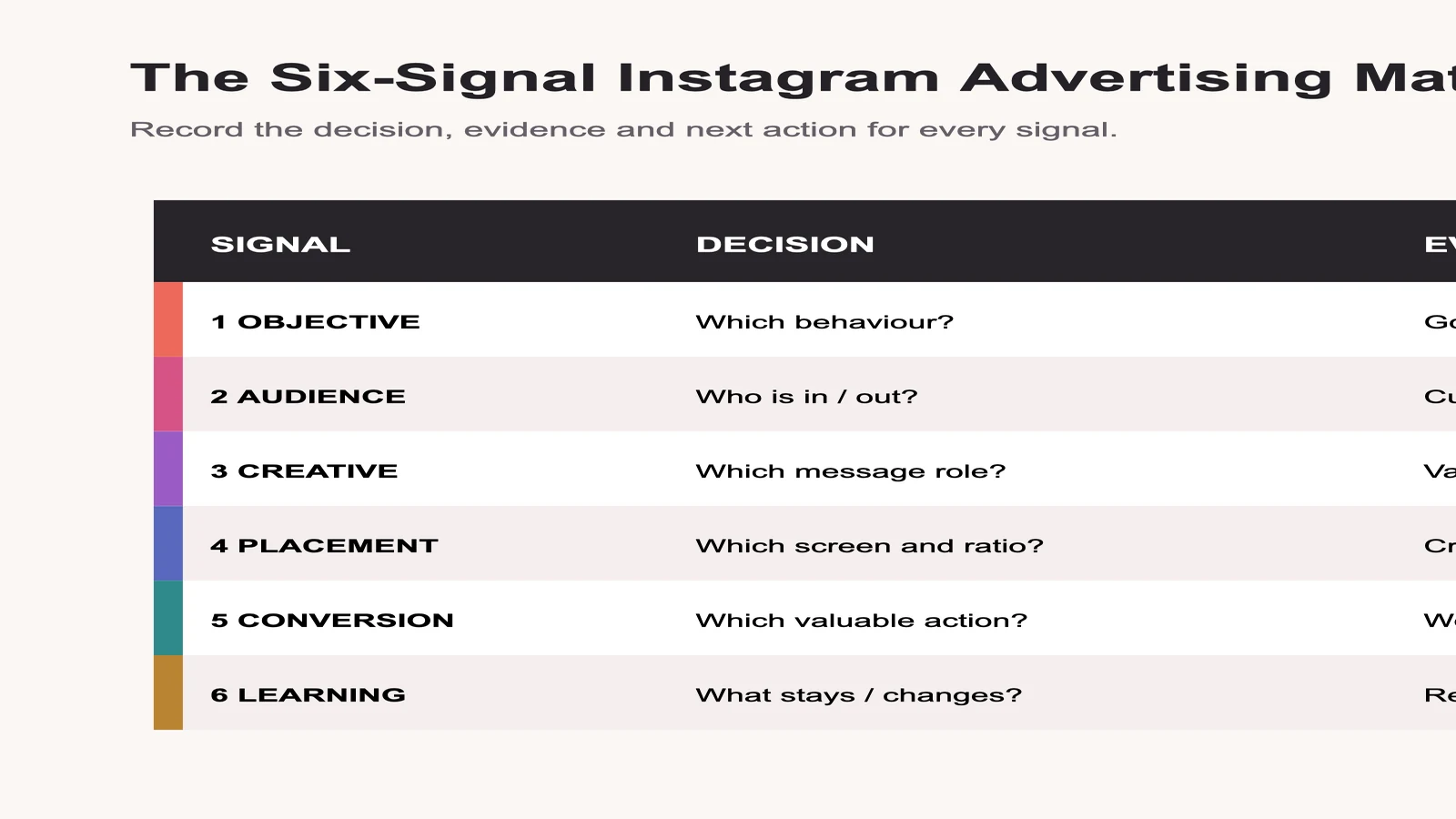
1. Objective signal
Translate the desired business outcome into an observable behaviour the platform can optimise toward. Record the evaluation window and decision owner.
2. Audience signal
Define who is included or excluded, which customer or behaviour data may be used and where the evidence is limited. Develop the audience and creative message together.
3. Creative signal
Give each variant one role: attract attention, explain the problem, demonstrate use, provide evidence or answer an objection. Do not confuse different ideas with trivial design changes.
4. Placement signal
Adapt assets to real screen ratios and viewing behaviour. Test cropping, readability, silent viewing and CTA visibility before launch.
5. Conversion signal
Verify that the website, form, message or app action is recorded correctly. Separate test events and incorporate sales or lead-quality feedback where possible.
6. Learning signal
Record which creative hypothesis, audience and placement was associated with which outcome. Decide what the next cycle should retain, stop or test with a new variation.
How should content production and media management be separated?
The proposal should itemise strategy, shoot or production, design, copy, format adaptations, media spend, campaign management, measurement setup, moderation and reporting. An “annual social media package” cannot be compared when it does not state how many ad variations, formats and revision rounds it includes.
When the need includes ongoing organic communication and community work, review social media consulting scope separately. For the wider relationship between campaign creative, media and agency responsibilities, use the advertising agency selection guide.
Questions to ask a consultant
- Who will own the ad account, data sources and creative files?
- Which business outcome will determine the campaign objective?
- Are creative strategy, production and format adaptations included?
- How many meaningful variations and revision rounds are included?
- Which evidence will guide automated or manual placement decisions?
- Who is responsible for the website, form and messaging journey?
- Are media spend and consulting or production fees separated?
- Will reporting explain the next creative and budget decisions?
- How will account and file handover work when the engagement ends?
Conclusion
Instagram advertising consulting is not about displaying more content. It manages the objective, audience, creative, placement and conversion signal as one learning system. When creative production and media-management responsibilities are explicit, platform metrics can support business decisions rather than remain a list of numbers. Explore the related digital marketing library for the wider context.