


Aydınlatma metni yükleniyor…
A private-sector tender portal is more than a form for collecting supplier prices and documents. It must protect commercially sensitive bids, apply the organisation’s procurement rules and show which evidence informed each decision. Otherwise, a fragmented process previously managed through email, shared folders and spreadsheets has simply been moved to a new screen.
In a well-designed portal, suppliers prepare and manage their own submissions until the deadline. Procurement coordinates the tender, while technical, financial and legal evaluators access only the information required for their assigned duties. Bid opening, score changes, exception approvals and final decisions are recorded. Confidentiality and operational efficiency therefore become parts of the same controlled workflow.
Why is bid confidentiality about more than passwords?
Being able to sign in does not mean a user should see every tender or every part of a bid. Authentication establishes identity; authorisation determines which resource that identity may access, under which conditions and for which action. The OWASP Authorization Cheat Sheet recommends least privilege, deny-by-default access and permission validation on every request. In a tender portal, these principles must cover APIs, files, previews and exports as well as visible screens.
Confidentiality also extends beyond encrypting a submission while it travels to the server. Storage, backups, previews, downloads and transfers to integrated systems all sit within the same security boundary. A predictable file address, an active session left unattended or an export exposed to the wrong role can disclose information despite strong passwords.
The ISO/IEC 27001 approach to information security addresses confidentiality, integrity and availability through risk management. For a portal, the relevant question is not only who viewed a bid. The system should also help prevent unauthorised changes, keep information available to authorised users when needed and align controls with the organisation’s risks.
How should the role and permission matrix be designed?
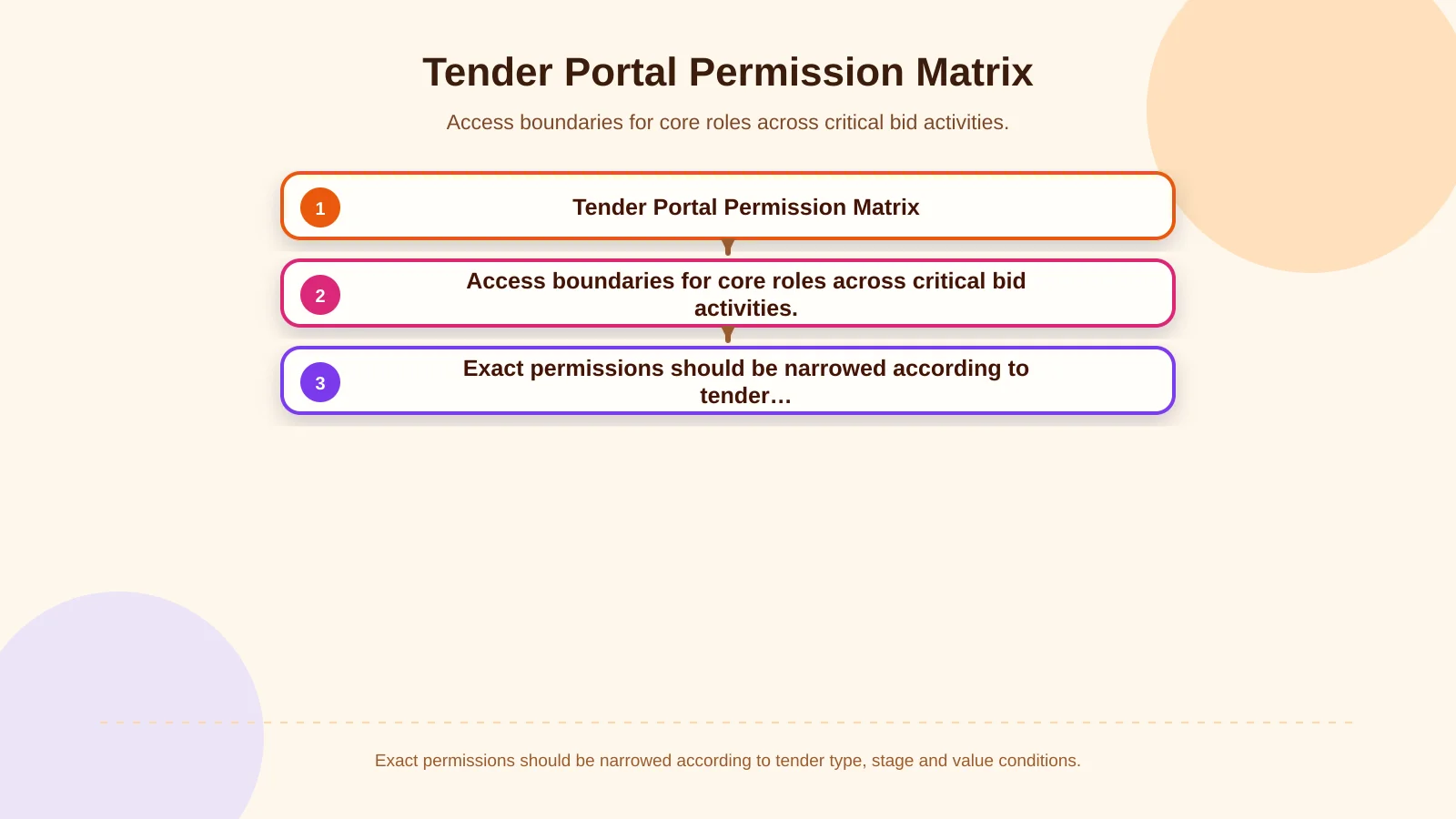
Naming roles is only the starting point. The practical requirement is a permission matrix defined at action and data level. A supplier may edit its own organisation’s draft but cannot see competing submissions. A tender manager can manage schedules and participants yet may be prevented from viewing price files before opening time. Technical evaluators can score technical evidence without seeing commercial prices. Finance or procurement may receive access to commercial sections only after technical qualification.
Role-based access should be supplemented with conditions such as tender type, business unit, value threshold, stage, location and conflict-of-interest status. The same employee may perform different duties in different tenders. Permission should therefore be tied to a particular tender, lot, evaluation section and validity period—not merely to a general “evaluator” role.
| Role | Visible data | Permitted actions | Primary restriction |
|---|---|---|---|
| Supplier | Own bid | Draft, submit, withdraw | Cannot see competing bids |
| Tender manager | Schedule and participants | Publish, coordinate | No early price access |
| Technical evaluator | Technical documents | Evidence-based technical scoring | Commercial envelope remains sealed |
| Finance / procurement | Authorised commercial fields | Cost comparison | Only bids at the valid stage |
| Approver | Decision summary and rationale | Approve, reject, request correction | Cannot alter scoring history |
Segregation of duties and temporary access
Concentrating critical actions in one account creates operational and ethical risk. The person who prepares a tender should not be the sole person who opens bids and finalises the award. Tenders above a defined value can require dual approval, legal review or executive authorisation. Delegated access should have start and end dates and expire automatically.
- Separate permissions for creating, publishing and cancelling tenders.
- Keep technical and commercial evaluation areas apart when the process requires it.
- Make every access path, including administrator access, justified and auditable.
- Reflect role changes, departures and the end of delegation promptly.
A secure process from bid submission to opening
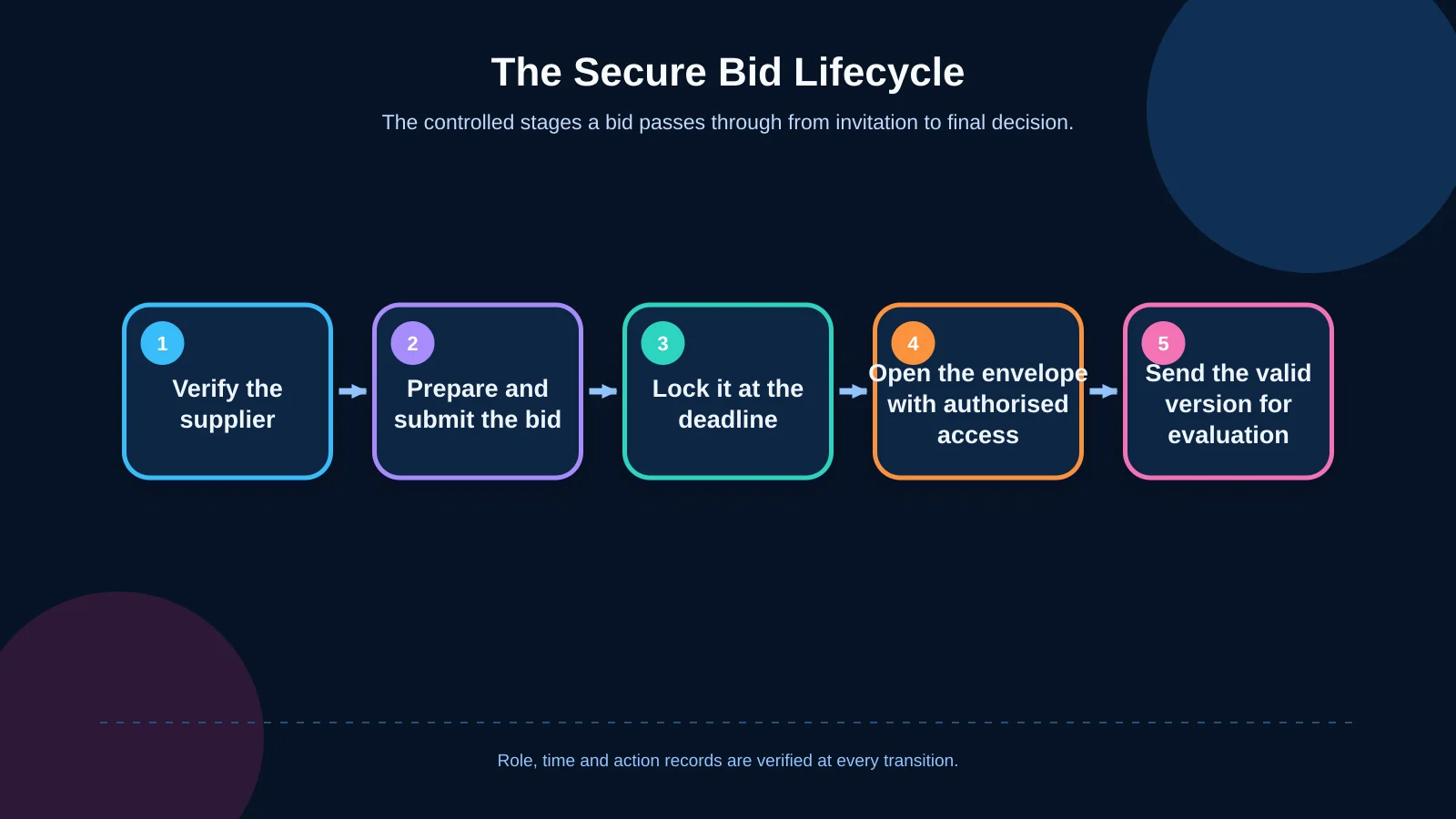
The secure journey begins with the supplier invitation. The invitation should be associated with an organisation and named user, with additional verification considered for sensitive actions. The supplier completes required fields, uploads technical and commercial files to their designated sections, previews the bid and submits it with an authorised declaration. The portal confirms successful receipt with a timestamp and reference number.
The post-submission rule must be explicit. A bid may become locked immediately, or the supplier may withdraw it and submit a new version before the deadline. Under the second model, previous versions should remain in the history while only the latest valid version enters evaluation. Changes after the deadline should require a defined exception and authorised approval, with old and new values retained.
Opening is itself a controlled state transition. Evaluators must not see bid contents before the scheduled time. At that point, the portal can apply the organisation’s policy through automatic opening or approval by an authorised committee. Where required, the technical envelope opens first and the commercial envelope remains sealed until technical qualification is complete. This reduces the risk that price information will improperly influence technical scoring.
How should evaluation criteria and scoring be designed?
Evaluation should apply predefined measures to evidence rather than rank bids through unstructured opinions. Criteria may cover technical compliance, delivery time, total cost, payment terms, warranty, service levels, sustainability or supplier capability. Before publication, each criterion should have a weight, scoring scale, required evidence and clearly stated effect on eligibility.
Pass-or-fail requirements must be separated from weighted scores. Allowing a bid without a mandatory certificate to remain competitive through a high price score would undermine the process. The portal should apply eligibility gates first and score only valid bids. Formulas for automatically calculated fields should be transparent, while manual scores may require an explanation or supporting evidence.
Independent evaluation and consensus
When several evaluators participate, the portal must define when they can see one another’s scores. Keeping opinions hidden during independent scoring reduces early influence. Once individual assessments are complete, the system may calculate an average or weighted outcome, or initiate a consensus session. Large differences can be flagged automatically for explanation. A consensus result should never overwrite the original individual records.
Comparing headline prices alone may also be misleading. Exchange-rate dates, taxes, freight, installation, maintenance, discounts, payment terms and expected usage volumes may need to enter the same cost model. Normalisation rules should be established in advance so users do not create conflicting calculations in offline spreadsheets. If revised bids are requested, the portal should separately manage round rules, deadlines, visible fields and equal treatment of participating suppliers.
Approval workflows and exception management
The highest-scoring offer is not automatically the winner in every case. Budget constraints, commercial risk, contract terms or supply continuity may demand further review. The portal should send the recommendation, evaluation results and rationale to the relevant approvers. The chain may vary by business unit, procurement category, tender value, deviation percentage or risk level.
Approval should not be limited to accept and reject. Requesting corrections, seeking more information and granting conditional approval may be valid outcomes, provided each one has a defined return point in the workflow. Requiring decisions within the portal strengthens record integrity compared with adding retrospective notes about approvals received by email.
Exceptions must not become invisible shortcuts. Deadline extensions, late-bid acceptance, changes to criterion weights, single-source procurement and score corrections should retain the reason, authorisation and previous value. If criteria must change after publication, supplier communications and the effect on existing bids should be governed by explicit business rules.
Which events should the audit trail record?
An audit trail is not simply a list of sign-in times. It should cover invitation creation; bid upload, viewing and download; role changes; opening; score entries; comments; approvals; integration transfers; and exceptions. Each event should identify the user or service, time, action, related tender, result and, where appropriate, previous and new values.
NIST SP 800-92 addresses the infrastructure and management processes required for effective organisation-wide log management. For a tender portal, producing logs is not enough. They must be protected, access-controlled, retained for the required period and available for investigating unusual events. Logs should avoid unnecessarily copying sensitive bid contents while retaining enough context to reconstruct an incident.
- Monitor denied access attempts as well as successful actions.
- Prevent ordinary users from changing or deleting audit records.
- Set retention according to organisational policy, contracts and applicable obligations.
- Limit reports to authorised audit and security roles.
ERP and enterprise system integrations
A tender portal rarely operates alone. Supplier master data may come from ERP, identities and organisational information from a corporate directory, and budgets or purchase requests from another platform. The winning bid may then become a purchase order or enter contract management. These enterprise resource planning integrations should address data ownership and transaction status, not only field mapping.
Every data domain needs an authoritative system. If the supplier’s tax identifier is maintained in ERP, the direction and approval of changes made through the portal must be clear. Independent updates in two systems can result in invitations being sent to the wrong company or incorrect orders being created. Service-account permissions should be restricted, while errors, retries and duplicate-prevention controls remain observable.
Security does not end at launch. Dependency updates, access reviews, backup tests, incident handling and capacity management require ongoing operation. Integration monitoring should distinguish a queued transaction from an accepted ERP record so users do not mistake a technical handoff for a completed business process.
How can user experience support confidentiality and data quality?
A secure portal does not have to feel complicated. Users should understand the current tender stage, mandatory information and what happens when they submit. Clear field names, file checks and a pre-submission summary reduce the risk of technical and commercial files being placed in the wrong sections.
Evaluation screens should present the criterion, weight, evidence, score and explanation in one context. If evaluators must move between numerous tabs or offline spreadsheets, the controlled process escapes the system. Accessibility, responsive interfaces, draft saving for long forms and understandable error messages also directly affect adoption and data quality.
How should a bespoke tender portal be planned?
Before selecting features, model the organisation’s real procurement workflow. Map tender types, bid envelopes, participant models, evaluation methods, value limits, approval chains, exceptions, reports and integrations together. A role–data–action matrix can then turn who may see or change what at every stage into testable requirements.
Kumsal Agency approaches custom web development by bringing business processes, user roles, data models, user experience and enterprise integrations into one architecture. The result can be planned as more than a bid-collection interface: it becomes software that enforces procurement governance, supports sustainable security controls and adapts as processes evolve.
Scenario workshops based on representative tenders help define the initial scope. Early submissions, late bids, missing documents, delegated authority, tied scores, rejected approvals, integration outages and incorrect file access should be tested during design. Acceptance criteria must verify not only that screens work, but also that unauthorised roles cannot reach protected data and every critical decision leaves a reliable record.
The next step towards secure, traceable evaluation
Bid confidentiality depends on encryption, role management, stage-based visibility, segregation of duties and audit records working together. Reliable evaluation requires predefined criteria, evidence-based scoring, controlled revisions and explicit approval chains. When one component is missing, a portal may look digital while the real process remains dependent on email, files and personal judgement.
Plan a tender portal tailored to your organisation by analysing bid confidentiality, the permission matrix, evaluation stages, approval workflows and integration requirements together. Contact Kumsal Agency to discuss the project.