


Aydınlatma metni yükleniyor…
Managing company vehicles through spreadsheets, email threads, service receipts and separate departmental lists becomes increasingly difficult as a fleet grows. Teams may struggle to confirm who currently has a vehicle, whether its next service is approaching, when its mileage was last recorded or which vehicle incurred a particular expense. Fleet management software brings these records into a shared, vehicle-centred data structure, giving operations, finance and management teams a consistent view of current fleet activity.
An effective system, however, is more than a vehicle list or a map. Driver assignments, mileage movements, journey purposes, maintenance rules, expense documents, approvals and accounting records must be connected. Custom fleet management software can turn these relationships into sustainable workflows that reflect the organisation’s actual responsibilities, policies and operational exceptions.
What problems does fleet management software solve?
The central challenge in fleet management is often fragmented data rather than a complete lack of data. Operations may maintain the latest mileage spreadsheet, finance may hold fuel invoices, HR may own driver information, and service providers may retain maintenance histories. Without a shared vehicle identifier and clear recording rules, reconstructing the full lifecycle of a single vehicle is difficult.
A central platform can combine vehicle inventory, responsibilities, usage records, scheduled and unscheduled maintenance, documents and costs. The US Department of Energy’s FEMP fleet management framework likewise highlights the importance of accurate, comprehensive vehicle-level data and of managing inventory, utilisation, cost and maintenance information together.
This structure helps fleet managers look ahead instead of merely reporting the past. Maintenance at risk of becoming overdue, unusual expenses, vehicles left idle for long periods and missing mileage entries can become actionable alerts or assigned tasks.
How should vehicle and driver assignments be managed?
Each vehicle record may include its registration number, make, model, model year, fuel or energy type, VIN, registration documents, acquisition method, location, department and operational status. If leased and company-owned vehicles follow different contractual, cost or usage rules, the data model should represent that distinction explicitly.
A driver assignment should answer more than “Who has the vehicle?” Its start and end dates, handover mileage, signed handover form, equipment checklist, permitted operating area and substitute driver can also be recorded. This creates a historical view of responsibility at any given date. Pool vehicles may instead use reservation, collection and return workflows, with inspections and mileage captured at each handover.
Roles and permissions should reflect real operations
Drivers might see only their assigned vehicles and required forms, while regional managers monitor vehicles used by their teams. Fleet managers can control assignments and maintenance, finance users can review expense documents and approval states, and administrators can maintain definitions and permissions. Access to sensitive driver information should follow job requirements. Critical changes should create an audit record containing the user, timestamp and previous value.
How should mileage and vehicle usage data be collected?
Mileage is a common reference point for maintenance planning, utilisation analysis, fuel monitoring and replacement decisions. Each reading should therefore retain its date, source and verification status. A driver may submit it through a mobile app, it may be captured during refuelling, or it may arrive automatically from a telematics platform. Where sources overlap, the organisation needs rules defining which value prevails and how discrepancies are reviewed.
A usage record can connect departure and return times, opening and closing mileage, driver, route or location, business purpose, project and cost centre. The system can flag a reading below the previous value, an implausible increase or overlapping bookings for the same vehicle before unreliable data spreads into reports.
Telematics should be introduced according to operational need rather than assumed to be identical for every vehicle. GSA’s fleet telematics guidance identifies examples including mileage, engine hours, journey counts, engine and diagnostic data, and maintenance reminders based on mileage or engine hours. If location tracking is included, its purpose, access permissions, retention period and employee notices require separate consideration.
Mobile recording supports field teams
Allowing drivers to send mileage, fuel receipts, damage photographs and inspection forms without returning to an office reduces reporting delays. Kumsal Agency’s approach to React Native mobile app development can support shared workflows across iOS and Android. For teams working with unreliable connectivity, the scope should include offline capture, later synchronisation and safeguards against duplicate submissions.
How does maintenance progress from mileage to a work order?
Maintenance management involves more than placing a date on a calendar. Rules can be defined by vehicle or vehicle class using mileage, engine hours, elapsed time or a combination of thresholds. Manufacturer recommendations, warranty terms, operating conditions and company policies should all inform those rules. GSA’s Motor Vehicle Policy Customer Guide recommends that preventive maintenance programmes account for safety and emissions requirements as well as manufacturer warranty conditions.
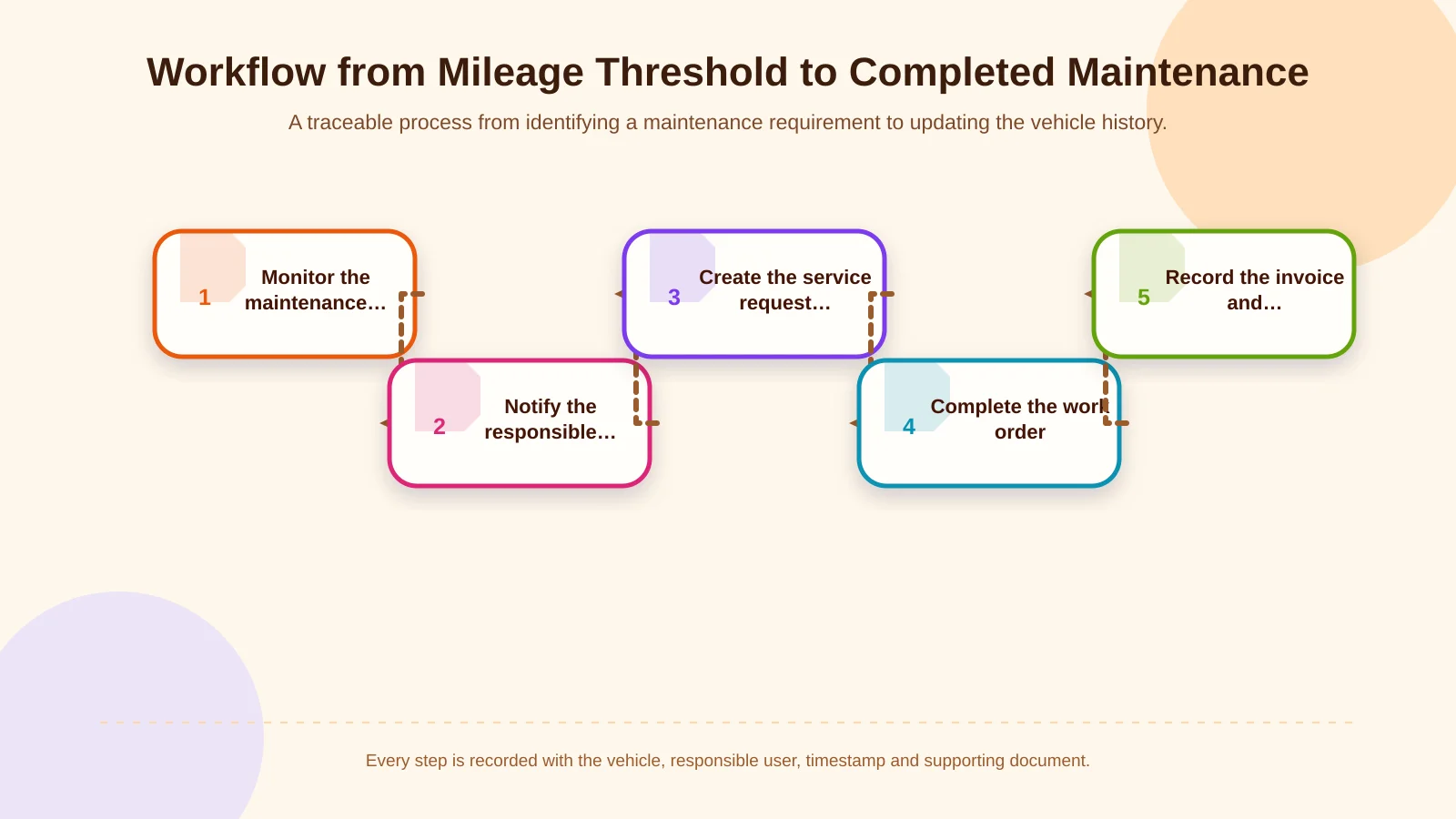
When a vehicle approaches a threshold, the system can notify the responsible person. A service request is then opened, approval obtained where necessary and an appointment scheduled. The work order may include the reported issue, planned work, service provider, estimated cost and need for a replacement vehicle. On completion, teams record the work performed, parts replaced, labour, invoice, closing mileage and next threshold.
Unplanned faults should enter the same lifecycle. A driver’s fault report, roadside assistance request, decision to remove the vehicle from service, workshop diagnosis and eventual return to operation should remain connected. The business can then report both repair cost and operational downtime.
- Define maintenance rules for a vehicle or vehicle class.
- Notify owners about approaching and overdue work.
- Keep service requests, quotations and approvals in one record.
- Change vehicle status through controlled workflow rules.
- Attach invoices and completed work to the maintenance history.
How should expense tracking and cost control be structured?
Fleet expenditure extends beyond fuel and maintenance. It may include leasing, insurance, tax, inspections, tolls, parking, tyres, damage, fines, accessories and depreciation. Connecting each entry to a vehicle, date, expense category, supplier, document number, amount, tax, currency, cost centre and project creates a more reliable basis for analysis.
Controls should examine context, not only the total. A repeated document number, an expense outside a vehicle’s assignment period, unexpectedly frequent tyre replacements or a workshop invoice above an approved limit can enter a review queue. The objective is not necessarily automatic rejection; it is to route the record and supporting evidence to the right reviewer.
Reports can compare total cost per vehicle, cost per mile or kilometre, expense distribution, maintenance budget variance and downtime cost. These figures remain dependent on record completeness. If cost per kilometre is calculated for a vehicle with missing mileage, the report should display a data-quality warning rather than present the result as fully reliable.
| Expense type | Core record | Control point | Suggested workflow |
|---|---|---|---|
| Fuel | Volume, amount, mileage | Consumption and duplicate receipt | Document validation |
| Maintenance and repair | Work order, parts, labour | Limits and maintenance history | Technical review + approval |
| Insurance and tax | Policy or assessment period | Due date and vehicle match | Scheduled approval |
| Tolls and parking | Transaction, location, date | Assignment and usage alignment | Rules-based review |
Approval workflows may vary by expense type
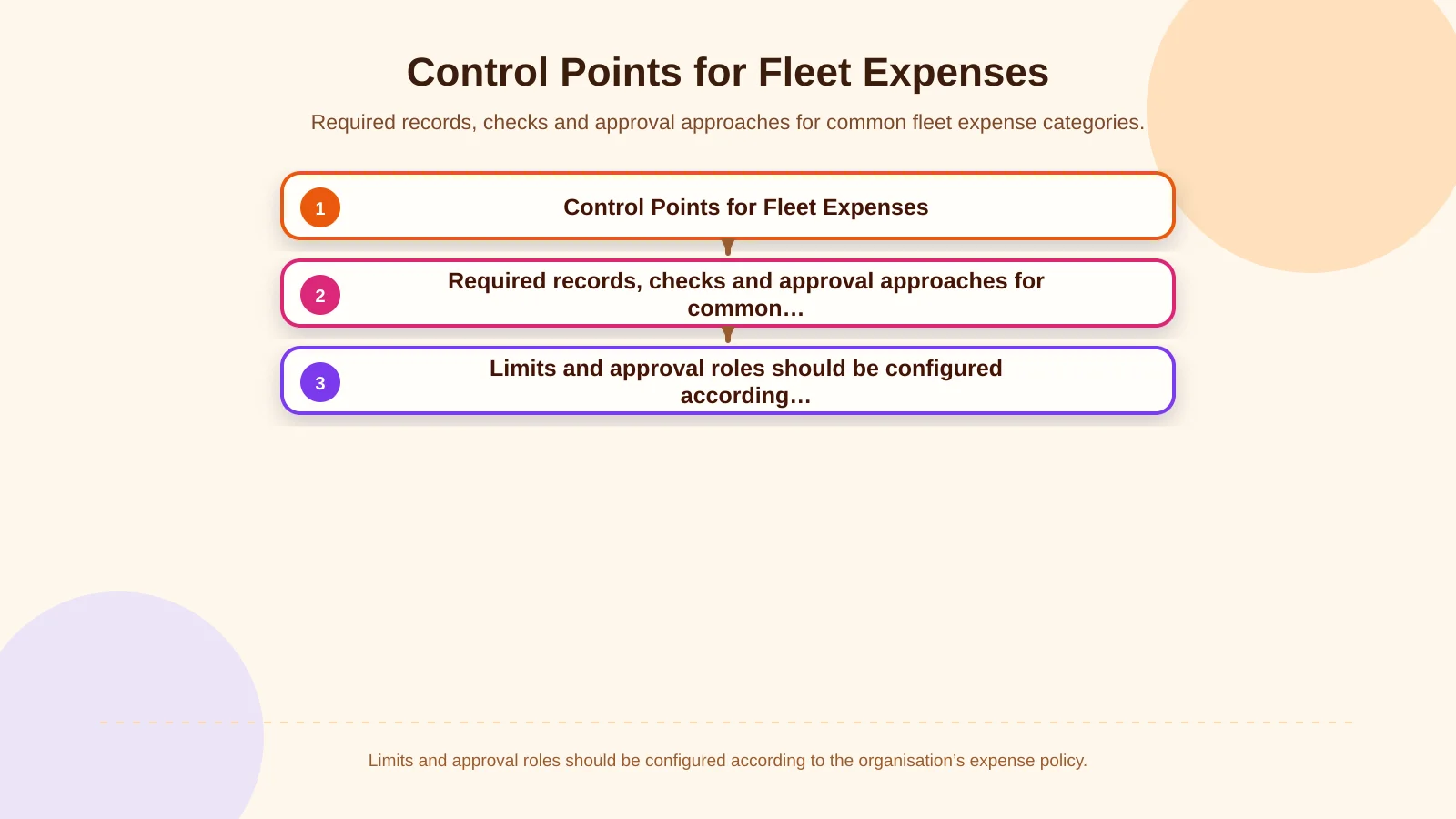
A routine fuel expense may require only document validation, while a high-value repair may need technical review and management approval. Emergency roadside assistance might be authorised after the event with a recorded justification. Software should support these exceptions through time-bound permissions and traceable decisions without weakening the standard process.
Why does ERP and enterprise systems integration matter?
Fleet software may be the operational source of detail, while supplier records, charts of accounts, cost centres, employees and accounting entries are owned by other systems. Integration design should identify the system of record for each field. A supplier may come from the ERP, for example, while a maintenance work order originates in the fleet platform and an approved expense returns to the ERP for posting.
Kumsal Agency’s enterprise resource planning and integration approach connects finance, purchasing and operational data around the organisation’s actual processes. Field mapping, transfer frequency, retry behaviour, duplicate prevention, error queues and reconciliation screens should be agreed before implementation.
Fuel cards, telematics providers, service networks, HR platforms and identity systems may also be relevant. Each connection should have a defined business purpose. The question is not how much data can be collected, but which decisions and workflows that data will improve.
Which decisions should fleet reports support?
A dashboard should direct users towards work, not merely display colourful charts. Fleet managers need upcoming maintenance and unavailable vehicles; operations managers need assignment and capacity information; finance teams need pending approvals and budget variances. Leadership may compare cost and utilisation trends by vehicle class, location, department and reporting period.
- Numbers of active, reserved, in-service and unavailable vehicles
- Upcoming, completed-on-time and overdue maintenance work
- Total expense by vehicle and per kilometre or mile
- Utilisation by location or department
- Unplanned fault frequency and downtime
- Missing mileage, document and assignment records
Report definitions must be shared across the organisation. If “active vehicle”, “overdue maintenance” or “total fleet cost” means something different to each team, even one dashboard can produce conflicting interpretations.
How do you plan custom fleet management software?
An off-the-shelf product may be sufficient for fleets with standard processes. Custom development can be more suitable where organisations have different vehicle classes, regional structures, specialist approval levels, field workflows or extensive ERP integration. The decision should consider process fit, data ownership, security, integration, maintenance and total operating burden—not feature count alone.
Discovery begins with user interviews and a review of existing documents to map the vehicle lifecycle. The team identifies mandatory records, task ownership, recurring exceptions and the decisions each report must support. The next stage defines the data model, roles, notifications, approvals, integration contracts and acceptance scenarios.
Kumsal Agency approaches this work as custom software shaped around real operations, rather than as a promise of a single standard fleet product. A phased rollout might begin with vehicles, assignments, mileage and maintenance, followed by expenses, integrations and advanced reporting. This limits operational disruption while allowing rules and data quality to be validated with real users.
Turn fleet data into a sustainable workflow
The value of fleet management software does not come from listing vehicles on one screen. It comes from connecting usage, maintenance and expense information throughout the same vehicle lifecycle. With a sound data model, clear ownership, auditable approvals and dependable integrations, teams can identify maintenance risks earlier, investigate uncontrolled costs and work from current information.
Contact Kumsal Agency to define the user roles, maintenance workflows, expense categories, reporting requirements and ERP integrations specific to your fleet operation.