


Aydınlatma metni yükleniyor…
In B2B sales, receiving an order or issuing an invoice does not mean that revenue has actually been collected. Long payment terms, instalments, returns, credits and cancellations can create a substantial gap between the sale and the cash received. If commission is calculated solely from an order or invoice value, the company may pay a representative before collecting the corresponding revenue. Correcting that payment later can also cause disputes between sales and finance teams.
Under a collection-based commission model, entitlement arises from an actual payment that meets defined conditions. Seeing a bank transaction, however, is not enough. The collection must be matched to the correct customer, invoice, sales line and representative. The business must also decide how to allocate partial payments and preserve a traceable record of every correction. The solution should therefore be treated as a business application that brings sales and finance data together under shared rules—not merely as a commission calculator.
What is collection-based commission accrual?
Collection-based commission accrual means that a sales representative earns commission when customer payment is received and matched to the relevant commercial transaction, rather than when an order or invoice is created. Depending on company policy, the entitlement may become final when the funds reach the bank, when accounting applies the receipt or after a defined waiting period.
Suppose an invoice is worth TRY 500,000 and carries a 2% commission rate. If the customer initially pays TRY 200,000, a straightforward proportional model uses TRY 200,000 as the eligible base and produces a gross accrual of TRY 4,000. No additional commission is earned until more of the invoice is collected. The company must separately define whether VAT, discounts, freight, deductions and exchange-rate differences affect the base.
This model should not be interpreted as “every collection always generates commission.” A late payment might qualify for a lower rate, certain products may be excluded, or low-margin sales may need to exceed a profitability threshold. What matters is that every rule is explicit, versioned and explainable retrospectively.
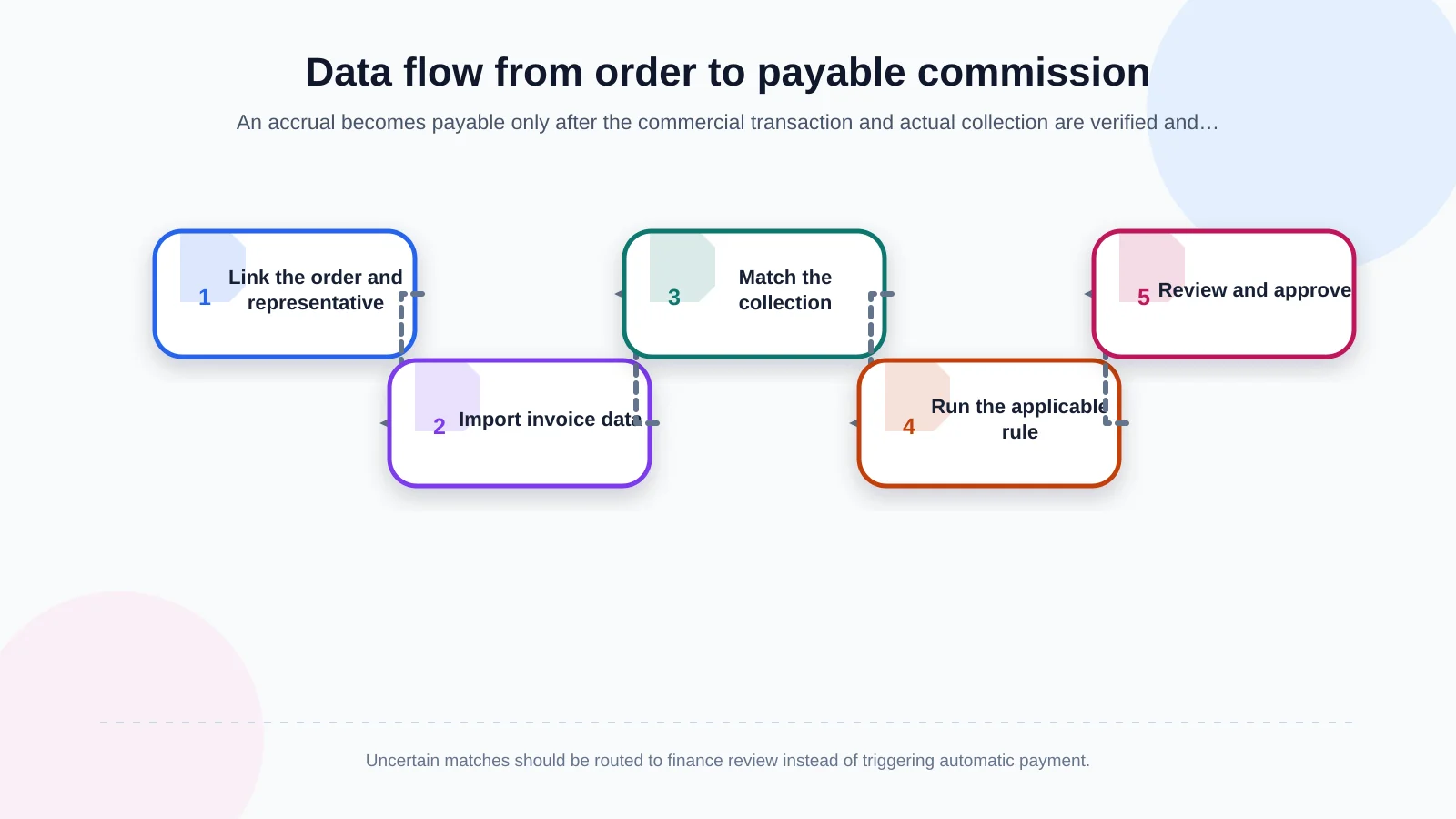
Data flow from order to payable commission
Reliable calculation depends on connected records rather than a single total. The order identifies the customer, products and sales owner; the invoice represents the financial liability; the receipt records the actual payment; and the accrual record preserves the applied rule and calculated outcome. A typical flow is:
- Record the relationship between the order, customer and sales representative.
- Import the invoice and invoice lines generated in the ERP.
- Receive the collection record from the bank, ERP or finance system.
- Match the collection to the appropriate customer account and open invoice.
- Run the applicable commission rule and create a draft accrual.
- Move the record into payable status after review and approval.
Oracle’s receivables guidance explains that all or part of a receipt can be applied to one or several debit items. This illustrates why partial-payment allocation should exist as a distinct, traceable relationship in the data model. Further detail is available in Oracle’s guidance on applying receipts and on-account credit memos.
The commission application does not need to replace the ERP. In many projects, the ERP remains the system of record for invoices and customer accounts, while the commission application manages sales attribution, rule versions, approvals and explainable calculation results. The integration boundaries can be defined with system owners as part of a custom web development project.
How should commission and accrual rules be modelled?
Commission logic should not be scattered throughout application code. It should be represented through manageable parameters, priorities and effective dates. Conditions may include representative, team, customer segment, product category, territory, currency, gross margin, payment term and collection age. The result may be a fixed percentage, tiered rate, fixed amount or capped amount.
Rule versions and effective dates
If a 2% rate used in January rises to 2.5% in April, earlier transactions should not automatically be recalculated at the new rate. Each rule needs a start date, optional end date, version, approving user and a definition of which transaction date controls eligibility. The application can then answer “Why was this amount calculated?” with the precise inputs and rule version.
Accrual statuses
Instead of one commission field, the workflow can use statuses such as pending, calculated, under review, approved, payable, paid and subject to recovery. Receipt import may create the draft; finance review confirms the allocation; an authorised manager approves the exception or result; and payroll or payment export closes the cycle. Each transition should depend on permissions and documented conditions.
Separating the eligible base from the rate
The calculation must answer two distinct questions: which amount is commissionable, and which rate applies to it? Net product value, tax, freight, discounts, exchange differences and deductions may be treated differently even within one organisation. Showing the collected amount, eligible base, rate and result as separate fields makes the calculation easier to inspect.
Partial collections, due dates and multiple invoices
A common approach to partial collection is to apply the payment ratio proportionally to the commissionable base. Yet a customer may settle several invoices with one transfer, or the payment reference may omit invoice numbers. The system can suggest an automatic match using customer, amount, date and reference data, but uncertain records should remain subject to finance review.
The allocation method must be explicit. Applying funds to the oldest due invoice first, assigning them to an invoice selected by a user, and distributing them proportionally across invoice lines can produce different commission outcomes. Oracle’s guidance notes that applying a partial receipt to an open debit item depends on the relevant rule being enabled. This supports treating matching behaviour as a configured decision rather than an unstated assumption.
Payment timeliness can also influence commission. The business might award the full rate for on-time collection, a reduced rate within a defined late-payment band and no commission after a critical delay. That policy should include an exception route for disputes, delivery problems or invoicing errors outside the representative’s control.
For foreign-currency business, the invoice exchange rate, collection rate and commission-payment rate should be kept separate. The project must define whether exchange differences affect entitlement and, if so, which date and rate source apply. Decimal precision, rounding and the treatment of final-line variances also belong in the acceptance tests.
How should returns, cancellations and reversed collections be corrected?
A product return, credit note, cancellation, failed payment or bank reversal may occur after commission has been approved. Deleting the historical calculation would obscure what happened. A safer design creates an offsetting adjustment so that the original calculation, reason for the change and revised balance remain visible together.
- An unapproved accrual can be recalculated.
- An approved but unpaid accrual can be reduced or blocked.
- A paid accrual can generate a negative entry for recovery in a later period.
- A partial return should adjust only the affected sales line and its allocated share of the collection.
If the system cannot determine which sale a return belongs to, it should create an exception instead of making an automatic deduction. Finance can match the document, request sales-management approval where necessary and record the rationale. This protects representatives from unexplained deductions while preserving financial control.
| Accrual status | Required action | Control point |
|---|---|---|
| Draft | Recalculate | Match the returned line |
| Approved | Reduce or block | Authorised approval |
| Payable | Remove from payment list | Period close |
| Paid | Create a negative accrual | Recover in a later period |
Critical decisions for ERP and finance integration
Before integration begins, ownership must be assigned for every field. Customers and invoices may originate in the ERP, bank movements in a finance platform, and representative assignments in the CRM or commission application. If the same value can be edited in two systems, conflicts become likely. The data dictionary should identify the source system, unique record key, update direction and team responsible for resolving errors.
Integration may use real-time APIs, scheduled services or controlled file transfers. Whatever the method, idempotency and uniqueness checks must prevent a repeated record from generating commission twice. Missing customer codes, closed periods and amount mismatches should not be silently skipped; they should enter a retryable error queue with a visible owner and resolution history.
An enterprise resource planning approach can help align finance, sales, inventory and operational requirements around shared data ownership. The commission system can then consume verified records without becoming an uncontrolled second ledger.
How should roles, approvals and audit trails work?
A sales representative may view their customers, collections and accrual details but should not be able to change commission rates or receipt allocations. Finance users may match collections, sales managers may assess exceptions, and system administrators may manage access. Separating the person who configures a commission rule from the person who grants final approval supports segregation of duties.
The OWASP Authorization Cheat Sheet recommends least privilege, deny-by-default access and permission validation on every request. These principles should cover API endpoints, report downloads and bulk data exports as well as visible menu items.
An audit entry should capture the time, user, affected record, action, previous and new values, reason and, where possible, a correlation identifier. The OWASP Logging Cheat Sheet emphasises recording when, where, who and what for relevant events and protecting logs from unauthorised alteration or deletion. Passwords, access tokens and unnecessary personal data should never be written to logs.
Reports managers need
A single total-commission report is insufficient for operational control. Managers should be able to see collected revenue, eligible base, rate, approval status and payable amount by representative. Customer and invoice breakdowns, ageing bands, post-return adjustments and unresolved exceptions make each figure easier to explain.
Finance should be able to reconcile collections with accrual totals, while sales management compares target attainment with cash conversion. Every report should show the calculation period, currency, applied rule version and last update time. If Excel export is available, permissions, masking and download logging should still apply.
Questions to answer before the project begins
- Does a bank receipt, ERP allocation or finance approval trigger entitlement?
- Do tax, discounts, freight or exchange differences enter the commission base?
- How are partial payments allocated across invoices and sales lines?
- Does late collection reduce the rate, and which exceptions are permitted?
- How is ownership determined if the customer or representative changes mid-period?
- In which period do returns and cancellations affect commission already paid?
- Which roles create rules, review calculations and approve payment?
- How are records retried after an ERP or banking integration interruption?
These questions should be tested against real invoices, partial payments, returns and reversals. The team can then prepare the data model, rule catalogue, screens, integration contracts and acceptance scenarios. During a pilot, software results should be compared with the existing manual calculation, and every variance classified as either a rule issue or a data issue.
How should custom commission accrual software be positioned?
Every organisation has different sales channels, ERP structures, payment terms and segregation-of-duty requirements. Collection-based commission management should therefore be planned as secure, explainable and manageable custom web software that works with existing systems—not as an inflexible off-the-shelf feature. An initial release can focus on the most critical sales channel and later expand to additional commission models.
Kumsal Agency is an Istanbul-based web design and software agency that approaches B2B applications through real user roles, data flows and integration requirements. To plan the scope, integrations and business rules of commission accrual software around your sales and collection processes, contact Kumsal Agency.