


Aydınlatma metni yükleniyor…
Contracts are not documents that can simply be signed and archived. Purchasing terms, service levels, price revisions, notice periods, payment provisions, confidentiality commitments and termination rights all create work throughout the contract lifecycle. When that work is scattered across email, spreadsheets and personal calendars, a renewal deadline may be missed, an incomplete obligation may be discovered too late or an unauthorised document version may be submitted for approval.
Contract management software goes beyond document storage by turning each agreement into a working process organised around dates, obligations, owners, versions, approvals and exceptions. Successful implementation, however, requires more than activating a set of standard screens. The real working practices of legal, procurement, sales, finance and operations teams must be represented through a shared data model and clearly defined responsibilities.
What should contract management software solve?
The primary objective is not to move every contract into one folder. It is to make the current status and next required action visible for every record. The system should connect the counterparty, contract type, owner, effective date, renewal or termination terms, financial value, relevant business unit and current document version. When users open a record, they should be able to answer three questions immediately: Who owns this contract? Which obligation or decision is approaching? What must happen next?
Central visibility should not mean unrestricted access. Procurement may need supplier terms, sales may work with customer agreements, and finance may require payment and guarantee fields. Legal teams can manage clauses and versions, while executives approve only the decisions within their authority. These requirements can be modelled through custom web development designed around the organisation’s processes, data and permission structure.
The software should also distinguish between a document, a contract record and the operational tasks generated by that contract. This separation allows a signed file to remain stable while its obligations, reviews and approvals continue to progress in a controlled workflow.
How should renewal and termination dates be tracked?
Recording a contract’s expiry date is not enough. The system should also capture whether renewal is automatic, how many days’ notice termination requires, when commercial discussions must begin and who is authorised to make the decision. For example, a contract expiring on 31 December but requiring 90 days’ notice has an effective decision deadline around 2 October. Waiting until the expiry date could lock the organisation into another unwanted term.
Notification rules should vary according to contract type and risk. Reminders at 30 and 7 days may be sufficient for a low-risk subscription, while a critical supply agreement may need to enter review 180 days before expiry. The first alert can go to the contract owner, an unanswered alert can escalate to the department manager, and a delayed decision can be routed to legal or procurement. The system should record whether an alert was acknowledged, a decision was made and the required action was completed instead of merely sending an email.
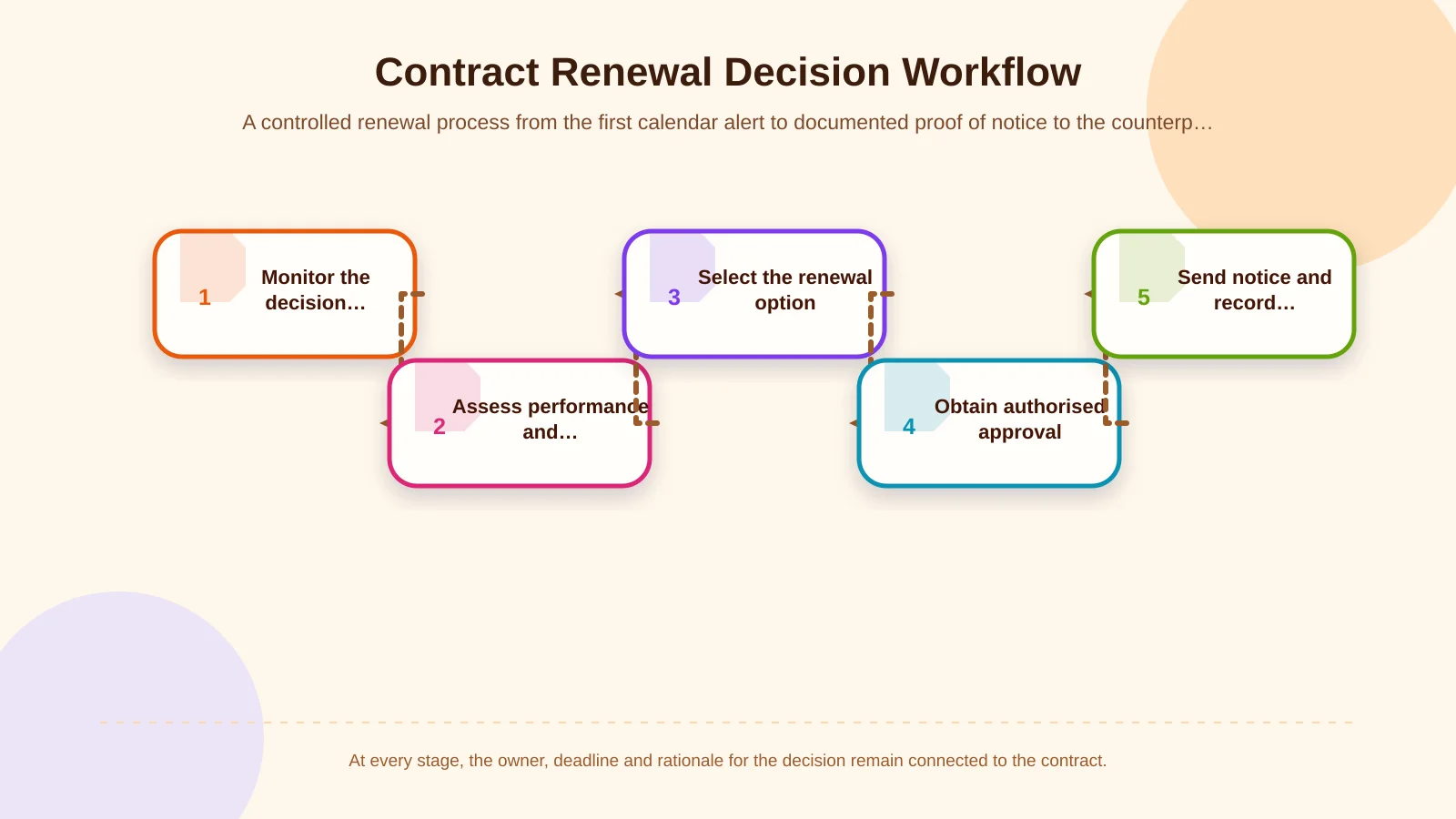
A traceable renewal decision workflow
A reliable renewal workflow does not turn a calendar alert directly into an automatic extension. The contract’s performance, cost, unresolved obligations and available alternatives should be assessed first. The owner can then recommend renewal, renegotiation, termination or a new procurement process. The rationale, approving authority and evidence of any notice sent to the counterparty should remain connected to the same record.
The UK government’s contract management principles, although prepared for public contracts, also provide useful general governance guidance. They emphasise clear roles and responsibilities, governance proportionate to risk and controlled management of change. Software can reflect those principles by applying earlier alerts, stronger approval requirements and more detailed evidence records to higher-risk contracts.
How is obligation tracking different from a document archive?
An obligation is a contract clause converted into actionable and measurable work. A provision stating that “a monthly report will be submitted” should become a record containing the report type, responsible person, reporting period, deadline, evidence and status. A requirement to maintain valid insurance can be connected to the policy expiry date, renewal certificate and verifying role. Teams can then see outstanding work without repeatedly reviewing lengthy agreements.
Each obligation should contain, at minimum, its contract, relevant clause, obligated party, internal owner, start and due dates, recurrence, priority, status and evidence. Statuses can use controlled values such as planned, in progress, awaiting evidence, completed, overdue and exemption approved. Free-text notes provide useful context, but they should not replace structured fields that can be filtered and reported.
The ISO 37301 compliance management systems approach brings together the identification of compliance obligations, risk assessment, assignment of responsibilities, monitoring and continual improvement. Contract management software cannot guarantee organisational compliance by itself, but it can support the control environment by maintaining consistent records of accountability, status and evidence.
Managing delays and exceptions
An overdue task should do more than turn red on a dashboard. The system should capture the cause of the delay, its impact, the remediation plan, a revised target date and the person who approved the change. Force majeure, a counterparty delay and a temporary management-approved exemption should not appear identical to ordinary completion.
Exception rules should also define escalation. A low-impact delay may remain with the operational owner, while a missed regulatory or high-value commercial obligation may require immediate legal and executive review. This gives management an accurate view of unresolved exposure instead of allowing revised dates to conceal recurring problems.
How should drafting, review and approval workflows be structured?
Contract approval is not a single “approve” button. The requesting business unit, sales or procurement team reviewing commercial terms, legal team assessing risky clauses, finance team checking budgets and payment conditions, and authorised signatory may all have different responsibilities. The workflow should branch according to factors such as contract type, value, country, data-processing scope and deviation from standard wording.
A contract that uses an approved template and remains within defined limits may follow a short route. A draft that changes liability limits, introduces currency exposure or includes personal data transfers may require additional review. Conditional routing should be explicit: which field triggers the review, who can resolve it, what evidence is needed and whether a change sends the document back to an earlier stage.
Approval limits should be versioned rather than silently overwritten. If an authority matrix changes, the system should preserve which rule applied when an earlier decision was made. Delegated authority should also include start and end dates so that temporary cover does not become permanent access.
Version control is part of approval
The file approved internally must be confirmed as the file ultimately signed. Each upload can record a version number, uploader, timestamp and change note, while previous versions remain available to authorised users. The version reviewed during approval should be locked to that decision; a later replacement must not inherit an earlier approval automatically.
When the counterparty returns a revision, the system should identify whether the change requires renewed legal, commercial or financial review. A comparison note, redline or structured change summary can support that decision. The final signed version, approval history and any annexes should then be linked without erasing the negotiation record.
Role-based access control and segregation of duties
Users should see only the contracts and actions required for their responsibilities. With role-based access control, permissions are assigned to roles such as legal counsel, contract owner, finance controller or executive rather than configured independently for every individual. The NIST definition of RBAC similarly associates permitted operations on resources with roles instead of individual identities.
Authorisation should extend beyond viewing. Downloading documents, changing fields, closing obligations, approving decisions, exporting data and deleting records can each have separate permissions. Segregation-of-duties rules can prevent the person who created a request from taking the same record through final approval alone. Delegations should have defined dates, and the audit trail should show when delegated authority was used.
ERP and enterprise system integrations
A contract record may be connected to data in ERP, CRM, procurement or document management systems. Account codes, supplier or customer details, order volumes, invoice status and guarantee records can be retrieved through integration where needed. Before building the connection, the organisation should identify the system of record for every field. For example, the supplier’s legal name may come from ERP, while legal classification remains under the contract system’s ownership.
Integration does not always need to operate in real time. Depending on the process, the appropriate method may be a live API, scheduled synchronisation or a controlled file transfer. Failed transactions should appear in an error queue, retries should not create duplicate records, and users should be able to understand whether an update is pending, accepted or rejected.
For broader programmes connecting finance, sales, inventory and procurement through shared data, the boundary between contract management and enterprise resource planning should be defined together. This prevents both systems from becoming competing masters for the same information.
What should reporting and the audit trail answer?
A management dashboard should show more than the total number of contracts. Useful indicators include agreements renewing within 30, 60 and 90 days, approaching termination-notice deadlines, overdue obligations, approvals concentrated with one person and unresolved high-risk exceptions. Filters by business unit, contract type, counterparty, risk level and owner help teams move from totals to actionable records.
The audit trail should answer who created a record, which field was changed and when, which version was approved, and why an exception was accepted. Logs should not be arbitrarily editable through the user interface. Timestamps should be consistent, and retention periods should follow organisational policy. Access records, download restrictions, backups, encryption and incident management should also be considered for sensitive documents.
Reports should distinguish between operational progress and altered targets. If a deadline was revised, managers need both the original date and the authorised replacement. That distinction makes recurring delays and control weaknesses visible instead of presenting every rescheduled task as timely performance.
| Control point | Responsible role | Evidence retained | Alert status |
|---|---|---|---|
| Renewal or termination | Contract owner | Decision and notice | 30/60/90 days |
| Obligation | Operations owner | Deliverable or report | Approaching/overdue |
| Version and approval | Legal and authorised approver | Approved file | Revision pending |
| Exception | Business unit manager | Rationale and remediation plan | Open/closed |
How should custom contract management software be planned?
Planning should begin with a process inventory, not a screen list. Identify contract types, participating teams, authority levels, existing file sources, templates, approval thresholds, renewal rules and integration points. Then validate the data model and lifecycle using a small but representative group of contracts.
- Define contract types, owners and mandatory fields.
- Set renewal, termination and notice rules for each contract category.
- Connect obligations to owners, dates, statuses and evidence.
- Model the standard workflow, financial thresholds and exception routes.
- Test role, visibility and action permissions against segregation-of-duties rules.
- Clarify data ownership, synchronisation and error handling for integrations.
During the pilot, real users should test realistic scenarios: an approaching termination deadline, an overdue recurring obligation, a revised draft, approval under temporary delegation and a failed ERP transfer. Acceptance criteria should verify both successful routes and exception handling. Training, data cleansing, migration of legacy documents, support ownership and the process for future enhancements are as important as the technical delivery.
Turn contract files into a controlled business workflow
Effective contract management makes the next decision, outstanding obligation, authorised person and evidence of action visible alongside the correct document. A custom software approach can create a shared and auditable working environment without forcing legal, procurement, sales, finance and operations teams into an unrealistic one-size-fits-all process.
Kumsal Agency is an Istanbul-based digital agency that designs and develops custom web software by considering business processes, user roles, data structures and integration requirements together. Share your contract volume, team roles, current approval process and integration needs to plan the scope of your organisation’s contract management software.