


Aydınlatma metni yükleniyor…
A multi-tenant SaaS architecture allows several customer organisations to use the same software product. However, multi-tenancy means more than storing every customer’s records in one shared database. Each organisation’s users, data, settings, subscription, integrations and operating limits must be managed within a distinct and enforceable tenant context.
When commissioning SaaS software, the first question should therefore not be “Will the database be shared?” It should be “Which rules separate one tenant from another?” If those rules remain undefined, the project can develop role conflicts, cross-tenant data exposure risks, uncontrolled customisation and costly architectural changes. A dependable scope connects the commercial model, user experience, security and ongoing operations.
What is a multi-tenant SaaS architecture?
A tenant represents a company, dealer, group of branches or other independent customer organisation using the SaaS product. Two tenants may share the application’s codebase and some infrastructure resources, but they must not be able to access each other’s records, files, reports, settings or integration credentials.
A tenant is not the same as a user account. One tenant may contain hundreds of users, while the same person may belong to several tenants with different roles—for example, when a consultant serves multiple clients or a group company shares central staff. Departments, workspaces and branches may introduce a second organisational layer beneath the tenant. The scope must define this hierarchy and explain where every permission applies.
AWS’s SaaS tenant isolation guidance discusses silo, pool and bridge models as approaches suited to different requirements. There is no universally correct data architecture for every SaaS product; the decision should reflect risk, customer commitments and operational needs.
Start scoping with the business and tenant model
Before selecting a technical architecture, establish who buys the product, who creates the account and who manages its users. An individual self-service subscription does not require the same onboarding journey as an enterprise account created by a sales or implementation team. If the product supports trials, contracted customers, dealers or group companies, document a separate lifecycle for each type.
Core tenant records may include the legal company name, billing details, responsible contacts, active plan, user limit, data-retention preferences, integration settings and account status. The scope should also assign responsibility for provisioning, invitations, verification, suspension, reactivation and closure. These decisions influence screens, automated workflows, support procedures and audit requirements.
Tenant hierarchy and membership rules
If a customer operates several companies or branches, decide whether they become separate tenants or organisational units inside one tenant. The answer directly affects billing, reporting and authorisation. If users can join multiple organisations, the interface must clearly show the active tenant. Permissions and visible data must be recalculated whenever that context changes.
At minimum, the scope should answer these questions:
- Who creates a tenant and appoints its first administrator?
- How many tenants can one user join, and can their role differ in each?
- At which level are branches, departments and workspaces managed?
- What happens to users, data, files and integrations when a tenant closes?
- Under which conditions may a platform administrator access a customer account for support?
How should data separation and tenant isolation be selected?
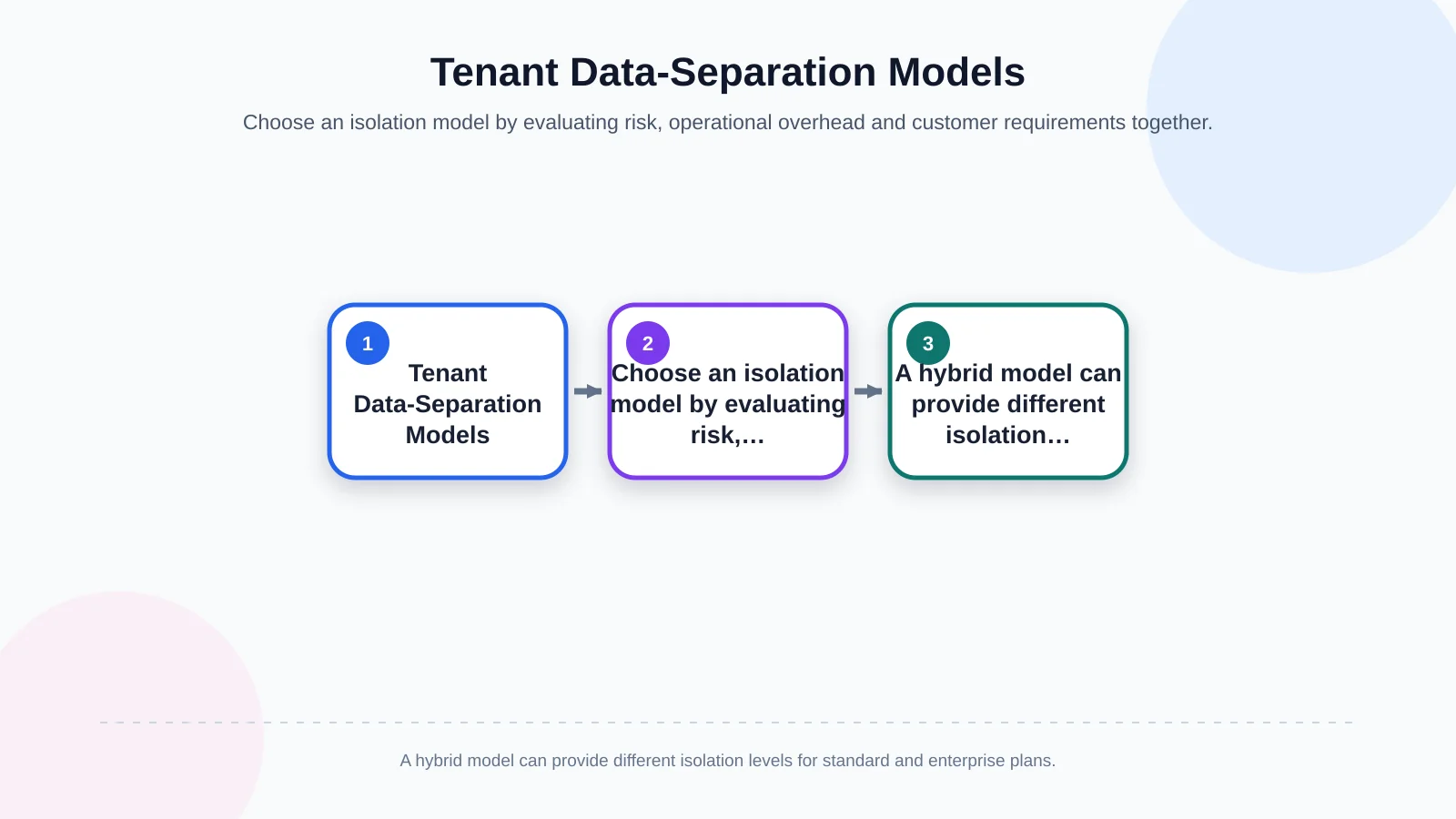
Common data-separation options include shared tables in a shared database, separate schemas within one database, a database for each tenant, or a hybrid of these models. With shared tables, every record and query is constrained by a verified tenant context. A separate database creates a more visible boundary, but may increase the effort required for deployment, backup, monitoring, migrations and version upgrades.
The choice should not be based on initial development cost alone. Consider the expected tenant count, data sensitivity, query volume, contractual commitments, regulatory obligations, single-tenant restoration needs and growth forecasts. A hybrid model can also support the commercial strategy: standard customers might use a shared pool while enterprise customers receive dedicated resources.
| Model | Separation approach | Strength | Key consideration |
|---|---|---|---|
| Shared pool | Shared tables with tenant scoping | Centralised operations | Isolation across every access path |
| Separate schema | One schema per tenant | Clearer data separation | Schema and version management |
| Separate database | One database per tenant | Strong physical boundary | Cost and operational overhead |
| Hybrid model | Different methods by plan | Flexible enterprise offering | Consistent management and monitoring |
Isolation is not limited to the database
OWASP’s multi-tenant application security guidance extends tenant isolation beyond database queries to areas such as cache keys, file storage paths, queues, rate limits and audit logs. Scheduled jobs and message consumers must also carry a validated tenant context.
Every access path needs a testable answer to the question: “Where and how is the tenant boundary enforced?” A tenant identifier supplied in a URL or by the client should not be trusted on its own. The server must match it against authenticated identity and active membership. Platform-wide operations must be authorised and logged separately from ordinary customer activity.
How should user roles and authorisation be scoped?
Beginning with a generic list such as “administrator, editor and user” is rarely sufficient. First identify resources and actions: inviting users, viewing records, changing prices, exporting reports, generating integration keys or accessing invoices. Then specify which role may perform each action and within which tenant, branch, department or workspace.
NIST defines role-based access control as a model in which permissions are assigned to roles representing organisational functions rather than directly to individuals. The SaaS scope should cover standard roles, permission sets, role hierarchy, custom-role requirements and the audit trail for access changes.
Platform administrators and tenant administrators must be clearly separated. If support staff need to impersonate a user or view an account, define the permitted reason, approval process, time limit, additional authentication and logging. Authorisation cannot stop at hiding interface buttons; it must also be enforced in APIs, background processes and the data-access layer.
Subscriptions, plans and quotas are part of the architecture
The SaaS commercial model must be translated into technical rules. Which modules does each plan enable? How are user, storage or transaction limits calculated? What happens when a quota is exceeded, and when does a plan change take effect? Hard-coded conditions created before these questions are answered can make future pricing changes expensive.
The scope may include feature flags, usage metering, trial periods, additional users, storage quotas, billing cycles and upgrade or downgrade rules. A failed payment does not always require immediate closure; warnings, a grace period, read-only access and suspension may be separate states. Contract-specific enterprise entitlements should also remain traceable instead of becoming undocumented exceptions.
Set boundaries between customisation and product standards
Enterprise customers may request their own logo, colours, domain, notification templates, custom fields, forms, approval flows or reports. Decide which requests are tenant settings, which are plan features and which require product development. Without that distinction, a shared product can gradually become a collection of customer-specific variants that are difficult to test and update.
A manageable approach keeps suitable customisation within a controlled configuration layer. Branding, field visibility, notification preferences and selected business rules can be offered as governed options. Requests that alter the core workflow should be assessed against the product roadmap, maintainability and their effect on every tenant.
The administration experience must support two operations
A tenant administrator manages their organisation’s users, roles, settings and usage. The platform operations team monitors all tenants, plans, resource consumption, integration failures and support incidents. These responsibilities require separate permissions and visibility, even if both experiences are delivered through the same application.
The platform console may need tenant search, status changes, plan assignment, usage monitoring, activity history and controlled support access. The tenant console may provide invitations, role assignment, company settings, integration configuration and billing visibility. Kumsal Agency’s custom web development approach plans these interfaces around actual operations, user roles, data and integration requirements rather than assuming that a generic administration template will fit.
ERP and third-party integrations must preserve tenant context
A SaaS product may connect to ERP, CRM, payment, email, identity or storage services. Determine whether each tenant connects its own account or the platform uses shared credentials. Define how secrets are stored, where data mapping occurs, how failures are attributed and which customer can see each error.
For every data flow, document the source, destination, field mapping, direction, frequency, tenant key, retry policy, duplicate prevention and reconciliation owner. Acceptance criteria should verify that a queued job cannot run through another tenant’s connection. For finance, inventory, sales and operations, Kumsal Agency’s enterprise resource planning expertise helps frame integration as an end-to-end business process rather than merely an API connection.
Make security, performance and operations measurable
The security scope should address session management, password or enterprise SSO options, multi-factor authentication, encryption, secret management, audit logs, backups and security testing. Create negative tests for cross-tenant access and test APIs, files, search results, reports and exports as distinct channels.
On shared infrastructure, one tenant’s heavy usage can degrade service for others. Mitigate this noisy-neighbour effect through tenant-level quotas, rate limits, queue capacity and resource monitoring. Performance targets should identify critical operations, expected concurrent users and data volumes instead of relying on an undefined “fast response” requirement.
Having backups is not enough. Establish whether one tenant’s accidentally deleted data can be restored without affecting other customers. Operational logs should contain a tenant identifier for diagnosis, while avoiding exposure of sensitive customer data. Assign responsibility for updates, security patches, incident response, capacity planning and restoration tests before launch.
Pre-proposal SaaS scoping sequence
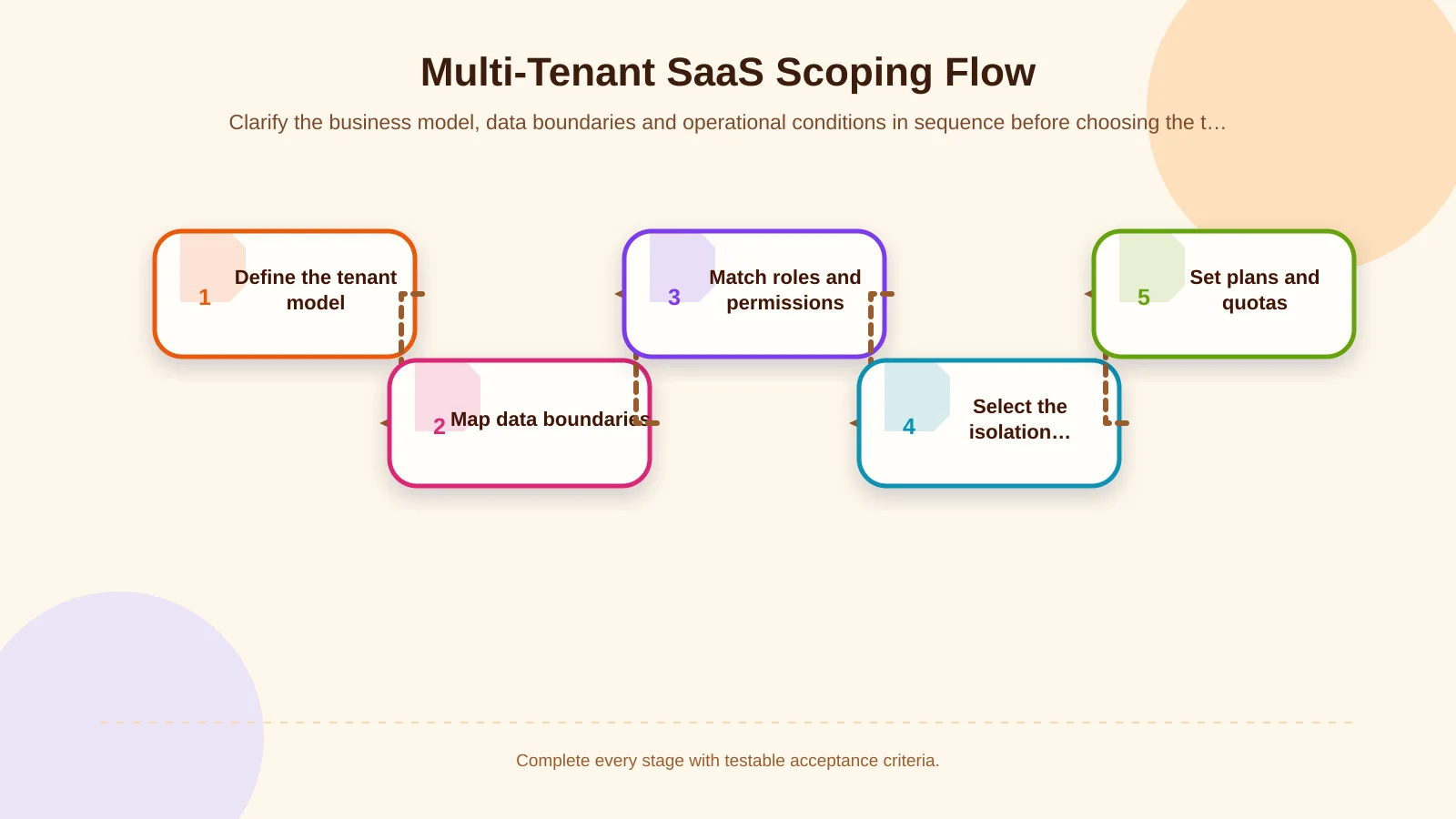
A strong scope is more than a list of screens. Business rules, data boundaries and acceptance measures should develop together. A practical sequence is:
- Identify target customer types, the tenant hierarchy and onboarding model.
- Inventory tenant-owned data, files, settings and integrations.
- Map roles against resources, actions and organisational scope.
- Select a pooled, isolated or hybrid model according to risk.
- Define plans, quotas, customisation and billing rules.
- Turn administration, monitoring, maintenance, backup and support responsibilities into acceptance criteria.
Write both positive and negative tests for every important scenario. For example, “A branch manager can view orders from their branch only” must verify permitted access and rejection of access to another branch. The proposal then covers not only the functionality to be built, but also the boundaries the software must protect.
Conclusion: Multi-tenant architecture is a business-model decision
A successful multi-tenant SaaS product balances the efficiency of shared infrastructure with secure data separation, understandable permissions and manageable operations. Database design is only one part of that system. Tenant lifecycles, subscriptions, integration ownership, customisation limits, observability, maintenance and recovery must be discussed before development begins.
As an Istanbul-based digital agency, Kumsal Agency designs and develops custom web software around business processes, user roles, data and integration requirements. To clarify your SaaS product’s tenant model, permissions, integrations and management needs, contact Kumsal Agency and build the scope around your real operations and sustainable growth goals.