


Aydınlatma metni yükleniyor…
There is no universal winner between an off-the-shelf platform and custom web software. If the requirement is standard, an established product fits the workflow naturally, and substantial future development is unlikely, an off-the-shelf platform may be the better choice. If the organisation depends on distinctive workflows, granular permissions, complex integrations, specialised data structures, or planned growth, custom web software becomes a stronger candidate. Projects between those two positions may benefit from a hybrid approach that combines established services with a purpose-built operational layer.
Do not base the decision on the initial price or feature list alone. Compare workflow fit, data and account ownership, integration limits, security responsibilities, performance and scaling requirements, licensing, maintenance, and the practical ability to leave or replace the system later.
The scorecard in this guide is designed to show which option deserves deeper investigation. It is not an automated quotation, a definitive cost calculation, or a security guarantee.
What Is the Difference Between an Off-the-Shelf Platform and Custom Web Software?
An off-the-shelf platform is a product developed around requirements shared by many organisations. Standard pages, content management, forms, memberships, sales, or similar functions can be configured through the product's built-in features, themes, extensions, and settings.
Custom web software is structured around an organisation's approved workflows, data model, user roles, integrations, and management requirements. This does not mean that every line of code must be written from scratch. A project-specific system can use reliable open-source libraries, frameworks, and third-party services. The custom contribution lies in how those components are selected, configured, developed, integrated, and governed around the organisation's actual requirements.
A hybrid approach keeps common capabilities in established services while developing the operational layer that genuinely differentiates the organisation. For example, payment processing or email delivery may be provided by a specialist service, while an internal approval process and reporting panel are built around the organisation's own rules.
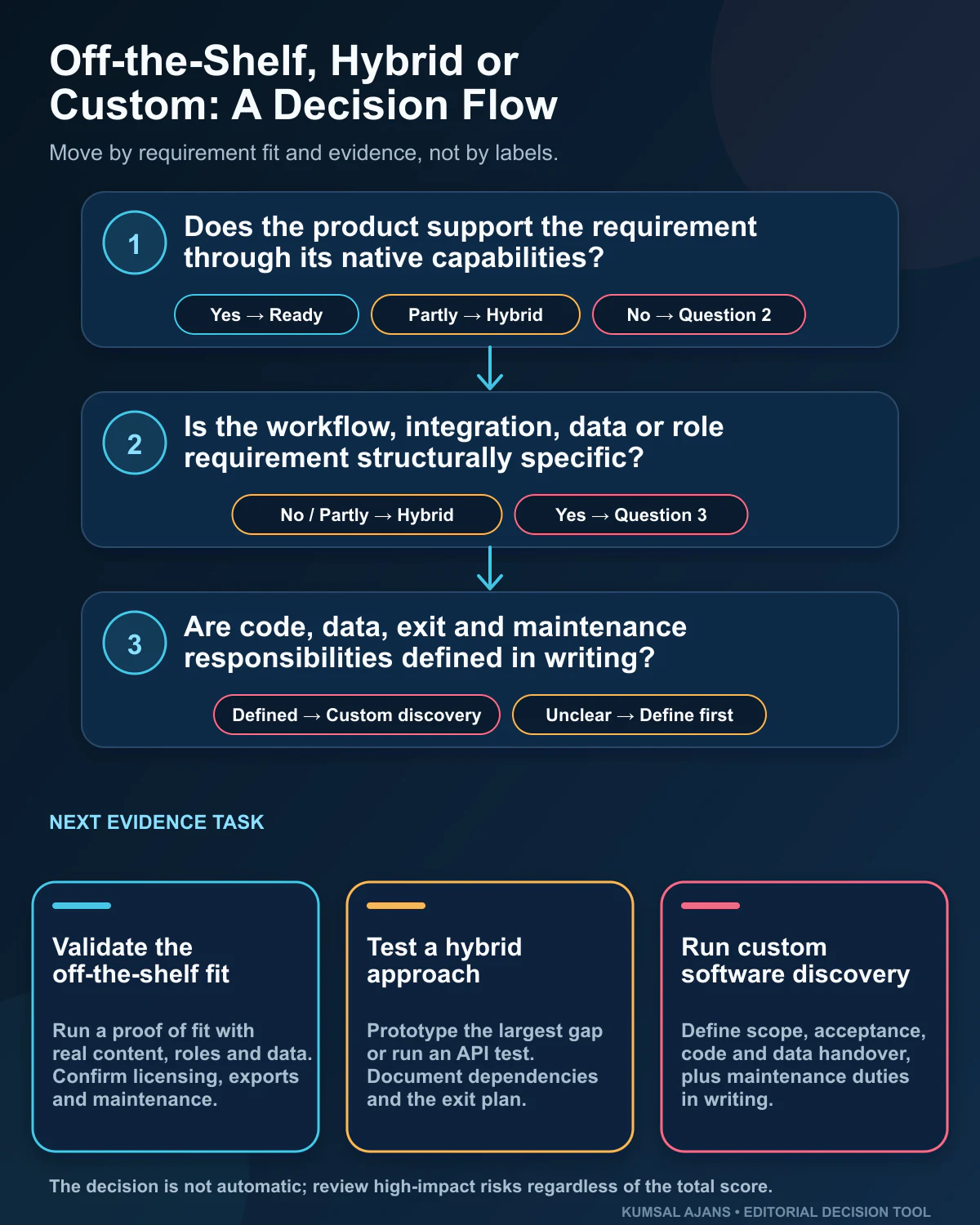
The practical question is therefore not simply “off-the-shelf or custom?” It is: Which capabilities should remain standard, which need configuration, and which genuinely require purpose-built development?
Clarify Four Distinctions Before You Decide
1. Does the product list the feature, or does it fit the real workflow?
Finding a feature on a product page does not prove that it supports your operating model. Test how the feature handles real roles, data, exceptions, and approvals. If teams must keep parallel spreadsheets, enter the same data more than once, or distort their process to accommodate the product, an apparent feature match may be hiding a structural gap.
2. Are you comparing the entry price or the lifecycle cost?
For an off-the-shelf product, include licence and user fees, themes, extensions, integrations, migration, support, updates, and a possible future exit. For custom development, include discovery, design, implementation, testing, documentation, infrastructure, and ongoing technical responsibility.
Use your own quotations and assumptions to compare these items over time. The three-year website budget guide provides a fillable model. Neither option should be assumed to be cheaper in every situation.
3. Does greater control also mean greater responsibility?
More control over source code, data, and infrastructure also creates responsibility for updates, security, monitoring, backups, and technical continuity. An off-the-shelf provider may carry part of that workload. With custom software, the contract and maintenance plan should identify who owns each operational task.
4. Is today's scope the same as the growth plan?
A project that currently needs five pages and a contact form may later require multiple languages, partner accounts, applications, approvals, or an ERP connection. It is wasteful to build every hypothetical feature on day one, but it is also risky to ignore changes already visible on the roadmap. Make the decision against a validated near-term plan.
If the requirements are not yet documented, start with the website requirements document guide.
A 10-Factor Off-the-Shelf vs Custom Software Scorecard
This is a Kumsal Ajans editorial decision tool. Score each row from 0 to 2 according to the closest description:
- 0: The requirement is standard and an established product supports it naturally.
- 1: Configuration, a limited integration, or a short technical validation is needed.
- 2: The requirement is structurally specific to the organisation, and the packaged option leaves a material gap.
| Decision factor | 0 — Closer to off-the-shelf | 1 — Validation or hybrid area | 2 — Closer to custom |
|---|---|---|---|
| Workflow | Standard page, form, or sales flow | A few custom steps or approvals | Organisation-specific, multi-stage process |
| Integrations | Existing connector is sufficient | Limited API adaptation | Custom data flow across several systems |
| User roles | Standard administrator, editor, or member roles | Some additional permission rules | Department, record, or action-level permissions |
| Data model | Standard fields are sufficient | Extra fields and limited relationships | Specialised data structure, rules, and reporting |
| Performance and scale | Predictable, standard usage | Peak periods or uncertain growth | Critical response time, volume, or scaling requirement |
| Security and risk | Standard risk profile and adequate provider controls | Additional configuration or review | Organisation-specific access, resilience, or threat requirements |
| Content and localisation | Independent, standard content entry | Custom fields or limited approval | Linked translations and multi-team publishing workflow |
| Ownership and portability | Provider export is sufficient | Some data or account dependency | High control required over code, data, accounts, and exit |
| Time and initial budget | Rapid launch and limited initial budget are priorities | Phased development is possible | Resources are available for discovery, build, and testing |
| Maintenance capability | Provider model is acceptable | Responsibilities will be shared | A custom roadmap and technical maintenance team are required |
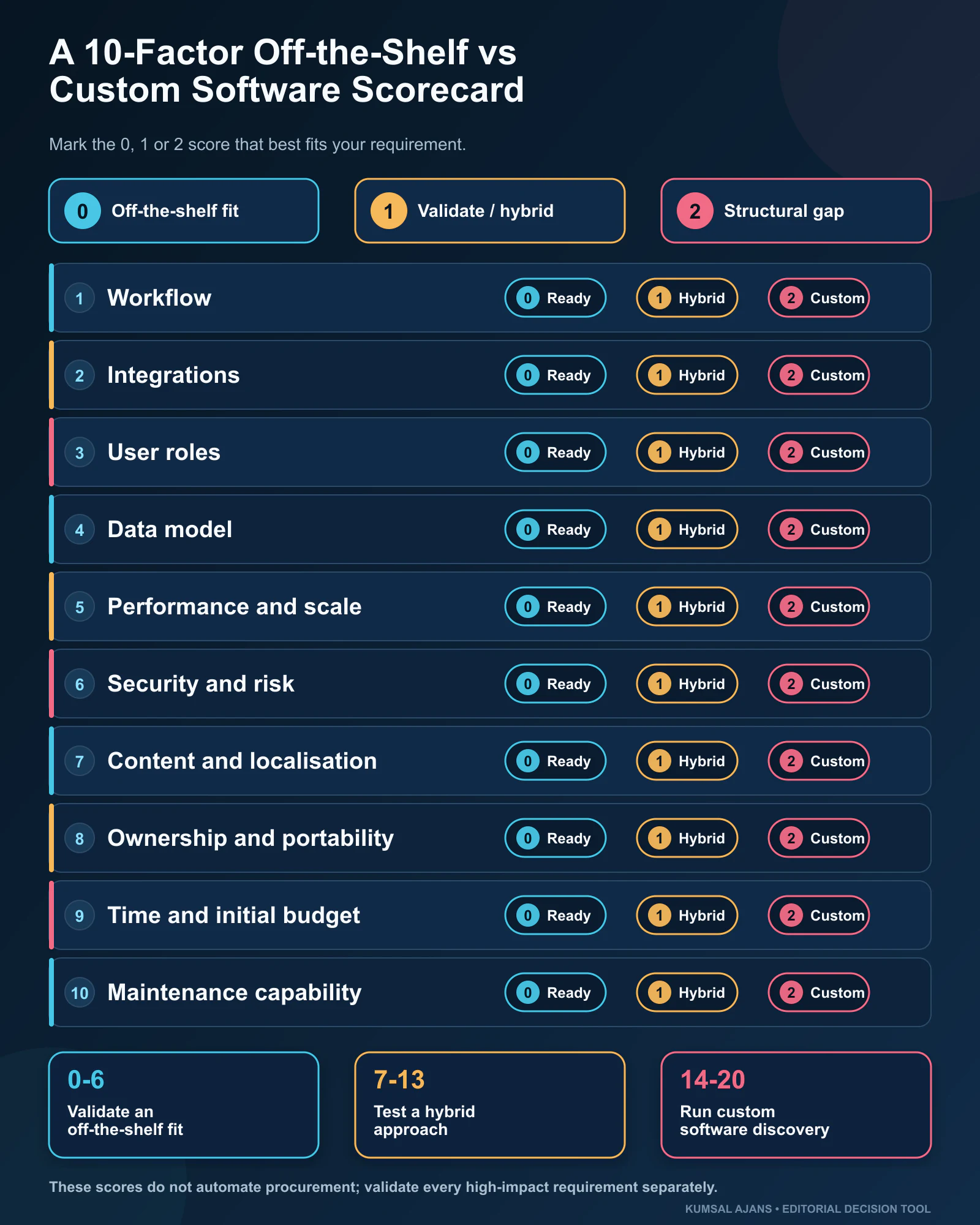
Interpret the total as a discovery signal:
- 0-6: An off-the-shelf platform is a strong candidate. Confirm licensing, exports, security, and maintenance before committing.
- 7-13: A hybrid solution or focused technical discovery is appropriate. Prototype or test the highest-scoring gaps.
- 14-20: Custom web software is a strong candidate. Define scope, acceptance criteria, handover, and maintenance in writing.
These ranges are not a scientific model and do not make the procurement decision for you. A single high-impact requirement involving security, regulation, a critical integration, or data portability may need separate review regardless of the total.
When Can an Off-the-Shelf Platform Be Enough?
Kumsal Ajans evaluates projects primarily from a custom software perspective. Even so, an off-the-shelf platform may be reasonable when the following conditions align:
- The organisation needs common corporate pages, standard content, a blog, basic forms, or a conventional sales flow.
- The product's native capabilities fit most of the requirement without disrupting the workflow.
- Granular permissions, a specialised data model, and complex integrations are not required.
- A rapid launch and a constrained initial budget matter more than extensive differentiation.
- The near-term roadmap does not contain substantial custom development.
- The provider's update, support, export, and licensing terms are acceptable.
Do not evaluate a platform only through a polished demo. Run a small proof of fit using realistic content, roles, and data. Confirm API limits, extension dependencies, licence renewals, backup options, and the format in which data can be exported if you decide to leave.
Being off-the-shelf does not automatically make a product insecure or low quality. A mature, well-maintained product that fits a standard process may be more sustainable than unnecessary custom development. The problem begins when the structural gap between the product and the organisation keeps growing.
When Is Custom Web Software Justified?
Custom development deserves serious consideration when these requirements affect how the system fundamentally works rather than how a few settings are configured:
- Organisation-specific application, approval, calculation, ordering, or operational flows
- Custom connections to CRM, ERP, payment, partner, reservation, membership, or other systems
- Detailed roles and permissions at department, user, record, or action level
- Specialised data relationships, reporting, and automation rules
- Linked multilingual content with a multi-team review and publishing process
- Requirements that exceed verified performance or scaling limits of the packaged option
- A need for greater control over code, data, accounts, documentation, and portability
- A strategically important workflow that is expected to evolve over several years
Custom software should not mean building every request at once. Start with the workflow that delivers the clearest operational value and place other modules on a phased roadmap with measurable acceptance criteria. This makes uncertainty visible instead of hiding it behind a vague instruction to “make everything custom.”
Custom software is not automatically fast, secure, or scalable. Those outcomes depend on discovery, architecture, code review, testing, monitoring, updates, and maintenance.
When Is a Hybrid Approach More Appropriate?
Many projects do not need to rebuild mature commodity services. A hybrid model can use established providers for standard functions while developing the layer that reflects the organisation's distinctive operation. For example:
- A payment provider handles transactions while the order and approval workflow is custom.
- An external platform sends email while organisation-specific notification rules are managed in a custom panel.
- A standard identity service handles authentication while application-level roles and data permissions are purpose-built.
- A project-specific content management platform is integrated with specialist mapping or storage services.
The question is not only whether the connection can be made. Review API limits, error handling, data ownership, service availability, price changes, and the exit plan for every external dependency.
Security and Sustainability Depend on the Process
“Off-the-shelf is insecure” and “custom is secure” are both incomplete statements. Either approach can introduce risk through outdated components, weak configuration, inadequate access controls, or missing maintenance.
OWASP's guidance on vulnerable and outdated components recommends knowing the versions of client-side and server-side components and their dependencies, monitoring them, and testing compatibility when they are upgraded. With a packaged product, that responsibility may be shared between the provider and customer. With custom software, it should be allocated across the developer, client, and infrastructure team.
The NIST Secure Software Development Framework explains that secure development practices should be prioritised around business requirements, risk tolerance, and available resources, while also considering cost, feasibility, and applicability. Before relying on a brand name or a “custom” label, ask for evidence of:
- Component and dependency inventory
- Update and security remediation process
- Backup and restoration testing
- Roles and access controls
- Testing, logging, and error monitoring
- Incident and service interruption responsibilities
- Handover arrangements when maintenance ends
Put Code, Data, and Account Ownership in the Contract
In Kumsal Ajans projects, project-specific source code is transferred to the client after the payment and handover conditions in the contract have been completed. Content created for the project, client and user records, and operational data belong to the client.
Where possible, domain, hosting, server, email, and third-party service accounts are created directly in the client's name. If Kumsal Ajans provides technical administration, access is granted for that purpose and transferred to the client at handover or when the service relationship ends.
Depending on scope, the handover list may include the source repository and current release, database and necessary backups, server and management panel access, domain and service accounts, setup information, and any available API or integration documentation. The actual deliverables should be listed individually in the quotation and contract.
Project-specific code must also be distinguished from third-party components. The Open Source Initiative's licensing guidance explains that open-source use remains subject to licence terms and that different licences, including copyleft licences, can impose different obligations. Ownership of open-source libraries, licensed components, and third-party services is not automatically transferred with the project; the client receives the rights granted by the applicable licence. This section is general information rather than legal advice, and project licences may require specialist review.
What Does Six Months of Free Technical Support Cover?
Unless a quotation or contract says otherwise, Kumsal Ajans provides six months of free technical support for custom web software from go-live or final handover. This is a warranty-style defect remediation period.
It covers:
- Correcting software defects within the delivered scope
- Ensuring existing functions operate as approved
- Investigating technical issues caused by the delivered project
It does not cover new features, modules, or integrations; scope expansion; design and user-experience revisions; substantial content or data entry; changes made by third-party services; remediation of interventions by other teams; or domain, server, licence, and service fees. Ongoing maintenance, security updates, performance monitoring, and operational oversight are handled through a separate monthly maintenance and support plan.
Documenting these boundaries alongside the acceptance criteria and support start date helps distinguish defect remediation from new development.
An Anonymised Real-Project Example
The following example is adapted from a real project and anonymised. The client name, sector, dates, user count, and integration details are withheld to prevent identification. No unmeasured performance, cost, or time improvement is claimed.
An organisation with several departments and user roles was experiencing performance, permissions, and integration problems in its existing off-the-shelf platform. As new requests were addressed through additional extensions, the system became increasingly complex and difficult to manage.
Kumsal Ajans first analysed the organisation's workflows and existing data. A custom-configured management panel and modular web software platform were then developed. Existing data was migrated in a controlled process, and user roles, workflows, and third-party service connections were restructured around the organisation's requirements.
The reason for choosing custom development was not simply a desire to look more distinctive. The gap between the packaged product and the real operation had become structural across permissions, data, and integrations. Those rows would each receive a high score in the decision matrix, creating a defensible reason for custom development.
Questions to Answer Before Turning the Decision into a Contract
- Which requirements are standard and which are specific to the organisation?
- Does the packaged product meet them natively, or through workarounds and extensions?
- What are the API, user, storage, traffic, role, and data-export limits?
- How do three-year licensing, integration, maintenance, and development costs compare?
- Who controls source code, data, domain, infrastructure, and service accounts?
- Which open-source and licensed components are used, and under what terms?
- Who owns updates, security, backups, monitoring, and incident response?
- Which scenarios and measures define acceptance testing?
- How are the six-month defect-remediation period, ongoing maintenance, and new development separated?
- How will code, data, documentation, and access be handed over if the provider or team changes?
Once the platform approach is clear, use the website proposal comparison scorecard to compare suppliers on the same scope and evidence.
Conclusion: Choose a Fit and Responsibility Model, Not a Label
An off-the-shelf platform can be the right choice when it supports a standard requirement naturally, aligns with the launch priority, and offers acceptable licensing, data, and maintenance terms. Custom web software is justified when organisation-specific workflows, data, permissions, integrations, or control requirements are structural. A hybrid approach avoids rebuilding standard services while creating a deliberate operational layer.
Complete the scorecard, test the highest-scoring requirements with realistic data, and put ownership and maintenance responsibilities in writing. Do not choose any option only because it is described as “cheap,” “fast,” “secure,” or “scalable.”
To evaluate whether your project needs an off-the-shelf, hybrid, or custom approach, explore the Kumsal Ajans web software service.