


Aydınlatma metni yükleniyor…
An investor relations website is one of the primary channels through which a listed company gives investors access to financial and corporate information. Its quality depends on more than publishing files. Investors must be able to find the right report quickly, identify its reporting period and confirm that they are viewing the current version. Meanwhile, investor relations, finance, legal and compliance, corporate communications and IT teams need a controlled and sustainable way to manage the content.
An effective investor relations section brings content inventory, classification, user experience, content management and publishing governance into one system. It should not make definitive assumptions about regulation. The company’s authorised legal and compliance teams must verify current obligations, retention requirements and publication rules.
Why does an investor relations website need a dedicated architecture?
Visitors to a general corporate website may explore the brand, products or careers. Investors usually arrive with a specific task: access the latest financial results, compare reporting periods, locate an announcement or review a corporate governance document. These intentions mean that investor relations content cannot be treated as an ordinary news archive.
Document collections grow over time. A single year may include multiple periods, languages, formats, corrections and revised editions. A long list of files may appear adequate initially, but discoverability deteriorates as the archive expands. The information architecture should reflect how investors search and what they need to accomplish—not the company’s internal folder structure.
In Türkiye, the Public Disclosure Platform (KAP) is an official channel through which users can search disclosures using fields such as company, disclosure type, date, year and period. A company website should not attempt to replace KAP. It should help users discover reports, announcements and governance materials consistently within the company’s own context. Verified obligations should determine which information appears in each channel and how long it remains available.
How should the content inventory and classification system be structured?
The first step is a content inventory that goes beyond counting files. Each record should capture the document title, content type, relevant reporting period, publication date, language, file format, version, source system, responsible team and visibility status. Duplicate files, unclear titles, broken links and potentially obsolete versions should be flagged. Deletion and archiving decisions should require approval from the appropriate teams.
| Content | Primary distinction | Visitor cue | Management control |
|---|---|---|---|
| Financial report | Year and period | Period + language | Version verification |
| Annual report | Reporting year | Language + file type | Current version |
| Announcement | Date and subject | Short summary | Approval record |
| Corporate document | Document type | Validity information | Archiving rule |
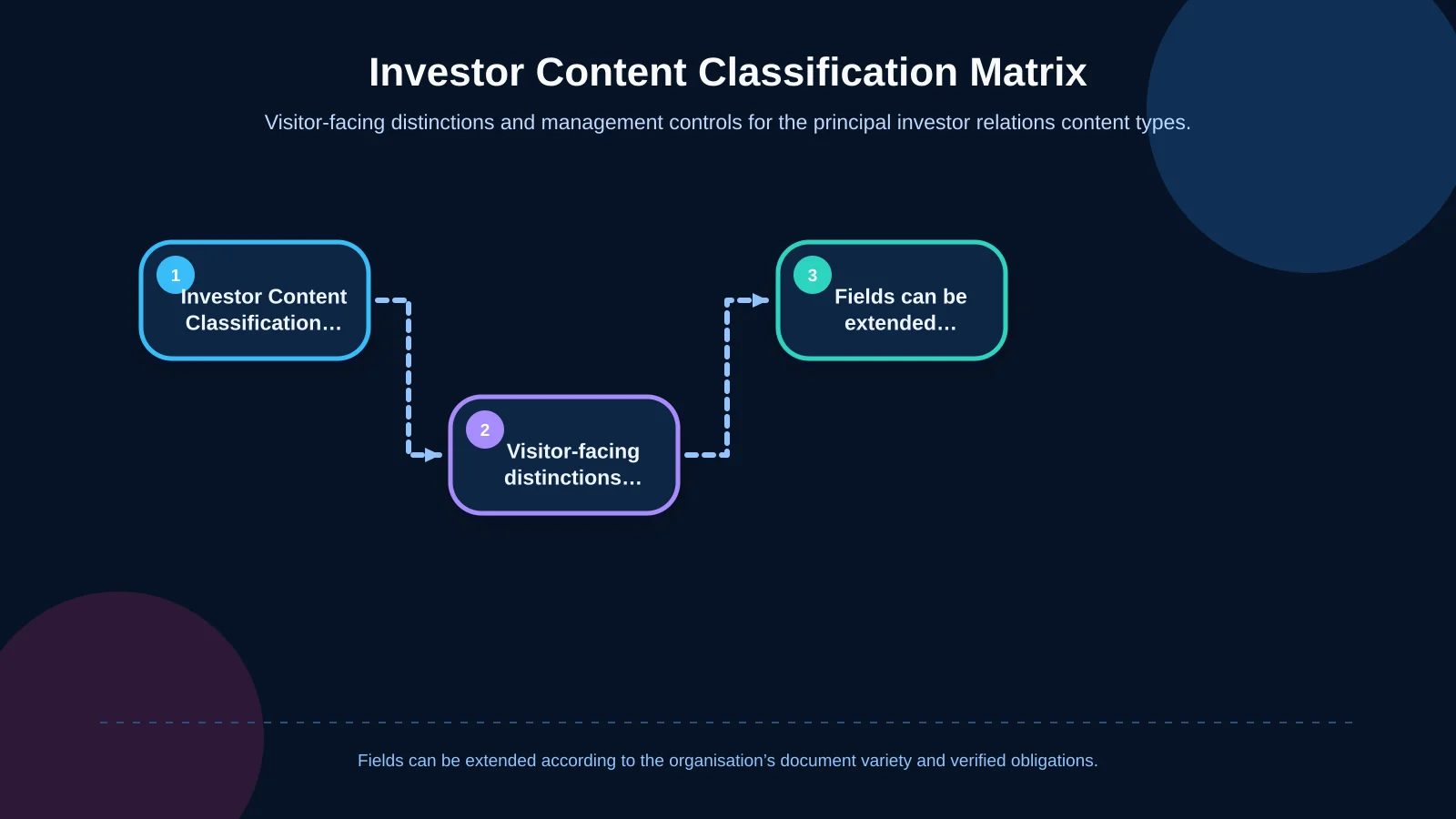
Core investor relations content types
- Financial statements, notes and independent audit materials
- Annual and integrated reports
- Investor presentations and financial results materials
- Material disclosures and corporate announcements
- General meeting documents
- Corporate governance policies and articles of association
- Sustainability and rating reports
Not every organisation needs identical categories. The taxonomy should follow the actual volume of content and investors’ tasks. Creating numerous subcategories for a handful of policy documents adds friction. Conversely, placing hundreds of financial documents under a single “Reports” heading provides too little distinction.
Essential metadata for every document
A filename is not a reliable classification field. Structured fields in the content management system should power archive filters and search results. At minimum, define a descriptive title, content type, fiscal year or period, publication date, language, file link and publication status. Depending on the organisation, the model may also include quarter, audit status, revision details, file size and a related KAP link.
Field names and options should come from controlled vocabularies. If one editor enters “Q3 2025” and another writes “2025 third quarter,” the system may treat them as different filter values. Separate the visitor-facing label from the stable value stored by the system. This preserves data consistency even when wording, design or language changes.
How should report and announcement discovery be designed?
The investor relations landing page should provide direct access to frequently requested current documents, such as the latest financial results, current annual report and recent announcements. These highlights must not replace the archive. Permanent category pages should keep historical material accessible instead of making investors dependent on a limited homepage selection.
Archive filters may combine document type, year or period, date and language. Where practical, options should include only values that return results. Active filters should remain visible and be removable in one action. On mobile devices, the filter panel should retain its context and support keyboard and screen-reader use. The W3C’s Web Content Accessibility Guidelines provide an international standard for making web content perceivable, operable, understandable and robust.
Search results should offer more than filenames
On-site search can use the visible title, category, reporting period and, where technically possible, indexable document content. Each result should clearly show the document type, date, period, language and file format so users understand what they will open or download. Search scope and ranking should be tested with real queries, spelling variations, abbreviations and searches that currently return no results.
PDF and link behaviour
Use the document’s descriptive title as the link text instead of a generic label such as “Download.” Displaying the PDF format and approximate file size provides useful context. Prefer accessible PDFs with searchable text, a logical reading order, a defined language and a meaningful document title over scanned images of pages.
Decide on permanent URLs and redirects before the archive grows. Replacing a file should not unexpectedly break saved links, search results or references in earlier announcements. The interface should also explain whether a link opens a document in the browser or downloads it.
How should document upload and publication be managed?
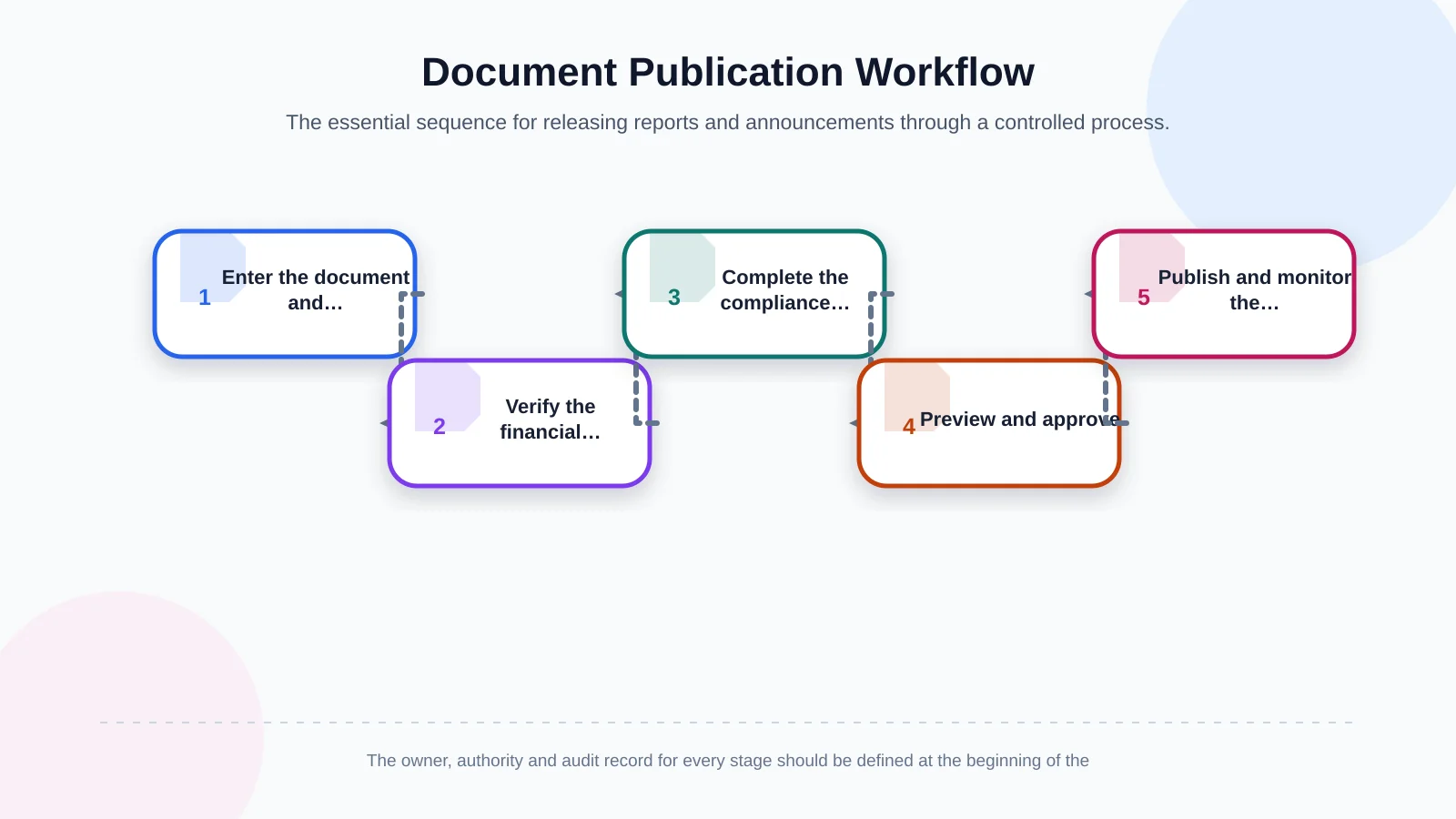
Trust in an investor relations website depends on the publication process behind the interface. Define the stages for drafting, financial verification, legal or compliance review, preview, approval, scheduling, publication and, where necessary, withdrawal. For critical documents, separation of duties can prevent the same person from both uploading and approving a record.
The upload interface should validate required metadata, reject unsupported formats and warn editors about possible duplicates. A preview should show the title, date, category, language, file and link behaviour before publication. After release, an audit trail should answer who changed a field, what changed and when the action occurred.
Version, correction and archive rules
Silently overwriting an earlier file when a corrected version is published can create uncertainty. Subject to the company’s verified procedure, the website should identify the relationship between versions, the correction date and the currently valid file. Expired content should follow controlled archiving, access, retention and redirect policies rather than automatic deletion.
Role-based permissions and strong authentication should protect the publishing workflow, while uploaded files should pass appropriate security checks. The OWASP Application Security Verification Standard offers an open framework for evaluating security requirements in modern web application design, development and testing. Acceptance criteria should consider the current standard alongside the organisation’s risk profile.
Content management, roles and integrations
The content management system should enable routine publishing without constant technical assistance while restricting critical actions. A content editor may prepare a draft, finance may verify the document and reporting period, legal or compliance may complete its review, and an authorised publisher may release the approved record. Keep the role model proportionate to the organisation, remove access promptly when employees leave and review permissions regularly.
Potential integrations include KAP references, document management platforms, media libraries, corporate data sources and notification services. First establish the authoritative source for each data field. For automated transfers, document field mapping, synchronisation frequency, error queues, retry rules and responsibility for manual correction. When an off-the-shelf module cannot support the required data model, permissions or integrations, a custom web development approach may be appropriate.
Managing multiple languages from one source
Multilingual publishing is not simply a matter of uploading copies into separate folders. Every language edition should be related to its source document, and the interface needs a defined fallback when no translation exists. Updating one language can trigger an alert or task for the owners of other editions. Dates and numbers should follow the selected locale, while changing language should keep the visitor on the equivalent document whenever one is available.
Mobile usability, performance and SEO
Investors access reports and announcements from phones as well as desktops. Dense archive tables should not force horizontal scrolling on small screens. They can adapt into rows or cards while preserving the hierarchy of title, period, date, language and format. Touch targets must be large enough, filters understandable and file-opening behaviour predictable. Show the size of large PDFs before download.
For performance, use pagination or controlled incremental loading rather than retrieving the entire archive on the first request. Optimise images, deliver critical interface components quickly and limit third-party scripts. However, JavaScript-dependent filtering must not prevent browsers or search engines from reaching permanent document links.
For SEO, each principal category needs a descriptive heading, unique introductory text, a consistent URL and accurate metadata. Prevent year and filter combinations from generating an unlimited number of indexable pages. Canonical and indexing rules should form part of the technical plan. PDFs need meaningful filenames and link text, while removed documents require an appropriate redirect or HTTP status.
Within a corporate web design project, information architecture, a brand-aligned interface, accessibility and technical implementation can be planned around the same investor journeys instead of being handled as isolated tasks.
How can success be measured and quality maintained?
Page views alone do not explain whether investors can complete their tasks. Useful measures include time to find a document, search-result click-through rate, zero-result queries, filter usage, broken links and the periods receiving the most interest. Measurement should avoid unnecessary personal data and remain consistent with the organisation’s privacy and cookie policies.
Pre-launch acceptance testing should extend beyond desktop appearance. Use practical tasks such as finding a specified quarter’s financial report, opening the English edition of the latest annual report or locating an announcement from a particular date. Test different devices and browsers, keyboard and screen-reader use, empty results, damaged files and integration outages.
- Are document classes and metadata fields consistent?
- Can users distinguish the current version from archived editions?
- Are permissions, reviews and approvals recorded?
- Can users search, filter and open files successfully on mobile?
- Are broken links and integration failures monitored?
- Are gaps between language editions visible to responsible teams?
A sustainable investor relations platform with Kumsal Agency
An investor relations section requires more than a ready-made page template. It brings content, operational processes and technology together. Kumsal Agency approaches the structure as a connected system, from needs analysis and content inventory to information architecture, user experience, Art Director-led brand interfaces and custom development.
The content management system, search and filtering, document workflows, user roles, integrations, multilingual operation and mobile experience are planned around the teams that will use and maintain them. Strong infrastructure, data security and client confidentiality are considered alongside sustainable content operations and measurable user tasks. Regulatory requirements enter the project scope only after the company’s authorised legal and compliance teams have converted them into verified rules.
To plan your investor relations content inventory, report and announcement taxonomy, management requirements and integrations with Kumsal Agency, contact our team.