


Aydınlatma metni yükleniyor…
An organisation comparing web design services in Bahçelievler needs more than a modern, responsive and manageable website. Service scope, address, operating time, coverage, booking or proposal conditions and contact routes must agree with real operations. A visually polished page still fails the visitor if it points to the wrong location, presents a discontinued service or prioritises an unmonitored channel.
This guide does not assume that every Bahçelievler business belongs to the same sector or serves only local customers. On-premises service, work at a customer's address, remote consultation, appointments, business proposals and product delivery need different information structures. The objective is to plan the website as a current record of where, how, when and under which conditions a service is available rather than as a decorative brochure.
Why is operational accuracy a relevant planning question in Bahçelievler?
The Bahçelievler Municipality 2025–2029 Strategic Plan states that the district contains 11 neighbourhoods and had an address-based population of 567,848 in 2023. It identifies Bahçelievler as an area of intense commercial activity, records the difficulty of quickly detecting newly opened and discontinued businesses, and notes that some sectors and lines of business operate alongside residential areas (Bahçelievler Municipality 2025–2029 Strategic Plan).
These official observations do not prove that private-business websites are out of date or that all customers share one local behaviour. A municipal licensing and inspection challenge is not evidence about a particular company's content. The narrower implication is that in a densely populated, commercially active district where business and residential uses can sit close together, precise service location, fit and freshness information is a useful web design task. Each business should verify the need through call records, misdirected enquiries, form topics and analytics.
Why can an attractive website be operationally wrong?
Responsive layout, brand colours and strong photography can establish initial confidence, but they do not complete a service decision. Visual quality cannot close the operational gap when a visitor cannot answer:
- Is the required service currently offered?
- Is it delivered at the business, at my address or remotely?
- Which area or location is covered?
- Is it available today, on a particular date or by appointment only?
- Is a document, measurement, budget, minimum order or another prerequisite required?
- Which channel fits this task, and who will receive the record?
Listing short names under “services” can force a visitor to ask every question again by phone. Web design scope should address information accuracy and update responsibility as well as page appearance.
The Kumsal six-record service access system
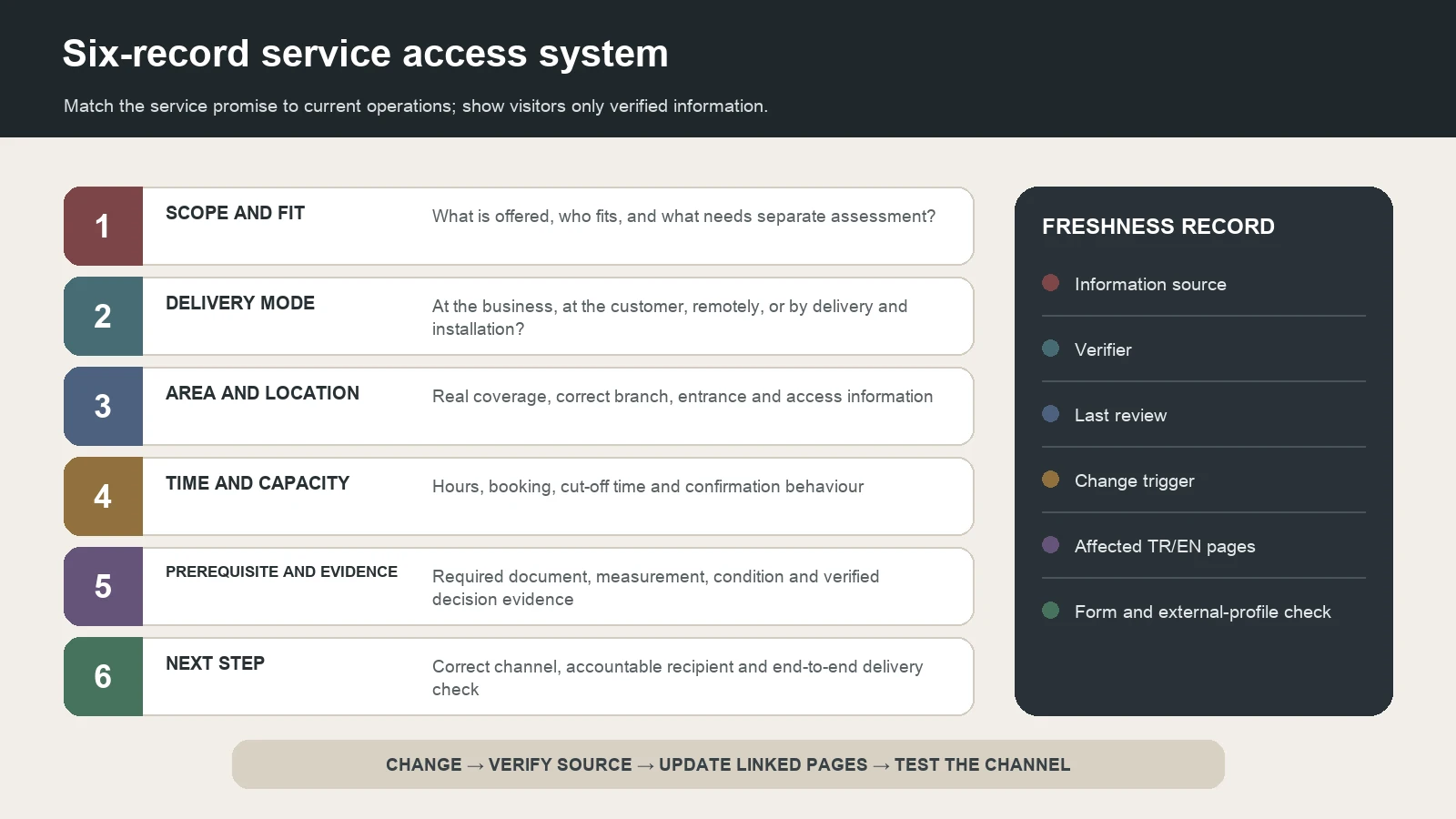
This original framework defines every important service through six records: scope and fit, delivery mode, area or location, time and capacity, prerequisites and evidence, and a verified next step. Every record has an internal owner and review date, while the visitor sees only the current information needed for the decision.
1. Define service scope and fit
A service name should explain what the customer receives. Labels such as “consulting”, “maintenance” or “corporate solution” may be insufficient alone. State the principal output, who the service fits and which situations require separate assessment.
When fit needs professional assessment, the page should not promise a result. Health, legal, financial, safety and similar subjects require a clear boundary between general information and individual evaluation. When scope changes, review the related page, form choices, cost explanation and campaign destinations together.
2. Separate the delivery mode
Will the visitor attend the business, will a team travel to the customer's location, can the service be delivered remotely, or does the product require delivery and installation? One organisation may use several modes, but that does not mean every service is available through all of them.
Delivery mode changes the address, directions, appointment, coverage, travel charge, document upload and technical prerequisites. After selecting the mode, the visitor can see only the relevant information and action. This prevents a physical branch, a service area and a remote service from being confused.
3. State the area or correct location
Replace vague phrases such as “Bahçelievler and surrounding areas” with a real boundary. For work at the customer's address, use a verified neighbourhood list, distance, zone or proposal-confirmation method. For a physical visit, present the correct branch, entrance, floor, transport, accessibility and parking information where relevant.
Do not duplicate the same copy for every neighbourhood unless a real difference changes the decision. A separate location page needs a branch, distinct operating time, team, delivery area or service scope. Address and map structured data should represent only genuine, verified locations.
4. Explain time and capacity behaviour
Operating hours, appointment windows, same-day cut-off, estimated first response and seasonal status are different facts. Publish only time information the organisation can verify, and do not turn estimates affected by demand, stock, staffing or assessment into guarantees.
Define which channels change for a public holiday, temporary closure, relocation, maintenance event or capacity adjustment. The website, business profile, advertising landing page, social profile and automated reply should not conflict. If current capacity cannot be shown, separate “request an appointment” from “confirm an appointment”.
5. Present prerequisites and decision evidence
A visitor may need a document, photograph, measurement, product model, minimum quantity, budget range or current-system access. Showing these requirements before contact helps the visitor and team prepare a more useful assessment. Do not request unnecessary or sensitive data in the initial form.
Evidence depends on the service: a permissioned project example, relevant team capability, process explanation, scope of a standard, genuine product document, cancellation term or delivery method. A logo, stock image, unattributed counter or unverified review is not evidence by itself. The design should not imply certainty where supporting evidence does not exist.
Use the corporate website content matrix to keep intended users, decision questions, evidence and actions in one service-page record.
6. Verify the next step and delivery
Calls, messages, bookings, forms and directions serve different tasks. Direct the visitor to a channel that is genuinely monitored for the current purpose. A form that records the service and delivery mode can route to the appropriate team, while a visitor seeking an address may need a location page rather than a proposal form.
A success message does not prove delivery. Test whether the record reaches the management panel, email, CRM or other destination; how misrouting and notification failure are detected; and what happens outside operating hours. The website form monitoring guide provides an end-to-end test method.
The framework's original contribution is to manage local service information as an auditable access record—scope, delivery, area, time, conditions and verified action—rather than as marketing copy alone.
Who should update service information, and how often?
The person with content-panel access is not necessarily the verifier of every fact. A service team may own scope, operations may confirm time, administration may verify an address, an authorised decision-maker may own proposal conditions, an appropriate specialist may approve legal copy, and the technical team may verify an integration.
A simple freshness record can contain:
- Page and related service
- Critical facts that may change
- Source and verifier
- Last review date
- Next review date or change trigger
- Affected TR/EN pages, forms and external profiles
- Emergency correction and approval route
A stable corporate history and daily operating time do not need the same review rhythm. Critical content can be checked on a schedule and when relocation, service, staffing or integration changes occur.
How can Turkish and English service information remain equally current?
Record each Turkish page's genuine English counterpart, content owner and review status. A change to Turkish service scope should flag the English page, form choices, actions, automated messages and related internal links as well as the principal copy.
A page without a genuine counterpart should not point to an unrelated substitute. The language control should open the linked version of the same service when one exists. Each locale needs a self-referencing canonical, and hreflang should connect only real counterparts. If a slug changes or pages merge, add the required redirects from the old TR and EN URLs after the new target has been published and verified. The existing slugs remain unchanged in this refresh, so no new redirect is required.
Use the multilingual website planning guide to organise page pairing, change records and language switching.
What is the boundary between a local page and a real business location?
An organisation may serve Bahçelievler without having a physical office in the district. Service area, target market, advertising location and genuine branch are not the same. The page should state whether the organisation serves the area or receives visitors at a verified address.
This article does not claim that Kumsal Ajans has an office, branch or proven local client portfolio in Bahçelievler. Its value for the local query comes from helping the reader plan website scope and provider selection, not from an unsupported proximity claim.
How should web design companies serving Bahçelievler be compared?
Give every candidate the same operational scenario: one service is provided at the business, one at the customer's address and one remotely; timing and prerequisites differ; form records must reach different teams. Ask how the design represents these facts and what must change when an operational fact changes.
Separate the following deliverables in the proposal:
- Service and user-task inventory
- Service-page, location and contact templates
- Fields for delivery mode, area, time and prerequisites
- Information source, ownership and update workflow
- Form fields, validation, routing and delivery checks
- Limits of mapping, booking, CRM or other integrations
- Accessibility, device, browser and functional testing
- TR/EN counterparts, canonicals, hreflang and redirect map
- Analytics events and review of misdirected or unsuitable enquiries
- Release, backup, training, access handover, maintenance and new-development boundaries
Ask which deliverable and acceptance test supports phrases such as “mobile friendly”, “SEO friendly”, “high converting” or “unlimited support”. A homepage visual alone cannot prove that changing service information will be managed or that an enquiry reaches the right team.
What determines web design cost in Bahçelievler?
District name does not determine cost. Relevant factors include original templates, service and location records, content production or migration, languages, forms and integrations, booking or eligibility rules, management roles, accessibility, testing, training and maintenance responsibility.
A five-page brochure site is not equivalent to a service website with three delivery modes, variable coverage, booking, document upload and CRM routing. Compare proposals against the same requirements and test scenario. List third-party licences, messaging and booking services, map usage, hosting and recurring maintenance separately.
Conclusion: Manage the website as a current service record
For an organisation operating in or serving Bahçelievler, web design is more than presenting the brand attractively. A visitor should understand which service fits, where and how it is delivered, when it is available, what must be prepared and which channel is appropriate.
The existing Turkish and English slugs remain unchanged, so this refresh needs no 301. Completed with the organisation's real operational evidence, the six-record service access system lets teams compare web design providers through accuracy, maintainability and working enquiry routes rather than general promises.