


Aydınlatma metni yükleniyor…
Google Ads consulting is broader than launching campaigns or bidding on a list of keywords. A sound engagement translates the business objective into measurable conversion actions and manages account ownership, data access, campaign structure, search intent, ad-to-landing-page continuity, budget, optimisation and reporting as one system.
Consulting does not automatically produce more sales or lower costs for every business. Product competitiveness, price, availability, sales follow-up, website experience and measurement accuracy all affect the outcome. The useful question is therefore not “Can the consultant launch ads?” but “Which decisions will they manage with which evidence, and which assets will we retain?”
What is Google Ads consulting?
Google Ads consulting can include auditing an existing account or planning a new one, defining campaign objectives, configuring conversion measurement, developing search and targeting approaches, preparing ad assets, managing budget and bidding, reviewing landing-page alignment and turning results into a regular learning cycle.
The service may extend beyond Search. Depending on the business model, Display, video, Shopping, app or other campaign types may be relevant. A campaign type should be selected from the objective and observable user behaviour, not from a list of features the consultant happens to use.
What should the consulting scope cover?
Account and access model
The scope should identify ownership of the ad account, conversion assets, Analytics connection, tag management, Merchant Center and any other relevant properties. An agency or consultant can work with appropriate permissions while the client retains durable access to its account, history and billing records. Contract-end handover, role removal and file delivery should also be specified.
Objective and conversion architecture
Define valuable actions such as a submitted form, qualified call, quote request, purchase or in-app action. Not every click is a conversion, and not every form has equal commercial value. Separate primary and secondary conversions, prevent test actions from contaminating reporting and connect lead-quality feedback from the sales team where practical.
Google Ads' conversion measurement documentation explains that advertisers define valuable actions such as purchases, sign-ups or calls for campaign measurement. Optimising only toward impressions and clicks without a valid measurement design provides an incomplete view of the business outcome.
Search intent and query control
A keyword plan should not be a list of high-volume phrases. Determine whether the user is researching, comparing, requesting a quote or seeking a specific product. Review search terms, exclude irrelevant intent and treat new opportunities according to their ad and landing-page fit.
Ad-to-landing-page continuity
The promise in the ad should be clearly fulfilled after the click. If the visitor finds a different offer, vague heading or broken form, the problem is not confined to ad copy. Mobile usability, speed, form fields, evidence, pricing or scope clarity and sales-team follow-up need joint review. When landing-page implementation is outside the consulting scope, the report should still assign the issue to an owner.
Budget and bidding governance
Budget planning asks not only how much can be spent, but how much uncertainty is acceptable for a given action. A new campaign may have limited evidence. Large daily changes made without considering learning periods, sales cycles and conversion delay make results harder to interpret. The consultant should document spending boundaries, the conditions for recommending an increase or reduction and the approval owner.
How should Quality Score be used?
Quality Score is a diagnostic measure shown on a 1–10 scale. Google's documentation says it is not a KPI and is not a direct input into the ad auction. It compares expected click-through rate, ad relevance and landing-page experience to help locate an experience problem. The goal is not to chase a score of ten, but to understand which component needs attention. General rules claiming that a fixed score guarantees a fixed percentage discount are not sound decision criteria. See Google's ad quality guidance for the distinction.
The Kumsal five-layer Google Ads control system
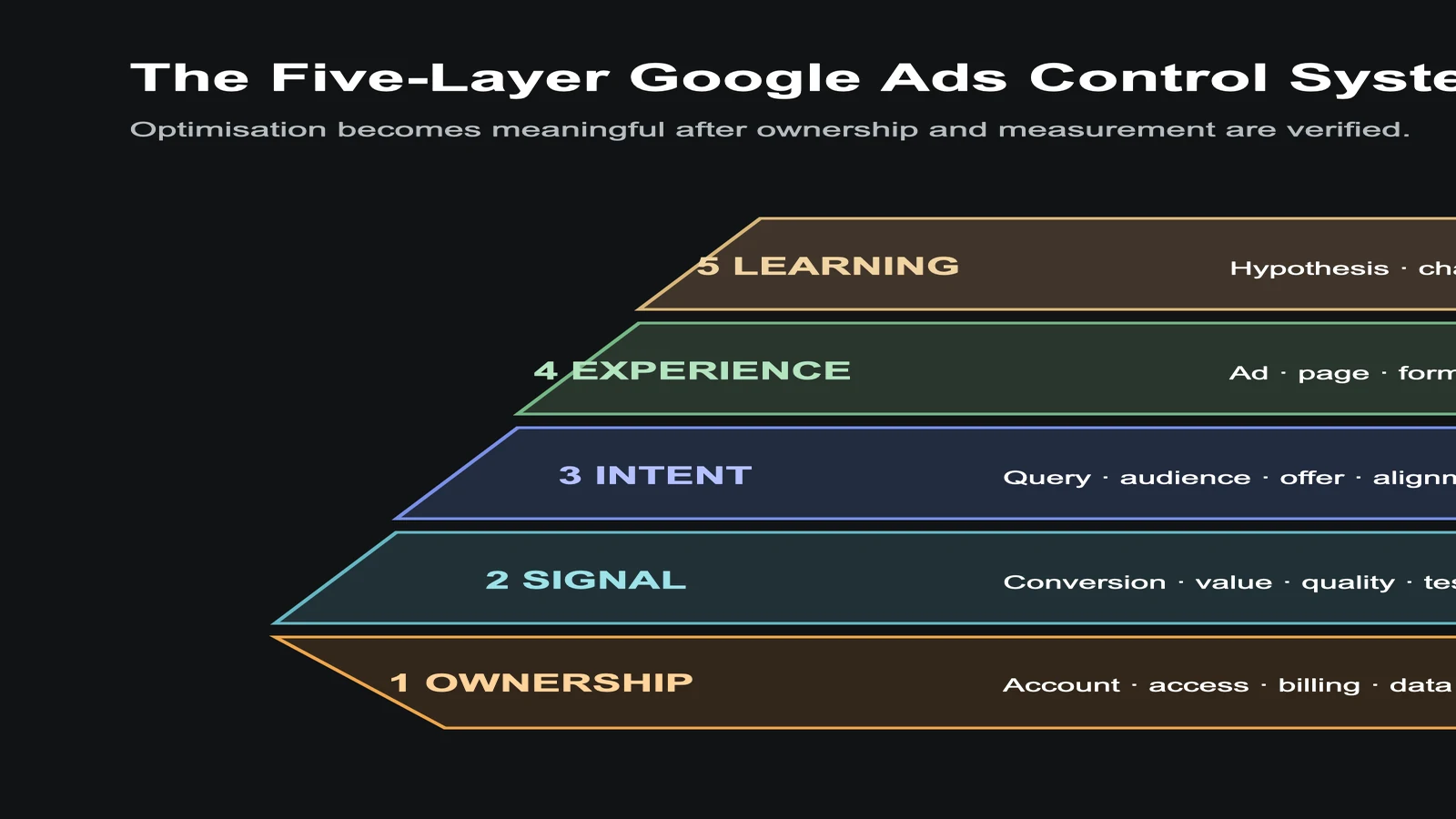
1. Ownership
Identify the owner of the account, billing profile, measurement assets, data and source files. Grant access through appropriate user roles instead of sharing personal passwords.
2. Signal
Verify conversion actions, values and quality feedback used for optimisation. A firing tag is not sufficient: test that it fires at the correct moment and for the intended action.
3. Intent
Match the query, audience and campaign objective to the offer. Do not force a research-stage visitor and a purchase-ready visitor into the same ad and destination.
4. Experience
Review the ad, assets, landing page, form or call flow and sales handoff as one journey. Assign website or operational problems that cannot be solved in the ad account to the appropriate owner.
5. Learning
Keep the change record, hypothesis, evaluation period and result together. Reporting should identify what to retain, stop and test—not merely present a metric table.
What should a report explain?
A useful report answers these questions:
- How was spend distributed across campaigns and business objectives?
- Which conversions were primary and which were observation-only?
- Is there a technical or operational confidence problem in the conversion data?
- Which search intents produced relevant or irrelevant demand?
- Where did the ad, landing page or sales follow-up create a bottleneck?
- Which change was made, and what evaluation period does it need?
- What are the next budget, test and content decisions?
Click-through rate or average cost per click is not sufficient evidence of success. If the objective is qualified demand, accepted leads and resulting opportunities should be incorporated where the business can provide that information.
Questions to ask a Google Ads consultant
- Will our company own the account and its data?
- Who will define and test conversion actions?
- Are ad spend, management fees and third-party costs itemised?
- Which roles will work on the account, and who owns each responsibility?
- How often will search terms, exclusions and landing pages be reviewed?
- Under which conditions will automated recommendations be applied or rejected?
- Will reporting include lead-quality feedback as well as platform metrics?
- How will handover and access removal work at the end of the engagement?
Certifications and partner status can support an assessment of platform knowledge, but they do not replace business understanding, measurement accuracy, change discipline and transparent account ownership.
Conclusion
Google Ads consulting should turn the ad account from an opaque spending mechanism into an auditable decision system. Establish ownership and measurement first, then intent and experience, and only then optimisation. For broader campaign, creative and agency-scope decisions, use the advertising agency selection guide and explore the digital marketing library.