


Aydınlatma metni yükleniyor…
A website for a hotel or tourism business is more than a digital brochure. It is a direct sales channel where prospective guests discover the property, compare rooms and experiences, check prices and decide whether to book. Effective hotel website design must therefore bring visual identity, useful content, user experience, booking technology and technical performance into one coherent journey.
A guest may arrive through an advertisement, organic search, social media or a comparison platform. Whatever the entry point, their questions are similar: Where is the property? What are the rooms like? What will the stay cost in total? Which facilities are available? Can I book securely? If the website cannot answer these questions quickly and consistently, the visitor may return to an intermediary. The objective is not necessarily to eliminate those platforms, but to make the hotel’s own website a credible, controllable and measurable sales channel.
Why direct booking is not just a design issue
Direct-booking performance depends on far more than attractive photography or an impressive homepage. Information architecture, price transparency, room comparison, mobile usability, booking-engine behaviour, page speed and trust signals must all support the same commercial goal. A weak link anywhere in that chain can interrupt the guest’s path to purchase.
For example, a homepage may create a strong brand impression, but the experience becomes fragmented if the booking engine suddenly introduces a different visual language. Asking guests to re-enter dates or occupancy details adds avoidable friction. Revealing mandatory charges only near the final step can also undermine trust. Google Hotel Center’s best practices for free booking links recommend prominently presenting the selected room and rate on the landing page, maintaining price accuracy and ensuring that the page loads within a reasonable time.
The project should consequently begin with more than “What should the website look like?” The team must also define its priority markets and room types, how the booking engine will operate, how offers will be managed and which events will be used to measure success.
Define the guest journey and commercial objective together
The website scope should reflect distinct guest scenarios. A family planning a holiday may prioritise occupancy limits, connecting rooms and children’s policies. An event organiser will need venue capacities, layouts and service details. International guests may pay closer attention to language, currency, transport and payment options.
During planning, match these visitor tasks with the property’s sales objectives. Every page can then provide relevant information while guiding the guest towards a meaningful next step:
- Understand the property, destination and location quickly
- Compare rooms by capacity, bed configuration, features and view
- Select dates and guest numbers, then check availability and price
- Evaluate packages, cancellation terms and optional services
- Complete a secure payment, booking or reservation request
These scenarios should also shape the analytics plan. Measuring room views, date selections, availability searches, booking starts and completed reservations reveals where guests leave the journey instead of reducing performance to a single conversion figure.
How should you plan a direct-booking-focused website?
An efficient project defines the booking journey before individual pages are designed. The following sequence makes user requirements, commercial priorities and technical dependencies visible from the outset.
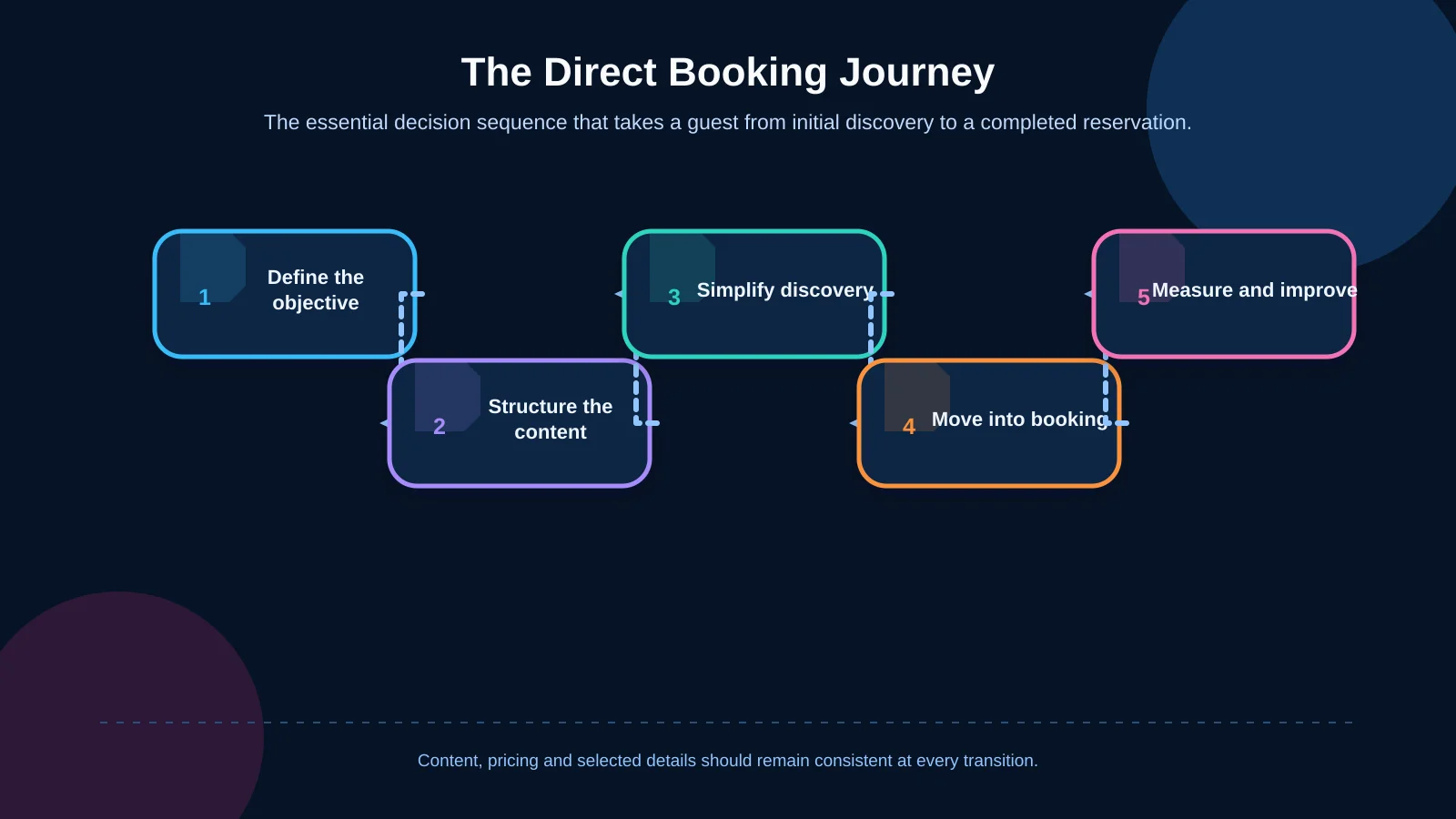
1. Establish objectives and the data foundation
First, define what a successful direct booking means to the business. In addition to booking volume, the team might monitor revenue, average booking value, length of stay, offer performance and abandonment. Review the current analytics setup, consent requirements and data available from the booking engine before specifying reports.
2. Build the content and page hierarchy
Depending on the property, the architecture may include accommodation, room details, restaurants, spa, meetings and events, experiences, offers, a destination guide, FAQs and contact information. Navigation should reflect the guest’s decision process rather than the hotel’s internal organisation. Each important page should answer a real question and provide a clear next action.
3. Design the transition from discovery to booking
The booking action should be easy to find on desktop and mobile without becoming an intrusive layer that obscures the content. Date and occupancy selection should remain concise. Guests should retain context about the property, room or offer they selected as they move into the booking environment.
4. Test integrations end to end
The scope may involve a booking engine, channel manager, property management system, payment provider, CRM and analytics tools. Integration means more than confirming that a link opens: rates, inventory, dates, currencies, languages, promotional codes, confirmation states and errors must behave consistently. When enquiries need to enter an organised sales process, website–CRM integration planning can connect form data, ownership and follow-up within the same information flow.
5. Improve with real-world data after launch
Launch is the beginning of measurement, not the end of the project. Monitor performance by device, traffic source, country, language and page type. Evaluate material changes through controlled tests where appropriate. This makes it possible to see not only whether conversion changed, but which audience and stage of the journey created the difference.
Room and experience content should support confident decisions
The central question for most visitors is simple: “Is this property right for me?” Content should answer it with practical detail rather than relying entirely on atmospheric language. Room size, bed arrangement, capacity, view, accessibility features, included services and key policies should appear in a consistent structure. If distinctions between similar room categories remain unclear, guests may base their decision on price alone.
Photography and video should be current, accurate and presented in context. Wide-angle imagery can establish atmosphere, while floor plans or layout information make expectations more concrete. Gallery performance matters too: high-resolution assets should use appropriate formats, responsive dimensions and progressive or lazy-loading techniques.
Experiences can contribute directly to the booking journey. Spa facilities, restaurants, beaches, children’s clubs, transfers and destination activities should explain who they suit, what is included and how guests can participate. Advanced animation can strengthen a sense of place, but it should never delay access to essential information or disregard visitors who prefer reduced motion.
Put the mobile experience at the centre of the booking flow
Mobile optimisation does not mean shrinking a desktop layout. Date pickers, room and guest selectors, rate options, policy text and payment forms must be reconsidered for touch interaction. Tap targets need sufficient size, labels should remain visible and validation messages should explain how to correct each problem.
A persistent booking action can be useful on mobile, provided it does not collide with cookie notices, chat widgets or promotional pop-ups. Test what happens when the keyboard opens, whether fields remain visible, whether the back button preserves selections and whether session timeouts arrive without warning.
Accessibility is a natural part of this work. The W3C’s WCAG 2.2 Quick Reference covers criteria such as text alternatives, contrast, keyboard access, visible focus, understandable labels and error prevention. Applying these checks helps more guests use the site independently while improving usability for everyone.
Checkpoints for speed, accessibility and trust
On image-rich tourism websites, performance cannot be separated from design. Unnecessary video downloads, uncontrolled third-party scripts and heavy animation can delay critical information, particularly on mobile connections. Google’s Web Vitals guidance assesses loading performance with LCP, interaction responsiveness with INP and visual stability with CLS. Laboratory testing is useful, but should be supported with real-user data whenever possible.
Trust also depends on HTTPS, maintained software components, authorised access to administration tools, reliable backups and disciplined handling of personal data. Payment information should not enter the custom website’s scope unnecessarily, and responsibilities between the property, agency and payment provider should be explicit. Cookies, marketing tags and forms should be reviewed alongside the purpose and legal basis of data collection.
Pre-launch technical checks must cover representative templates and complete reservation scenarios. A fast homepage is not enough; room pages, offer landing pages, enquiry forms and the transition into the booking engine should meet the same quality expectations.
| Area | Primary risk | Check |
|---|---|---|
| Performance | Slow-loading media and interactions | Measure LCP, INP and CLS |
| Accessibility | Keyboard and form barriers | Test focus, contrast and labels |
| Security | Unauthorised access and data loss | Verify HTTPS, permissions and backups |
| Integration | Rate or date inconsistencies | Run end-to-end booking scenarios |
How should booking-system and integration scope be defined?
Not every hotel needs a booking platform built from scratch. If an existing engine already supports rate, inventory and channel operations, integrating it well may be safer and more efficient. Multi-property groups, membership pricing, complex packages or unusual sales rules may require a broader custom solution.
Assess mobile usability, languages, currencies, promotional codes, ancillary sales, cancellation rules, payment methods, analytics and alignment with the brand interface. If guests move to another domain, the transition should remain clear, trustworthy and measurable. Dates, occupancy and offer context should be carried across wherever the technology permits.
Channels such as Google’s free hotel booking links place additional importance on current rate and availability data. The room, dates and price shown in search should remain consistent with the landing and booking experience. Any mismatch can weaken confidence at precisely the moment the guest is ready to convert.
Which metrics indicate direct-booking success?
Traffic alone cannot explain whether a hotel website succeeds commercially. Measurement should combine intent signals throughout the journey with confirmed business outcomes:
- Booking-engine click-through and availability-search rates
- Booking starts, completed reservations and abandonment by stage
- Direct-booking revenue, average booking value and length of stay
- Conversion by device, language, country, campaign and traffic source
- The contribution of room, offer and experience pages
- Assisted sales contacts through forms, telephone and email
Test analytics event names, referral handling and confirmation data before launch. Personal information should not be sent to analytics platforms, while data-layer definitions and access permissions should be documented. Reports should show which page or step needs attention, not merely describe totals.
What should you look for when choosing a hotel web design agency?
Do not evaluate an agency only by the appearance of its portfolio. Consider whether it can coordinate research, content, user experience, development, integrations and measurement. For third-party systems such as booking engines, responsibilities and the end-to-end testing approach should be clear before delivery begins.
Kumsal Agency is an Istanbul-based digital agency combining custom corporate web design, information architecture, content planning, interactive experiences and project-specific web development. Its approach to tourism projects focuses on preserving the brand’s visual world while helping guests explore rooms and experiences, simplifying mobile journeys and placing necessary integrations within a manageable technical structure. The Schloss Lüdersburg web design project offers an example of this approach.
The proposal should define content responsibilities, unique templates, language options, animation depth, content management, forms, booking integration, performance testing, baseline accessibility checks and post-launch support. This allows creative goals, budget, timing and technical ownership to be evaluated within the same framework.
Turn your website into a measurable direct-sales channel
A hotel website that increases direct bookings connects brand storytelling with decision-ready content and a dependable booking journey. Success comes not from enlarging the “Book Now” button, but from clear information architecture, transparent pricing, mobile usability, fast pages, trustworthy integrations and continuous measurement.
To plan a website and integration scope around the direct-booking goals of your hotel, boutique property, resort or tourism business, contact Kumsal Agency.