


Aydınlatma metni yükleniyor…
A freight quote form on a logistics company’s website should be more than a generic contact form. It must help prospective customers describe their shipment while giving sales and operations teams enough structured information to assess feasibility, route the enquiry and prepare an accurate quotation. A well-planned form collects route, cargo, timing, vehicle and additional-service requirements in a logical order, reducing the need for repeated follow-up calls.
The answer is not to place every possible question on one screen. An excessively long form increases abandonment, while an overly short one produces enquiries that cannot be priced. The company’s service model, operational rules and sales workflow should therefore shape the form’s fields, conditional logic, validation, integrations and security controls.
How should you define the purpose of a freight quote form?
Begin by deciding what should happen after submission. Will the form only notify the sales team, or should it create an opportunity in the CRM, assign an owner according to region or service type and alert operations when specialist review is required? Can the operations team complete an initial assessment from the submitted data alone? Creating a field list before answering these questions usually results in unnecessary data collection or missing operational details.
Sales, operations, marketing, IT and legal stakeholders should participate in a focused discovery session. Reviewing recent enquiries can reveal which omissions repeatedly delay quotations. “I have cargo from Istanbul to Berlin,” for example, may not be actionable without the loading location, dimensions, weight, readiness date, delivery terms and customs-clearance requirements.
Success metrics should also extend beyond completion rate. Track the proportion of assessable enquiries, follow-ups caused by missing information, first-response time, quote conversion, duplicate records and requests routed to the wrong team. These measures show whether the form creates business value rather than simply generating submissions.
What steps should a freight quote form include?
The exact flow depends on the logistics services offered, but it should follow the customer’s natural decision sequence: define the shipment, provide the route and cargo details, specify timing and optional services, then add contact information and review the request. Show the number of steps and the type of information required from the outset.
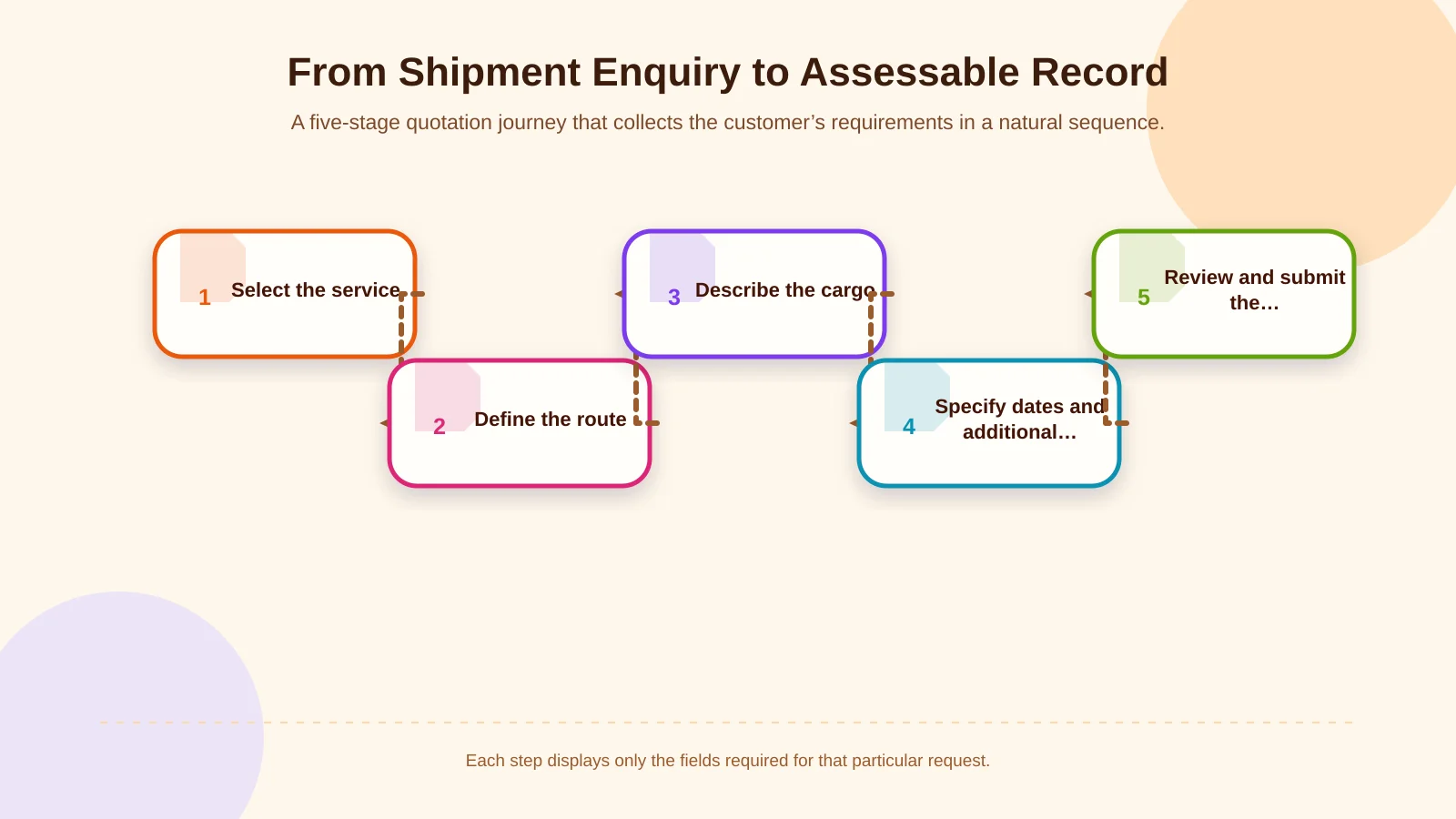
1. Transport mode and service scope
Offer road, sea, air, rail or intermodal transport only where relevant. Services such as full truckload, less-than-truckload, express delivery, project cargo and temperature-controlled transport can become choices that determine later questions. Include an “I’m not sure—please advise me” option for customers who do not know the technical service category.
2. Origin and destination
Choose the necessary geographic detail according to pricing requirements: country, city, district or postcode. If a full street address is not needed for the initial quotation, making it mandatory creates friction and collects more personal data than necessary. For multi-stop shipments, let users add locations and clearly display their sequence.
3. Cargo characteristics
Use separate fields for the cargo description, total weight, volume, package or pallet count and dimensions. Display units such as kilograms, tonnes, centimetres and cubic metres beside the relevant input. When operationally critical, answers should reveal follow-up questions about dangerous goods, temperature control, fragile items, high-value cargo or non-stackable pallets.
4. Dates, vehicle requirements and additional services
Separate the cargo-ready date from the requested delivery date. If customers cannot reliably select a vehicle, collect the cargo data and let operations determine the appropriate equipment. Customs clearance, insurance, warehousing, handling, tail-lift vehicles, scheduled delivery and shipment tracking can be presented as understandable optional services.
5. Contact details and final review
Name, company, business email, telephone number and preferred contact method are sufficient for many first-contact scenarios. Before submission, show an editable summary of the route, cargo, dates and contact details. The confirmation screen should provide a request number, expected response time and a clear explanation of what happens next.
The W3C’s guidance on multi-page forms recommends grouping long forms into logical steps, communicating progress and allowing people to review previous steps. This makes complex logistics enquiries easier to complete without compressing every question into one demanding screen.
How can conditional fields create a shorter, better-qualified journey?
Instead of displaying every field to every visitor, reveal questions in response to earlier choices. Selecting sea freight might open container and loading-method fields; cold-chain transport might request a temperature range; and dangerous goods might require a UN number and document upload. A domestic part-load enquiry and an international project shipment can therefore use one entry point while reaching different levels of detail.
Conditional logic must be documented rather than hidden inside the interface. A form data dictionary should record what triggers each question, whether it is required and which CRM field receives the answer. Define incompatible combinations as well: a past readiness date, zero cargo weight or a vehicle request with no shipment details should be prevented or flagged.
Do not force users to guess. Provide “I don’t know” options, short examples and an optional notes field where appropriate. Free text should supplement structured data rather than replace it. These rules can be implemented through custom web development aligned with the logistics company’s actual workflow, roles and integrations.
How should field validation and error messages work?
Validation should not wait until the user presses Submit and then return a generic error. Check email format, telephone country codes, date order, numerical values and file requirements beside the relevant field. Explain both the problem and its remedy—for example, “Enter the total weight as a number and select kg or tonnes.”
Do not identify required fields by colour alone. Use visible text, programmatic labels and accessible error associations. Persistent labels are preferable to placeholders that disappear while typing. Keyboard navigation, visible focus, screen-reader labelling, adequate contrast and understandable movement to the invalid field should be part of acceptance testing.
On mobile devices, numerical inputs should open an appropriate keypad and controls should have comfortable touch targets. Answers must remain intact when users move between steps. On a slow connection, show that submission is in progress and prevent repeated taps from creating duplicate enquiries.
How can file uploads remain secure and usable?
Packing lists, product photographs, technical drawings, safety data sheets and customs documents may accelerate evaluation. Allowing unlimited file types and sizes, however, introduces security and storage risks. State the accepted extensions, maximum size, file count and purpose before upload.
The OWASP File Upload Cheat Sheet recommends controls such as allowlisting extensions, validating file types, generating filenames within the application, limiting file size and storing files securely. Malware scanning, access permissions and retention periods should also be defined as architectural requirements.
A failed upload should not reset the entire form. Show progress, success and error states for each file, allowing the user to remove and retry only the problematic item. Sensitive commercial documents should normally be accessed through an authorised portal instead of being attached to notification emails.
How should KVKK, GDPR and data security be addressed?
Do not collect information simply because it may be useful later. Define the purpose, legal basis, access permissions and retention period for every field. The Turkish Personal Data Protection Authority’s explanation of the obligation to inform data subjects covers matters including the controller’s identity, processing purposes, recipients, collection method, legal grounds and individual rights. Legal specialists should assess the final wording against the company’s actual data flows.
Privacy information and marketing permission serve different purposes. Processing required to assess a quotation should be separated from consent for commercial communications. Where marketing permission is requested, present it as an independent, unticked choice. The record can retain the applicable notice version, timestamp and necessary evidence.
Encrypt information in transit, enforce role-based access in administrative interfaces and log access. A salesperson may need contact details without needing permission to download every cargo document. Deletion and anonymisation rules, backups, application logs and third-party processors must also be included in the data inventory.
How should CRM and enterprise system integration be planned?
A successful submission should create more than an email. Send the enquiry to the CRM or quotation system with a unique reference, source page, campaign information, service category and structured answers. Document field mappings, required formats, duplicate-handling rules and assignment logic before implementation.
Requests can be routed automatically according to route, service or customer type, with alerts for urgent or specialist shipments. The reason for an automated decision should remain visible, and authorised users should be able to reassign a record. Kumsal Agency’s enterprise resource planning services illustrate how operational data and management processes can be considered as a connected system.
If an integration fails, the customer must not receive a misleading success message and the request must not disappear. Retain it in a secure exception queue, retry under controlled rules and notify the technical owner. An idempotency key can prevent the same submission from being processed twice.
Which scenarios should be tested before launch?
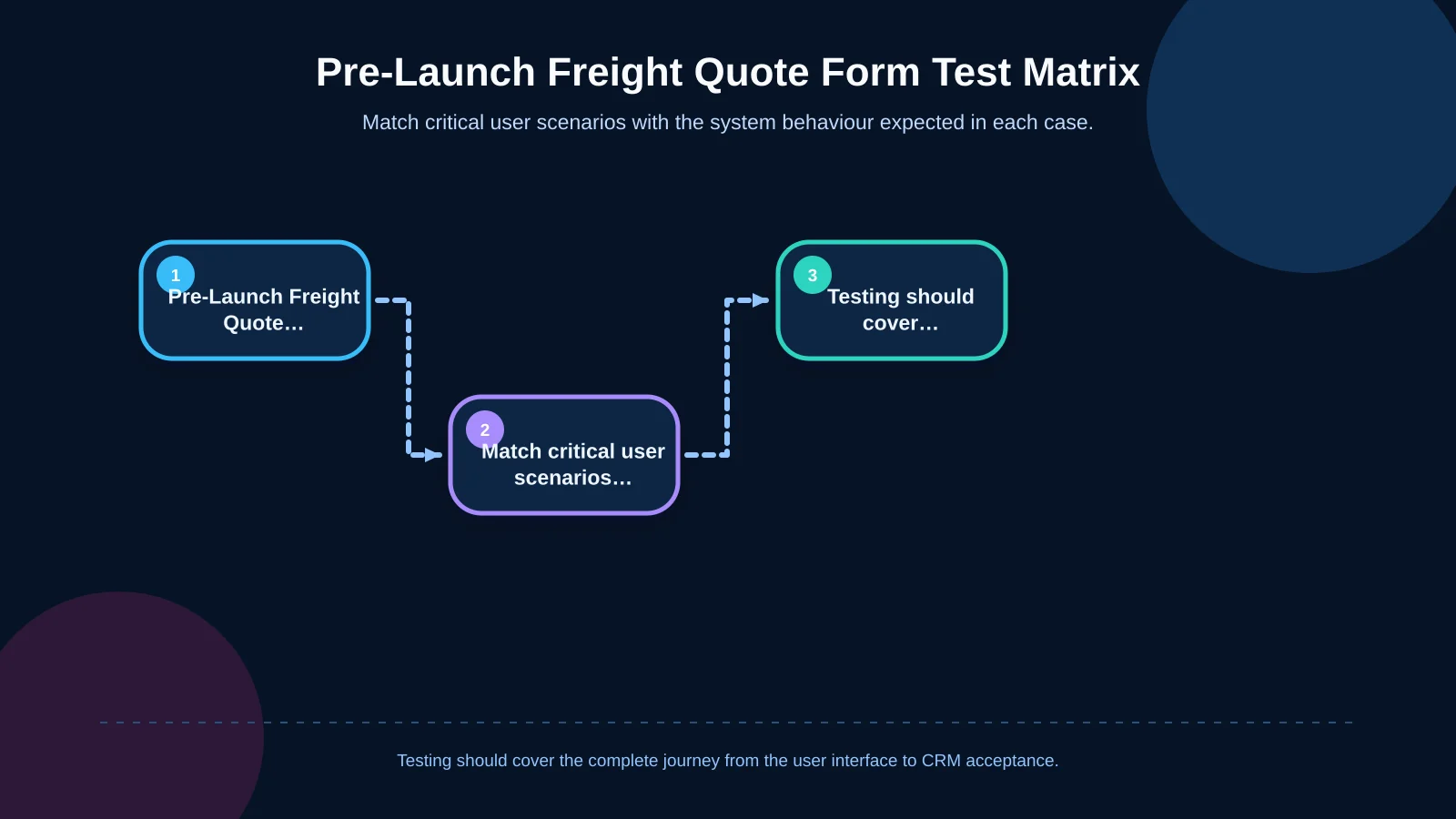
Testing involves more than checking empty-field warnings. Run realistic scenarios such as a simple domestic shipment, a multi-stop route, international freight, dangerous goods, an oversized file, an unsupported format and a mobile connection failure. For every case, verify the user interface, stored record, CRM transfer, team notification and confirmation message together.
- Do conditional fields appear for the correct answer and clear irrelevant data after a selection changes?
- Do units, dates and locations reach operations in the expected format?
- Do steps, uploads and back navigation work reliably on mobile devices?
- Can a double tap or network retry create duplicate enquiries?
- Is the record preserved and the responsible team alerted during a CRM outage?
- Are the correct versions of privacy notices, permissions and access records retained?
After launch, measure the funnel by step. Review where people leave, which errors recur and which values sales teams routinely correct. Never send names, telephone numbers, email addresses, cargo contents or free-text commercial details to analytics platforms.
| Scenario | Checkpoint | Expected result |
|---|---|---|
| Simple shipment | Required fields | One record is created |
| Conditional service | Field visibility | Only relevant questions appear |
| Invalid file | Type and size validation | A clear warning is displayed |
| CRM outage | Exception queue | The request is retained and the team is alerted |
| Mobile submission | Steps and retries | Data is preserved and no duplicate is created |
How should a custom logistics quote form project be scoped?
Adding a few fields to a standard contact form may appear quick, but it becomes limiting as conditional journeys, secure uploads, CRM integration and role-based administration grow. Treat the form as a digital business process, with a service model, user journeys, data dictionary, integration contract, administrative screens, security controls and measurement plan.
Kumsal Agency is an Istanbul-based digital agency that combines brand-led corporate web design with strong software infrastructure. For logistics companies, it can plan responsive interfaces, multi-step conditional forms, field validation, secure file uploads, CRM connections and management functions around real operational workflows.
To plan a website and custom quotation form suited to your logistics company’s enquiry and evaluation process, contact Kumsal Agency.