


Aydınlatma metni yükleniyor…
Client logos can create an immediate sense of credibility on a B2B website, but they cannot answer the questions that matter most to a serious buyer: What problem did the provider solve? What did the team actually deliver? Can it handle a comparable project? Is the claimed outcome verifiable? Decision-makers in engineering, manufacturing, technology and professional services usually need more than a row of recognisable names. They need enough context to judge whether the experience is relevant to their own organisation.
The purpose of a reference section should therefore be to turn claims into evidence, not to display the largest possible collection of logos. A well-structured project presentation makes the initial need, chosen approach, delivered scope and approved outcomes easy to understand. A logo may still appear, but it becomes one element in a wider chain of proof rather than the proof itself.
Why is a client logo not enough on its own?
A logo suggests that two organisations had a commercial relationship, but says nothing about its nature. A visitor cannot tell whether the engagement involved a short consultation, a single campaign page or a complex digital transformation. The date, intended users, agency responsibilities and delivered components remain unclear. For procurement, technical and management teams assessing capability, that ambiguity limits the logo’s value as evidence.
A context-free logo wall can introduce other risks. An old engagement may be interpreted as evidence of current capability. Work completed for one subsidiary may be attributed to an entire group, while a logo published without permission may create an inaccurate expectation. When competing agencies display similar brands, the visitor also has no meaningful basis for comparing their actual contributions.
Removing logos altogether is not essential. The better approach is to connect each one to an explainable relationship. A short scope label such as “corporate website,” “dealer portal,” “multilingual product catalogue” or “CRM integration” can clarify the engagement. Visitors who need more detail can then continue to the relevant project page.
What questions should project evidence answer?
An effective case study does not need to become a long success story. It only needs to answer five questions clearly enough for a prospective client to assess relevance. This structure translates the experience normally explained by a sales team into consistent, scannable website content.
1. What was the initial need?
Instead of saying only that “the website was redesigned,” explain the condition that made change necessary. Fragmented product information, inaccessible technical documents for overseas buyers, a weak mobile experience or enquiries being routed to the wrong sales team are genuine starting points. The category of problem can be described clearly without disclosing confidential processes.
2. Who were the users and what were the business goals?
One project may serve several stakeholders. A procurement specialist may assess technical suitability, a distributor may look for stock or pricing information, an investor may investigate the organisation, and a candidate may explore its culture. The project page should identify the priority users and the tasks they need to complete. This demonstrates that design decisions were driven by user and business requirements rather than aesthetics alone.
3. How was the solution approach developed?
Replace generic phrases such as “modern and innovative design” with specific decisions. Rebuilding the content hierarchy, simplifying product taxonomy, adding technical-document filters, introducing role-based administration, connecting ERP data or establishing a multilingual publishing workflow all make the approach visible. Kumsal Agency’s custom corporate web design approach brings information architecture, user experience, an original visual direction and technical development into one connected system.
4. What exactly was delivered?
Delivery scope is one of the easiest layers of evidence to verify. It may include original page templates, responsive interfaces, a content management system, a product data model, form workflows, API connections, analytics events, performance optimisation and security checks. If the agency was responsible for only part of the engagement, that boundary should be stated. Transparent attribution is more credible than claiming ownership of every aspect of a project.
5. Which outcomes can be verified?
An outcome does not have to be a dramatic increase in sales. A live multilingual structure, a working product filter, centralised document management, successful completion of a task on mobile, a measured speed result or traceable transfer of leads into a CRM are also valid outcomes. Performance claims should identify the measurement tool, date range, device category and comparison basis. Google’s Core Web Vitals business-impact case studies illustrate how methods and measurements can be presented alongside the relationship between technical improvements and business results.
Moving from a logo wall to an evidence-led project page
The transition should not begin by turning every existing reference into a long article. First assess publication rights, evidence quality and sales relevance. Develop the strongest projects into complete case studies, while engagements with limited approved information can remain concise cards with accurate scope labels.
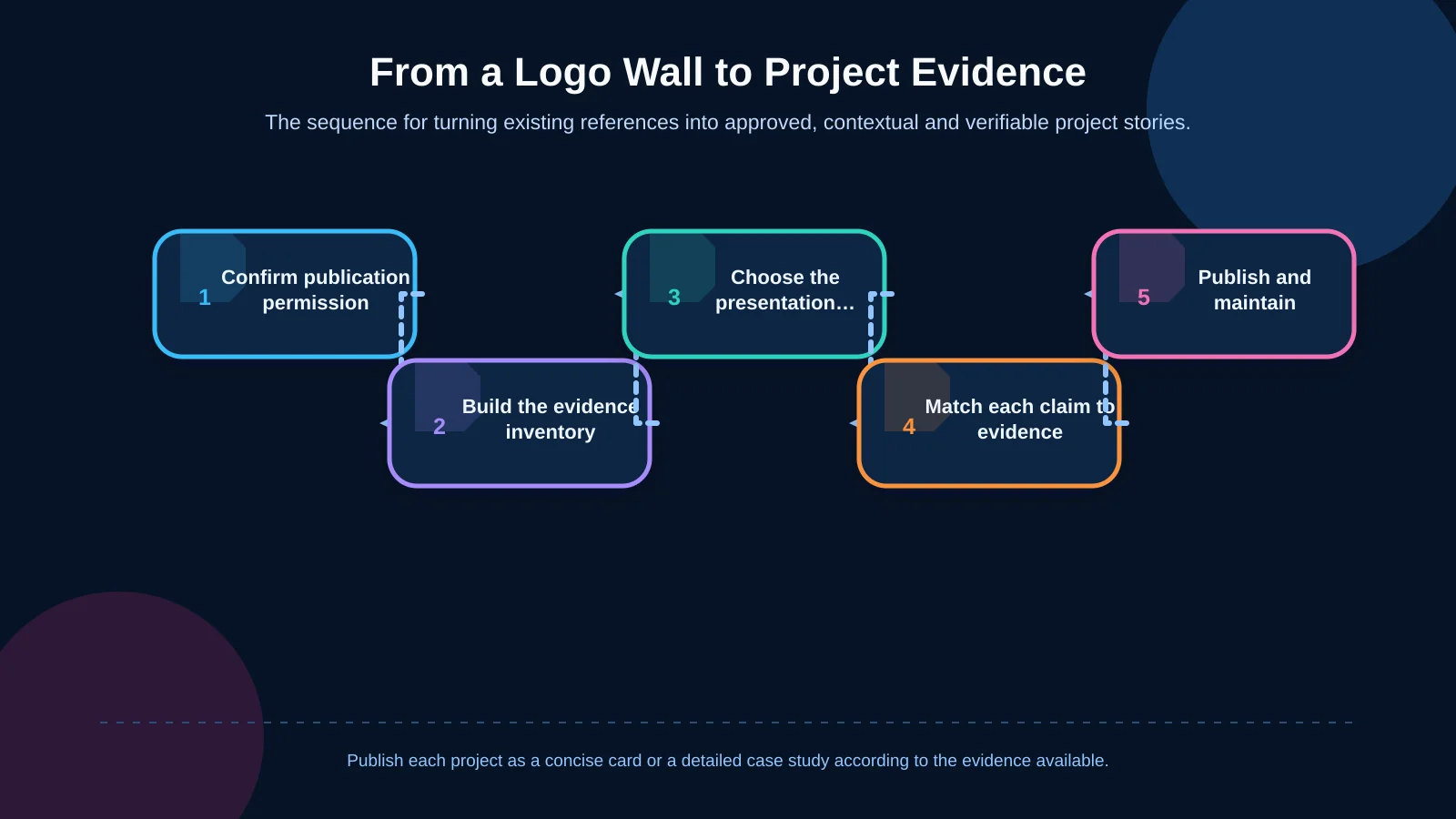
Confirm publication permission and boundaries
Permission to publish a client’s name does not automatically cover its logo, screenshots, employee quotations or performance data. Review each asset separately and record what has been approved. The ASA/CAP guidance emphasises retaining evidence that a testimonial is genuine, keeping the relevant person’s or organisation’s contact details, and obtaining permission to use the endorsement. Its testimonials and endorsements guidance provides a useful governance reference for B2B project libraries.
Create an evidence inventory
For every project, record the client sector, initial need, target users, delivery scope, available screenshots, launch date, team responsibilities, measurement source and approval status. Missing content becomes visible before page production begins. The same inventory can supply relevant proof to homepage and service-page modules, reducing inconsistent descriptions across the website.
Choose a format that matches the evidence level
Not every engagement should be presented with equal depth. If only the relationship and service type can be verified, use a logo and short scope label. If the process and deliverables are approved, create a summary project card. If the starting position, approach, visuals and results can all be documented, publish a complete case study. This tiered model prevents teams from filling evidence gaps with unsupported marketing language.
Place claims beside their evidence
If the page states that a complex product structure was simplified, show the revised information architecture, filter logic or a representative user journey nearby. If it claims that the mobile experience improved, support that statement with device views, test coverage or field data. Evidence should not be hidden several clicks away; it should appear where the visitor encounters the claim.
Publish, measure and maintain
Page views alone do not show whether a case study supports a buying decision. Track journeys from services to projects, contact clicks within a case study, document views and qualified form submissions. Assign responsibility for periodically checking client names, links, screenshots and technical details. An outdated case can be archived or retained with an explicit date and historical context.
Which evidence supports each type of claim?
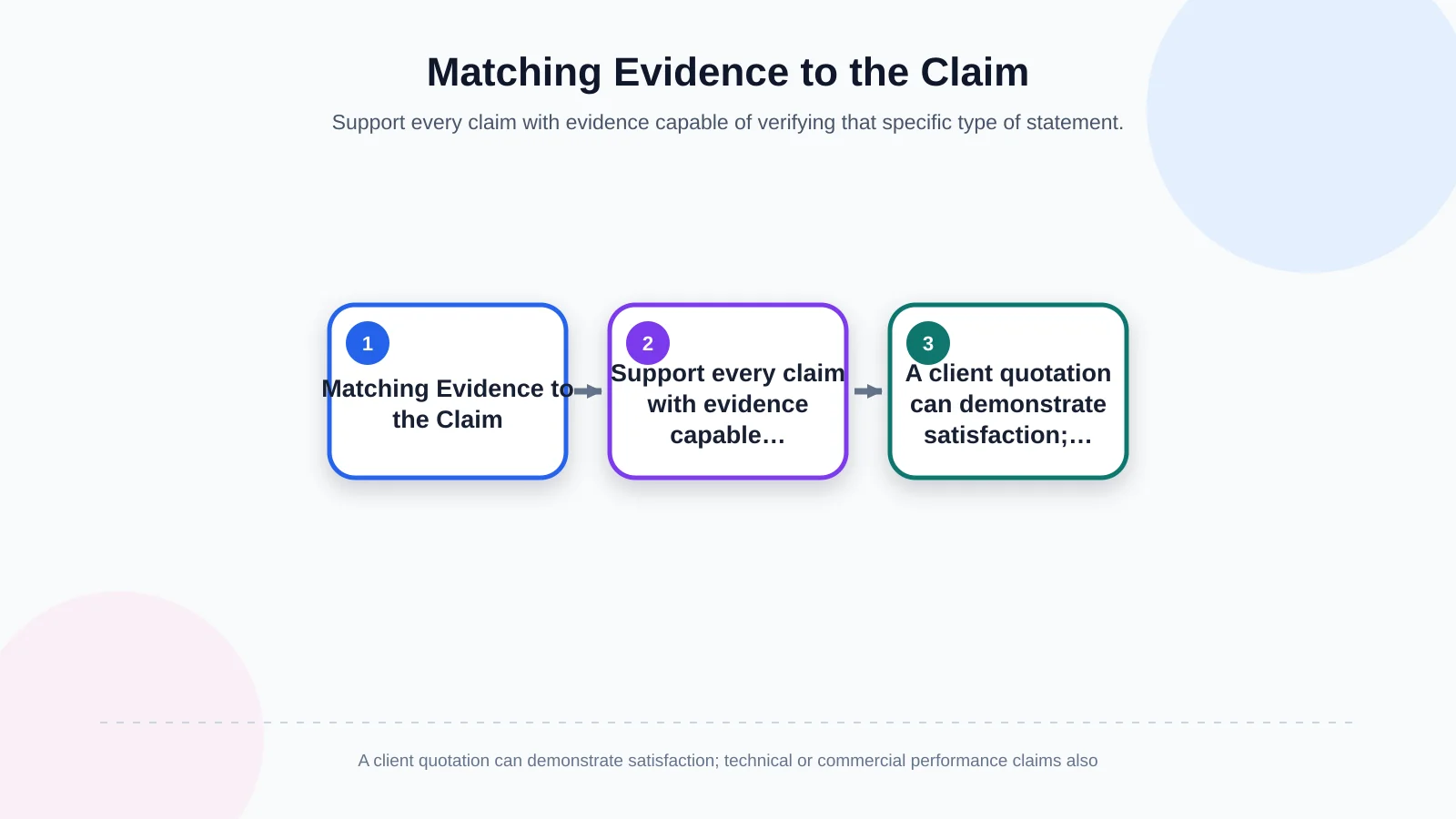
Evidence should match the nature of the claim. A client quotation cannot prove overall project performance, while a screenshot alone cannot demonstrate a business result. Combining several evidence layers helps visitors assess both what was completed and what supports the stated outcome.
- Context evidence: sector, user group, initial need and project date.
- Process evidence: research summaries, sitemaps, prototypes, decision rationale and test scenarios.
- Delivery evidence: live pages, interface views, management features, integrations and technical scope.
- Performance evidence: analytics records, field-performance data, form-delivery tests or integration logs.
- Client evidence: an approved statement from an authorised person, presented with its original context intact.
The FTC’s guidance on endorsements and testimonials in advertising explains that explicit and implied claims conveyed through endorsements must not be misleading and require appropriate substantiation. A statement such as “increased conversion,” for example, should depend on a defined metric, period and data source—not merely a general expression of client satisfaction.
| Type of claim | Suitable evidence | Validation check |
|---|---|---|
| The need was understood | Brief and documented starting point | Date and scope |
| The right solution was designed | Sitemap, prototype and test record | Decision rationale |
| The agreed scope was delivered | Live page, management panel or integration | Responsibility boundary |
| Performance improved | Analytics or field measurement | Period and data source |
| The client was satisfied | Approved client testimonial | Permission and context |
Can you build a strong project story without commercial metrics?
Yes. In many B2B projects, sales data is not shared with the agency, transaction volume is too low for a meaningful comparison, or the client does not permit figures to be published. In that situation, use verifiable operational outcomes rather than inventing numbers or relying on vague descriptions such as “highly successful.”
Centralising scattered files in one management panel, introducing defined user roles, linking multilingual pages, transferring quotation requests to a CRM or testing a performance budget are concrete outcomes. A before-and-after narrative can also work without percentages: a document update previously managed through email may now be completed by an authorised editor in the content management system.
The key is to distinguish delivery from impact. “The CRM integration went live” is a verifiable delivery outcome. “Sales efficiency increased” is an impact claim that requires separate measurement. When the data is unavailable, state the limitation and report only what can be substantiated.
How should a project page be structured?
Above the fold, readers should understand who the project served, why it was needed and what it covered. The starting point, solution approach, deliverables and outcomes should follow. Technical detail, galleries and related services can appear further down. End with a contextual call to action that tells visitors with a similar requirement what they can discuss, rather than using a generic contact prompt.
A practical sequence is: project summary, initial need, target users, solution approach, delivery scope, verifiable outcomes, supporting evidence, limitations and next step. At card level, the sector, need, solution and one concrete outcome may be sufficient. Visitors should also be able to compare applications across sectors through Kumsal Agency’s web design projects.
The management system must make this structure sustainable. Store project type, sector, service, publication date, permission status, metric source and related content as separate fields instead of relying only on free text. Filtering, multilingual relationships, image alternative text, revision history and publishing approval should be defined at the start of the project.
Common mistakes that weaken trust
- Displaying major client logos without explaining the scope of the relationship.
- Publishing a logo, screenshot or employee quotation without permission.
- Claiming responsibility for strategy, software or outcomes delivered by another party.
- Using percentages without identifying the measurement period and source.
- Presenting one exceptional result as the expected outcome for every client.
- Showing an old interface as current work without a date or version note.
- Turning the project page into a gallery while omitting the problem and decision rationale.
- Describing every engagement with the same template and promotional adjectives.
A short publishing review involving content, client relations or legal stakeholders, and the delivery team can prevent these issues. For every claim, record its source, approver, date and applicable limitations.
Build project evidence into your corporate website redesign
Project evidence is not a content block to add after the design is finished. It should be planned with the information architecture, content model, management panel, analytics specification and client-approval workflow. A concise homepage proof card, a related case on a service page and the complete project page can then draw from the same approved source.
Kumsal Agency combines Art Director-led custom design with user experience, content planning, custom web development and the integrations required by each organisation. Responsive behaviour, performance, data security and a sustainable management model provide the technical foundation needed to make the presentation credible as well as visually distinctive.
Plan a corporate website with Kumsal Agency that strengthens your existing reference sections through meaningful project context, a clear solution approach and verifiable outcomes.