


Aydınlatma metni yükleniyor…
A product launch microsite can bring advertising, social media, events and public relations into one focused experience. Once the launch ends, however, countdown timers, pre-order messages and event announcements quickly become outdated. Closing the domain or leaving the website untouched can put earned traffic, inbound links and user trust at risk.
The better approach is to define the microsite’s post-campaign role before design begins. Will it become an evergreen product page, provide customer support, continue collecting qualified enquiries or transfer its content to the main corporate website? The answer should reflect the product lifecycle, users’ continuing needs, search visibility and the brand’s operational capacity.
Why should a microsite not remain unchanged after the campaign?
The campaign may end, but the user journey does not. Someone who first encountered the product in an advertisement may type in the domain weeks later. An existing customer may need an installation guide, a journalist may look for approved images, and a business partner may require technical documents. Search engines, old QR codes and third-party websites may also continue sending visitors to campaign URLs.
An expired offer, broken form or past event announcement creates uncertainty and undermines confidence. Leaving forms active can be equally problematic if submissions are sent to a sales team that no longer processes them. After the campaign, the microsite should either take on a clear new function or guide visitors to relevant permanent content through a controlled transition.
A launch plan should therefore cover more than the publication date. It should define the campaign’s closure conditions, content owner, domain owner and archiving policy. Recording the purpose, required assets, approval status and responsible team for every page in a content matrix makes the transition easier to govern.
How should you choose a post-campaign content scenario?
There is no single correct closure model. Before deciding, review analytics, search queries, inbound links, form submissions, sales feedback and support requests together. If people are still looking for information about the product, transforming the experience around that need will usually create more value than simply taking it offline.
1. Convert it into an evergreen product or service page
If the product remains available, the microsite can move from launch excitement to sustainable product communication. Remove countdowns, competitions and “coming soon” messages. Replace them with a clear value proposition, features, use cases, technical information, pricing or quotation routes, frequently asked questions and current calls to action.
This model is suitable when the product has a distinctive brand world or requires regular content updates. The microsite and the corresponding page on the corporate website should not compete for the same search intent, however. Select one as the primary resource, then align canonical tags, navigation and internal links with that decision.
2. Turn it into a support and documentation hub
If installation, operation, maintenance or warranty questions increase after purchase, the microsite can evolve into a support hub. Quick-start guides, videos, release notes, downloadable documents, compatibility information, service channels and known issues can be organised within a clear information architecture.
This approach is particularly valuable for technical products because it extends the customer experience beyond purchase. Decide who updates each resource, how document versions are controlled and which content the on-site search should cover. If the experience requires customer accounts, warranty verification, service records or integrations, these functions can be planned as part of custom web development.
3. Continue collecting enquiries, demo requests or waitlist registrations
A microsite can keep generating qualified demand when a product is available only in selected regions, a new release is being prepared or sales require consultation. Instead of requesting contact details alone, the form can include a limited number of useful qualification fields, such as intended use, organisation type, location and expected timescale.
The confirmation message, CRM transfer, lead assignment and response-time target should be designed as one process. If the site receives traffic but generates few enquiries, the problem may extend beyond the colour of a button. Message relevance, evidence, form effort, delivery failures and sales follow-up should all be examined.
4. Move the content to the main corporate website
When maintaining a separate microsite no longer creates value, move useful content into the main website. The critical principle is not to redirect every old URL to the homepage. Map the product overview to the relevant product page, documents to matching support resources and campaign news to an appropriate archive. Old competition or registration pages with no meaningful replacement may return a 404 or 410 response, depending on the context.
Google recommends server-side 301 or 308 redirects for permanent moves where possible; temporary redirects serve a different purpose. The distinction is explained in Google’s redirect documentation. Prepare a page-level map instead of relying on JavaScript or sending every visitor to a generic homepage.
A five-step post-campaign transition plan
The transition should not be an improvised decision made on the final night of the campaign. Marketing, product, sales, support, legal and technical teams need a shared closure plan with explicit ownership.
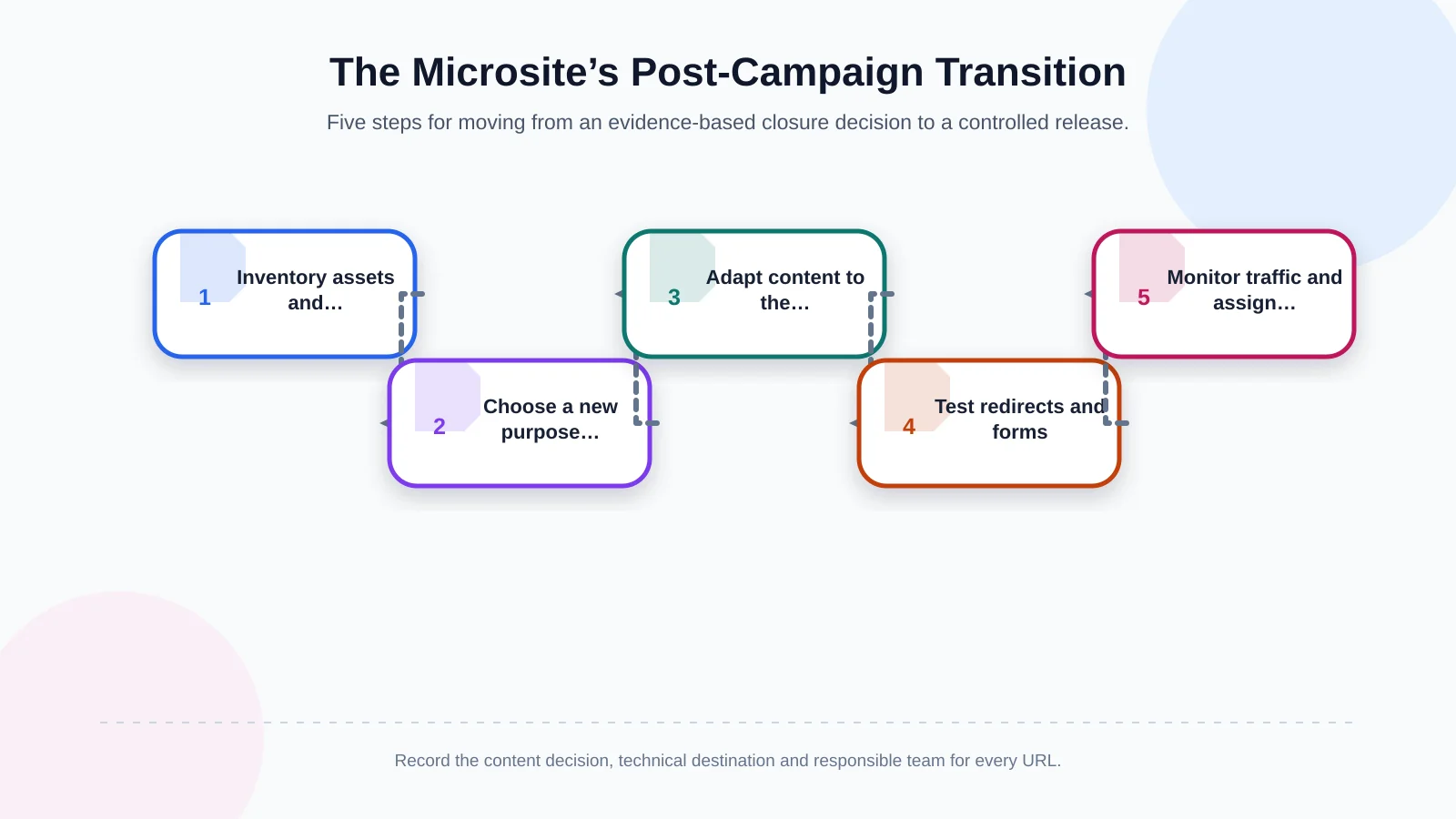
1. Inventory the assets and assess performance
List every page, form, media file, downloadable document and integration. Identify which URLs generate traffic, backlinks, enquiries or useful engagement. Look beyond campaign parameters and short-term metrics to understand the information people will continue to need after launch.
2. Assign a new purpose to every URL
Classify each page as “update,” “convert to support content,” “move to another URL” or “remove.” Define the primary source where similar content exists in more than one location. If pages will move, prepare and review the old-to-new URL mapping before publication.
3. Rewrite content for the new user intent
Launch copy is usually designed to create curiosity and urgency; evergreen copy should support decisions and ongoing use. Replace vague phrases such as “discover now” with specific information about suitability, technical features, operating steps, support routes or the quotation process. Retain production assets that remain relevant, while removing expired promotions and time-sensitive claims.
4. Test the technical transition
Redirects should reach the correct destination in a single hop. Canonical tags, sitemaps, robots directives, internal links and analytics must reflect the new structure. Google’s site migration guidance recommends mapping old URLs to new ones and monitoring traffic on both sides. Test mobile layouts, forms, file downloads and error pages on real devices as well.
5. Monitor results and establish ownership
After publication, monitor redirect errors, 404 reports, organic traffic, form delivery and support searches. Assign responsibility for domain renewal, certificates, hosting, content approval and security updates. Conduct the first review within a few days, then schedule further checks around the product’s sales and usage cycle.
Which scenario is best for each situation?
An evergreen product page is strongest when the product is actively sold and requires continuing discovery. A support hub is more appropriate when post-purchase questions are frequent. Lead generation makes sense when sales progress through consultation or the product is not yet widely available. A controlled migration reduces operational overhead when the separate domain no longer offers meaningful value.
These scenarios do not have to be mutually exclusive. The homepage can retain the permanent product story, while a support section holds documentation and a demo form serves enterprise buyers. What matters is that each section answers a distinct user question, has an appropriate measurement method and belongs to a named team.
| Scenario | When is it suitable? | Core content | Primary measure |
|---|---|---|---|
| Evergreen product page | The product remains actively available | Benefits, features and use cases | Product engagement |
| Support hub | Post-purchase needs are high | Guides, videos and service routes | Support needs resolved |
| Lead generation | Sales progress through consultation | Demo, qualification and form | Qualified enquiries |
| Controlled migration | The separate site no longer creates value | URL mapping and redirects | Error-free transition |
How can you protect the domain, SEO value and content legacy?
Do not release the domain as soon as the campaign ends. Old advertisements, printed materials, QR codes and inbound links may generate visits for years. The brand should document renewal dates, account access, payment settings and DNS ownership. Allowing a third party to acquire an expired campaign domain may also create impersonation and brand-safety risks.
For SEO, make decisions at URL level. Keep content that remains useful and accurate, and permanently redirect pages that have genuinely equivalent replacements. Sending unrelated URLs to one destination misleads visitors and can weaken the migration. Page titles, descriptions and structured data should now communicate the purpose of the evergreen content rather than the expired campaign.
If the microsite is moving into the main website, changing the domain, CMS, design and content structure simultaneously can make problems harder to diagnose. A phased approach is often safer: validate redirects and measurement first, then improve the wider experience. The same lifecycle thinking should inform the site’s web design and content architecture.
Closure checks for forms, cookies and personal data
When a campaign ends, reassess the legal and operational purpose of every form. Data collected for a competition registration cannot automatically be repurposed for sales communication. Privacy notices, consent scope, retention periods, transfers and deletion workflows must correspond to the new scenario and actual processing activity.
The European Commission’s explanation of the GDPR principles emphasises collecting data for specified purposes, limiting it to what is necessary and retaining it no longer than required. Processes operating in Türkiye should also be assessed under applicable local requirements and the organisation’s legal guidance.
Disable or restrict unused API keys, webhooks, third-party tags and administrator accounts. If a form remains live, test the entire delivery chain and document which team receives the record, how failures are detected and how quickly someone should respond. An ownerless post-campaign form creates both an invisible customer loss and a data-security risk.
Design and governance principles for a sustainable microsite
A strong microsite should not only look impressive on launch day; it should remain coherent as its content changes. A modular interface, manageable content fields and reusable components make it easier to replace a countdown with product benefits or transform a registration form into a support module.
Advanced animation and interaction can strengthen the product story, but they should be planned alongside performance and accessibility. Reduced-motion preferences, keyboard use, readable contrast, media alternatives and mobile performance need measurable acceptance criteria from the design stage. Kumsal Agency brings creative concepts, interactive experiences, digital design, production and technical development together around this lifecycle.
The content management system should do more than edit paragraphs. Where relevant, it should support publication dates, document versions, form recipients, redirect records and content approvals. This allows product, support and digital communication teams to maintain the asset safely even after the original campaign team has moved on.
A short checklist to complete before launch
- When and under what conditions will the campaign end?
- What will be the microsite’s primary user need after the campaign?
- Will each URL be retained, transformed, redirected or removed?
- Who owns the domain, DNS, hosting and analytics accounts?
- Where do form submissions go, and how long is the data retained?
- Who is responsible for keeping content, documents and support information current?
- Have redirect, performance, accessibility and measurement acceptance criteria been agreed?
Turn a temporary campaign into a sustainable digital asset
A product launch microsite does not have to lose its value when the campaign calendar ends. The right content scenario can preserve earned traffic, support existing customers, capture qualified demand and simplify the brand’s digital estate. Strategy, information architecture, design, software, measurement and data governance should therefore be considered together from the beginning.
As an Istanbul-based digital agency, Kumsal Agency combines web design, custom software, digital brand consulting, digital design and production. To create a brand-specific microsite whose pre-launch and post-campaign lifecycle is planned as one manageable experience, contact Kumsal Agency.