


Aydınlatma metni yükleniyor…
A corporate website for an energy company is more than a digital brochure displaying its power plant portfolio. Investors want financial results, business partners assess generation capacity, local stakeholders look for environmental information, candidates explore workplace culture, and journalists need current corporate statements. Serving these expectations within one coherent experience requires content architecture, data sources, user experience and technical infrastructure to be planned together.
A well-structured energy company website presents capacity and generation figures with the context needed to interpret them. It also makes relationships across facilities visible and keeps investor content current. Mobile usability, performance, accessibility, multilingual publishing and content management are not finishing touches; they should shape the project from the outset.
Which audiences should an energy company website support?
A website designed around one visitor profile cannot adequately serve the energy sector’s many stakeholders. Retail and institutional investors evaluate financial performance and growth strategy, while banks, funds and analysts require comparable data. Suppliers look for procurement or contact channels, local communities want to understand environmental and social effects, and candidates search for vacancies and insight into working life.
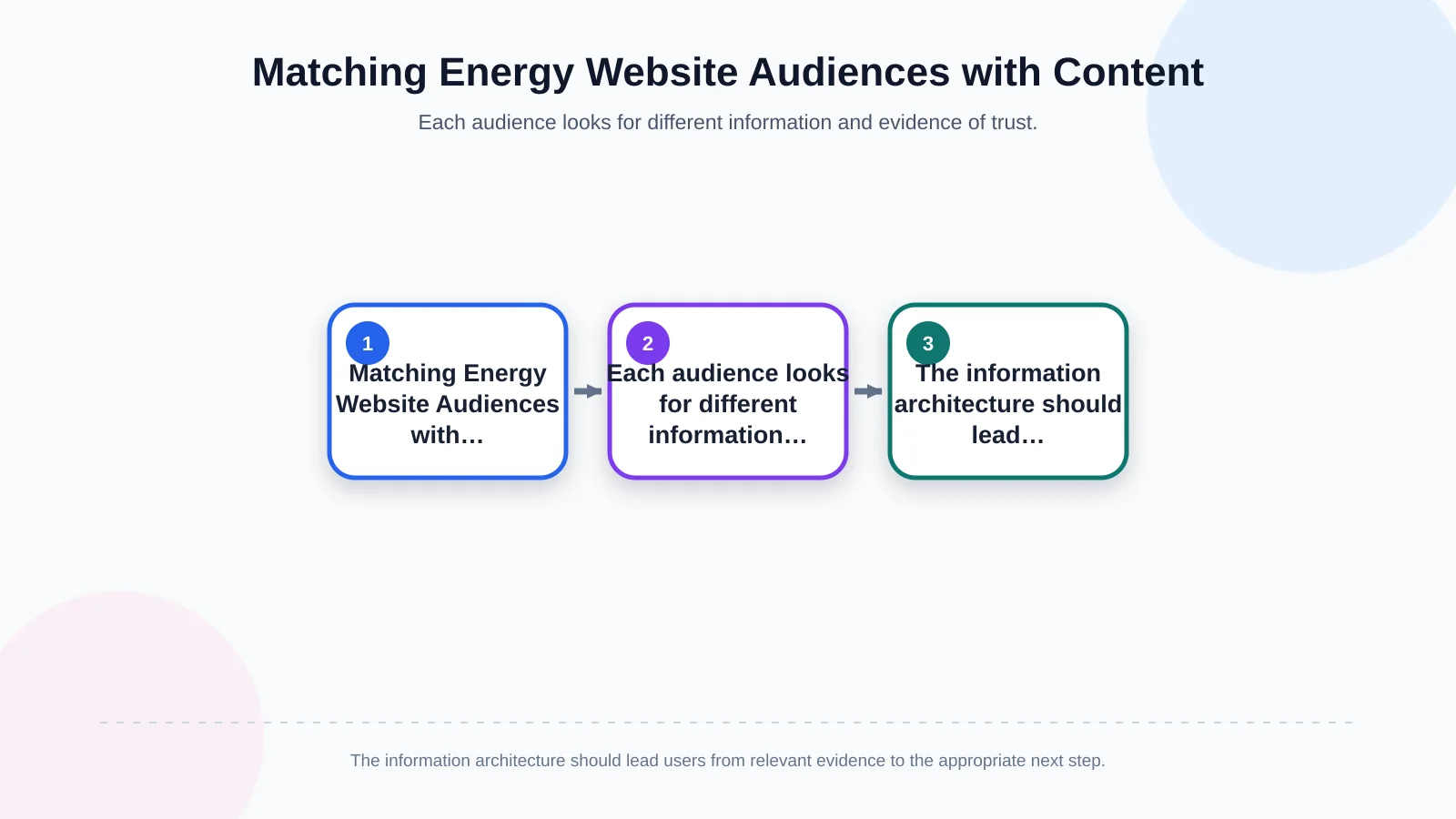
User research should therefore go beyond demographic profiles. The project team must identify the question that brings each audience to the site, the evidence they expect and the next action they need to take. An investor may ask, “Where is the latest annual report?” while a prospective partner may prioritise, “Which energy sources and regions does this company operate in?”
- Financial reports, presentations, material disclosures and governance information for investors and analysts
- Power plant portfolios, technologies, capacity, geographic coverage and capabilities for business partners
- Environmental performance, social contribution and feedback channels for local stakeholders
- Current news, media assets and official statements for journalists
- People policies, areas of work and application routes for candidates
| Audience | Primary need | Evidence of trust | Next step |
|---|---|---|---|
| Investor | Financial outlook | Report and KAP record | Review a document |
| Business partner | Portfolio and capabilities | Power plant details | Make contact |
| Local stakeholder | Environmental and social impact | Indicator and methodology | Provide feedback |
| Journalist or candidate | Current corporate information | News and company content | Visit media or careers area |
How should a power plant portfolio be presented?
Power plant pages should not be limited to a facility name, photograph and installed-capacity figure. Visitors should first understand the overall portfolio, then move into detail by energy source, operating status or location. Maps, filters and comparison tools are useful when they genuinely improve decisions, but essential facts should never be accessible only through animation or complex interactions.
From portfolio overview to power plant detail
The portfolio overview can introduce total installed capacity, the generation mix and the company’s operating regions. Each facility should then use a consistent detail template. Presenting energy source, location, installed capacity, operating status, commissioning year and the company’s role in the same order makes facilities easier to compare.
Wind, solar, hydroelectric, thermal and hybrid plants may not share every field. The content model should separate a common core from technology-specific information. This avoids irrelevant fields in the management panel and keeps units, dates and statuses consistent. A custom web development approach can connect the resulting model to maps, approved data sources and editorial workflows.
Context, scope and effective date of data
Metrics such as installed capacity, annual generation, avoided emissions and capacity factor need a stated unit, period and scope. “Total capacity,” for example, might mean operational assets only, projects under construction or gross capacity before ownership interests are applied. Showing an effective date or reporting period beside every critical metric prevents old information from appearing current.
How should investor relations content be structured?
An investor relations section should not become a chronological pile of unrelated files. Users need direct routes to financial statements, annual reports, investor presentations, general meeting documents, governance information and material disclosures. Filters for year, reporting period and document type can substantially reduce search time, particularly for companies with long reporting histories.
In Türkiye, disclosures required under capital markets and stock exchange rules are published with electronic signatures through the Public Disclosure Platform (KAP). A corporate website should not attempt to replace KAP. It should provide company-specific organisation and access without conflicting with the official record. A visible KAP link also helps users identify the document source and publication timing.
From document archive to decision-support experience
The investor relations landing page should distinguish the investment case, portfolio summary, key financial indicators and latest disclosures. Charts must not replace downloadable tables; the same information should have an accessible text or tabular equivalent. Large figures shown without currency, consolidation scope or comparable periods may create uncertainty rather than trust.
Document title, publication date, reporting period, language, file type and size should be manageable fields. Revised documents should display a version or update date. This allows the investor relations team to publish a new period without depending on developers while preserving existing links and search visibility in a controlled way.
Publishing workflow for power plant and investor content
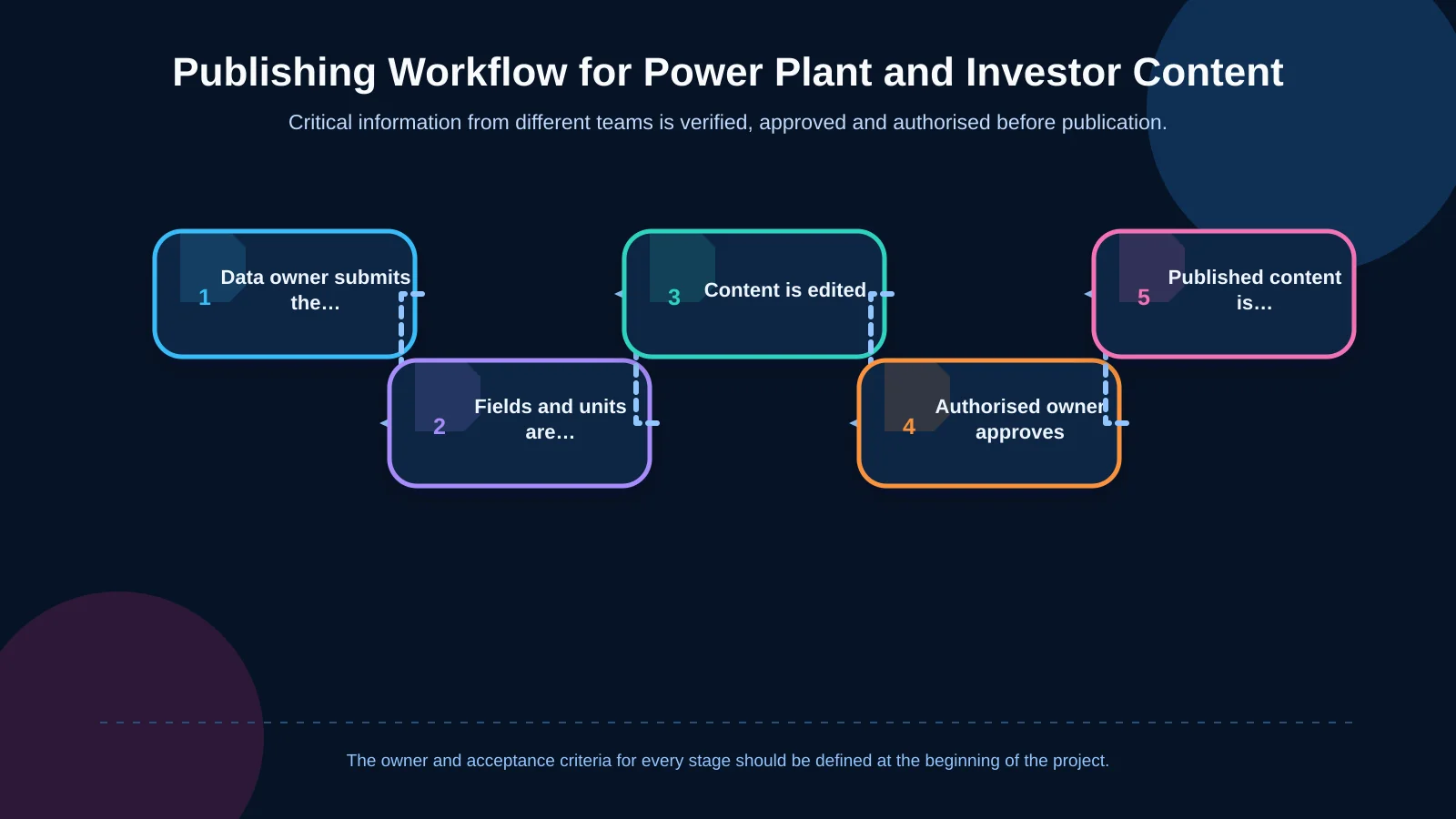
Energy-sector content is not owned by corporate communications alone. Operations verifies facility information, investor relations or finance supplies financial documents, and subject-matter specialists provide sustainability indicators. Content ownership, approval authority and publishing permissions must therefore be defined at the beginning of the website project.
A practical workflow may cover the data owner’s update, field and unit validation, editorial review, authorised approval and post-publication verification. Applying a four-eyes principle to critical investor disclosures reduces the risk of publishing the wrong file or reporting period. Drafts, previews, scheduling, version history and role-based permissions in the content management system should reflect this process.
Specific rules are more useful than a general promise to “keep the website updated.” Teams should know which pages are affected when plant capacity changes, how the previous period is archived after a new annual report appears, and who approves content when the usual owner is unavailable. This turns the website from a periodic design project into a sustainable publishing system.
How can sustainability claims be connected to evidence?
A sustainability section should not consist of broad environmental language. Climate, energy use, water, biodiversity, occupational health and safety, and local community impacts should be connected to the company’s activities and materiality assessment. Each indicator should identify its scope, methodology, period and unit, with access to the relevant report where possible.
The GRI Sector Program links topics likely to be material within particular sectors to relevant reporting disclosures. Whatever standard a company uses, its website should not extract selected claims from their reporting context. Visitors need access to scope and methodology information, and the interface should clearly distinguish targets from results and policies from measured performance.
Claims can link to the relevant report, assurance information or methodology note. Broad terms such as “clean,” “green” or “zero impact” should be limited to a demonstrable scope. If the calculation method changes between years, a comparability note helps investors interpret the figures correctly.
How should multilingual content architecture work?
For energy companies addressing international investors and partners, multilingual publishing is not simply a translated menu. Equivalent English and Turkish pages should be associated with each other, and untranslated content must not send users to empty or incorrectly localised pages. A shared terminology guide should cover report names, financial vocabulary, dates and number formats.
A content matrix can define which materials are published simultaneously in both languages and which remain in one language because of regulatory requirements. Every language needs its own publication status, metadata and document versions. The architecture must also account for localised URLs, hreflang annotations, language switching and freshness checks so that each audience reaches the intended version.
Performance, mobile experience and accessibility
Power plant videos, high-resolution aerial imagery, interactive maps and extensive PDF archives can make pages unnecessarily heavy. Images should be delivered at suitable dimensions, video should begin on user request, map components should load in a controlled way, and downloadable files should be routinely optimised. Essential facility information and investor documents must remain available on slower connections.
Mobile design is not a compressed desktop layout. Filters, download controls, chart explanations and contact options need testing on small screens. Because investors may access disclosures by phone, readable type, generous touch targets and straightforward navigation deserve particular attention.
The W3C’s Web Content Accessibility Guidelines provide a shared framework for content that is perceivable, operable, understandable and robust. Relevant checks include keyboard access, visible focus, sufficient contrast, image alternatives, form labels and text explanations for charts. Automated checks are useful but insufficient; human testing with keyboards and assistive technologies should also form part of acceptance.
Integration and content management decisions
Integration choices should follow a clear decision about the source of facility data, news and investor documents. When information is held in an ERP platform, data warehouse or another corporate system, the team must define refresh frequency, field mappings, failure behaviour and ownership. Not every figure requires real-time transfer; approved periodic publishing may be more appropriate for some indicators.
User roles in the management panel should mirror the organisation. Operations may propose plant updates, investor relations may manage documents, corporate communications may control page presentation, and final publishing rights may remain limited. Acceptance scenarios should also define whether the last verified value remains visible during an integration outage and how administrators are alerted.
Energy company website project process
A sound process begins with business goals and user tasks, not a visual critique of the existing homepage. Stakeholder interviews, analytics, site-search records, the current content inventory and technical systems inform the scope. The team can then validate page hierarchy, content models, screen flows and integration boundaries.
- Define objectives, audience roles and measurable success indicators.
- Inventory power plant, investor relations and sustainability content.
- Validate information architecture and data fields through prototypes.
- Design brand-specific interfaces, interactions and mobile behaviours.
- Develop the management panel, integrations, performance controls and accessibility foundations.
- Complete content entry, user acceptance testing, training, launch and maintenance planning.
Proposals should be compared across unique templates, migration volume, languages, user roles, integrations and post-launch support—not page count alone. A custom web design process can bring the corporate identity together with the energy sector’s technical information while keeping the experience consistent across devices.
How should success be measured?
Success cannot be assessed through visits and time on page alone. More meaningful measures may include the rate of reaching plant details, time required to find an investor document, archive-filter use, failed searches, successful mobile downloads and completed contact forms. Internally, teams can track publishing time, overdue updates and incorrect documents.
Task-based usability testing before launch reveals uncertainty in navigation. After launch, search queries and user feedback should be reviewed regularly, while analytics implementation respects cookie choices and data minimisation. The website can then evolve from evidence about real use rather than assumptions.
From power plant data to corporate trust
An effective energy company website brings the power plant portfolio, investor information and sustainability performance into one coherent information architecture. Consistent data fields, clear sources and reporting periods, role-based publishing, mobile performance and accessibility foundations become the digital expression of corporate trust.
Kumsal Agency is an Istanbul-based digital agency combining research-led digital brand consulting, brand-specific web design and custom web development. To plan your energy company’s power plant and investor content around business goals, user needs and technical requirements, contact Kumsal Agency.