


Aydınlatma metni yükleniyor…
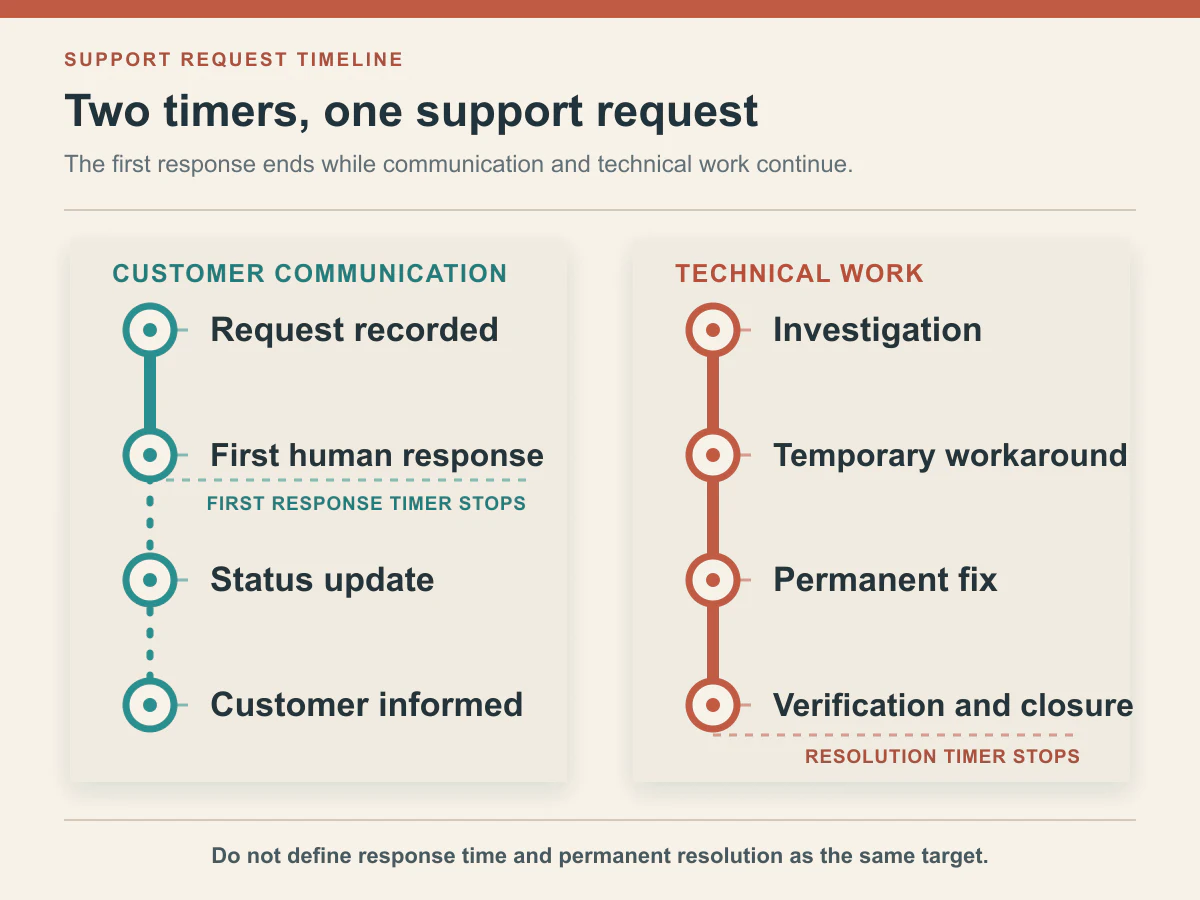
No. First response time is the period between submitting a support request and receiving the first meaningful response from a person who has taken the request into review. Resolution time covers the wider process of investigating the issue, addressing dependencies, applying a fix, and checking the result.
When these terms are treated as interchangeable, a promise of “fast support” can be misleading. A request may receive a prompt reply even though the cause has not yet been identified. In another case, a workaround may restore service while the permanent correction is still pending.
When reviewing a website maintenance or technical support proposal, do not ask only, “How quickly will you get back to us?” Also establish what starts the clock, whether an automated acknowledgement counts as a response, when you will receive an update if work continues, how waiting periods are handled, and what checks are required before a request is closed.
Six Distinct Stages in a Support Request
Support performance cannot be described accurately with one timer. A proposal should distinguish between the following stages:
| Stage | What it means | What it does not mean |
|---|---|---|
| Automated acknowledgement | Confirms that a message reached the designated system. | It does not show that a technical review has taken place or that the issue has been resolved. |
| First human response | Confirms that an authorised person has reviewed the request and communicates the initial assessment and next step. | It is not a promise that a permanent fix is complete. |
| Status update | Explains the current status, any blocker, and the next action while the investigation continues. | It is not automatically a guaranteed resolution date. |
| Temporary workaround | Restores continuity or reduces the impact through an interim method. | It does not mean the underlying cause has been removed. |
| Permanent fix | Applies a correction aimed at the cause of the issue. | It does not by itself close the request before verification. |
| Closure | Records that the required checks have been completed, the customer has been informed, and the request has been concluded. | It is not simply the point at which messages stop. |
Zendesk’s documentation on understanding ticket reply time treats first reply time as the period between ticket creation and the first public agent response. It also shows that calendar-hour and business-hour values can be handled separately. These are details of Zendesk’s product, not universal rules for every support provider. They do, however, illustrate why a proposal should define both the event that counts as a first response and the type of working time being measured.
The Official Channel Determines When a Request Starts
A technical issue might be mentioned during a phone call, sent through WhatsApp, emailed to an individual team member, or raised in a meeting. Without an official request channel, the parties may disagree about when the issue was received and who became responsible for following it.
Kumsal Ajans receives official support requests by email. Critical issues reported by phone or WhatsApp are additionally placed on record. This preserves both the speed of direct communication and a traceable support history.
There is no standard automated “we have received your request” message across every Kumsal Ajans project. An automated notification can be configured where the project infrastructure supports it. When one is used, its meaning must remain clear: it may confirm receipt, but it does not show that a person has completed a technical assessment.
A proposal should answer the following questions:
- Which email address or support system is the official request channel?
- Who converts a critical phone or messaging report into a formal record?
- Does the clock start when the message is sent or when the official request is created?
- How are requests received outside working hours handled?
- Are the automated acknowledgement and first human response measured separately?
Priority Should Reflect Business Impact, Not the Word “Urgent”
Not every request should enter the same queue or follow the same handling process. A typographical error does not have the same operational impact as an incident that stops sales or a core user journey.
In Kumsal Ajans’s confirmed classification:
- A critical request is an issue that completely stops the system, sales, or a core function.
- A high-priority request causes a significant loss of functionality without necessarily stopping the entire system.
- A normal request covers a non-blocking defect or a development request.
One boundary is particularly important. A request for a new feature or a change should not automatically enter the support-resolution clock as a “normal bug.” The first decision is whether the request concerns an error within the delivered scope, an ongoing maintenance task, or new development. Our guide to free support, ongoing maintenance, and new development explains that scope decision in more detail.
Define not only the priority labels but also the impact criteria for each one. Otherwise, the customer may not understand why a request they consider critical has been placed in the normal queue, while the technical team has no consistent basis for managing changing expectations.
Business Hours or Calendar Hours?
A sentence such as “we will respond within four hours” is incomplete unless it defines the working-time model. Four business hours and four calendar hours produce very different outcomes when a request arrives in the evening, at a weekend, or on a public holiday.
Each time target should answer these questions:
- Which event starts the clock?
- Is the target measured in business hours or calendar hours?
- Which days and hours count as working time?
- Does the clock pause while information or access is awaited from the customer?
- What status is reported while a third-party provider is being awaited?
- Does a temporary workaround end a target, or is the permanent fix tracked separately?
- What happens to the timing if a request is reopened?
- Does closure require a technical check or customer confirmation?
Zendesk’s guide to defining SLA policies illustrates that reply, periodic update, and resolution metrics can have different activation, pause, and completion conditions. The status rules in that document are specific to Zendesk. The useful lesson is not to copy one product’s configuration, but to define the behaviour of each timer in the support agreement being evaluated.
Kumsal Ajans does not apply one fixed SLA time to every project. Response and resolution targets are determined according to the project scope, maintenance agreement, and proposal terms. This makes it possible to set conditions that reflect the project’s actual risks and service scope instead of relying on a broad claim of “very fast support.”
What Should a Meaningful First Response Contain?
A first human response should communicate more than “we are looking into it.” Depending on the request and the information available, it should ideally include:
- confirmation that the request has been received and connected to a formal record;
- a short summary of the issue as understood by the team;
- the initial priority assessment;
- any access, screenshot, error time, or reproduction steps needed for the investigation;
- the known user or business impact;
- the next communication or technical action;
- the route for assessment if the request appears to fall outside the current scope.
It may not be possible to give a definite cause or resolution date in the first response. Intermittent faults, third-party dependencies, and problems spanning several server or application layers may require further investigation. It is more useful to state what is known, what remains unknown, and when the next meaningful update will be provided than to give a premature deadline.
If Resolution Takes Longer, Status Updates Prevent Silence
The first response does not complete customer communication. When a permanent fix takes time, the customer needs to understand:
- whether the investigation is still active;
- whether the impact has changed;
- whether an interim method can reduce disruption;
- whether information is being awaited from the customer or a third party;
- what will trigger the next update.
When resolution takes longer at Kumsal Ajans, the customer is informed by the team member responsible for the project or by the project manager. The update is provided by email or through the communication channel already used for that project. There is no single update interval for every project; it is set according to the service scope.
Rather than stating only that “the customer will be informed until the issue is resolved,” the proposal should define the situations that require an update and the role responsible for it. Even when there is no new technical result, the team can report that an external response or customer access is still required. This prevents silence from being interpreted as inactivity.
Record the Workaround and Permanent Fix Separately
During a critical incident, the immediate objective may be to restore sales, form delivery, or another core function before the underlying cause can be corrected. An interim method can preserve service continuity while the permanent change is prepared.
Kumsal Ajans records temporary workarounds and permanent fixes separately wherever possible. The first priority is to maintain or restore service, followed by the permanent correction. Applying an interim method therefore does not automatically close the request.
The record should distinguish between:
- what the workaround restored;
- which limitation or risk remains;
- what investigation is required for the permanent fix;
- when the temporary method should be removed;
- how the final implementation will be checked.
Without this distinction, an interim routing change can remain in place as though it were a finished solution, or the customer may reasonably assume that the underlying issue has been removed.
What Happens While the Customer or a Third Party Is Being Awaited?
Some requests cannot progress through the technical team alone. The team may need management-panel access, information from the time of the error, a customer decision, a response from a payment provider, or action from another service provider.
At Kumsal Ajans, a request is placed on hold while a customer or third-party response is awaited. The customer is told why progress is delayed and what information is required. The effect of that waiting period on any timer is not assumed to be identical across every project; it must be defined in the project proposal or maintenance agreement.
An on-hold record should state:
- who is expected to provide what;
- why the request cannot progress;
- whether any temporary risk remains during the wait;
- how work will resume once the information arrives;
- when the customer will next be updated.
A third-party dependency does not remove all responsibility from the support process. It does, however, require the time outside the technical team’s control to be distinguished from the team’s own working time. That distinction supports clearer customer communication and a fairer interpretation of support performance.
The 11-Field Support Time Definition Card
The following card can be completed as part of a proposal, maintenance plan, or project kick-off document:
| Field | Information to record |
|---|---|
| 1. Official request channel | The address or system used to open a request and how other channels are recorded |
| 2. Priority | Critical, high, and normal criteria and the role responsible for assigning them |
| 3. Automated acknowledgement / human response | The scope of an automated message and the separate definition of the first technical human response |
| 4. First response target | The target established for the project and priority level |
| 5. Status update | Who provides information, and under which condition or interval, when resolution continues |
| 6. Temporary workaround | The accepted purpose and limitations of an interim method that preserves service continuity |
| 7. Permanent fix | Correction of the underlying issue and the required repeat check |
| 8. Working time | Business or calendar hours, including working days, hours, and holidays |
| 9. Waiting and pauses | Timer behaviour while awaiting the customer, access, or a third party |
| 10. Scope and exceptions | Boundaries between defects, maintenance, new development, and external services |
| 11. Closure | Technical checks, customer notification, and customer approval where required |
Use the card to record targets that genuinely apply to the project rather than copying arbitrary response times. A transaction-focused website, a corporate information site, and a web application with several external integrations do not necessarily require the same support model.
An Anonymised Real-World Example
In one project, an outage at a third-party email service meant that website forms continued to function, but the resulting notifications did not reach the customer. Users saw a successful submission message even though the expected notification chain was not completing.
A temporary routing method was introduced to preserve continuity. The request was not closed merely because the form interface appeared to work; delivery of the notification was treated as a separate check. After the third-party service recovered, permanent checks and log monitoring were introduced.
This incident shows why the first response, temporary workaround, and permanent fix should be recorded separately. It also demonstrates the value of making third-party waiting time visible. The example does not identify a service, customer, date, or resolution time, and it does not imply that every incident will follow the same path.
12 Questions to Ask During a Support Proposal Review
- Which channel officially opens a support request?
- Is an automated acknowledgement separate from the first response target?
- What minimum information should the first human response contain?
- Which business impacts define critical, high, and normal priority?
- Are targets measured in business hours or calendar hours?
- How are working days, working hours, and public holidays defined?
- Who provides status updates if resolution takes longer?
- Are the temporary workaround and permanent fix tracked separately?
- How are the request record and timer handled while awaiting the customer or a third party?
- How are new development requests separated from support-resolution targets?
- Which technical checks are required before a request is closed?
- Is additional customer approval required for critical incidents?
Expressions such as “fast response,” “resolved as soon as possible,” or “priority support” do not answer these questions. If the proposal does not identify the channel, criteria, responsible role, working-time model, and exceptions, clarify these expectations before the project begins.
Conclusion: Ask for a Clear Support Lifecycle, Not One Number
First response time and resolution time are not the same. A support request may also pass through status updates, an interim workaround, customer or third-party waiting, a permanent fix, and closure checks.
A well-defined support model does more than state how quickly someone will reply. It explains which channel opens the request, how priority is assigned, when each clock starts or pauses, who communicates during a longer investigation, and how the permanent result is accepted.
Kumsal Ajans does not apply one fixed SLA to every project. Response and resolution targets are set according to the project scope, maintenance agreement, and proposal terms. When assessing the support model for your website or custom web platform, use the 11-field Support Time Definition Card to establish conditions that reflect the project’s business impact, team structure, and external dependencies before work begins.
This article is a general guide to assessing service scope. Seek appropriate professional advice when reviewing the legal effect of contractual terms.