


Aydınlatma metni yükleniyor…
The MVP scope for a web software project should not be defined by selecting the easiest items from a feature list. It should be the smallest usable release in which the target user can complete the most important job from beginning to end. If a user can sign in but cannot create the core record, or can create it but cannot track the outcome, the essential workflow is still incomplete.
A first-release decision should therefore answer four questions:
- Which user needs to complete which essential job?
- Which steps are indispensable to complete that job?
- Which technical and operational conditions are required for a secure, traceable and usable release?
- Which testable acceptance criteria will show that the release is complete?
The MVP First-Release Decision Matrix in this guide assesses every request through the user, business outcome, core workflow, data and permissions, mandatory controls, dependencies, acceptance criteria and phase decision. Its purpose is not to make the scope arbitrarily small. It is to create a focused first release that people can use, the team can operate, and the business can learn from.
An MVP Is Not Simply the Product with the Fewest Features
MVP is often interpreted as “do as little as possible”. That can produce a fragmented release. A first release must be limited while still completing the core business task.
For example, a sign-in screen alone does not make a customer portal usable. If creating a request, viewing its status and accessing only permitted records are all parts of the main workflow, they need to be considered together. Advanced charts or multi-channel notification scenarios may be valuable, but they can often follow after the main workflow is operating.
The Scrum Guide describes the Product Goal as the future state that provides a target for planning, and the Product Backlog as an emergent, ordered list of what is needed to improve the product. The practical lesson is useful beyond teams that formally use Scrum: define the outcome first, then order the work according to how it contributes to that outcome. A long feature list is not an MVP plan by itself.
Write the Product Goal Before Prioritising Features
Before making first-release decisions, write one product goal that all parties can understand. It should not stop at the solution name, such as “build a customer portal”. It should identify the user, the job and the expected result.
For example:
Authorised client users can create their own service records, see their current status and review previous activity within their permissions, without relying on email for every step.
This goal establishes three boundaries:
- User: the client organisation and its authorised staff
- Core job: creating and tracking a service record
- Expected outcome: a visible and traceable process inside the portal
If a request cannot be connected to this goal, it has a weak case for the first release. Security, backup and error tracking may be invisible to users but still necessary to operate the workflow responsibly.
If the project goal, users, data or integrations are still unclear, begin with the questions in our website requirements document guide. The resulting information becomes the input to the MVP decision rather than a substitute for it.
Who Should Take Part in MVP Discovery?
MVP scope should not be only a technical decision made by the software team or a wish list compiled by one executive. In Kumsal Ajans's project approach, business objectives, user needs, core workflows and technical requirements are considered together.
Depending on the project, discovery involves:
- Client-side decision-makers
- Representatives of the departments that perform the work
- The Kumsal Ajans project team
- Designers
- Software specialists
Decision-makers clarify the objective and investment boundaries. Department representatives reveal real process steps, while the project team assesses usability, dependencies and technical risks.
By the end of discovery, the following outputs should be visible:
- A requirements inventory
- Prioritised features
- Core user flows
- User roles and data-access boundaries
- Known integrations and technical dependencies
- A general project roadmap
- Draft acceptance criteria for the first release
The format can vary, but the approved scope should be traceable in the proposal, requirements document or project-tracking system.
Map the End-to-End User Flow First
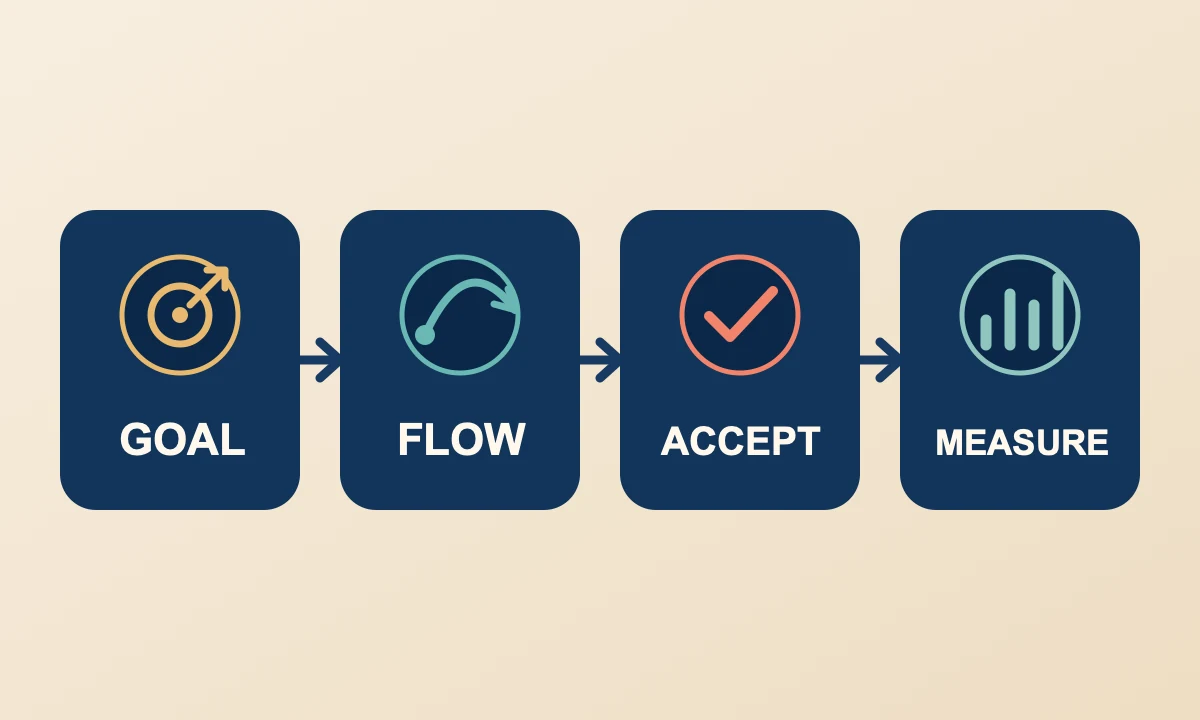
Before assigning scores to individual features, write the user's path from the starting point to the intended outcome. A customer portal workflow might be:
- An authorised user signs in securely.
- The user selects a record type available to their role.
- They enter the required information and create the record.
- The system stores it and assigns a traceable status.
- An authorised internal team can view and progress the record.
- The client user can track its current state.
- Completed work appears in baseline reporting.
If one essential link is missing, the user may not complete the job. Advanced reporting does not compensate for missing permission boundaries, and automated notifications cannot repair an incorrect status process.
The PMI Disciplined Agile practice for decomposing features into user stories recommends breaking large functions into smaller items that a team can implement, while asking who will use the function and why. Connecting each item to a user goal and acceptance criteria turns a broad feature name into work that can be discussed and tested.
The Eight Fields in the MVP First-Release Decision Matrix
Use the same eight fields for every requested capability.
1. Target user
Replace “users” with an actual role, such as a client administrator, field worker, operations specialist or system administrator.
2. Core problem and business outcome
State the problem and the observable result for the user or organisation. If the outcome is unclear, the request may be a preference rather than a current requirement.
3. Position in the core workflow
Ask whether the primary job can be completed without it. If the workflow still works and the feature mainly adds comfort or detail, consider a later phase.
4. Data, roles and permissions
Record which data is read, created or changed and who may view it. Make permission boundaries visible before interface decisions are finalised.
5. Operational, security or regulatory necessity
An invisible requirement may still be essential for continuity, security, traceability or an applicable obligation. The answer must match the project and business model.
6. Technical and commercial dependencies
Record dependencies on modules, services, licences, data, contracts or client decisions. An unresolved dependency may require a smaller interim approach.
7. Testable acceptance criteria
Replace “reporting will be available” with an observable result, such as: “A client administrator can list their organisation's open and completed records for a selected date range.”
8. Phase decision
Conclude each row with one of three decisions:
- First release: needed for the core workflow, a mandatory control or the first learning objective
- Later phase: useful but not critical to initial use, or better defined after observing real usage
- Out of scope: not directly connected to the current product goal
A Worked Decision-Matrix Example
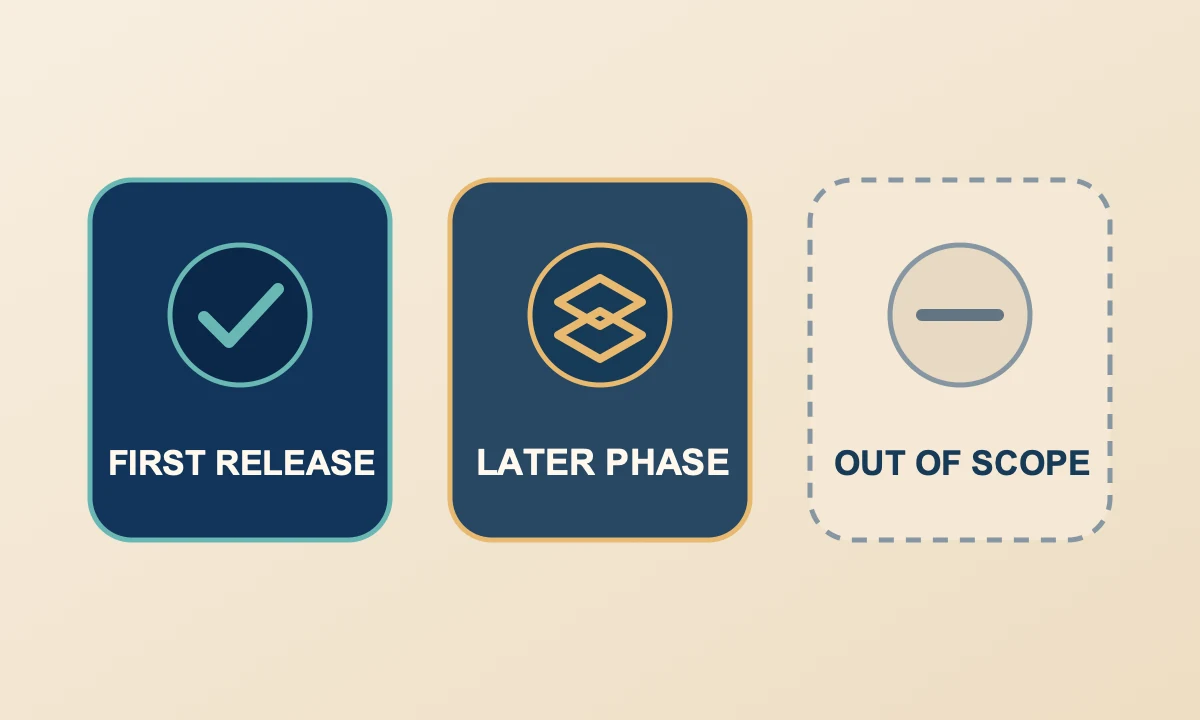
The following simplified matrix applies the method to an anonymised customer portal scenario.
| Request | Outcome and workflow | Roles, data and necessity | Acceptance criterion | Decision |
|---|---|---|---|---|
| User sign-in | Gives authorised users access to the portal | Authentication and access control are mandatory | A valid user signs in with the correct role; unauthorised access is rejected | First release |
| Role-based permissions | Restricts each user to permitted records | Required to separate organisational data | A user cannot view or change another organisation's record | First release |
| Record creation | Starts the primary request inside the system | Requires mandatory fields and data validation | Valid data creates a record with a unique reference | First release |
| Status tracking | Shows the user where the request is in the process | Requires status history and role visibility | The user sees the current status and the permitted history of their own record | First release |
| Baseline reporting | Makes early usage visible to the operations team | Restricted to authorised roles | The authorised user can view basic record and status counts for a selected date range | First release |
| Advanced reports | Adds deeper management analysis | Reporting needs should be refined through usage | Measures and filters are defined separately with stakeholders | Later phase |
| External service integrations | Automates data exchange with other systems | Depends on APIs, contracts and data mapping | Defined separately for each integration | Later phase |
| Automated notification scenarios | Sends status changes through additional channels | Requires decisions on channels, permissions and copy | Priority scenarios are selected after observing usage | Later phase |
| Mobile application | Offers the portal workflow through a native app | Creates a separate product and distribution scope | Defined after web usage patterns are understood | Later phase |
The deferred items remain valuable, but they do not prevent secure record creation and status tracking. Usage data can improve their later scope.
How to Separate the First Release, Later Phases and Out-of-Scope Requests
Ask these questions in order for every request:
- Is it directly connected to the product goal?
- Can the user complete the core workflow without it?
- Is it mandatory for security, data integrity, operations or an applicable obligation?
- Does another first-release capability depend on it?
- Is it required to measure the first question we want the product to answer?
- Can the acceptance criteria be written clearly today?
A strong “yes” to one of the first five questions makes the request a first-release candidate, not an automatic inclusion. Effort, budget effect, risk and alternatives still matter.
If the core workflow works without the feature and real usage would improve the decision, a later phase may be appropriate. If the request cannot be connected to the current product goal or belongs to a different product problem, keep it out of scope.
Do Not Remove Invisible Technical Work from the MVP
An MVP consists of more than visible screens. User roles, accessed data, transaction volume, integrations and project risks should inform requirements such as:
- Roles and permissions
- Security controls
- Backup policy
- Activity and change logs
- Error tracking
- Performance requirements
- Integration failure scenarios
- Necessary recovery and operational steps
These items do not need the same depth in every project. Ask what level is required for this workflow to be secure and operable, rather than whether the entire area can be removed.
If you are still assessing whether a standard platform can support the necessary roles, data and integrations, our off-the-shelf platform and custom web software comparison can help frame that decision before the release scope is fixed.
Separate Feature Acceptance Criteria from Release-Wide Quality Conditions
Acceptance criteria describe the expected behaviour of a specific capability. Instead of saying “role-based permissions are complete”, specify which role may view which information and which action must be rejected.
Atlassian's acceptance-criteria guide describes acceptance criteria as clear, concise and testable conditions that a unit of work must satisfy to be complete. A user story expresses purpose and value; its acceptance criteria explain how the intended outcome will be verified.
The first release also needs shared quality conditions that apply across its features. In Kumsal Ajans's documented approach, acceptance considers whether:
- Approved user flows work
- Core features are complete
- Roles and permissions behave correctly
- No critical defect remains
- Responsive behaviour has been checked
- Agreed performance and security reviews are complete
The Definition of Done in the Scrum Guide provides a shared description of the state in which an increment meets the product's required quality measures. Even if your project does not use Scrum, separating feature-level acceptance criteria from release-wide quality conditions makes the completion boundary clearer.
When the release approaches formal handover, the website handover checklist can help extend this logic to accounts, access, forms, responsive behaviour and technical checks.
Record Phase Decisions and Manage New Requests Explicitly
The matrix should not be created at the beginning and then forgotten. In Kumsal Ajans's project process, phase decisions are made jointly by the client's project owner and the project team. The approved scope is recorded in the proposal, requirements document or project-tracking system, depending on the project.
When a new request arrives after design or development has begun, assess its effect before adding it:
- Does it change the core workflow or approved objective?
- Does it affect the existing design, data model, role structure or an integration?
- Does it require new tests or acceptance criteria?
- What is the effect on schedule and budget?
- If it enters the current phase, which approved work will move?
The request may enter the current phase, move to a later one or become a separate scope. A “small” interface change can still affect data, permissions and integrations.
When evaluating a supplier, consider not only development skills but also how it records scope, tests, access and change decisions. Our technical capability guide for web software companies provides a broader review framework.
Let Post-Launch Evidence Reorder the Next Phase
Planning does not end when the first release goes live. One purpose of the MVP is to observe which needs are confirmed in real use and where the next investment should go.
Depending on the product, useful signals may include:
- Total and active users
- Number of completed transactions
- Completion rate and time
- Steps where users leave the workflow
- Error rates
- Topics and frequency of support requests
- User feedback
- Processes that still require manual intervention
Measures should fit the product. In a small enterprise portal, successful transactions, processing time and support demand may matter more than total sign-ups.
Return these observations to the later-phase matrix. Are advanced reports solving a verified decision problem? Are missing notifications causing delays? Would an integration remove repeated manual work? Is demand for a mobile application supported by actual usage patterns? Later phases should be reordered using observed needs wherever possible, not only the assumptions made before launch.
Common MVP Scoping Mistakes
Treating every request as critical
If every request has the same priority, no prioritisation has taken place. Connect each one to the product goal and core workflow.
Counting screens instead of assessing the system
Screen count does not reveal permissions, data integrity, logging, errors or integration risk. Record invisible technical work explicitly.
Leaving acceptance criteria until the end
If the team cannot explain how a capability will be tested, the scope may be unclear. Define acceptance criteria with the decision row.
Turning “phase two” into an unowned list
Give every deferred request a reason, dependency and reconsideration condition so that the later phase has an owner.
Assuming a new request has no wider effect
Review effects on data, design, dependencies, testing, budget and schedule. Without impact assessment, the first release can expand invisibly.
Practical MVP Scope Checklist
Before approving the first-release scope, confirm that:
- The product goal is written in one clear sentence.
- Target users and roles are identified.
- The core user flow works from start to finish.
- Every request has been assessed through the eight-field matrix.
- Reasons for first release, later phase and out-of-scope decisions are recorded.
- Data access and role boundaries are defined.
- Security, backup, logging, error and performance requirements match the risk.
- Technical and commercial dependencies are visible.
- Every core capability has testable acceptance criteria.
- Shared release quality and acceptance conditions are documented.
- The method for new requests and scope changes is agreed.
- Relevant post-launch signals have been selected.
- The basis for reordering the next phase is clear.
Conclusion: Make the First Release Focused, Not Merely Small
Good MVP scoping is not about doing the least work. It creates a focused release where the user completes the essential job, boundaries are known, acceptance criteria are testable and the team can learn from use.
Write the product goal first and then map the end-to-end workflow. Assess every request through the user, outcome, place in the workflow, data and permissions, mandatory controls, dependencies, acceptance criteria and phase decision. Keep invisible technical requirements inside the discussion. Manage new requests through impact analysis and use real product signals to reorder later phases.
To discuss the first-release boundary, technical requirements and later development phases for your project, explore the Kumsal Ajans web software service.